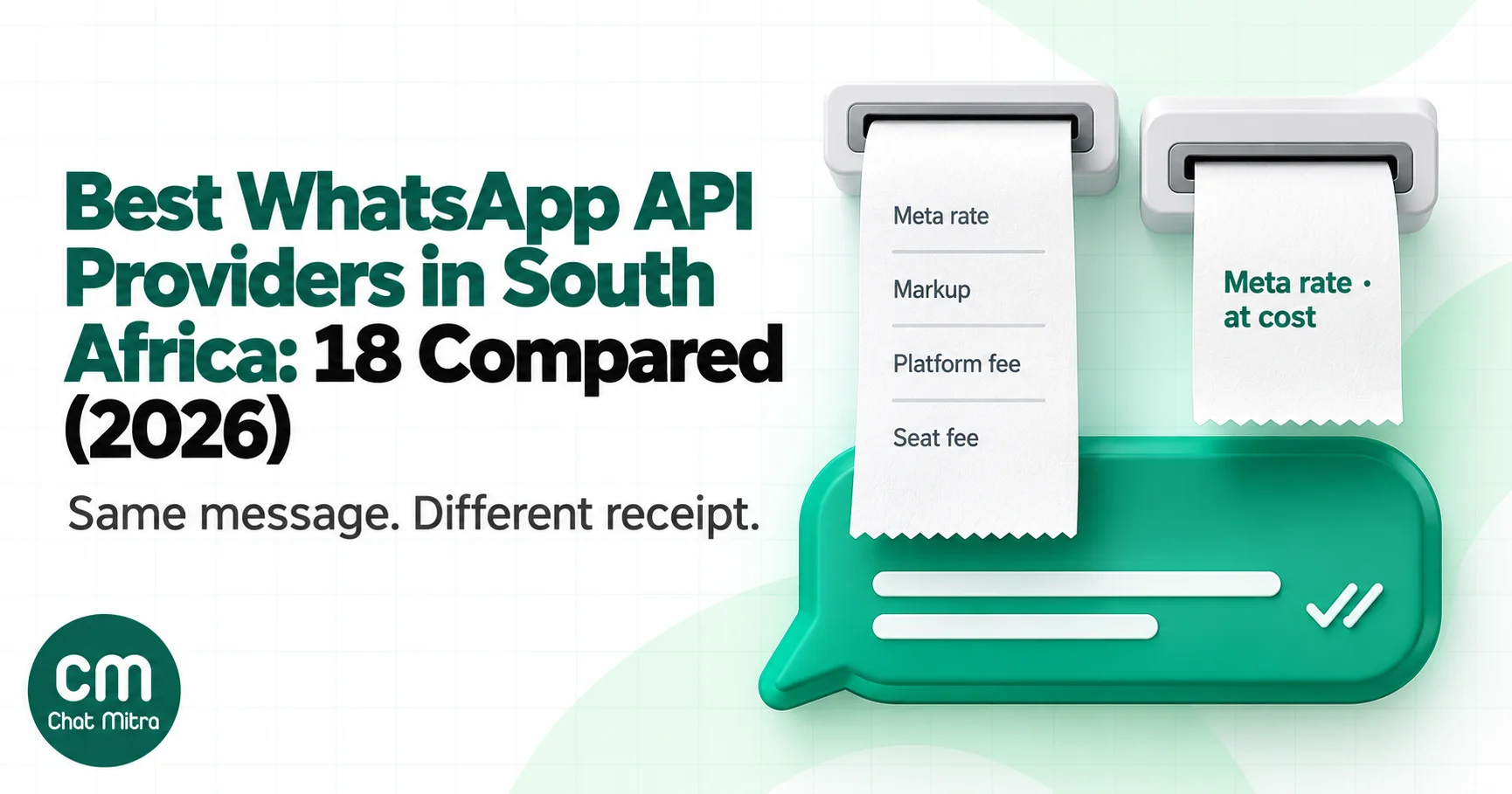
The best WhatsApp API provider for most South African small and mid-sized businesses is ChatMitra. It has a free plan with a shared inbox and broadcasts, no seat cap, and Meta’s rates passed through at cost. In our worked month for a three-person team it was also the cheapest option with an inbox and broadcasts, at $256.94 (about R4,232). Whatever provider you choose, Meta charges $0.0379 per marketing message to a +27 number and $0.0095 per utility, authentication or service message. What separates providers is what they add on top.
This guide is ChatMitra's, and it puts ChatMitra's product first. We took every competitor price from that company's own website on 14 October 2026, and wrote "not published" where we found none. Two options came within a dollar of ChatMitra in our sample month, and one free plan came in cheaper for a single user; the worked example names them. Prices change, so confirm them before you buy.
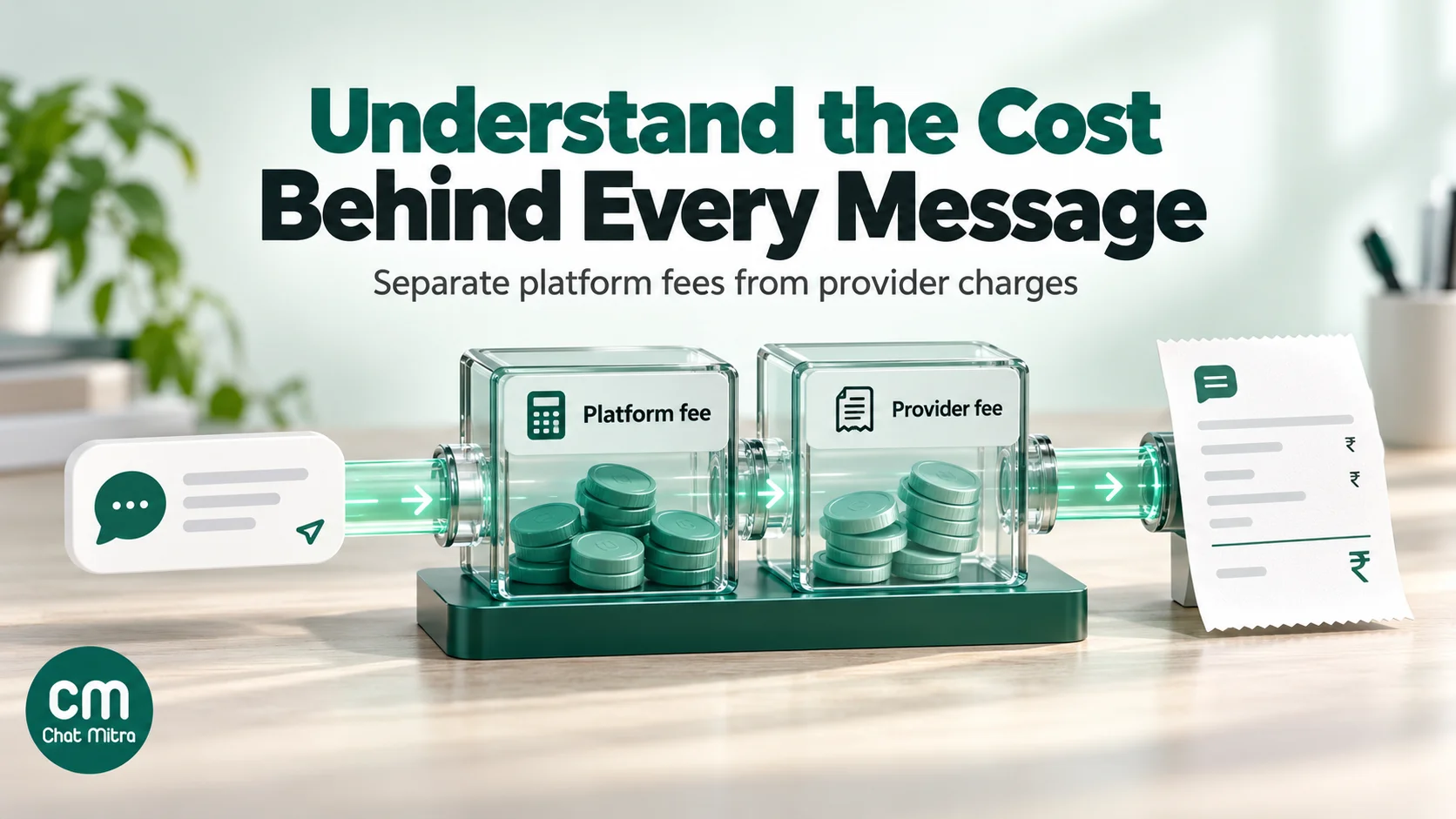
What Meta charges for South African (+27) numbers
Meta charges per delivered message, by category, based on the recipient’s country. These are the South Africa rates from Meta’s USD rate card effective 1 October 2026:
| Category | Meta’s rate (USD) | ≈ ZAR* | What it’s for |
|---|---|---|---|
| Marketing | $0.0379 | R0.62 | Offers, launches, reminders to buy, re-engagement |
| Utility | $0.0095 | R0.16 | Order updates, delivery notices, account alerts |
| Authentication | $0.0095 | R0.16 | One-time passwords |
| Authentication-international | $0.02 | R0.33 | OTPs sent to +27 numbers by businesses based outside South Africa |
| Service | $0.0095 | R0.16 | Your replies inside a customer-started 24-hour chat, after the first 1,000 a month |
Source: Meta’s rate card, linked from its WhatsApp pricing page (downloaded 14 October 2026). *At the European Central Bank reference rates of 14 October 2026, about R16.47 per US dollar. Meta has no rand rate card, so your real cost depends on the exchange rate your card or provider uses. Figures exclude VAT.
Three things changed on 1 October 2026, and they matter for any South African budget:
- Utility and authentication went up 25%. Meta’s pricing page lists South Africa among the markets whose utility and authentication rates increased. Third-party trackers had the old rate at $0.0076. Marketing stayed at $0.0379.
- Service messages are charged again. Each business phone number gets 1,000 free service messages a month. After that, every reply is charged at $0.0095. The free tier resets monthly and unused messages don’t roll over.
- Utility templates inside an open chat are charged. A shipping update you send while the customer’s 24-hour window is open used to be free. Now it costs $0.0095.
Meta also offers volume tiers that lower utility and authentication rates as your monthly volume grows. Marketing isn’t tiered. For how the categories work, see our guide to WhatsApp Cloud API pricing.
Paying from South Africa: Meta doesn’t bill in rand
Meta supports 16 billing currencies for WhatsApp, from the US dollar and euro to the Indian rupee and UAE dirham. The rand isn’t one of them, and Meta says a messaging account’s currency can’t be changed once it’s chosen. That leaves South African businesses two ways to pay Meta’s share:
- Pay Meta in dollars with a card your bank allows for international payments. You carry the exchange-rate risk, and your bank’s card rate is usually a little worse than the reference rate.
- Pay a provider in rand and let it pay Meta. CM.com’s South African price list is in rand. Gotbot shows rand prices but says they are “indicative and subject to slight adjustments based on daily foreign exchange fluctuations at the time of invoicing”. So even rand-billed providers pass the dollar risk on to you.
None of the ten global platforms we checked publishes rand billing.
How we compared the providers
We read each provider’s own pricing page and rate card on 14 October 2026, with the country set to South Africa where the page allowed it. Where a provider publishes South African per-message rates, we compared them with Meta’s card above. “Markup” means the provider’s rate minus Meta’s rate. A provider that charges a flat per-message fee says so. One that charges Meta’s rate exactly doesn’t need to.
We grouped the 18 providers into four kinds: ChatMitra, South African and locally present providers, self-serve global platforms, and developer and enterprise platforms.
WhatsApp API providers for South Africa: price comparison (October 2026)
| Provider | Entry paid plan | Users on entry plan | Broadcasts on entry plan | On top of Meta’s rates |
|---|---|---|---|---|
| ChatMitra | Starter free; Pro ₹999 (≈R173) a month | No seat cap | Yes, on the free plan | ₹0.20 (≈R0.035) per conversation on Starter and Pro; none on Enterprise (₹2,499, ≈R433) |
| CM.com | GO R965 a month, annual contract | 1 profile | Campaigns module | Message bundles “contact for bundle prices” |
| Gotbot | R6,980 a month (40 messages a second) | Not stated | Not stated | Published rates above Meta’s marketing rate |
| Kero (BulkSMS) | Essential £49 a month | 5 | Yes | Not stated |
| Clickatell, SMSPortal, Cellfind, Turn.io, Everlytic | Not published (quote) | — | — | Turn.io: “Passed through at cost” |
| YCloud | Growth $52 a month ($39 yearly) | 2 | Yes | ”Zero Mark-up” |
| Chakra | Starter $12.49 a month | 2 | Yes | None; you pay Meta directly |
| AiSensy | Basic $45 a month | Owner + 5 | Yes | Marketing $0.045 (+19%), others $0.011 (+16%) |
| Wati | Growth $69 a month | 3 | 15,000 a month | Marketing $0.0606 (+60%), utility $0.0171 (+80%) |
| respond.io | Starter $99 a month | 5 | No (Growth and up) | None (“passes Meta’s rates through unchanged”) |
| Twilio | Pay as you go | API | API | $0.005 per message, in or out |
| 360dialog | Regular $59 per number a month | Not stated | Not listed | 7% on marketing sent outside Meta’s Marketing Messages API |
| Gupshup | Pay as you go | API | API | $0.001 per message, in or out, plus $0.002274 on marketing outside MM Lite |
| Infobip | Pay as you go | API | API | Marketing $0.0506 (+34%), others $0.01235 (+30%) |
Prices from each provider’s own site, 14 October 2026; monthly billing unless stated. Rand and dollar conversions at ECB reference rates of 14 October 2026 (≈R0.173 per rupee, R16.47 per dollar).
Worked example: a month of WhatsApp for a Johannesburg pet-supplies store
Take an online pet-supplies store in Johannesburg with three people on WhatsApp. In a month it sends:
- 4,000 marketing templates: a weekly offer to opted-in customers.
- 6,000 utility templates: order confirmations, dispatch and delivery updates.
- 500 authentication templates: login codes for its app.
- 3,000 service replies, across 1,200 customer-started chats, to about 3,500 incoming customer messages.
Meta’s share is the same whoever you use, unless a provider marks it up:
| Category | Messages | Rate | Charge |
|---|---|---|---|
| Marketing | 4,000 | $0.0379 | $151.60 |
| Utility | 6,000 | $0.0095 | $57.00 |
| Authentication | 500 | $0.0095 | $4.75 |
| Service | 3,000 (first 1,000 free) | $0.0095 | $19.00 |
| Total | $232.35 (≈R3,827) |
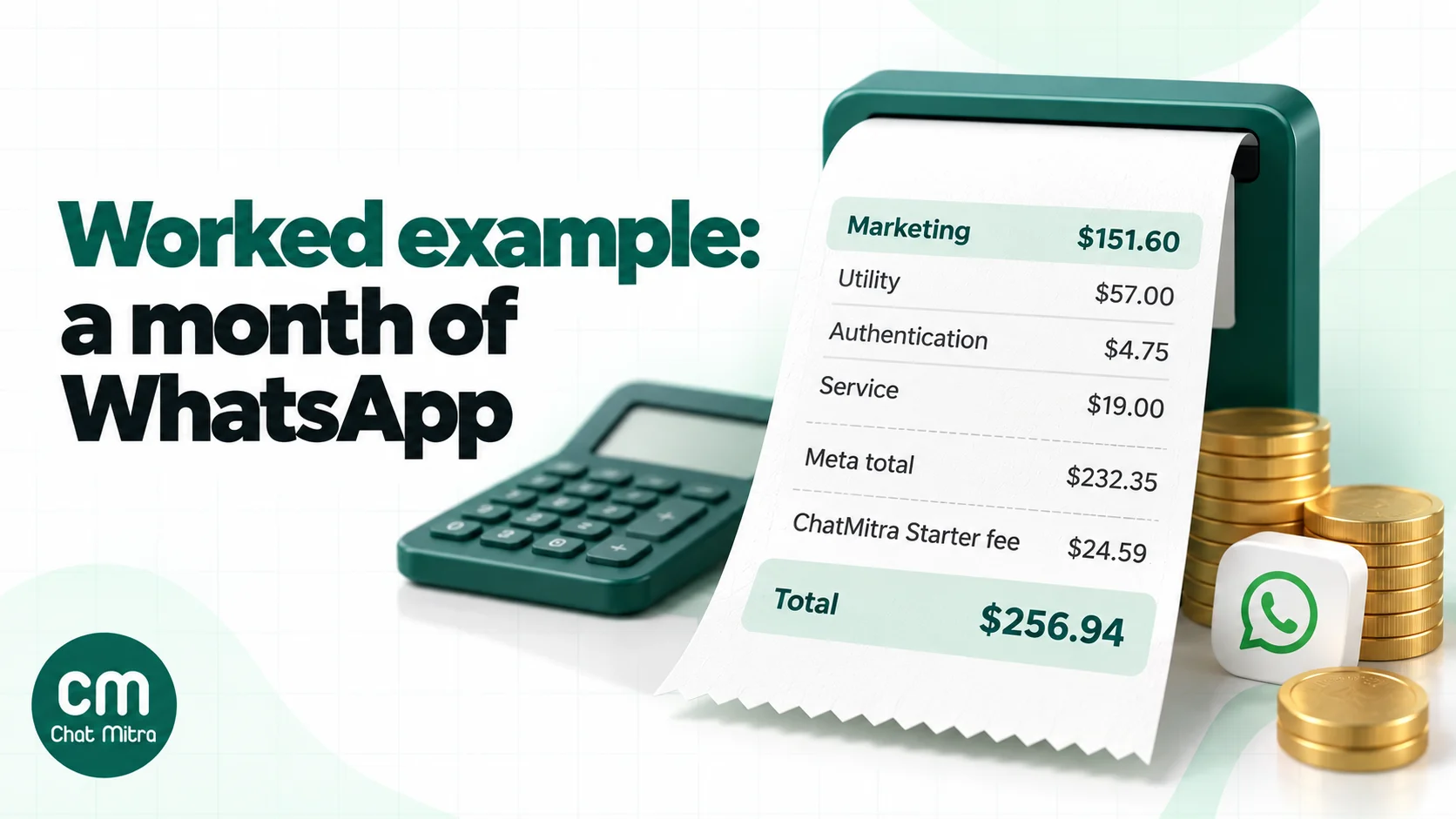
What the month costs with each provider:
| Option | Platform fee | Meta charges as billed | Other fees | Total | ≈ ZAR |
|---|---|---|---|---|---|
| ChatMitra Starter | $0 | $232.35 | $24.59 conversation fee* | $256.94 | R4,232 |
| Chakra Growth (3 seats) | $24.99 | $232.35 | — | $257.34 | R4,238 |
| Gupshup (API only) | $0 | $232.35 | $26.10 per-message fees | $258.45 | R4,257 |
| ChatMitra Enterprise | $26.26 (₹2,499) | $232.35 | — | $258.61 | R4,259 |
| ChatMitra Pro | $10.50 (₹999) | $232.35 | $22.49 conversation fee* | $265.34 | R4,370 |
| YCloud Growth + 1 user | $62.00 | $232.35 | — | $294.35 | R4,848 |
| Kero Essential** | $65.01 (£49) | $232.35 | — | $297.36 | R4,897 |
| Infobip (API only) | $0 | $307.38 (its rates) | — | $307.38 | R5,063 |
| Twilio (API only) | $0 | $232.35 | $85.00 per-message fees | $317.35 | R5,227 |
| AiSensy Basic | $45.00 | $273.50 (its rates) | — | $318.50 | R5,246 |
| 360dialog Premium | $119.00 | $232.35 | $10.61 marketing surcharge | $361.96 | R5,961 |
| respond.io Growth | $199.00 | $232.35 | — | $431.35 | R7,104 |
| Wati Growth | $69.00 | $376.35 (its rates) | — | $445.35 | R7,335 |
| Gotbot (40 mps)*** | $423.80 (R6,980) | $291.65 (its table) | — | $715.45 | R11,783 |
*ChatMitra’s ₹0.20 is charged once per customer per 24-hour conversation, including customer-started ones. We assumed the maximum: every template opens its own conversation (10,500) plus the 1,200 customer-started chats, so 11,700 conversations, ₹2,340 on Starter. Pro includes 1,000 free credits a month, so it pays for 10,700 (₹2,140). **Kero doesn’t say whether it marks up Meta’s rates; we assumed none. ***Gotbot’s published table still shows per-conversation wording and a service price of zero, so its real bill may differ. YCloud’s Free plan would cost only Meta’s $232.35, but it allows one user. Rates converted at ECB reference rates, 14 October 2026.
Three things stand out. ChatMitra Starter, Chakra Growth, Gupshup and ChatMitra Enterprise all finish within $2 of each other, so pick between them on features, not price. Providers that add a markup to Meta’s rates cost more as you send more marketing, because that’s where most of the money goes. And a flat platform fee hurts a small sender most: Gotbot’s R6,980 minimum is built for high-throughput enterprises, not a three-person shop.
Why ChatMitra comes first for South African SMBs
Each row below can be checked against the tables above.
| ChatMitra advantage | What it means | How others compare |
|---|---|---|
| Cheapest option with a shared inbox and broadcasts in our worked month | Starter: $256.94 (≈R4,232) all in | Chakra Growth $257.34; YCloud Growth $294.35; AiSensy Basic $318.50; Wati Growth $445.35 |
| A free plan that can broadcast | Starter costs nothing and includes broadcasts, scheduling, retargeting and reports | AiSensy’s free plan has no broadcasting; respond.io’s Starter has no broadcasts; Chakra’s Free plan has no broadcasts |
| No seat cap | The whole team works from one inbox, with permissions by role | Chakra Starter 2 users, YCloud Growth 2, Wati Growth 3, respond.io Starter 5 |
| Meta’s rates at cost | You pay Meta’s South Africa card, nothing added | Wati’s rate card is 60–80% above Meta’s; Infobip’s 30–34%; AiSensy’s 16–19% |
| No per-message fee on Enterprise | Above about 12,500 conversations a month, ₹2,499 flat beats paying ₹0.20 each | Twilio adds $0.005 per message in or out: 53% on top of a $0.0095 utility message |
| AI chatbot included on Pro | Pro (₹999, ≈R173) includes the AI chatbot with your own model key, from 18 providers | Check whether AI is an add-on during each trial |
Good to know: ChatMitra’s plan and conversation fees are charged in Indian rupees, so you need a card cleared for foreign payments, though the sums are small (about R433 a month for Enterprise). ChatMitra has no South African office, and its template list doesn’t include the en_ZA English variant. Businesses that need a rand contract with local account management should look at CM.com or Clickatell.
The 18 providers, compared
1. ChatMitra: free start, Meta’s rates at cost, no seat cap
ChatMitra is built in India and works with South African numbers end to end: +27 is accepted when you sign up, add contacts or build a campaign, and Afrikaans (af) and Zulu (zu) are in its template language list.
Plans in rand terms: Starter costs nothing. Pro is ₹999 a month (about R173), with a 15-day trial that needs no card and 1,000 free messaging credits each month. Enterprise is ₹2,499 (about R433) and drops ChatMitra’s ₹0.20 conversation fee, which otherwise applies once per customer per 24 hours on Starter and Pro.
Meta’s share: charged by Meta to your own card at Meta’s South Africa rates, with nothing added.
What you get:
- one inbox the whole team works from, with role permissions and no seat cap;
- broadcasts by tag, retargeting and campaign reports;
- Shopify and Google Sheets automations, and an Android app;
- coexistence with the WhatsApp Business app.
Pro adds auto-replies, the AI chatbot, API access and webhooks.
South African and locally present providers
2. CM.com. A Dutch company with offices in Cape Town and Johannesburg. Meta named it a Premier Partner in July 2026, the top level of the WhatsApp partner programme. Its South African prices are in rand on annual contracts:
- GO: R965 a month (1 profile)
- Basic: R2,925 (5 profiles)
- Advanced: R9,790 (15 profiles)
Message bundles are “contact for bundle prices”, and there’s a one-time onboarding fee with no amount shown. Strong on the agent inbox, campaigns, chatbot and SMS fallback. The catch is that you can’t work out a full bill without a quote.
3. Clickatell. Founded in Cape Town in 2000 and now headquartered in California, with an office in South Africa. It calls itself a WhatsApp Business Solution Provider. Its Chat Commerce platform covers an inbox (Chat Desk), broadcasts, AI, automation and in-chat payments. WhatsApp pricing is contact-sales only.
4. Gotbot. Founded in Johannesburg, and an official WhatsApp Business Solution Provider by its own description. It charges a platform fee based on throughput, from R6,980 a month for 40 messages a second up to R55,980 for 320. Its rate table shows marketing at R0.94 ($0.0604), well above Meta’s $0.0379, and utility at R0.12 ($0.0077), below Meta’s current rate. The same page still offers “1,000 free conversations every month”, which is Meta’s retired model. Ask for a current per-message card. Gotbot suits enterprises building AI agents; its client list includes Toyota and Momentum.
5. Kero (BulkSMS.com). BulkSMS.com is run by Cape Town-based Celerity Systems. Its WhatsApp product, Kero, says it is “an official WhatsApp Business API provider” and shows a Meta Tech Provider badge. Plans are in pounds:
- Essential: £49 a month (5 users)
- Professional: £95 (15 users)
- Enterprise: £149
Meta’s charges are “separate from your Kero subscription”. Kero adds RCS and SMS fallback. Its calculator FAQ still says utility templates in the 24-hour window are free, which stopped being true on 1 October 2026.
6. SMSPortal. A Cape Town company, part of LINK Mobility since November 2025. It sells WhatsApp alongside its SMS platform, but WhatsApp pricing is “get in touch”. Good if you already use SMSPortal for SMS and OTPs.
7. Everlytic. A Johannesburg email-and-messaging platform. WhatsApp is only on its top plan, Accelerate plus, where “additional charges apply”. Contracts run 12 months, with a free setup fee on those. Pricing is quote-only in rand, excluding VAT.
8. Turn.io. Turn.io started in 2017 inside the Cape Town non-profit Praekelt.org. It’s an official WhatsApp Business Solution Provider, priced per inbound user. It promises Meta’s fees “Passed through at cost. The processor takes 5%; we take nothing”. Pricing is now aimed squarely at healthcare programmes, with nonprofit rates. No figures are published.
9. Cellfind. A Centurion company that promises “unlimited users and devices” and “flexible and affordable pricing options”. It publishes no figures, and we found no current Meta-partner statement on its own site.
Self-serve global platforms
10. YCloud. It promises “Zero Mark-up Charges on WhatsApp Messages”, and with South Africa selected, its page shows Meta’s rates exactly. Plans:
- Free: 1 user
- Growth: $52 a month, or $39 yearly (2 users)
- Pro: $118 (6 users)
Extra users are $10 each, and campaigns are on every plan. Meta’s fees come out of a USD wallet you top up.
11. Chakra. The cheapest paid seat price we found:
- Starter: $12.49 a month (2 users, 10,000 templates)
- Growth: $24.99 (3 users, 25,000 templates)
Each template over the quota costs $0.001. You pay Meta directly, at Meta’s rates. The free plan has no broadcasts.
12. AiSensy. Basic is $45 a month for an owner plus 5 agents, with broadcasts. Its October 2026 country sheet charges $0.045 for South African marketing and $0.011 for utility, authentication and service, which is 16–19% above Meta. The free plan can’t broadcast.
13. Wati. For South Africa, Growth is $69 a month (3 users, 15,000 broadcasts) and Pro is $149. Its October 2026 rate card for these plans charges $0.0606 for marketing and $0.0171 for utility and authentication, which is 60–80% above Meta. That makes it the dearest self-serve option in our worked month.
14. respond.io. Starter is $99 a month (5 users), but broadcasts start on Growth at $199. It says it “passes Meta’s rates through unchanged”, funded from a WhatsApp balance you top up. A good inbox for multi-channel teams, if the platform fee fits.
Developer and enterprise platforms
15. Twilio. Pay as you go, at Meta’s rates plus “$0.005 per message”, inbound or outbound, and $0.001 for each failed message. For a utility message that’s 53% on top. Best for developers who already run SMS and voice on Twilio.
16. 360dialog. API plans start at $59 per number per month (Regular), with Premium at $119 adding inbox and sending add-ons. It advertises “zero message markup”, but its docs add a 7% surcharge on marketing sent through the standard endpoint instead of Meta’s Marketing Messages API. Messaging is billed from a prepaid balance in EUR or USD.
17. Gupshup. A self-serve API at Meta’s rates plus $0.001 per message, incoming included, and $0.002274 on each South African marketing message sent outside MM Lite. It’s cheap for developers, but you build or buy your own inbox.
18. Infobip. A pay-as-you-go API with its own South African rates: $0.0506 for marketing and $0.01235 for utility, authentication and service, about 30–34% above Meta. Infobip has had a Johannesburg office since 2010, which suits banks and large brands that want local integration teams. Parts of its pricing page still describe per-conversation charging.
Which kind of provider should you choose?
| If you are… | Look at | Why |
|---|---|---|
| A small or mid-sized business that wants an inbox and broadcasts | ChatMitra, Chakra, YCloud | Low or free plans, Meta’s rates at cost |
| A brand that needs a rand contract and a local account team | CM.com, Clickatell | South African offices; rand pricing (CM.com) |
| A developer adding WhatsApp to an app | Gupshup, Twilio, 360dialog | Clean APIs, small per-message fees or flat number fees |
| A bank, insurer or retailer with complex integrations | Infobip, CM.com, Clickatell | Enterprise support and on-site teams |
| A health or social-impact programme | Turn.io | Built for it, with nonprofit pricing |
| A business that already sends SMS through a local gateway | SMSPortal, Kero | One platform for SMS fallback and WhatsApp |
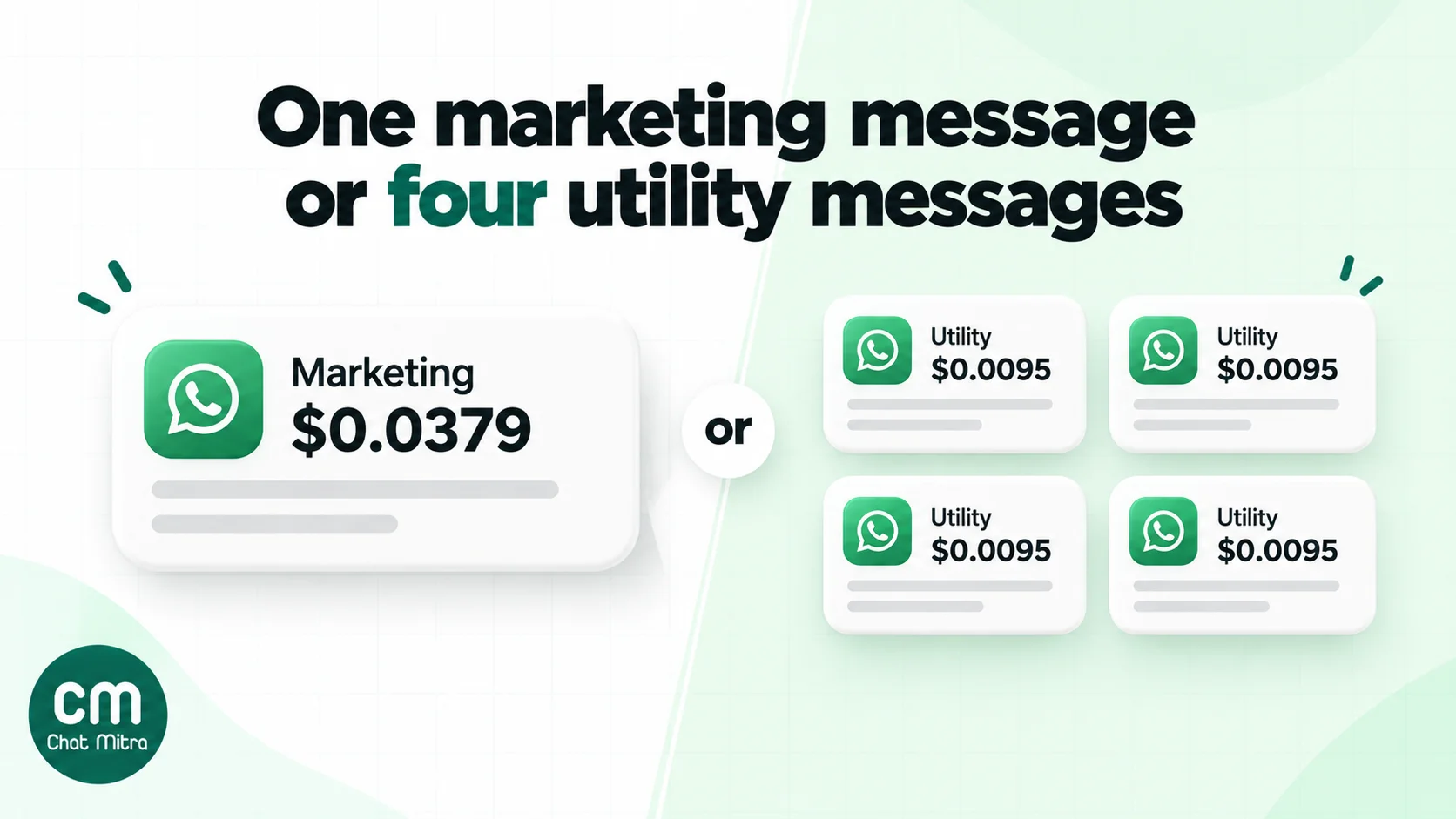
Where the money goes: one marketing message costs about four utility messages
At $0.0379 against $0.0095, one marketing message to a South African number costs the same as four utility messages. In our worked month, marketing was 38% of the templates sent but 65% of Meta’s charges. Three habits keep that under control:
- Send marketing to fewer, warmer people. Segment by purchase history instead of messaging your whole list. Our WhatsApp broadcast list guide shows how.
- Don’t disguise marketing as utility. Meta re-categorises promotional content, and a rejected or re-categorised template costs you time and quality rating.
- Answer inside the free 1,000. For most small businesses, service replies stay within the monthly free tier for each number. A second number gets its own 1,000.
English, Afrikaans and isiZulu templates
Meta supports three South African template languages: English (South Africa, en_ZA), Afrikaans (af) and Zulu (zu). isiXhosa, Sesotho, Setswana and the other official languages aren’t on Meta’s list. You can still write a template in them, but it has to be filed under another language code, and you lose the right language tag for review.
Practical points:
- Pick the variant your customers read. An Afrikaans offer to a Western Cape list can outperform English, but only if the list chose Afrikaans.
- Keep one template per language. Meta reviews each translation as its own template, so a rejection in one language doesn’t block the others.
- Check the language list during a trial. ChatMitra offers Afrikaans and Zulu, plus English, English (UK) and English (US), but not
en_ZA. For most South African English messages, plainenworks fine.
POPIA and consent
South Africa’s Protection of Personal Information Act (POPIA) is the rule that most often trips up WhatsApp marketers. Section 69 bans direct marketing “by means of any form of electronic communication” unless one of two things is true:
- The person has consented. You may approach someone for consent only once, and only if they haven’t already refused.
- They are an existing customer. You must have got their details when you sold them a product or service, you may market only your own similar products or services, and they must have been given a chance to opt out when you collected the details and in every marketing message since.
Every marketing message must also say who it’s from and give contact details for opting out. The Information Regulator’s guidance note on direct marketing (3 December 2024) is non-binding, but it confirms a broad reading of “electronic communication” and points to Form 4 for requesting consent.
Meta’s own policy adds a second layer: you need opt-in before you message anyone on WhatsApp, whatever the local law. In practice:
- Collect opt-ins at checkout or with a click-to-chat ad, and record the date and the wording.
- Add a one-tap “Stop promotions” button to marketing templates, and honour it at once.
- Keep utility messages about the order. Don’t slip offers into a delivery update.
Our WhatsApp opt-in guide covers consent wording and record-keeping in detail. This section is general information, not legal advice.
How to get the WhatsApp Business API in South Africa: 6 steps
- Choose a number. Use a South African mobile or landline number you can receive an SMS or call on, and that isn’t registered on another WhatsApp API account. You can keep using the WhatsApp Business app on the same number through coexistence, if your provider supports it.
- Set up a Meta business portfolio in your registered company name. Business verification, using official documents such as your CIPC registration certificate, unlocks higher messaging limits.
- Pick a provider and connect the number through its Embedded Signup flow. You log in with Meta, choose or create your WhatsApp Business Account, and verify the number.
- Add a payment method for Meta’s charges, either your own card in a supported currency or your provider’s wallet. Without one, service messages stop after the free 1,000.
- Submit your first templates, a utility template for orders and a marketing template for offers, in English, Afrikaans or Zulu.
- Start small. New numbers begin with a messaging limit that rises as you send good-quality messages. See WhatsApp messaging limits.
For the full walkthrough, read how to get the WhatsApp Business API.
Seven questions to ask before you sign
- Is Meta’s South Africa rate passed through at cost? Ask for Meta’s rate and the provider’s charge as separate lines.
- Is your rate card dated after 1 October 2026? If it still says $0.0076 for utility, or “free conversations”, it’s out of date.
- Do you charge for incoming messages? Twilio and Gupshup do.
- How many users are included, and what does each extra seat cost?
- Are broadcasts on the plan I’m buying? respond.io and several free plans leave them out.
- Which currency will I be invoiced in, and at what exchange rate?
- Is there a contract term, setup or onboarding fee? CM.com and Everlytic sell annual contracts.
Summary
Meta’s rates for South Africa are the same for every provider: $0.0379 for marketing and $0.0095 for everything else since 1 October 2026. The 18 providers differ in what they add, and the gap is wide. In our worked month, totals ran from $256.94 to $715.45 for the same messages. For a small or mid-sized business that wants a shared inbox and broadcasts without seat limits or markups, ChatMitra Starter was the cheapest option we found, and ChatMitra Enterprise caps the platform cost at ₹2,499 (about R433) as volumes grow.
Plug your own monthly volumes into Meta’s rates above to see your bill, then start free on ChatMitra.