Disclosure
We make ChatMitra, and it's first on this list. Judge the ranking on the evidence: every price is what the provider's own site showed on 5 October 2026, anything we couldn't find says "not published", and the worked month shows the two options that cost less than ChatMitra and why.
For most US businesses, the best WhatsApp API provider is the one with the smallest fees around Meta’s rate, because Meta’s own rate is tiny. A utility or authentication message to a US number costs $0.0034, so a $0.005 per-message fee more than doubles your bill. On prices checked on 5 October 2026, ChatMitra Enterprise came to about $104 in our worked month with unlimited users and no per-message fee; only YCloud’s one-user free plan and Chakra’s six-seat Growth plan were cheaper. Twilio, Telnyx and Vonage suit developers already on their APIs; Infobip and Sinch suit large companies. And one fact shapes every choice: Meta doesn’t deliver marketing templates to US phone numbers at all.
So WhatsApp in the US is a different product from WhatsApp in India, Brazil or Mexico. This guide explains what you can and can’t send, what Meta charges, and then compares 16 providers in four groups: ChatMitra, US-based platforms, self-serve inbox platforms, and developer and enterprise APIs.
Key takeaways
- No marketing templates to US numbers. Meta has blocked them since 1 April 2025, with no end date announced.
- Everything else is cheap: $0.0034 for utility, authentication and service, with 1,000 service replies free per number each month.
- Provider fees decide the bill. Twilio and Bird add $0.005 per message (147% of Meta's utility rate), Telnyx $0.004, Gupshup $0.001.
- ChatMitra is our pick for SMBs: unlimited users, Meta's rates at cost, and a flat Enterprise plan with no per-message fee.
- Growth comes from inbound. Click-to-WhatsApp ads open a 72-hour window in which every message is free.
The US rule that changes everything: no marketing templates
Meta’s per-user marketing limits page, last updated 17 June 2026, is direct: “WhatsApp does not currently deliver marketing template messages to WhatsApp users with United States phone numbers (numbers composed of a +1 dialing code and a US area code).” A send attempt fails with an error rather than being delivered and charged. Meta started the block on 1 April 2025, and several providers’ help pages describe it as still active with no announced end date.
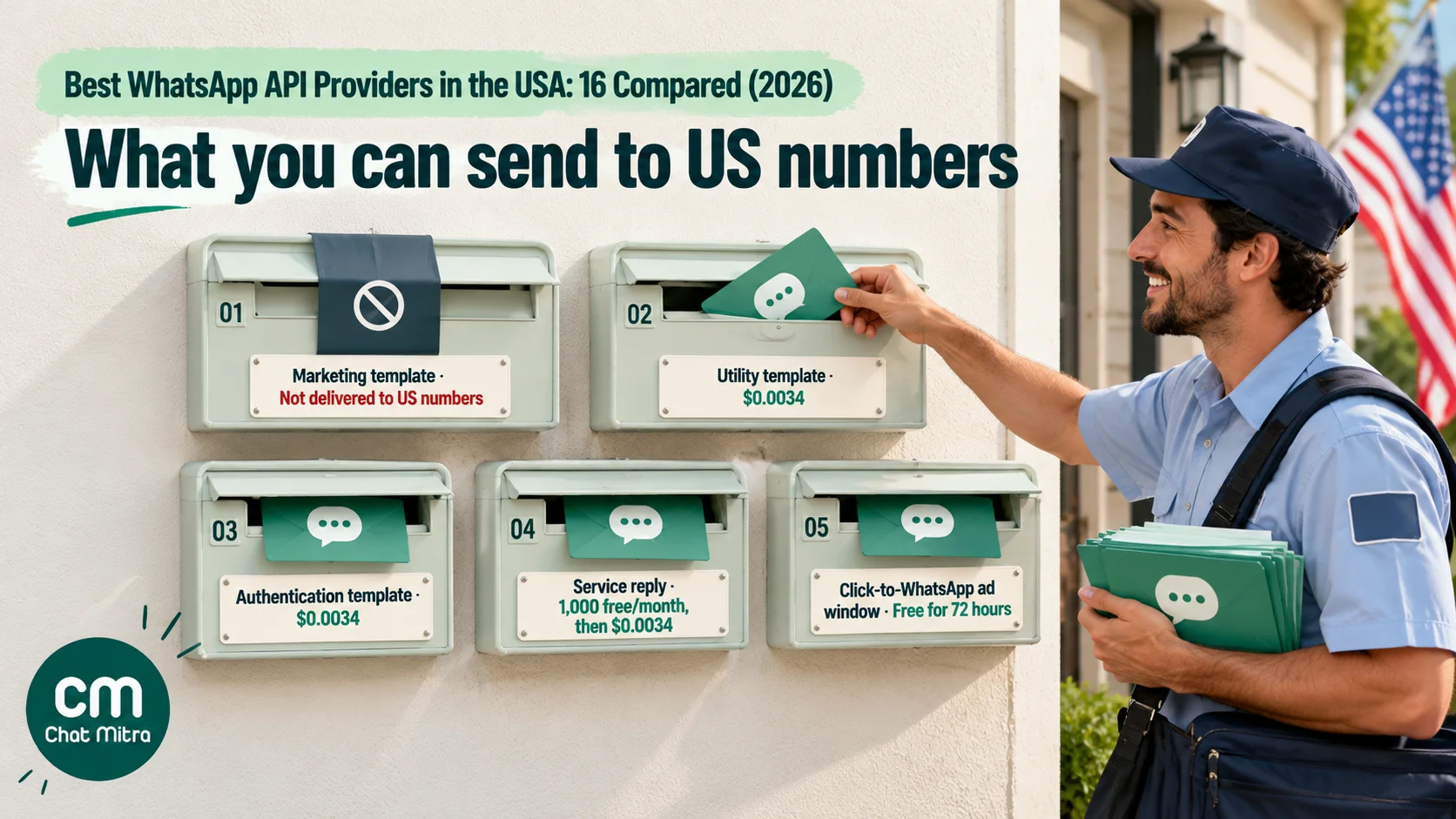
In practice, here’s what works and what doesn’t for a US audience:
| Message | Delivered to US numbers? | Meta charge |
|---|---|---|
| Marketing template (promotions, launches, win-backs) | No | n/a |
| Utility template (order, shipping, appointment, payment updates) | Yes | $0.0034 |
| Authentication template (one-time passcodes) | Yes | $0.0034 |
| Service reply inside the 24-hour window | Yes | Free for the first 1,000 a month per number, then $0.0034 |
| Any message in a Click-to-WhatsApp ad’s 72-hour free window | Yes | Free |
Two consequences follow. First, a US WhatsApp programme is built on transactional updates and conversations customers start, not on broadcasts. Second, a provider’s marketing features (campaign builders, retargeting, A/B tests) matter only for customers outside the US. A Houston brand selling to Mexico, or a New Jersey exporter with buyers in India, can still run campaigns there at those countries’ rates.
The audience is there to serve. Meta said in July 2024 that WhatsApp had passed 100 million monthly users in the US, with Texas alone above 10 million and Los Angeles, New York, Miami and Seattle among its fastest-growing markets.
Who uses WhatsApp with US businesses
WhatsApp in the US skews toward a few audiences, and they tell you whether the channel is worth the set-up:
- Customers with family or business abroad. People who already use WhatsApp to reach relatives in Latin America, India, the Philippines or the Middle East expect to use it with businesses too. Remittance services, travel agents, immigration lawyers and international schools hear from them first.
- Spanish-speaking customers. In Miami, Houston or Los Angeles, a bilingual WhatsApp line often gets more replies than SMS, and Spanish templates sit under the same template name as English ones.
- Businesses that sell across borders. A US brand with buyers in Mexico, the UK or India uses one WhatsApp number for all of them, sending marketing abroad and transactional messages at home.
- High-touch purchases. Furniture, real estate, home services, car dealerships and clinics, where a customer wants to send photos, ask questions and confirm a slot, suit a chat thread better than a call.
Healthcare and financial businesses should check their own obligations (HIPAA, GLBA and state rules) before sending personal health or account details over any messaging channel, and keep sensitive data out of templates.
What Meta charges for US (+1) numbers
The US sits in Meta’s “North America” pricing region with Canada. Rates on the card effective 1 October 2026:
| Category | Rate per delivered message | What changed in 2026 |
|---|---|---|
| Marketing | $0.025 (not delivered to US numbers) | No change |
| Utility | $0.0034 | Cut from $0.004 on 1 January |
| Authentication | $0.0034 | Cut from $0.004 on 1 January |
| Authentication-international | Not applied | None |
| Service | $0.0034 after 1,000 free a month per number | Charged from 1 October |
Meta’s USD rate card and volume tiers effective 1 October 2026, downloaded 5 October 2026 from Meta’s WhatsApp pricing page (updated 30 September 2026). The January change is in Meta’s pricing-update history.
Volume tiers start early. Monthly utility volume across your business portfolio above 80,000 drops to $0.0032, and the rate keeps stepping down to $0.0026 above 6 million. Authentication tiers start after 100,000.
October ended two free rides. Meta now charges customer-service replies beyond the first 1,000 per number each month, and utility templates sent while a customer chat is open. For a support-heavy US business, those replies are now the second-biggest line on the bill.
Why provider fees matter more in the US than anywhere else
In Saudi Arabia, a marketing message costs $0.0576 at Meta, so a $0.005 provider fee adds under 9%. In the US the typical message is a $0.0034 utility update, and the same fee adds 147%. That’s the single most useful thing to know when comparing US providers: look at the per-message fee first and the plan price second.
Fees we found on providers’ own pages, in addition to Meta’s rate:
- $0.005 per message: Twilio (inbound or outbound) and Bird.
- $0.004 per message: Telnyx, despite a “$0 markup” headline that refers to its monthly fee.
- $0.00219 per message: Vonage’s North America platform fee on utility, authentication and service ($0.01615 on marketing).
- $0.001 per message: Gupshup, on incoming and outgoing messages.
- About 15–40% on the rate itself: SleekFlow (+15% on templates), AiSensy (+18% on utility), Infobip (+40%).
- None: ChatMitra Enterprise, YCloud, respond.io, 360dialog, Kommo; Chakra charges $0.001 only beyond its plan allowance.
How we compared the providers
All prices come from each provider’s site as it appeared on 5 October 2026, with United States selected wherever a page varies by country. We noted the per-message fee or markup on US rates, the lowest plan that can send bulk templates, seats included, the total for one worked month, billing currency, any US office, and whether the provider tells customers about the US marketing block. Partner status is quoted as each provider states it.
WhatsApp API providers for US businesses: comparison (October 2026)
| Provider | Type | Entry plan with bulk sending | On top of Meta's US rate | US presence | Mentions US marketing block |
|---|---|---|---|---|---|
| ChatMitra | SMB platform | Starter free · Pro ₹999/mo · Enterprise ₹2,499/mo | Nothing on Enterprise; ₹0.20 per conversation on Starter and Pro | None (India-based) | Our guides do |
| Twilio | Developer CPaaS | Pay as you go | $0.005 per message, in or out | US company | Yes ("Not available for this region") |
| Telnyx | Developer CPaaS | Pay as you go, $1 per number/mo | $0.004 per message | Austin, TX | No |
| Vonage | Developer CPaaS | Usage only (plan page not readable) | $0.00219 utility; $0.01615 marketing | New Jersey (unconfirmed) | No |
| Kommo | Sales CRM | Advanced $35 per user/mo, 6-month minimum | Nothing; Meta bills you directly | San Francisco, CA | Yes |
| YCloud | Global BSP | Free plan (1 user) · Growth $39/mo yearly | Nothing ("Zero Mark-up") | None | Yes |
| Chakra | Inbox platform | Starter $12.49/mo (3 seats) | $0.001 per template beyond plan limit | None (India-based) | Yes |
| Wati | SMB platform | Growth $69/mo, or $59/mo yearly | Calculator still per conversation ($0.0048 utility) | None stated | Yes |
| AiSensy | SMB platform | Basic $45/mo | Own sheet: $0.004 utility (+18%) | None | Yes (blog) |
| respond.io | Omnichannel inbox | Growth $159/mo | Nothing | None | Yes |
| SleekFlow | Omnichannel inbox | Pro $109/mo yearly + $15/mo number | +15% on templates | Dover, DE | Yes (blog) |
| 360dialog | Developer BSP | Premium $119 per number/mo (Regular $59 is API only) | Nothing ("0% markup") | None | Yes |
| Gupshup | Developer CPaaS | Pay as you go | $0.001 per message | Not checked | Yes (support centre) |
| Bird | Developer CPaaS | Prepaid balance; free inbox | $0.005 per message | None listed | In docs only |
| Infobip | Enterprise CPaaS | Pay as you go or custom | All-in $0.00476 utility (+40%) | Jersey City, NJ | Yes (docs) |
| Sinch | Enterprise CPaaS | Engage Basics $99/mo + $10 add-on | $0.05 per templated message after 1,000 | Atlanta, GA | Yes (blog) |
Providers’ own pricing, help and contact pages, 5 October 2026, United States selected. Wati’s US prices come from its own plan feed, as its page varies by visitor location. Vonage’s fee card was read from its help centre; its pricing page blocked our browser. YCloud and SleekFlow prices are for yearly billing.
Worked example: a Miami furniture store’s WhatsApp month
A Miami online furniture retailer sells across the US. Its customers can’t receive WhatsApp promotions, so the store uses WhatsApp for what happens after the click. One month from October 2026:
- 12,000 utility templates: order confirmations, delivery-window scheduling, “out for delivery” and receipt messages.
- 3,000 authentication templates: sign-in codes for its website.
- 9,000 service replies: questions about fabrics, assembly and returns; the first 1,000 are free.
- 1,500 chats from Click-to-WhatsApp ads, with 4,500 replies sent inside the free 72-hour windows.
| Category | Messages | Meta rate | Meta charge |
|---|---|---|---|
| Utility | 12,000 | $0.0034 | $40.80 |
| Authentication | 3,000 | $0.0034 | $10.20 |
| Service | 8,000 charged (1,000 free) | $0.0034 | $27.20 |
| Click-to-WhatsApp window | 4,500 | Free | $0.00 |
| Total | 28,500 sent | $78.20 |
Service replies are now a third of the bill: $27.20 that didn’t exist before October. Over the year so far, the store’s Meta bill went from $60.00 (2025 rates) to $51.00 (after January’s cut) to $78.20 (after October’s service charge).
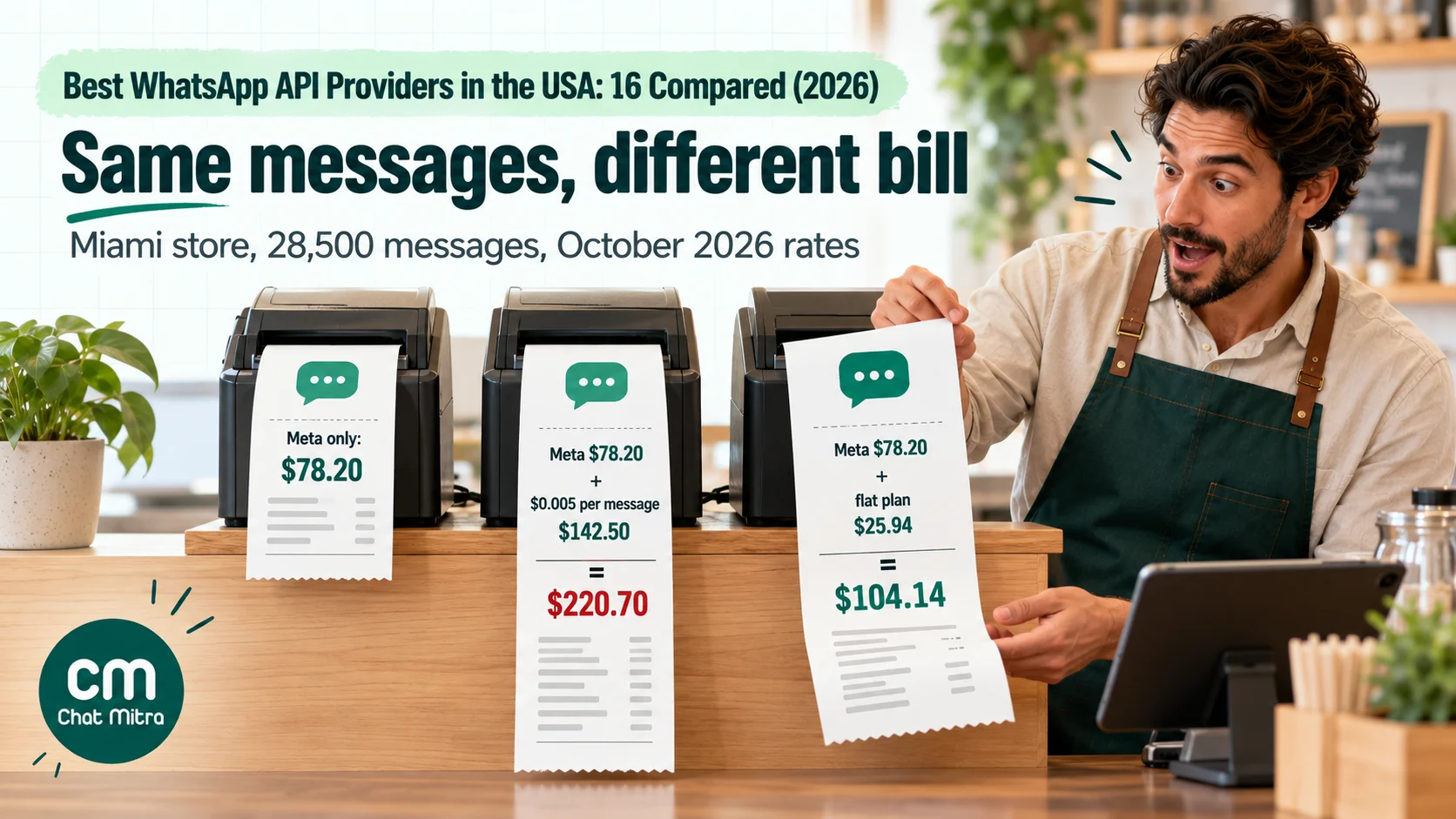
Here’s the full month on each provider’s lowest plan that can send templates in bulk:
| Provider and plan | Plan / month | Fees on 28,500 messages | Total / month |
|---|---|---|---|
| ChatMitra Enterprise (unlimited users) | ₹2,499 (≈$25.94) | None | ≈$104.14 |
| ChatMitra Starter (unlimited users) | ₹0 | Up to ₹3,900 (≈$40.49) in conversation fees* | up to ≈$118.69 |
| YCloud Free (1 user) | $0 | None | $78.20 |
| Chakra Growth (6 seats)** | $24.99 | None within allowance | $103.19 |
| Gupshup (self-serve) | none | $28.50 | $106.70 + $0.001 per incoming message |
| Infobip | none | Included in its $0.00476 rate | $109.48 |
| Kommo Advanced (1 user) | $35 | None | $113.20 ($183.20 with 3 users) |
| AiSensy Basic | $45 | $13.80 above Meta at its $0.004 rate | $137.00 |
| Vonage | not published | $62.42 at $0.00219 | $140.62 |
| Wati Growth (3 users) | $69 | Not published per message*** | ≈$147.20 |
| Telnyx | $1 (number) | $114.00 at $0.004 | $193.20 |
| 360dialog Premium | $119 | None | $197.20 |
| SleekFlow Pro (yearly) + number | $124 | $7.65 (15% on templates) | $209.85 |
| Twilio | none | $142.50 at $0.005 | $220.70 + $0.005 per incoming message |
| Bird | none | $142.50 at $0.005 | $220.70 |
| respond.io Growth | $159 | None | $237.20 |
| Sinch Engage Basics + social add-on | $109 | 14,000 templates over the 1,000 included, at $0.05**** | ≈$809 |
Rupees converted at about ₹96.32 per dollar (ECB reference rates, 2 October 2026). *Upper bound: ₹0.20 for each of 15,000 template sends treated as its own 24-hour conversation, plus 3,000 customer-started and 1,500 ad-started conversations. **Chakra Starter ($12.49) caps service messages at 5,000 a month, below this store’s 13,500, so Growth is the lowest plan that fits. ***Wati’s calculator still shows per-conversation US rates; we assumed Meta’s rates unchanged. ****Sinch bundles Meta’s fee into $0.05 per templated message or conversation; service conversations would add more. Fees per incoming message aren’t counted, because inbound volume varies.
What the numbers say. The three cheapest options are within $26 of each other. YCloud’s free plan is the floor, but one person can use it. Chakra Growth undercuts ChatMitra Enterprise by 95 cents with six seats and monthly caps. Everything from Gupshup down is driven by fees on each message or by plans priced for bigger teams.
The same store at double the volume
Growth changes the order. Suppose the store doubles: 24,000 utility, 6,000 authentication and 18,000 service messages, plus 9,000 replies inside ad windows, 57,000 sent in all. Meta’s charge becomes $159.80.
| Provider and plan | Total / month at 57,000 messages | Change from the first month |
|---|---|---|
| ChatMitra Enterprise (unlimited users) | ≈$185.74 | +$81.60, Meta’s charge only |
| YCloud Free (1 user) | $159.80 | +$81.60 |
| Chakra Advanced (12 seats)* | $209.79 | +$106.60 and a plan upgrade |
| Gupshup | $216.80 | +$110.10 |
| Infobip | $223.72 | +$114.24 |
| Vonage | $284.63 | +$144.01 |
| Telnyx | $388.80 | +$195.60 |
| Twilio | $444.80 | +$224.10 |
*27,000 service and ad-window replies exceed Growth’s 15,000 allowance, so Advanced ($49.99) is the lowest Chakra plan that fits. Per-incoming-message fees are again excluded.
At this size ChatMitra Enterprise is the cheapest option with more than one user, and the gap to per-message pricing widens with every message: Twilio’s fee alone ($285) is now nearly twice Meta’s charge.
Why ChatMitra comes first for US small businesses
| ChatMitra advantage | Why it matters in the US | How others compare |
|---|---|---|
| No per-message fee on Enterprise | With Meta at $0.0034, any per-message fee is a big percentage; Enterprise is a flat ₹2,499 (≈$26) | Twilio and Bird $0.005, Telnyx $0.004, Vonage $0.00219, Gupshup $0.001 |
| Unlimited team members | Support-heavy US WhatsApp needs many agents in one inbox | YCloud Free 1 user, Chakra Growth 6, Wati Growth 3; Kommo charges per user |
| Meta's rates at cost, billed by Meta | You pay $0.0034, not a marked-up rate | Infobip $0.00476, AiSensy $0.004, SleekFlow $0.00391 on utility |
| A free plan with bulk sending | Starter costs nothing and includes broadcasts, scheduling and reports for your non-US audiences | AiSensy's free plan has no broadcasting; respond.io's Starter has no broadcasts |
| AI chatbot on Pro | Answers the inbound questions that drive US WhatsApp, with your own model key from 18 providers | AiSensy's AI agent is a $50 monthly add-on |
| English and Spanish templates | en_US, en, es and es_MX in the template builder | Check each provider's language list in a trial |
Good to know: ChatMitra is India-based, bills its plans in Indian rupees through Razorpay (check your card accepts an international charge in INR), has no US office, and has an English dashboard. On Starter and Pro, the ₹0.20 conversation fee (about $0.0021) is large next to Meta’s US rate, so US businesses above roughly 12,500 conversations a month should choose Enterprise.
The 16 providers, compared
1. ChatMitra: flat Enterprise pricing, unlimited users
ChatMitra describes itself as a Meta Business Partner and is built in India. It accepts +1 numbers at sign-up and in contacts and campaigns, and offers en_US and Spanish templates.
- Plans: Starter free; Pro ₹999 a month (about $10.37) with a 15-day card-free trial and 1,000 messaging credits a month; Enterprise ₹2,499 (about $25.94). Meta charges your own card directly. Starter and Pro carry ₹0.20 per 24-hour conversation; Enterprise carries no platform fee.
- For US use: a shared inbox with roles for any number of agents, utility-template broadcasts by tag, Shopify and Google Sheets automations, coexistence with the WhatsApp Business app, and an Android app. Pro adds auto-replies, the AI chatbot, API access and webhooks.
US-based platforms
2. Twilio: the developer default, with a fee on every message
Twilio passes Meta’s rate through and adds “$0.005 per message, inbound or outbound”, plus $0.001 per failed message. It’s the clearest about the US block: its pricing page marks the US marketing template “Not available for this region”. Twilio suits teams already running SMS or voice through it. There’s no campaign interface, and on US utility traffic the fee is larger than Meta’s charge. See ChatMitra vs Twilio.
3. Telnyx: Austin-based API with a $0.004 fee
Telnyx, headquartered on Congress Avenue in Austin, calls itself “a WhatsApp BSP”. Its page leads with “Meta’s rate. $0 markup”, but the rate card below lists “Platform usage $0.004 per message”, which its FAQ confirms. Pay as you go, $1 a month per number, and commitments from $500 a month. API only, with no inbox.
4. Vonage: per-message fee by category
Vonage’s help centre publishes a North America fee card effective 1 October 2026: $0.00219 per utility, authentication or service message and $0.01615 per marketing message, on top of Meta’s rates. Its support pages don’t mention the US marketing block, and its pricing pages blocked our browser, so we couldn’t read plan prices or confirm its New Jersey address.
5. Kommo: a US-registered sales CRM
Kommo lists QSOFT LLC in San Francisco as its first contact address and says it’s “an official Meta Partner”.
- Pricing: Base $25, Advanced $35 and Pro $45 per user a month, on a minimum six-month term (“Monthly payment is not currently available”). Broadcasting starts on Advanced.
- Meta rates: Meta bills you directly; its help centre says marketing templates “are currently paused for all U.S. (+1) numbers”.
- Watch for: every user must be on the same plan, so the bill grows with the team.
Self-serve inbox platforms
6. YCloud: free plan, zero markup
YCloud’s US table shows Meta’s rates exactly, and its help docs explain the US block (error 131049). Free at $0 for one user; Growth $39 a month billed yearly; Pro $89. Support on lower plans runs 9:30 to 18:30 UTC+8, which is overnight in New York.
7. Chakra: cheap plans with caps
Chakra (Bangalore) says it “adds zero markup” and sends you to Meta for message charges. Starter is $12.49 a month with 3 seats, 10,000 templates and 5,000 service messages; Growth is $24.99 with 6 seats, 25,000 and 15,000. Past the template allowance you pay $0.001 a message; past the service allowance you upgrade.
8. Wati: popular SMB inbox, outdated US calculator
Wati’s own plan data for the US shows Growth at $69 a month or $59 billed yearly, with 3 users. Its support centre explains the US block, but its calculator still prices US messages per 24-hour conversation, including $0.0162 for authentication against Meta’s $0.0034. Ask for a current per-message rate sheet. See ChatMitra vs Wati.
9. AiSensy: about 20% over Meta
AiSensy’s October 2026 sheet lists the US at $0.03 for marketing and $0.004 for utility, authentication and service. Basic is $45 a month; the free plan can’t broadcast; the AI agent costs $50 a month extra. Its blog acknowledges the US block while the sheet still prices US marketing. See ChatMitra vs AiSensy.
10. respond.io: omnichannel, priced by active contacts
respond.io’s calculator shows Meta’s North America rates unchanged, and its help centre names the US among paused countries. Starter ($79) can’t broadcast; Growth at $159 a month can, at 1,000 monthly active contacts. See ChatMitra vs respond.io.
11. SleekFlow: inbox with a Delaware address
SleekFlow lists an office in Dover, Delaware. Pro costs $109 a month billed yearly ($139 monthly) with 10 users and 500 monthly active contacts, plus $15 a month to host a WhatsApp number. Its October rate card adds 15% to US template rates ($0.00391 utility) and passes service at Meta’s price. See ChatMitra vs SleekFlow.
Developer and enterprise APIs
12. 360dialog: clean API at Meta’s price
360dialog’s calculator shows US messages with “0% markup”. Regular at $59 per number a month is API access only; Premium at $119 adds an inbox and its Sendout tool for bulk sends. Its docs explain the US block. See ChatMitra vs 360dialog.
13. Gupshup: $0.001 per message
Gupshup’s self-serve pricing has no monthly fee: Meta’s rate plus $0.001 per incoming or outgoing message, and an extra $0.0015 on marketing sent outside Meta’s Marketing Messages API, which matters only for non-US audiences. See ChatMitra vs Gupshup.
14. Bird: free inbox, $0.005 processing fee
Bird (formerly MessageBird) gives away its shared inbox and charges per message from a prepaid balance: Meta’s rate plus $0.005, so $0.0084 for a US utility message. Its pricing hub still headlines a “US marketing message” price, though its developer docs describe the block.
15. Infobip: enterprise, with a Jersey City office
Infobip, a “Premier Meta Partner”, has a US office at Town Square Place in Jersey City. Its published US rates are all-in: $0.00476 for utility, authentication and free-form messages, about 40% above Meta, and $0.0374 for marketing that its own docs say won’t be delivered. See ChatMitra vs Infobip.
16. Sinch: bundled pricing for enterprise marketing teams
Sinch calls itself “an official Meta Premier Partner” and lists an Atlanta office. Its Engage product starts at $99 a month for one user, plus a $10 social-channels add-on for WhatsApp, with 1,000 templated messages or conversations included and $0.05 each after that. That suits low-volume teams mixing SMS and WhatsApp; at transactional volumes it’s the most expensive option here.
Which kind of provider should you choose?
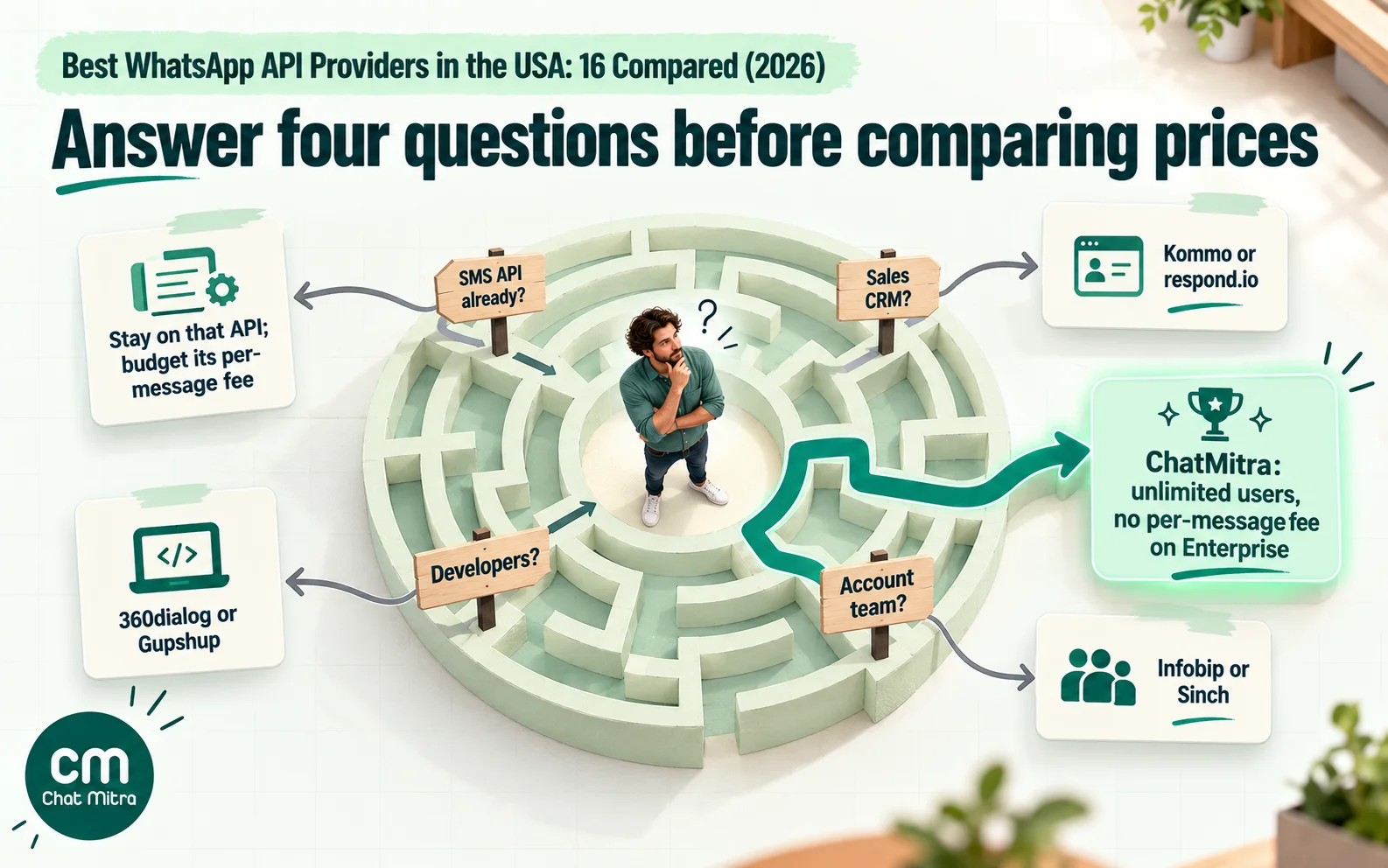
| If you… | Consider |
|---|---|
| Need a shared inbox, order updates and support at Meta’s rates on a small budget | ChatMitra (YCloud or Chakra for very small teams) |
| Already send SMS or voice through Twilio, Telnyx or Vonage | Stay with that API for WhatsApp, and budget for its per-message fee |
| Run sales pipelines and want WhatsApp inside a CRM | Kommo or respond.io |
| Have developers who want raw API access at Meta’s price | 360dialog or Gupshup |
| Are a bank, airline or national retailer with an account team | Infobip or Sinch |
Growing a US audience without marketing templates
Since you can’t broadcast promotions to US numbers, US WhatsApp growth comes from customers who message you first:
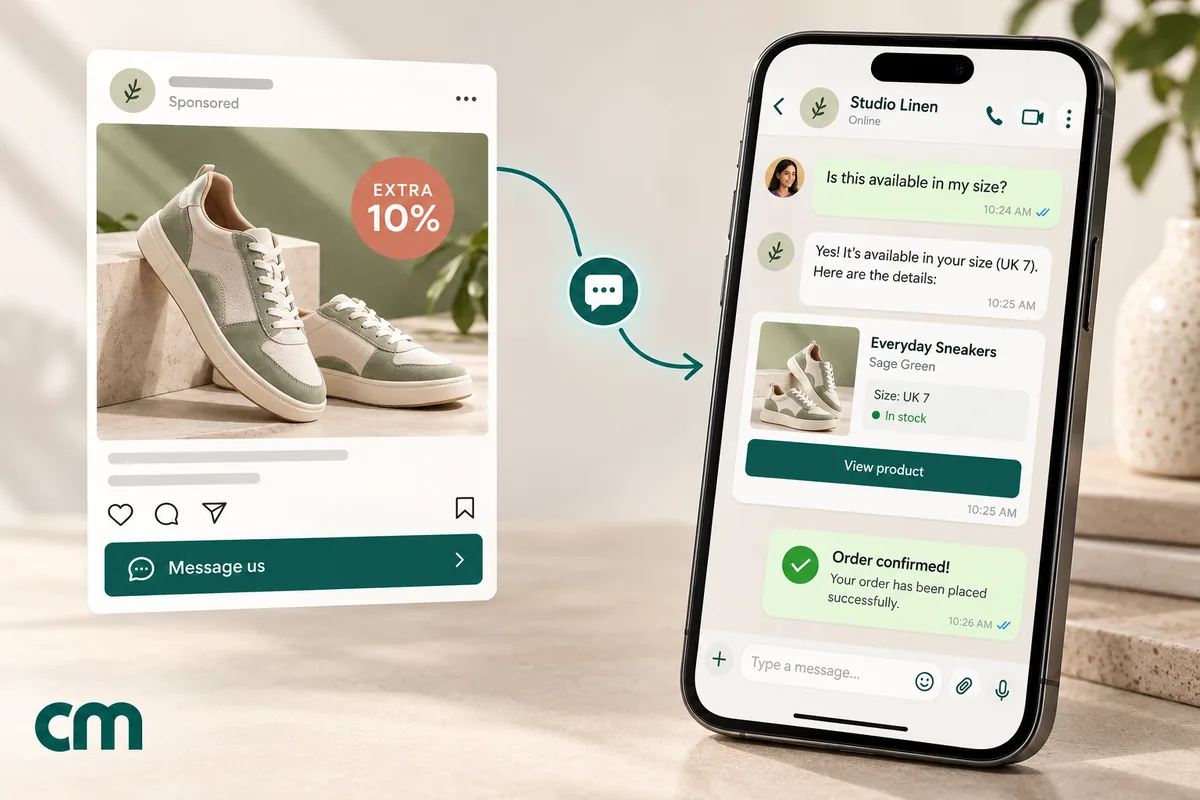
- Click-to-WhatsApp ads. A customer who taps the ad and gets your reply within 24 hours opens a 72-hour window in which nothing is charged. It’s the main route for promotions to US shoppers; our Click-to-WhatsApp Black Friday guide covers set-up and offers.
- “Chat with us” entry points. WhatsApp buttons on product pages, checkout and order emails, plus QR codes on packaging and in stores.
- Useful transactional messages. Order and delivery updates, appointment reminders and receipts on WhatsApp give customers a reason to keep the chat; see our guides to order confirmation messages and reminder messages.
- Fast replies. Answering inside the 24-hour window keeps the conversation free up to 1,000 replies a month per number and cheap after that.
Keep utility templates clean. Adding a coupon to a delivery update turns it into a marketing template, which won’t be delivered to a US customer at all. Keep promotions for the ad window or for markets where marketing is delivered.
Consent and compliance in the US
The Telephone Consumer Protection Act is the law US marketers know from SMS. The FCC’s rules (47 CFR 64.1200) bar autodialed telemarketing to mobile numbers without the recipient’s prior express written consent and let people revoke consent “by using any reasonable method”. The FCC treats text messages as calls; how those rules apply to app-based messaging such as WhatsApp hasn’t been clearly settled. Our WhatsApp vs SMS guide covers TCPA consent and 10DLC registration in more detail.
WhatsApp’s own policy is stricter than the uncertainty: every business-initiated message needs opt-in, and opt-outs must be honoured. Record when and where each customer agreed, say “WhatsApp” in the consent wording, and stop immediately when someone asks. Our WhatsApp opt-in guide covers collection methods. This is general information, not legal advice.
Templates for US customers: en_US and Spanish
- Use
en_USfor American spelling and date formats (“Your order ships 10/15” reads correctly only in the US). Meta also accepts plainen. - Add Spanish under the same template name if you serve Spanish-speaking customers.
esis general Spanish andes_MXsuits customers of Mexican origin. Meta reviews each language separately. - Use the right category. Delivery updates, payment receipts and appointment reminders are utility; sign-in codes are authentication. Anything promotional is marketing and won’t reach US numbers.
- Put tracking links and order numbers in buttons or at the end of a line, so the message stays readable on small screens.
How to get the WhatsApp Business API in the USA: 6 steps
- Set up a Meta business portfolio at business.facebook.com with your legal business name, address and website as registered with your state.
- Choose a number that can receive a verification SMS or call. A landline works. If it already runs the WhatsApp Business app, use coexistence to keep both.
- Connect through your provider’s Embedded Signup and add a payment method in Meta’s Billing Hub, or fund the provider’s wallet.
- Verify your business. New portfolios reach 250 unique customers per 24 hours with business-initiated messages; verification, or 2,000 good-quality template deliveries in 30 days, raises that to 2,000. Our messaging limits guide explains the tiers.
- Create utility and authentication templates in
en_US(andesif needed), and keep promotional copy out of them. - Add entry points and Click-to-WhatsApp ads so US customers can start conversations.
Verification usually takes longest. See how to get the WhatsApp API for the full process.
Test a provider in one week before you commit
Most providers offer a free plan or trial. Use it to check the things a pricing page can’t show:
- Day 1: send a utility template to your own US number. Check delivery, the charge in Meta’s Billing Hub or the provider’s wallet, and any per-message line the provider adds.
- Day 2: try a marketing template to a US test number. See whether the provider blocks it before sending or lets it fail with error 131049, and whether anything is billed.
- Day 3: reply from the test phone and answer in the inbox. Confirm inbound messages carry no hidden fee and that every agent can see the thread.
- Day 4: run a Click-to-WhatsApp test ad with a small budget and confirm the conversation lands in the inbox, tagged as ad-sourced.
- Day 5: raise a support ticket during your business hours and time the first human reply.
- Day 6: export your contacts and templates to make sure you can leave cleanly.
Two hours of testing usually settles a choice that a feature table can’t.
Eight questions to ask a US provider
- What do you charge per message, inbound and outbound, on top of Meta’s rate?
- Is your US rate sheet per message and current for 1 October 2026?
- How do you handle a marketing template sent to a US number: blocked before sending, or failed and billed?
- How many users and template messages does the plan include, and what happens past the cap?
- Do your service-reply charges follow Meta’s 1,000 free per number?
- Can I run Click-to-WhatsApp ad conversations in your inbox?
- What hours does support cover in US time zones?
- Is there a minimum term, and can I move my number if I leave?
Common mistakes
- Planning US promotional broadcasts. They won’t be delivered; plan ad-led conversations instead.
- Ignoring the per-message fee. At $0.0034 per message, a $0.005 fee is the biggest line on your bill.
- Slipping offers into utility templates. The message becomes marketing and fails for US customers.
- Forgetting service charges. Replies beyond 1,000 a month per number cost $0.0034 each since October.
- Choosing a per-seat plan for a support team. Seat prices add up quickly when every agent needs access.
Summary
WhatsApp in the US is a transactional and conversational channel: Meta doesn’t deliver marketing templates to US numbers, and everything else costs $0.0034 a message, with 1,000 service replies free each month. With Meta’s charge that low, provider fees decide what you pay. For most US small and mid-sized businesses, ChatMitra Enterprise gives unlimited users and no per-message fee for about $26 a month, within a dollar of the cheapest multi-seat option in our worked month. Choose Twilio, Telnyx or Vonage if you’re already on their APIs, Kommo for a CRM, 360dialog or Gupshup for raw API access, and Infobip or Sinch for an enterprise contract.
Selling beyond the US? See our India, Mexico, UK and Saudi Arabia comparisons, WhatsApp Cloud API pricing, or ChatMitra’s plans.