Disclosure
ChatMitra is a WhatsApp platform, so this guide puts WhatsApp first and says why. The other ten channels are described from their owners' own documentation, checked on 15 October 2026. ChatMitra doesn't send SMS, RCS, Messenger, Instagram or Telegram messages.
The business messaging apps worth knowing in 2026 are the ones your customers already open every day: WhatsApp, SMS, RCS, Facebook Messenger, Instagram Direct, Telegram and Apple Messages for Business, plus Viber, LINE, WeChat and KakaoTalk in the markets where they dominate. For most businesses in India, WhatsApp should be the main channel, because it combines reach, two-way conversation and a published price per message; SMS remains the fallback. The right mix depends on three things: where your customers are, whether you need to start conversations or only answer them, and what each message costs.
Looking for team chat, such as Slack, Microsoft Teams or Google Chat? Those are workplace tools for colleagues. This guide is about channels for talking to customers.
Key takeaways
- WhatsApp comes first for most businesses selling in India and much of Asia, Africa, Latin America and Europe: more than 3 billion monthly users, business-initiated templates, and a public rate card.
- Who may start the chat decides more than features do. Telegram bots, Apple Messages for Business and Instagram DMs can only answer.
- Pricing models differ completely. WhatsApp charges per message by category and country; SMS per 160-character segment; RCS per message or per conversation at carrier rates.
- Every channel needs consent, but the rules differ: Meta's opt-in policy, TRAI's DLT system in India, and TCPA and 10DLC in the US.
- Two channels beat ten. A primary conversational channel plus a fallback covers most customers without splitting your team's attention.
Customer messaging apps vs team chat apps
The phrase “business messaging app” covers two different products, and search results mix them up.
- Customer messaging channels are consumer apps, such as WhatsApp, Messenger and Telegram, plus the phone’s own SMS and RCS, that a business joins through a business account or an API. The customer uses the app they already have. The business uses a dashboard, an inbox tool or its own software.
- Team chat apps such as Slack, Microsoft Teams, Google Chat and Zoho Cliq are where employees talk to each other. Customers don’t install them.
This guide covers only the first group. The question it answers is: which channels should a business use to talk to customers, and on what terms?
The 11 apps at a glance
| # | App | Best for | Can the business start the chat? | How business messages are priced |
|---|---|---|---|---|
| 1 | WhatsApp (via ChatMitra) | Sales, support, updates and marketing in India and most WhatsApp-first markets | Yes, with an approved template to opted-in customers | Per delivered message, by category and country, on Meta's public rate card |
| 2 | SMS | One-time passwords and alerts that must reach any phone | Yes, from a registered sender | Per 160-character segment, at your provider's rate |
| 3 | RCS for Business | Rich messages in the phone's built-in Messages app | Yes, through an approved agent, within carrier rules | Per message or per conversation, at carrier rates |
| 4 | Facebook Messenger | Customers who find you on Facebook | Mostly no: replies within 24 hours, with limited exceptions | No published per-reply rate; marketing messages run through an ad account |
| 5 | Instagram Direct | Brands that sell through Instagram | No: replies within 24 hours (7 days for human agents) | No published per-message rate |
| 6 | Telegram | Communities, channels and bots | No: the user must message the bot first | Free for bots, with a paid option for very fast broadcasts |
| 7 | Apple Messages for Business | Support for iPhone users from your app or website | No: the customer starts every conversation | Free from Apple; your messaging provider may charge |
| 8 | Viber | Parts of Eastern Europe and Southeast Asia | Yes, through approved Viber partners | Per delivered message, through partners |
| 9 | LINE | Japan, Thailand and Taiwan | Yes, to friends of your Official Account | Monthly plans with message allowances |
| 10 | Customers in China | Limited: to followers of an Official Account | Set by Tencent's account rules and partners; check current terms | |
| 11 | KakaoTalk | Customers in South Korea | Yes, informational AlimTalk messages through official dealers | Per message, through dealers |
Two channels you’ll still see in older lists are gone or unusable for this job. Google Business Messages shut down on 31 July 2024, and Google now points businesses to RCS. Signal has no business messaging programme that we could find.
1. WhatsApp: the default for most businesses
WhatsApp is the largest of the group. Meta’s chief executive said on 30 April 2025 that it has more than 3 billion monthly active users, and on 28 January 2026 that it has more than 2 billion daily actives. Meta reported 200 million monthly users of the WhatsApp Business app in July 2023 (more figures in our WhatsApp statistics roundup). It’s widely used for business messaging across India, Indonesia, Brazil, Mexico, the Gulf and much of Africa and Europe.
There are two ways in:
- The WhatsApp Business app. It’s free and runs on one phone plus linked devices. It suits a sole trader. There’s no automation beyond greeting and away messages, and no API.
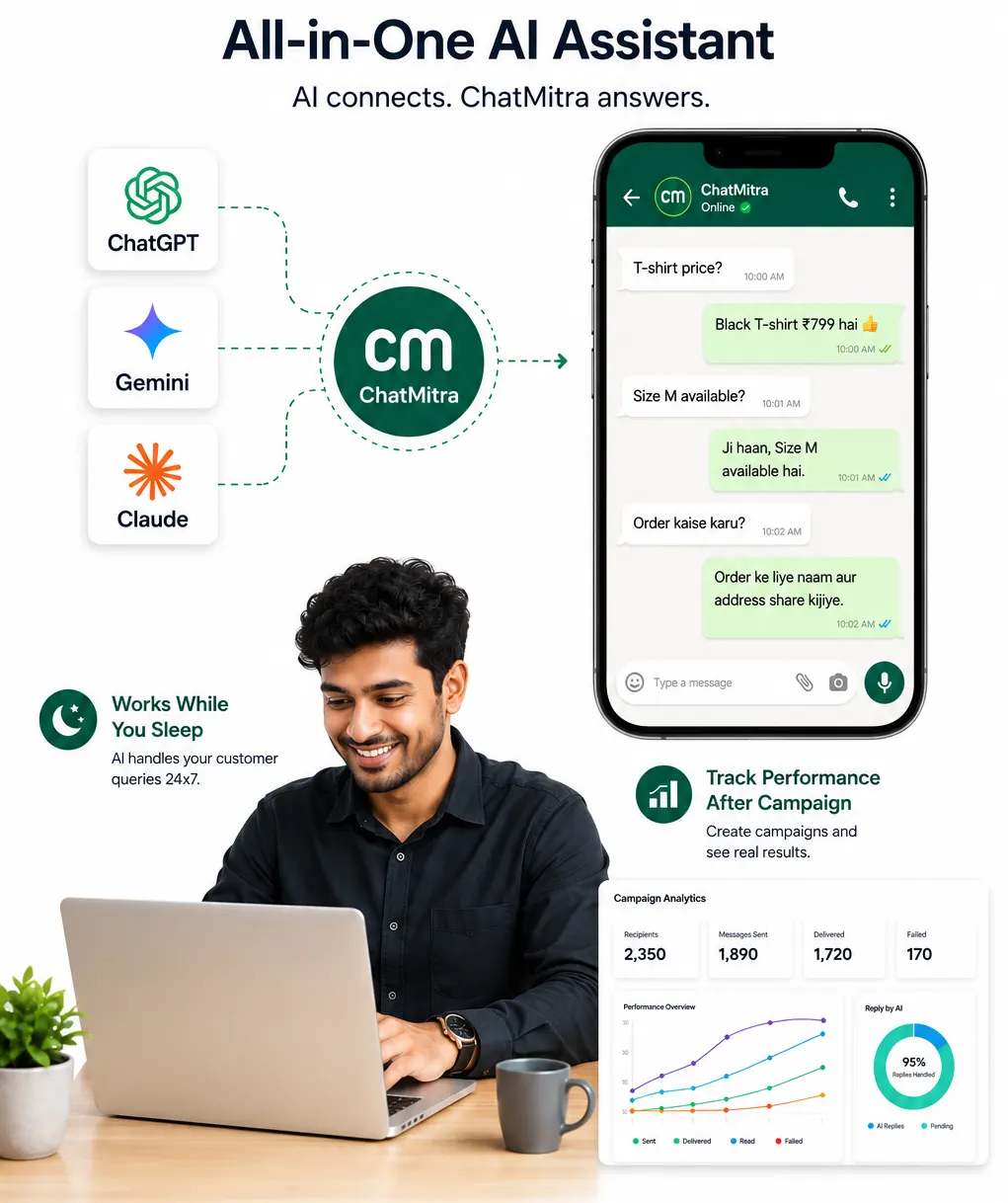
- The WhatsApp Business Platform (API). You reach it through a provider such as ChatMitra. It adds a shared inbox, chatbots, broadcasts to opted-in lists, approved templates, integrations and reporting.
Who starts the conversation. When a customer messages you, a 24-hour customer service window opens, and inside it you can reply freely. Outside that window, or to start a conversation, you send a template Meta has approved, in one of four categories: marketing, utility, authentication or service.
Cost. Since 1 July 2025 Meta charges per delivered message, by category and the recipient’s country. India’s rates since 1 October 2026 are ₹0.8631 per marketing message and ₹0.1150 per utility or authentication message. Each business number gets 1,000 free service messages a month. A customer who arrives from a Click-to-WhatsApp ad on the WhatsApp phone app opens a free entry point window when you reply within 24 hours; it can last up to 7 days, and Meta charges nothing for your messages to them while it’s open. Our cost per message guide has the full card.
Limits to know.
- Meta requires opt-in before you send templates.
- It caps how many marketing templates one person receives.
- It doesn’t currently deliver marketing templates to US phone numbers.
- New accounts start with a cap on how many people they can message in 24 hours, which rises as you send well-rated messages.
2. SMS: the universal fallback
SMS needs no app, no data connection and no account. If a phone has a number, it can receive a text. That makes SMS the safest channel for one-time passwords, delivery alerts and anyone who doesn’t use WhatsApp.
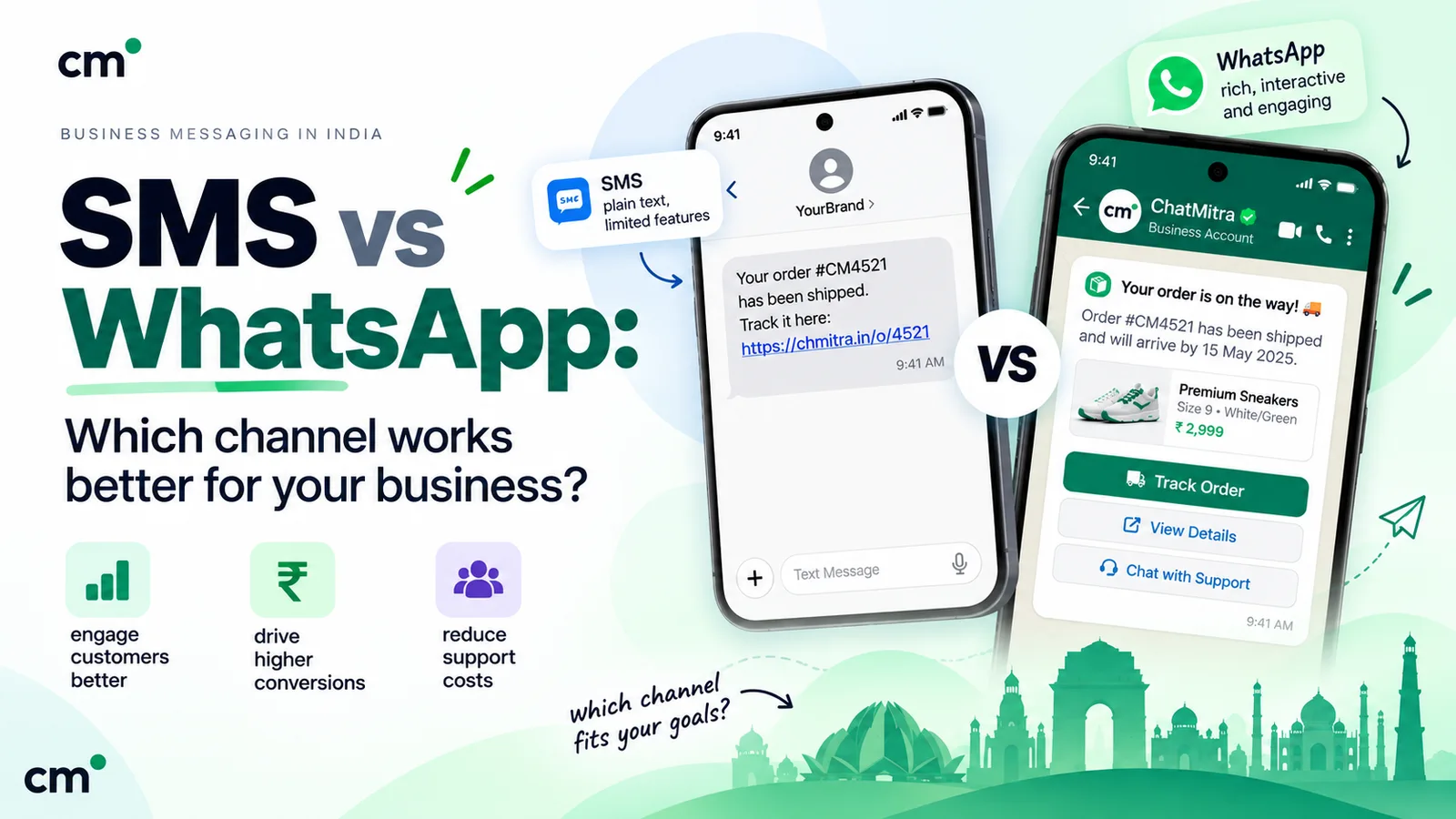
What you give up is everything else. There are no buttons, no rich media and no read receipts, and replies are awkward unless you use a two-way number. Pricing is per segment: 160 characters in the standard alphabet, or 70 if the message contains Hindi, emoji or other Unicode. A long Hindi message can cost three or four segments.
Registration. In India, commercial SMS runs on TRAI’s DLT system: you register your business, your sender headers and every content template with an operator before you can send. In the US, texting from an ordinary 10-digit number requires 10DLC brand and campaign registration, and marketing texts need consent under the TCPA. Our WhatsApp vs SMS guide compares the two in detail.
3. RCS for Business: rich messages without an app
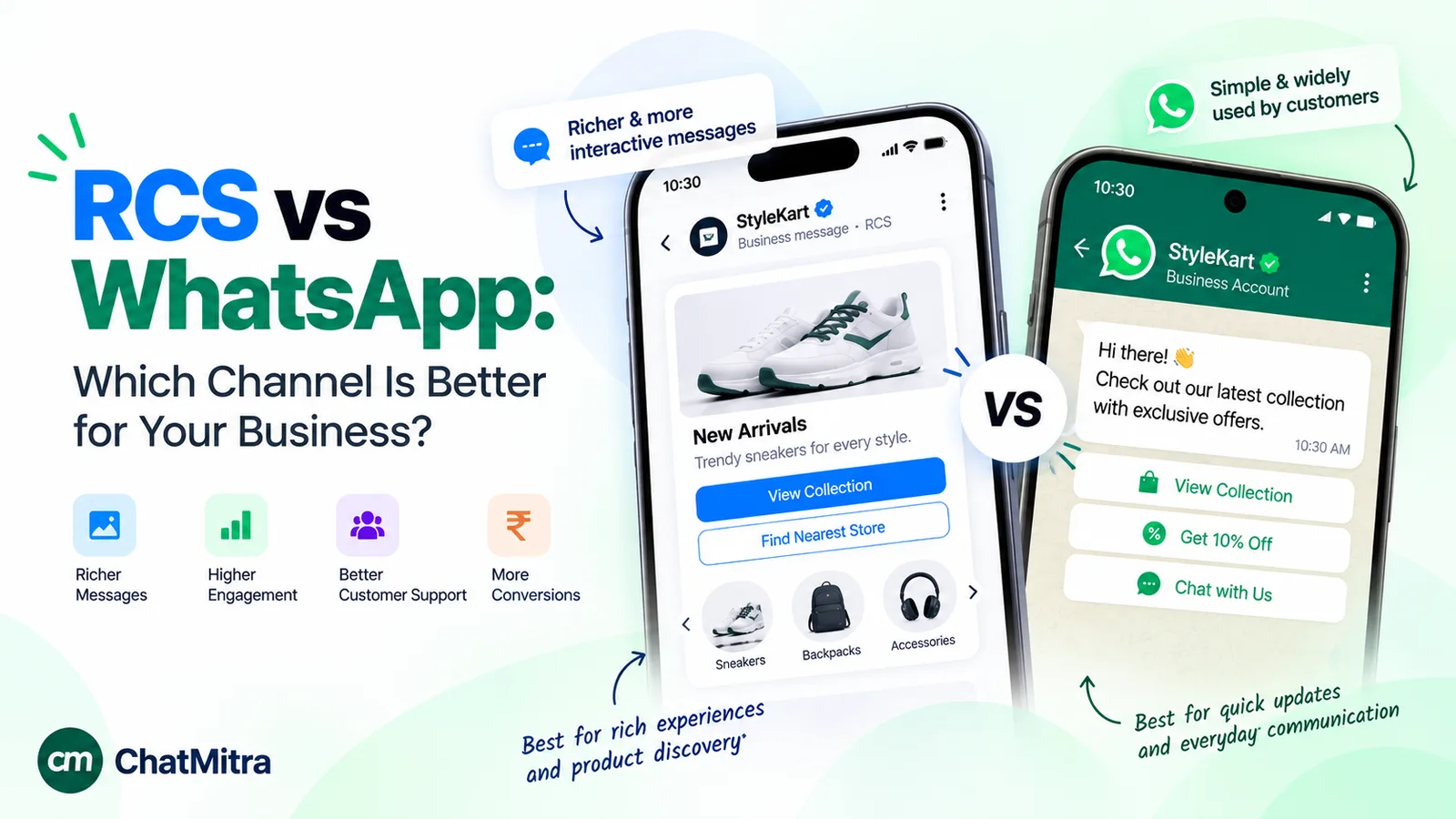
RCS (Rich Communication Services) upgrades SMS inside the phone’s built-in Messages app: images, carousels, suggested replies, read receipts and a verified sender name and logo. Google says more than a billion RCS messages are sent every day in the US alone.
- Reach depends on the phone and carrier. Most Android phones support it through Google Messages. iPhones need iOS 18 and a carrier that supports RCS on iPhone, so coverage varies by country and network. Messages can fall back to SMS when RCS isn’t available.
- The business starts the conversation, through an RCS agent that Google and the carriers approve. In India, Google caps how many first messages a promotional agent can send each person in a rolling 28 days, and business-initiated RCS is allowed only between 7 am and 10 pm.
- Billing changed in November 2025. Google merged the old “basic” and “single” message types into one non-conversational category billed per message. Conversational agents are billed per 24-hour conversation. Carriers decide the actual prices, and Google publishes no rate card.
See RCS vs WhatsApp for India’s carrier situation and how to compare quotes.
4. Facebook Messenger: for customers who start on Facebook
Messenger works well when customers find you through a Facebook Page or a Click-to-Messenger ad. Businesses connect through Meta’s Messenger Platform, usually via an inbox tool.
- The window. After a customer messages you, you have 24 hours to reply. When the first message comes from a Click-to-Messenger ad, Meta says the window can last up to 7 days. A Human Agent tag lets a person (not a bot) reply within 7 days.
- Message tags are shrinking. From 27 April 2026, requests using the old Confirmed Event Update, Account Update and Post-Purchase Update tags return an error. Meta tells developers to use utility templates or its Marketing Messages API instead.
- Marketing is paid through ads. Marketing messages on Messenger are sent as campaigns from an ad account, with budgets and frequency caps.
5. Instagram Direct: for brands customers discover on Instagram
Instagram is where many fashion, beauty, food and lifestyle brands are discovered, so its DMs fill up with “price?” and “is this available?” messages. Businesses use the Instagram messaging API with a professional (business or creator) account, and since Meta’s update the API works without a linked Facebook Page.
The same window rules apply as on Messenger: 24 hours after the customer’s message, up to 7 days after a Click-to-Direct ad, and a human_agent tag for replies within 7 days. You can’t start a conversation with someone who hasn’t messaged you. A common pattern is to answer the first question on Instagram and then invite the customer to WhatsApp for order updates.
6. Telegram: communities and bots, on the user’s terms
Telegram passed 1 billion monthly active users in March 2025, according to its founder. It’s popular for channels (one-to-many broadcasts), large groups and bots.
- Bots can’t start conversations. Telegram’s documentation says a user must add the bot to a group or send it a message first. Customers find a bot by its username or a t.me link.
- Bots are free to run, up to about 30 messages a second for broadcasts. Faster broadcasts, up to 1,000 a second, cost 0.1 Telegram Stars per message above the free rate, and a bot needs at least 100,000 Stars and 100,000 monthly users to switch them on.
- Telegram Business adds opening hours, quick replies, away messages and chatbot connections to a personal account, free for Premium subscribers.
Telegram suits communities, creators and education audiences that already gather there. Because a bot can only answer people who found it, it works best alongside a channel that lets you send order updates and reminders.
7. Apple Messages for Business: support for iPhone users
Apple Messages for Business lets customers chat with you in the iPhone’s Messages app by tapping a Messages button on your website, app or listing.
- Customers always start. Apple’s rules say a customer starts each conversation, and once they end it the business must stop messaging and wait for them to start a new one.
- Access is through an approved messaging service provider. You register with Apple and connect through one of its approved providers.
- Apple charges nothing, though your provider may.
It’s a support channel, not a marketing one, and only useful where a large share of your customers use iPhones.
8. Viber: strong in specific regions
Rakuten Viber says hundreds of millions of people use it each month. Its strength is regional: parts of Eastern Europe, the Balkans, Greece and Southeast Asia. Businesses send Viber Business Messages through approved partners and, by Viber’s own description, pay only for messages delivered. Partner documentation describes a 24-hour session window after a customer writes, billed as a flat session fee. Consider it only if your customers are in a Viber market; elsewhere it adds little.
9. LINE: essential in Japan, Thailand and Taiwan
LINE’s operator announced in January 2026 that LINE had passed 100 million monthly users in Japan. Businesses use a LINE Official Account, which customers add as a friend. Pricing in Japan is by monthly plan:
- the free Communication plan includes 200 messages;
- the Light plan is ¥5,000 for 5,000 messages;
- the Standard plan is ¥15,000 for 30,000 messages, with extra messages from about ¥3 each.
If you sell into Japan, Thailand or Taiwan, plan around LINE first.
10. WeChat: the only option for China
Tencent reported 1.439 billion combined monthly users of Weixin and WeChat at 30 June 2026. WhatsApp and most Meta products aren’t available in mainland China, so businesses selling to Chinese customers use WeChat Official Accounts, Mini Programs and WeChat Pay. Expect Tencent’s account verification, and check whether the features you need require a Chinese business entity or a local partner.
11. KakaoTalk: the default in South Korea
KakaoTalk is South Korea’s dominant messenger. Businesses use Kakao channels for marketing to followers and AlimTalk for informational messages such as orders, payments and deliveries. Kakao recommends AlimTalk for those messages and says it costs less than SMS. AlimTalk is sold only through Kakao’s official dealers, so prices come from them. Kakao reported that its business messaging revenue grew 20% year on year in Q2 2026.
Why WhatsApp through ChatMitra comes first
For a business selling in India, and in most WhatsApp-first markets, WhatsApp combines what the other ten offer separately: a customer base that checks it daily, the right to start conversations with approved templates, rich two-way chat and a public price per message. ChatMitra is how a business runs it as a team.
| ChatMitra advantage | What it means | How other routes compare |
|---|---|---|
| Free Starter plan that can broadcast | Broadcasts, scheduling, retargeting and reports without a subscription | The WhatsApp Business app has no API and is built for one phone plus linked devices |
| Unlimited team members on every plan | Sales, support and branch staff share one WhatsApp inbox with no seat fee | Many inbox tools price per seat |
| Meta's rates at cost, billed by Meta | You pay Meta's own card, such as ₹0.1150 per utility message in India | SMS and RCS rates are set by providers and carriers, with no public card |
| AI chatbot on Pro | Pro (₹999 a month) includes the AI chatbot using your own AI key | Check whether AI is an add-on in other tools |
| No per-conversation fee on Enterprise | Enterprise (₹2,499 a month) removes ChatMitra's ₹0.20 per-conversation fee | Starter and Pro add ₹0.20 per conversation (once per customer per 24 hours) |
Good to know: ChatMitra handles WhatsApp only. If you need Instagram, Messenger or SMS in the same inbox, you’ll need another tool for those channels.
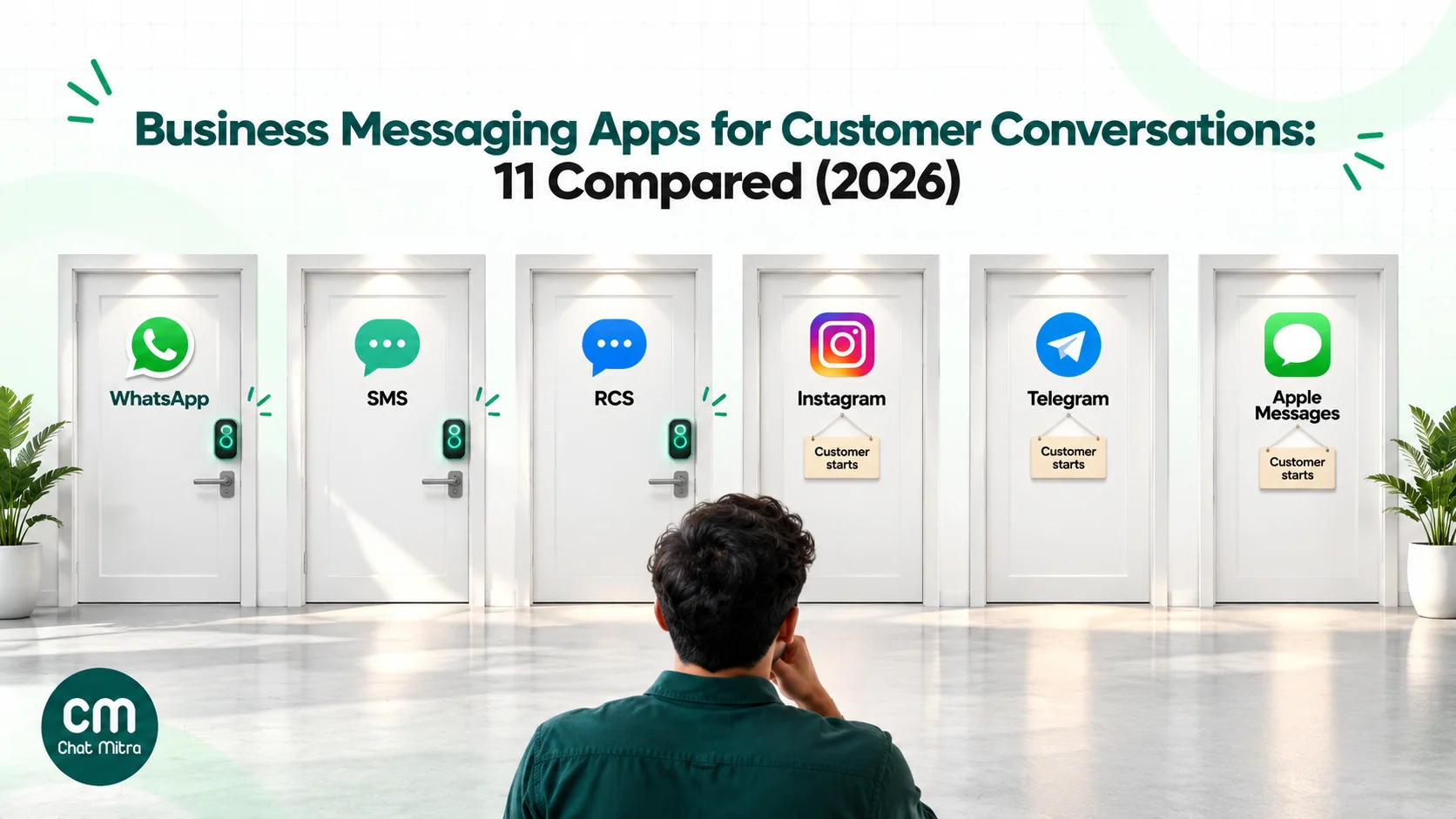
Who can start the conversation: the rule that decides most choices
Before comparing features, decide what you need the channel for. If you need to send order updates, reminders or campaigns to people who haven’t just messaged you, only some channels allow it.
| Channel | Business can message first? | After the customer writes |
|---|---|---|
| Yes, approved template to opted-in contacts | Free-form replies for 24 hours | |
| SMS | Yes, registered sender and (India) DLT template | Two-way only with a two-way number |
| RCS | Yes, approved agent; India caps and 7 am–10 pm window | Conversation billed per 24 hours on conversational agents |
| Messenger | Limited: marketing messages bought through an ad account | 24 hours; up to 7 days after a Click-to-Messenger ad; 7-day Human Agent tag |
| No | 24 hours; up to 7 days after a Click-to-Direct ad; 7-day human_agent tag | |
| Telegram bot | No | Bot can message the user afterwards |
| Apple Messages for Business | No | Until the customer ends the conversation |
What a message costs, channel by channel
No two channels price the same way, which makes “cheapest” a trap. Compare the cost of the outcome, such as a delivered order update or a reply to an enquiry, not the headline rate.
| Channel | Pricing model | Published example |
|---|---|---|
| Per delivered template, by category and recipient country; 1,000 free service messages per number a month | India: ₹0.8631 marketing, ₹0.1150 utility and authentication (from 1 Oct 2026) | |
| SMS | Per 160-character (or 70 Unicode) segment, plus registration | No single official rate; quotes vary by provider and route |
| RCS | Per message (non-conversational) or per 24-hour conversation | Carrier-set; Google publishes no rate card |
| Messenger and Instagram | Replies have no published rate; Messenger marketing is bought through an ad account | No public per-message card |
| Telegram | Free for bots; paid broadcasts above 30 a second | 0.1 Stars per message above the free rate |
| Apple Messages for Business | Free from Apple; provider fees | Ask your provider |
| LINE (Japan) | Monthly plan with message allowance | ¥5,000 for 5,000; ¥15,000 for 30,000 |
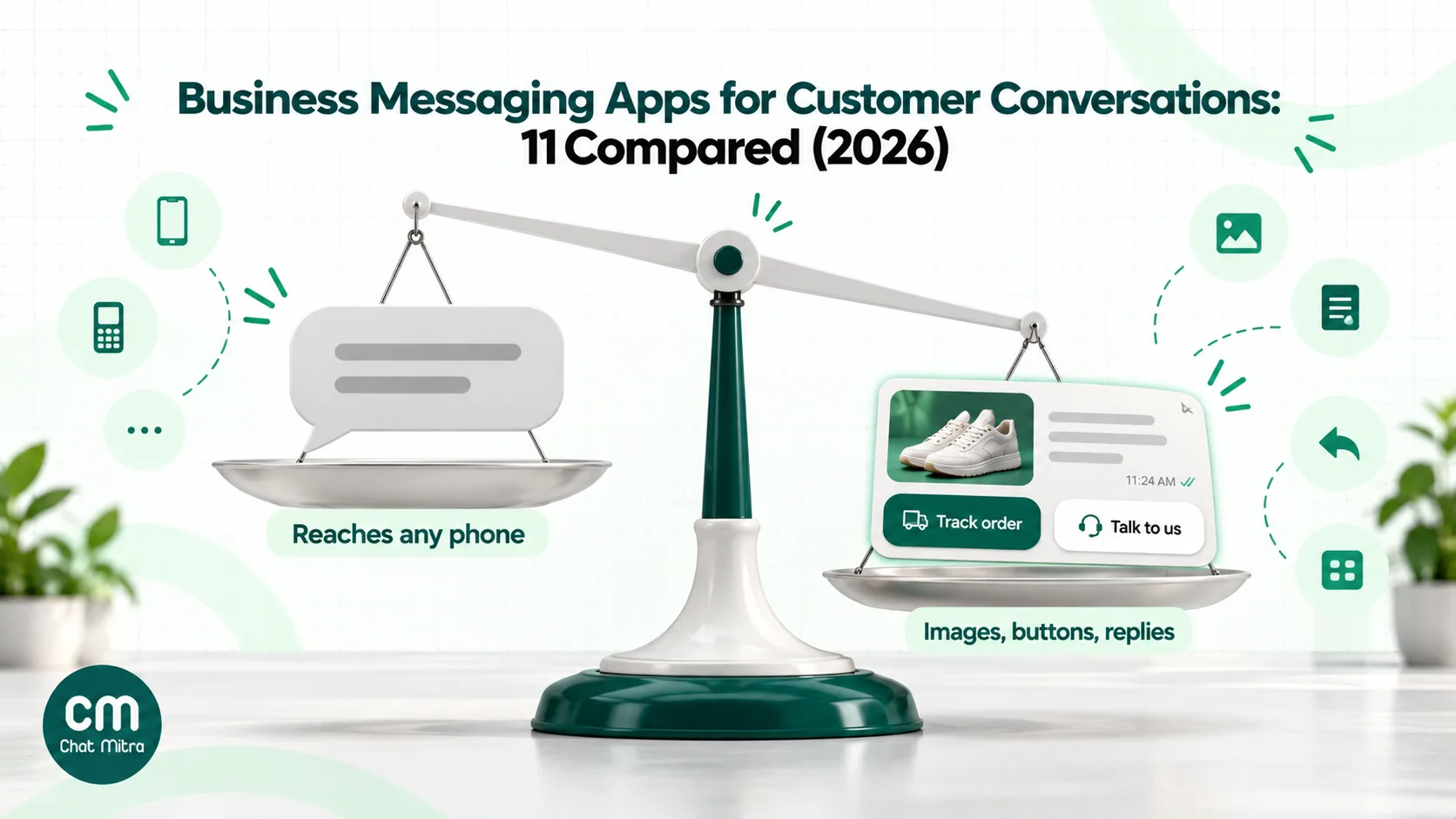
A worked comparison for India. A store sends 10,000 order-shipped updates a month. On WhatsApp, as utility templates, Meta’s charge is 10,000 × ₹0.1150 = ₹1,150, and each message can carry a tracking button, an image and the customer’s reply. On SMS, the same update in English fits one segment, so the cost is 10,000 × your provider’s segment rate plus DLT, and a Hindi version may need two or three segments. On ChatMitra’s Starter or Pro plan, add ₹0.20 per conversation; on Enterprise (₹2,499 a month) there’s no per-conversation fee. Ask your SMS provider for a written rate before comparing.
Consent and opt-in rules
Every customer channel requires permission, and regulators and platforms enforce it differently.
- WhatsApp: Meta’s policy requires opt-in before a business messages someone, and people can block or report a business in one tap. A high block rate lowers your quality rating and messaging limit. Our opt-in guide covers collection methods.
- SMS in India: TRAI’s rules require DLT registration of the sender, headers and templates, and promotional messages must respect the customer’s Do Not Disturb preferences.
- SMS in the US: the TCPA requires consent for marketing texts, and 10-digit senders need 10DLC registration.
- RCS in India: Google limits promotional first messages per person and allows business-initiated messages only between 7 am and 10 pm.
- Messenger and Instagram: outside the reply window you need a permitted tag or Meta’s marketing-message product, which uses opt-in and frequency caps.
- Apple Messages for Business: customer-initiated only, which keeps it consent-based by design.
Whatever the channel, keep a record of when and where each person agreed, and make opting out one tap.
How to choose: six questions
- Where are your customers? Use the channel they already check. In India that’s WhatsApp; in Japan, LINE; in China, WeChat; in Korea, KakaoTalk. Your own data beats any national statistic: look at which channel customers reply on.
- Do you need to start conversations? If you send order updates, reminders or campaigns, choose a channel that lets the business message first: WhatsApp, SMS or RCS.
- What kind of messages? One-time passwords need maximum reach (SMS, or WhatsApp authentication templates). Sales and support need two-way chat. Promotions need rich media and opt-in lists.
- What does an outcome cost? Price the message you actually send, with its category, length and country, and include platform fees.
- Who will answer? A shared inbox, routing and chatbots matter more than the channel once volume grows. Check that your tool supports the channel through its official API.
- What does compliance require? DLT for SMS in India, opt-in for WhatsApp, and the rules of the countries you send to.
A sensible channel mix
Most businesses do best with two channels, not ten:
- India, consumer brands: WhatsApp as the main channel for sales, support and updates; SMS as the fallback for people without WhatsApp; Instagram DMs answered and moved to WhatsApp for orders.
- India, B2B and services: WhatsApp for quotes, follow-ups and reminders; email for contracts and invoices.
- Global ecommerce: WhatsApp where it dominates; SMS (with 10DLC) in the US, where Meta doesn’t deliver WhatsApp marketing templates; Apple Messages for Business if most support contacts come from iPhones.
- Japan, China and Korea: LINE, WeChat or KakaoTalk first; WhatsApp only for international customers.
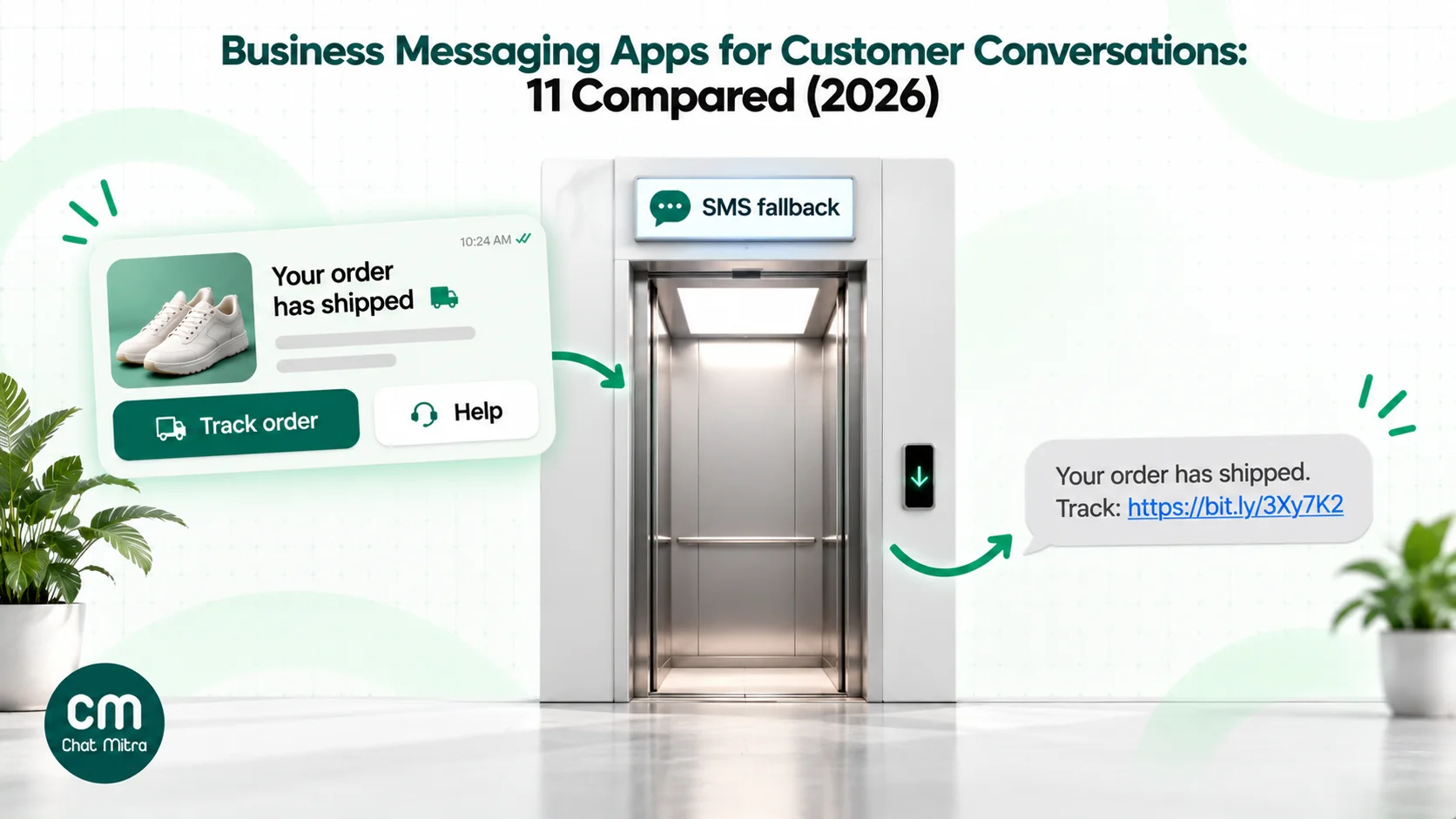
Run the main channel through one shared inbox, decide which messages fall back to which channel and after how long, and measure replies and orders per channel rather than opens.
Common mistakes
- Choosing a channel your customers don’t use because it’s cheaper or newer.
- Expecting to message first on a reply-only channel such as Instagram or a Telegram bot.
- Comparing headline rates instead of the cost of a delivered, useful message.
- Spreading a small team across six inboxes, so nothing is answered quickly.
- Skipping opt-in, which gets numbers blocked and, for SMS, breaks the law.
- Building on a channel that’s being retired. Google Business Messages closed in 2024, and Messenger’s old message tags stopped working in April 2026.
Summary
For businesses talking to customers in India and most WhatsApp-first markets, WhatsApp is the primary business messaging app, with SMS as the fallback and Instagram or Messenger where customers discover you. RCS is worth watching as carrier support grows, Apple Messages for Business suits iPhone-heavy support, and LINE, WeChat and KakaoTalk are essential only in their home markets. Pick by where customers are and who needs to start the conversation, then compare the cost of each message you’ll actually send.
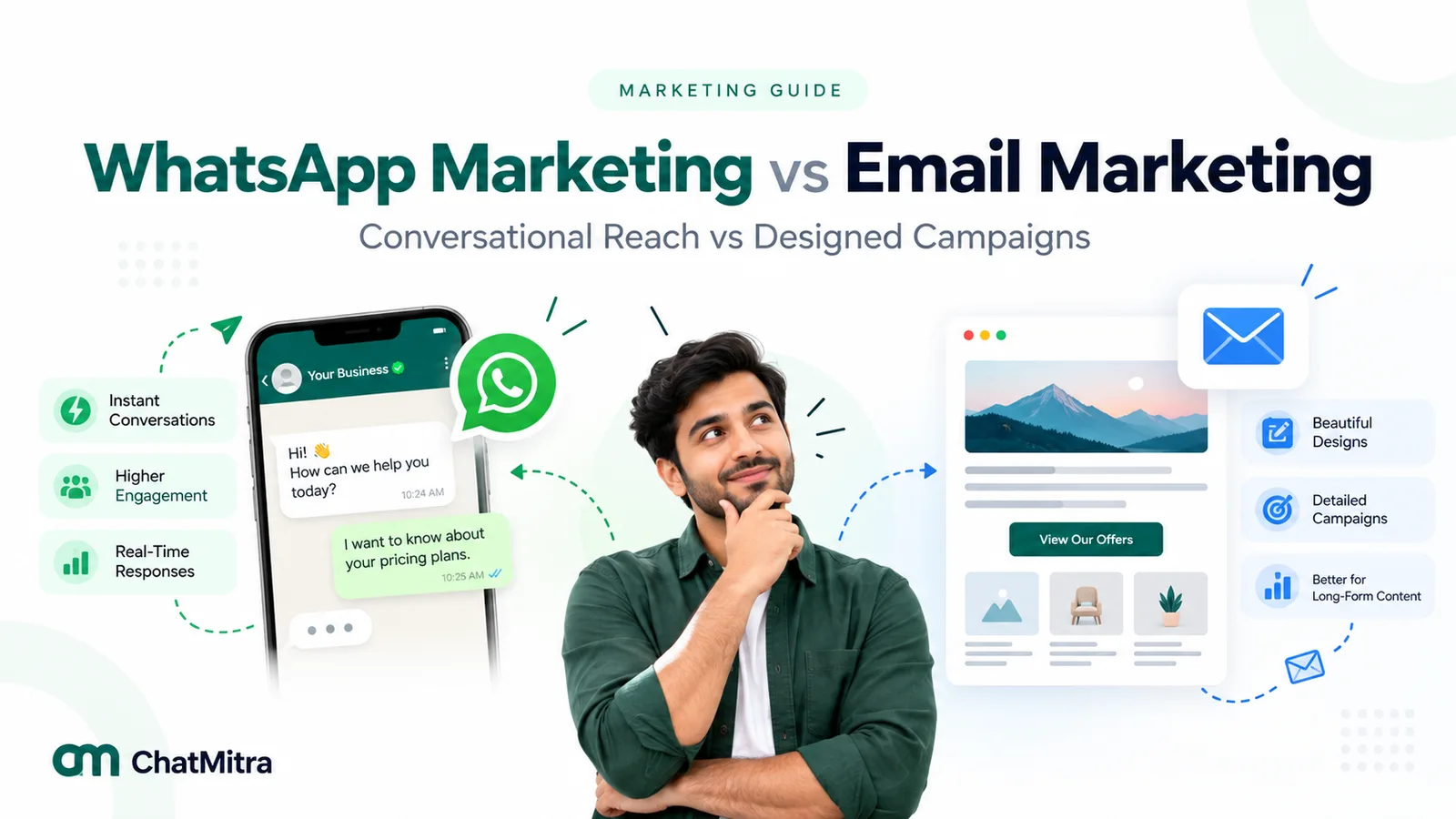
To get started on WhatsApp, see how to get the WhatsApp API, compare WhatsApp with email, or start free with ChatMitra.