Click-to-WhatsApp ads for healthcare are Facebook and Instagram ads that open a WhatsApp chat with a clinic, hospital or lab instead of sending patients to a website. They suit healthcare because most patients have a question before they book. They also carry the strictest rules of any ad category, and in India those rules changed on 6 October 2026, when the National Medical Commission (NMC) issued advertising guidelines that name WhatsApp as an advertising medium.
This guide is for practice managers, hospital marketing teams, labs and their agencies. It covers the rules, a compliant setup, the first five minutes of the chat, and the cost. For WhatsApp ads in general, see our WhatsApp ads guide.
Using ChatMitra? You create the ad in Meta Ads Manager; ChatMitra runs the chat that follows. Every plan sends an automatic welcome message to new contacts and tags them, so night-time enquiries get an answer and a label. On Pro you add keyword replies matched to each ad, an away message, an AI chatbot for timings and fees, and webhooks that carry each chat’s ad details to your own systems. Jump to running healthcare ads with ChatMitra.
This article explains rules for general information. It isn’t legal or medical advice. Check your own situation with your State Medical Council, your hospital’s legal team or a lawyer.
How a Click-to-WhatsApp ad works for a clinic
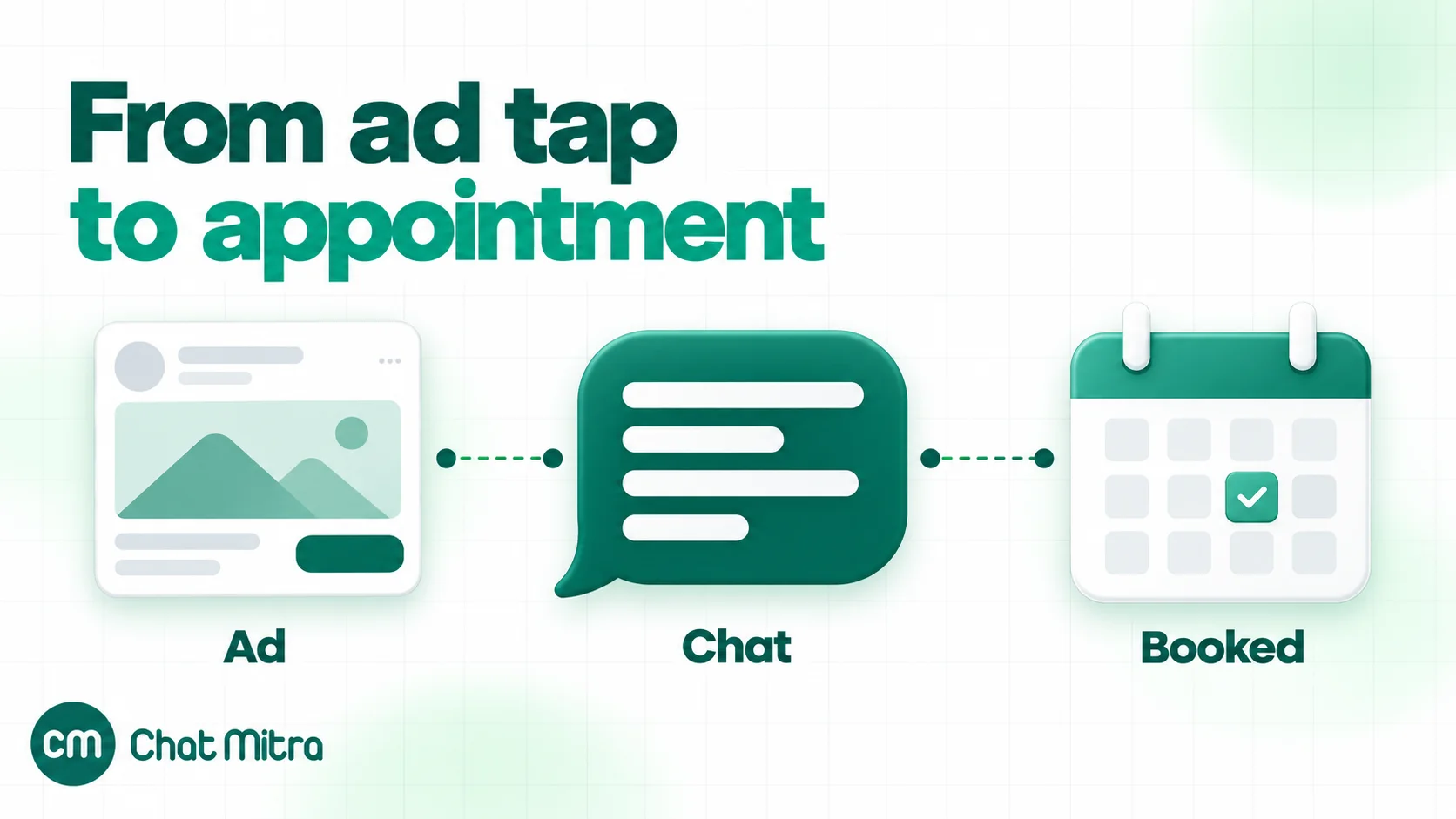
The patient’s side takes about ten seconds:
- They see your ad on Facebook or Instagram: “Dental check-up and cleaning, Baner, Pune. Mon–Sat, 9 am–8 pm. ₹600.” The button says Send WhatsApp message.
- They tap it. WhatsApp opens a chat with your clinic’s number, with a message already typed: “Hi, I’d like to book a dental check-up.”
- They press send. Your team, or an automatic reply, answers. The conversation that follows ends in a booking, a question passed to a doctor, or nothing.
You choose the objective (Engagement, Leads, Sales or Traffic), the creative (image, video, carousel or slideshow) and the first message: a prefilled text, a greeting or ice breakers, tappable questions such as “Timings and fees” (Meta: Click-to-WhatsApp ads).
Why healthcare suits chat better than a landing page
Patients rarely book a dentist or a diagnostic package from an ad alone. They want to know whether the doctor is in on Saturday, whether a fasting test needs an early slot, or what the root canal costs. A form makes them wait for a callback; a chat lets them ask now, often for a parent, in their own language.
Emergencies belong on the phone, and your auto-reply should say so: in India, 112 is the national emergency number and 108 the ambulance service in most states.
The rules that apply before you spend a rupee
Four layers of rules apply: Meta’s ad policies, India’s medical advertising law, WhatsApp’s policies and data protection law. Breaking any one can get an ad rejected, an ad account restricted or a complaint filed with your State Medical Council.
Layer 1: Meta’s advertising standards for health
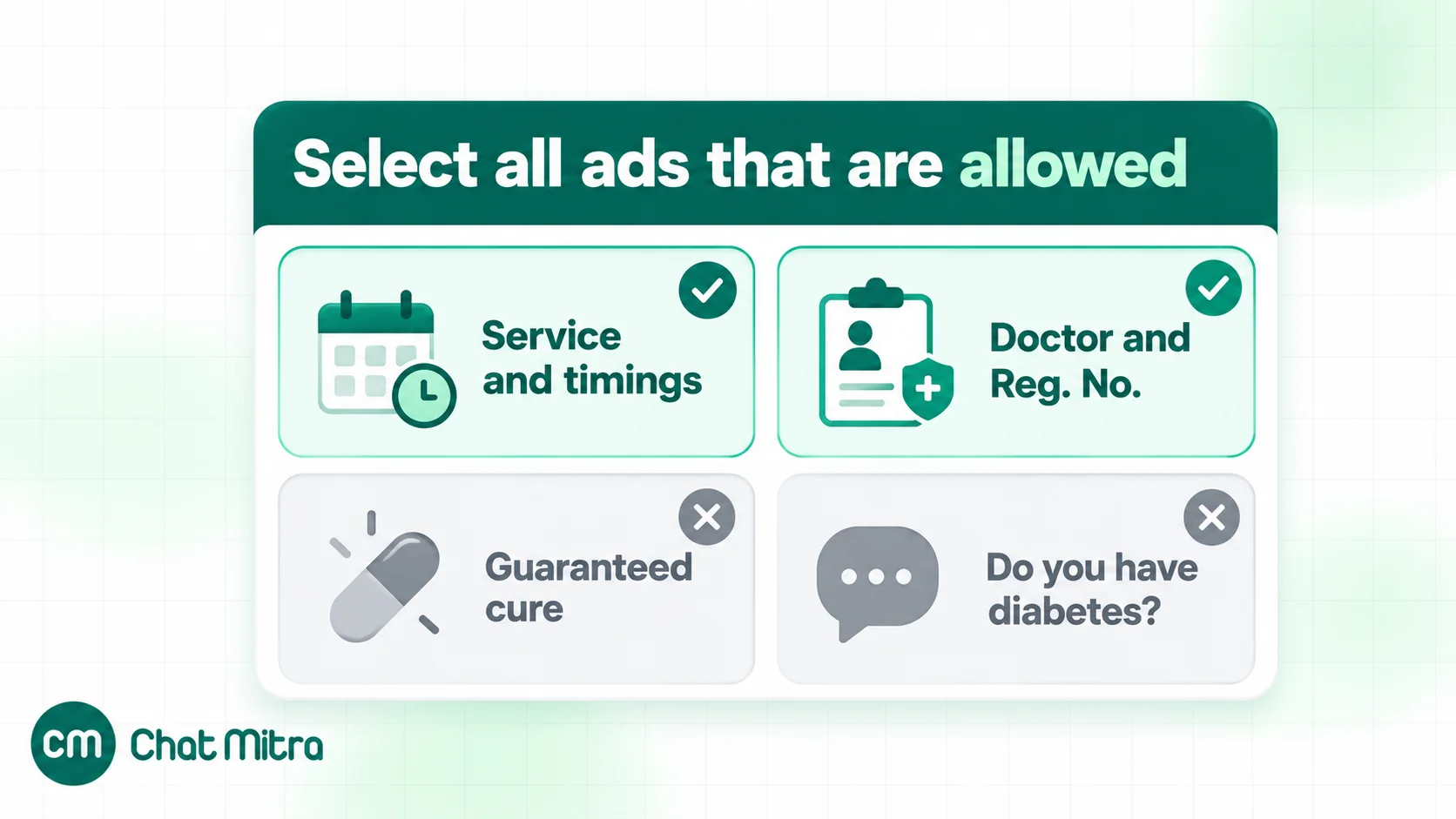
No ads that imply the viewer has a condition. Meta’s personal attributes policy says ads “must not contain content that asserts or implies personal attributes”, including “physical or mental health (including medical conditions)” (Meta: Personal attributes). Meta’s own examples make the line clear:
| Allowed | Not allowed |
|---|---|
| ”New diabetes treatment available" | "Do you have diabetes?" |
| "Depression counseling" | "Depression getting you down? Get help now." |
| "Knee replacement consultations at our Andheri hospital" | "Suffering from knee pain?" |
| "Fertility consultations, Saturday clinic" | "Struggling to get pregnant?” |
The first two rows are Meta’s examples; the last two follow the same rule. The test is simple: describe your service, never the reader.
Age limits and claims. Meta’s health and wellness policy (Meta: Health and wellness) requires that ads for weight-loss products and services, and for cosmetic procedures and surgery, are shown only to people aged 18 or over. Reproductive health ads must also target 18+ and focus on health, not sexual pleasure. The policy bans claims to cure a listed set of conditions, including diabetes, thyroid disease, psoriasis, cancer, HIV, autism, Alzheimer’s and Parkinson’s. Claims about treating or managing symptoms aren’t covered by that ban.
Prescription drugs. Only advertisers certified by LegitScript may advertise prescription drugs, and only to people in the United States, Canada or New Zealand (Meta: Drugs and pharmaceuticals). India isn’t on the list. Over-the-counter medicines must follow local law and can’t target under-18s. Telehealth services can be promoted in general terms.
No WhatsApp Status. Meta’s documentation for ads in Status says that “sensitive verticals (Pharma, Healthcare, and GSI) are excluded from WhatsApp Status delivery” (Meta: Ads in WhatsApp Status). Your Click-to-WhatsApp ads run on Facebook and Instagram feeds, Stories and Reels, not inside WhatsApp’s Updates tab.
No condition-based targeting. Meta removed detailed targeting options linked to health causes in January 2022, with examples such as “Lung cancer awareness”, “World Diabetes Day” and “Chemotherapy” (Meta for Business). Custom audiences and lookalikes that reference specific health conditions are flagged and can’t be used (Meta Business Help).
Limits on what your website can share. If Meta classifies your site as health and wellness (a patient portal, telemedicine platform or pharmacy), it restricts what your pixel can send, including URL paths and custom parameters (Meta Business Help). Trade reports say some health advertisers lost lower-funnel optimisation from January 2025; Meta hasn’t said where. One more reason to send ads to WhatsApp: the conversation is the conversion, and no health data leaves your website.
Layer 2: India’s medical advertising rules
The NMC’s guidelines of 6 October 2026. The NMC’s Ethics and Medical Registration Board issued “Guidelines on Ethical Advertising and Public Communication”, effective immediately (Public Notice R-13014/01/2024-Ethics). They sit on top of the 2002 Code of Ethics Regulations, which still apply because the 2023 regulations were held in abeyance in August 2023. Their definition of “medium of advertisement” includes “messaging platforms (WhatsApp, Telegrams, Facebook etc.)”, “digital marketing campaigns” and “sponsored posts”.
What they say, in the order a clinic runs into it:
- Hospitals may advertise facts. Hospitals and medical institutions “may disseminate factual, objective and verifiable information concerning their name, location, contact details, departments, facilities, equipment, services, emergency services, accreditation status, charges” (clause 8.3).
- Individual doctors may not solicit. A registered medical practitioner (RMP) “shall not solicit patients directly or indirectly”, “engage any third party for marketing medical services”, or “participate in promotional campaigns giving an impression of commercialization” (clause 8.1). Formal announcements remain allowed: starting a practice, a change of address, temporary absence and a public declaration of charges. If your clinic is a single doctor’s practice, take advice before running paid promotions.
- Show who the doctors are. Electronic posts must give each featured doctor’s name, qualifications and State or National Medical Register number.
- Banned phrases. “Guaranteed cures”, “Best doctors”, “No.1 Specialist”, “100% success”, “painless treatment”, “Miracle treatment” and “Exclusive cure” are named as examples (clause 8.1). Comparative words such as “best”, “leading”, “most trusted” or “top” are banned unless objectively verifiable with a disclosed method.
- No testimonials, no promotional before-and-after. No fake, paid or solicited reviews, and patient consent “shall not, by itself, make permissible” a testimonial or before-and-after depiction (clause 6.2).
- Careful with offers. Discounts, limited-period offers and free procedures are barred when likely to encourage unnecessary care. Prices must be “factual, transparent and not misleading”.
- Careful with pay-per-lead deals. Agency fees must not be linked to “the procurement or referral of individual patients” (clause 8.1). A fixed fee to run ads is different from a fee per patient.
- AI-made promotions. “AI Generated promotional campaign for furtherance of commercial interest is prohibited” (clause 7.2); permitted AI content must be labelled, and must never fabricate a patient or outcome.
Penalties are imposed by State Medical Councils on a graded scale, starting with a warning and ethics training, then censure and a monetary penalty, then suspension of registration (NMC guidelines, PDF; coverage in Telangana Today). We couldn’t find the document on nmc.org.in at the time of writing; the copy linked here is the digitally signed notice.
Other laws that catch healthcare ads:
- Drugs and Magic Remedies (Objectionable Advertisements) Act, 1954. It bars advertising any drug for the diseases in its schedule, which includes diabetes, obesity, cancer, heart disease, high or low blood pressure, sterility in women and sexual impotence (India Code). The Act’s definition of “drug” is broad. Whether it reaches a clinic advertising a procedure is debated, but an ad promising to “cure diabetes” or “cure infertility” is high-risk under every rule in this guide.
- Drugs and Cosmetics Rules, 1945. Schedule H, H1 and X drugs can’t be advertised without central government sanction.
- PCPNDT Act, section 22. Any clinic with ultrasound or imaging equipment is barred from advertising “in any form, including internet” anything about pre-natal sex determination or sex selection. Fertility and imaging centres must never hint at it.
- Telemedicine Practice Guidelines, 2020. Chat consultations are allowed, but RMPs “are not permitted to solicit patients for telemedicine through any advertisements or inducements”.
Layer 3: WhatsApp’s own policies
The chat is governed by the WhatsApp Business Messaging Policy and Meta’s Commerce Policy, not by the ad rules. Two points matter for healthcare:
- No selling medical products through WhatsApp’s commerce features. Drugs and “medical and healthcare products” are on the policy’s prohibited list, and Meta’s Commerce Policy covers “medical and healthcare products and services”, including devices and supplements. So no catalogues, carts or in-chat payments for them. Answering questions and booking appointments in the conversation is standard use. Over-the-counter medicine messages are allowed in India on the Business Platform, to adults only and without commerce features.
- Health information needs care. The policy says not to use WhatsApp to send or request health information where regulations require systems with heightened protections. Meta’s Terms for WhatsApp Business Platform state the platform “is not HIPAA compliant” and make no promise to meet healthcare’s confidentiality needs. Use the chat for logistics, and share reports through a secure portal where you can.
Layer 4: Patient data and consent
The DPDP Rules, 2025 (published 13 November 2025) bring most notice, consent and security duties into force around May 2027 (DPDP Rules, Gazette). The DPDP Act has no separate “sensitive data” class, but until then the IT Act’s 2011 rules still treat medical records as sensitive. The practical steps are the same:
- Ask only what you need to book: name, preferred date, the service. Not symptoms in detail, not reports.
- A patient messaging you from an ad has asked you to reply. That isn’t consent to future promotions. Ask separately (“Can we send you health-camp and check-up reminders on WhatsApp?”) and record the answer. Our opt-in guide has wording.
- Make stopping as easy as starting, and keep a record of who stopped.
A quick check for every ad
| Write this | Not this | Rule |
|---|---|---|
| ”Diabetes clinic, every Thursday. Dr A. Mehta, MD (Medicine), Reg. No. [your number]" | "Diabetic? Reverse it in 90 days” | Meta personal attributes; cure claims; DMR Act schedule |
| ”Full-body check-up, 62 tests, ₹1,499. Home sample collection in Navi Mumbai" | "Best lab in Mumbai, 100% accurate” | NMC: superlatives and guarantees |
| ”Teeth cleaning and check-up, ₹600. Mon–Sat" | "Painless root canal, guaranteed” | NMC: “painless treatment”, guarantees |
| ”IVF consultations with Dr R. Shah, MS (OBG). Book a slot on WhatsApp” | Patient story with baby photo and “We finally did it!” | NMC: testimonials, patient images |
| ”Hair transplant consultations. Ad shown to 18+“ | Before-and-after scalp photos | Meta 18+ rule; NMC before-and-after bar |
| Real photo of your reception or equipment | AI-generated “happy patient” | NMC: AI promotions, fabricated patients |
What each type of healthcare business should know
| Business | Good ad subjects | Watch out for |
|---|---|---|
| Multi-speciality hospital | Department launches, OPD timings, health-check packages with prices, emergency services, accreditation | Featuring one doctor promotionally (clause 8.3 bars “promotional portrayal of an individual RMP”) |
| Single-doctor or small clinic | Formal announcements: new practice, new address, timings, charges | NMC clause 8.1 on soliciting and third-party marketing; get advice before paid campaigns |
| Dental, dermatology, cosmetic | Services and prices, 18+ targeting for cosmetic work | Before-and-after photos (Meta allows some for 18+, the NMC bars promotional use), “painless” |
| IVF and fertility | Consultation availability, doctors’ qualifications, counselling sessions | Success rates, baby photos, anything that hints at sex selection (PCPNDT), 18+ targeting |
| Diagnostic labs and imaging | Test packages, prices, home collection areas, report timelines | ”100% accurate”, fear-based prompts (“Is your heart at risk?”), sending sensitive results in chat |
| Pharmacies | Store location, delivery areas, opening hours | No prescription-drug ads in India; no selling medicines through WhatsApp’s commerce features |
| Physiotherapy, nutrition, wellness | Programmes, session prices, qualifications | 18+ for weight-loss services; no implied conditions (“Overweight?”) |
| Charitable hospitals, NGOs, health camps | Free camps, vaccination drives, screening dates | Government public-health campaigns are exempt from the NMC guidelines; others aren’t |
One cost point for the last row: since 1 October 2026 Meta has charged for service messages beyond a free 1,000 a month per number, but eligible government bodies and community non-profits, including public-health organisations, stay free beyond that tier until 31 December 2027 (Meta: pricing).
How to set up a healthcare Click-to-WhatsApp campaign
These steps follow the general setup in our WhatsApp ads guide, adjusted for healthcare.
- Connect the right number. Link your clinic’s WhatsApp number to your Facebook Page. Use the number your front desk actually answers, not a doctor’s personal phone.
- Pick the objective. Engagement, optimised for conversations, is the simplest first campaign; Leads works if you’ll qualify enquiries in the chat. Set the conversion location to Messaging apps → WhatsApp.
- Define the audience by place, not condition. A radius around the clinic (patients rarely travel far for a check-up), age where the policy requires 18+, and languages your team can answer in. Don’t upload patient lists as custom audiences.
- Choose placements. Facebook and Instagram feeds, Stories and Reels. Status isn’t available to healthcare advertisers.
- Build the creative. A real photo of your facility or team, the service and price, the location and the doctors’ names with qualifications and registration numbers where doctors appear. One service per ad.
- Write the first message. Give each ad its own prefilled message (“Hi, I’d like to book a dental check-up in Baner”) and add ice breakers for common questions: “Timings and fees”, “Book a slot”, “Location”, “Do you accept my insurance?”.
- Schedule for staffed hours if no one answers at night, or set an automatic reply that promises a time and keeps it.
- Run for at least a week before judging it. Meta recommends a duration over six days so delivery can settle (Meta ad pricing).
The first five minutes of the chat
A patient who taps an ad at 10 pm and gets no reply until 11 am has usually booked elsewhere by then.
A first reply that works, for a dental clinic:
Patient: Hi, I’d like to book a dental check-up in Baner
Clinic (automatic): Hello, thanks for messaging Smile Dental, Baner. A check-up with cleaning is ₹600. We’re open Mon–Sat, 9 am–8 pm. Which day suits you? Reply with a day, or tap a button below. [Tomorrow] [This weekend] [Talk to the front desk]
Clinic (automatic, after 8 pm): Our team replies from 9 am. For a dental emergency, please call 020-XXXXXXXX.
What to put in place:
- An instant first reply that answers the question the ad raised: the price, the timing, the next available slot.
- Clear limits for automation. A chatbot can share timings, fees, directions and booking options. It shouldn’t diagnose, triage or advise on medicines. The Telemedicine Practice Guidelines say AI can’t counsel patients or prescribe. Hand clinical questions to a qualified person, and say how long that will take.
- Minimal questions. Name, preferred day, the service. Don’t ask for reports, photos of symptoms or detailed history in the chat.
- A confirmation and a reminder. Send the booking confirmation while the chat is still open, then a reminder the day before. Our appointment booking templates and reminder messages have ready wording.
- An emergency line in the auto-reply and the away message, every time.
What it costs
There are two bills: the ad, and the messages.
The ad is priced by Meta’s auction. There’s no rate card. Ads Manager shows your cost per messaging conversation started once the campaign runs, and that number varies widely by city, specialty and season. Treat any “₹X per lead” you read online, including in competitors’ guides, as someone else’s result.
The messages are cheap, mostly because of Meta’s free entry point window. When a patient messages you from a Click-to-WhatsApp ad on the WhatsApp phone app and you reply within the 24-hour customer service window, “the FEP window may remain open for up to 7 days” (Meta: pricing). During it Meta charges nothing for your messages, templates included. It doesn’t open for chats started on WhatsApp’s desktop or web apps, and “up to” means it can close sooner.
Outside the window, Meta’s India rates (October 2026 card) are about ₹0.8631 per marketing template and ₹0.115 per utility template, such as an appointment reminder. Free-form service replies are free for the first 1,000 a month per number, then ₹0.115 each. Your provider’s fee is separate. On ChatMitra it’s ₹0.20 per conversation (once per patient per 24 hours) on Starter and Pro, and nothing on Enterprise.
A worked month for a dental clinic
The figures below are assumptions to show the arithmetic, not benchmarks.
| Item | Calculation | Cost |
|---|---|---|
| Ad spend | Set by the clinic | ₹20,000.00 |
| First replies to ad chats | 400 chats inside the free window: Meta ₹0; ChatMitra 400 × ₹0.20 | ₹80.00 |
| Follow-ups on later days, still in the window | 250 patients, one more 24-hour conversation each: Meta ₹0; ChatMitra 250 × ₹0.20 | ₹50.00 |
| Reminders for appointments after the window closed | 60 utility templates × (₹0.115 + ₹0.20) | ₹18.90 |
| Other service chats this month | 80 conversations, inside Meta’s free 1,000: Meta ₹0; ChatMitra 80 × ₹0.20 | ₹16.00 |
| Total | ₹20,164.90 |
If 120 of the 400 chats booked and 90 patients turned up, that’s about ₹168 per booking and ₹224 per patient seen. The messaging side is under 1% of the total. The ad is the cost, so the number to manage is how many chats become appointments, and how many appointments turn up.
How to measure it
- In Ads Manager: conversations started and cost per conversation, which show what the ad cost, not what it produced.
- In your inbox: bookings and attended appointments per ad. Give each ad its own prefilled message and tag chats by it.
- Through the API: the first message from an ad arrives with a
referralobject carrying the ad’s ID, headline, body and a click ID,ctwa_clid(Meta webhook reference). You can store it against the booking. - Back to Meta: the Conversions API for Business Messaging can report events such as LeadSubmitted or QualifiedLead using that click ID, so Meta finds people who book, not just people who chat. It needs a developer. Send an event name and the click ID only; never send diagnoses, test names or treatment details.
Running healthcare WhatsApp ads with ChatMitra
ChatMitra doesn’t buy or create ads; that happens in Meta Ads Manager. It runs the WhatsApp side. Checked against the product in October 2026:
| Need | ChatMitra | Plan |
|---|---|---|
| Shared inbox for ad chats | One official API number, every staff member sees the same chats, on web and Android | All plans |
| Instant welcome reply for new patients | Text, an approved template or buttons, up to 20 messages, with automatic tags | All plans |
| A different reply per ad | Auto Reply rules matched to each ad’s prefilled message (exact, starts-with or regex; not case-sensitive) | Pro |
| Night-time cover | An away message for one daily time window in your time zone | Pro |
| Answers to timings, fees and directions | AI chatbot using your own AI provider key (18 providers), given your clinic’s details in its instructions | Pro |
| Which ad started the chat | The message.received webhook includes the ad’s referral details, including ctwa_clid | Pro |
| Reminders from your booking sheet | Google Sheets automation sends an approved template when a row is added or a date approaches | All plans |
| Tags and notes on each patient | Yes, from the inbox | All plans |
Good to know: ad details reach your webhook but aren’t shown in the inbox yet, so use prefilled messages and tags for day-to-day tracking. ChatMitra has no built-in appointment calendar, no chat-assignment rules and no Conversions API connection; use your clinic software or a developer integration for those.
Why clinics choose ChatMitra for ad chats
| ChatMitra advantage | What it means for a clinic | How it compares |
|---|---|---|
| Free Starter plan with the shared inbox and welcome message, Meta’s rates at cost | Test ads into WhatsApp without a subscription or markup | Meta’s rates are the same everywhere; provider fees differ |
| ₹0.20 per conversation, not per message | A long chat about a procedure costs the same as a short one | Per-message fees add up in healthcare, where patients ask many questions |
| Enterprise (₹2,499/month) removes the ₹0.20 fee | Busy hospitals pay one fixed fee for unlimited conversations | Above about 12,500 conversations a month, Enterprise costs less than Starter |
| AI chatbot with your own key, no add-on fee | After-hours answers on Pro at ₹999/month, with a 15-day trial and no card | Compare total monthly cost, including any AI add-on, across providers |
Plans and prices are on the pricing page.
A first setup: connect your ChatMitra number to your Facebook Page as the ad’s destination; turn on the welcome message with timings, fees, the emergency number and an “ad-lead” tag; on Pro, add one Auto Reply rule per ad’s prefilled message and an away message; and get a utility reminder template approved.
Mistakes that waste healthcare ad budgets
- Ads that address the reader’s condition. “Back pain?” gets rejected, or worse, approved and then flagged later. Describe the service.
- Promising outcomes. “Guaranteed”, “painless”, “100% success” break Meta’s rules and the NMC’s at once.
- Running ads nobody answers. Unanswered chats cost the same as answered ones. Plan front-desk capacity before raising the budget.
- Letting a chatbot give medical advice. Keep automation to logistics; hand clinical questions to qualified staff.
- Treating ad chats as a broadcast list. Ask for consent before sending health-camp offers or check-up promotions.
- Pay-per-patient agency deals. Under the NMC’s 2026 guidelines, structure agency fees so they aren’t tied to each patient delivered.
Where to start
Pick one service people already ask about before booking: a check-up package, a consultation slot, a home sample collection. Write one factual ad with the price, place, timings and the doctor’s registered details. Give it a specific prefilled message, make sure someone or something answers within minutes, and run it for a week. Then compare attended appointments per ad, not chats per rupee.
If you want help with the WhatsApp side, ChatMitra’s Pro plan has a 15-day free trial with the shared inbox, Auto Reply and AI chatbot used in this guide. For everything else WhatsApp can do for a clinic after the first booking, including reminders, report notifications and follow-ups, read our WhatsApp for healthcare guide, and see the healthcare template library for ready wording.
Sources: Meta Transparency Center: Personal attributes, Health and wellness, Drugs and pharmaceuticals. Meta for Developers: Click-to-WhatsApp ads, Ads in WhatsApp Status (updated 28 July 2026), WhatsApp pricing (updated 30 September 2026), messages webhook reference, Conversions API for Business Messaging. Meta for Business: Removing certain ad targeting options (9 November 2021), custom audience restrictions, core setup. WhatsApp Business Messaging Policy (updated 23 September 2026). Meta Commerce Policy: medical and healthcare products. Meta Terms for WhatsApp Business Platform, section 4.2. National Medical Commission, Guidelines on Ethical Advertising and Public Communication (6 October 2026). Indian Medical Council (Professional Conduct, Etiquette and Ethics) Regulations, 2002. Drugs and Magic Remedies (Objectionable Advertisements) Act, 1954. Drugs and Cosmetics Rules, 1945 (Rules 74, 78 and 106, Schedule J). PCPNDT Act, 1994, section 22. Telemedicine Practice Guidelines (25 March 2020). Digital Personal Data Protection Rules, 2025. ChatMitra product behaviour as verified in ChatMitra's code (October 2026) and ChatMitra's pricing page.