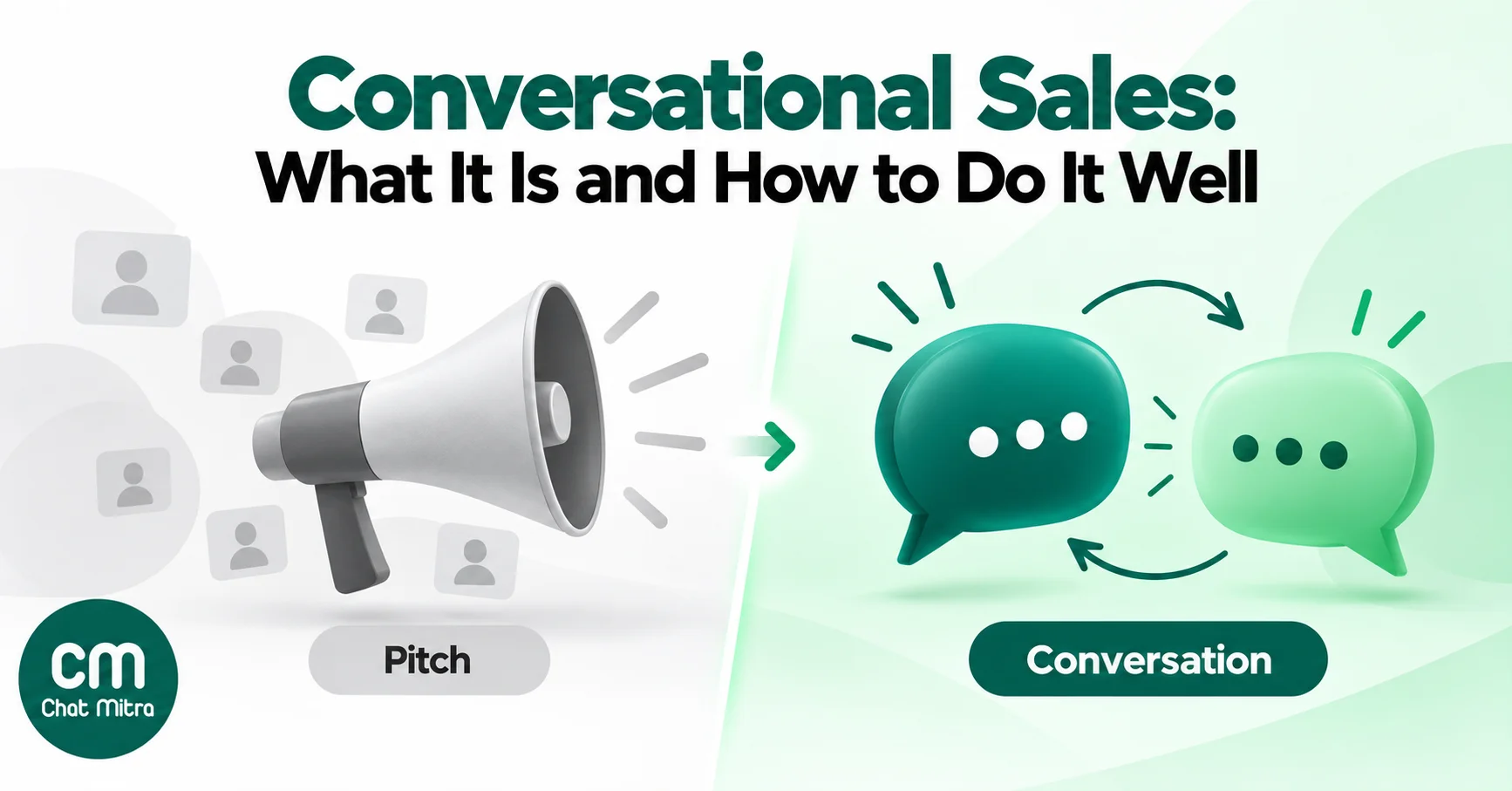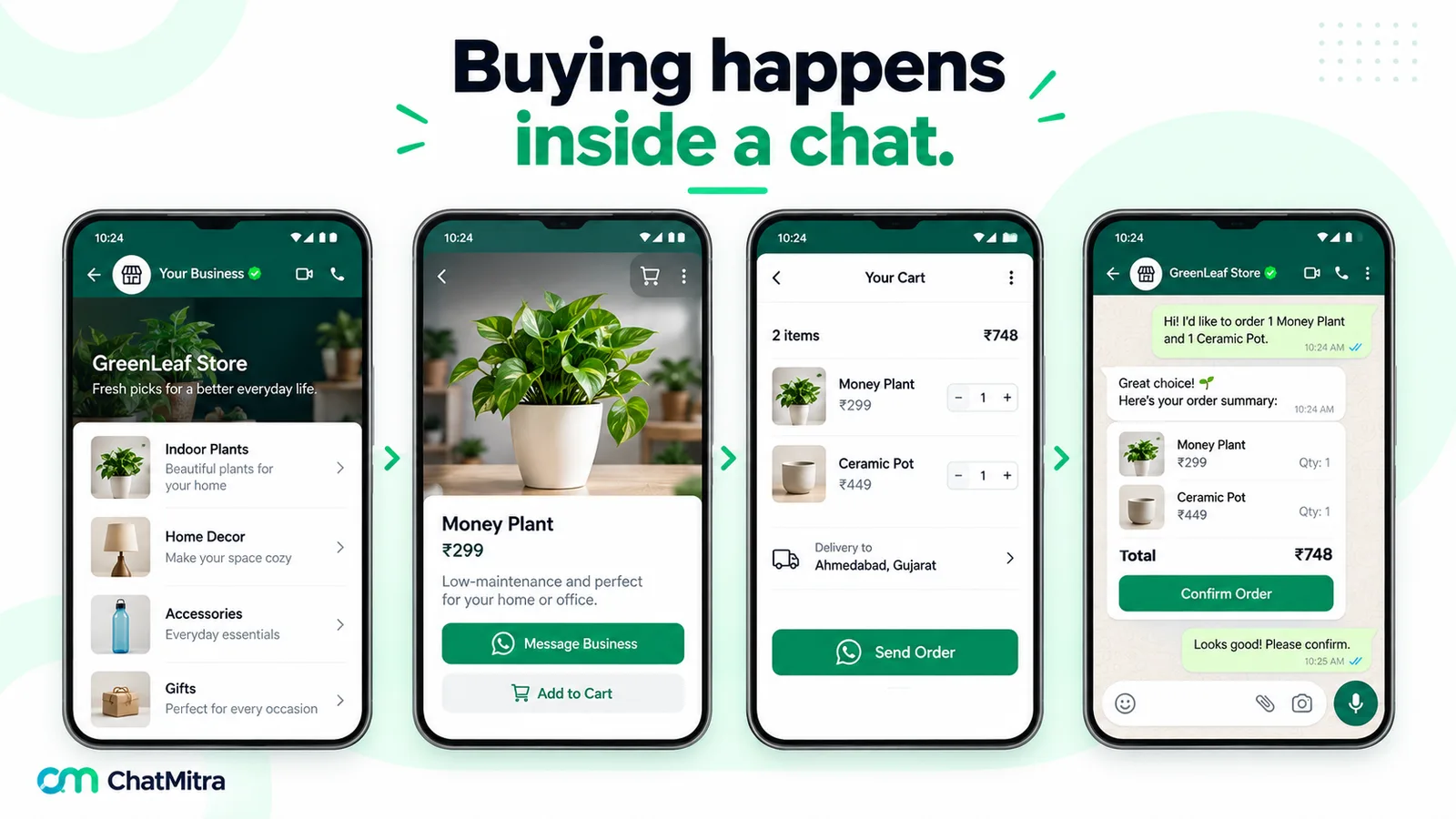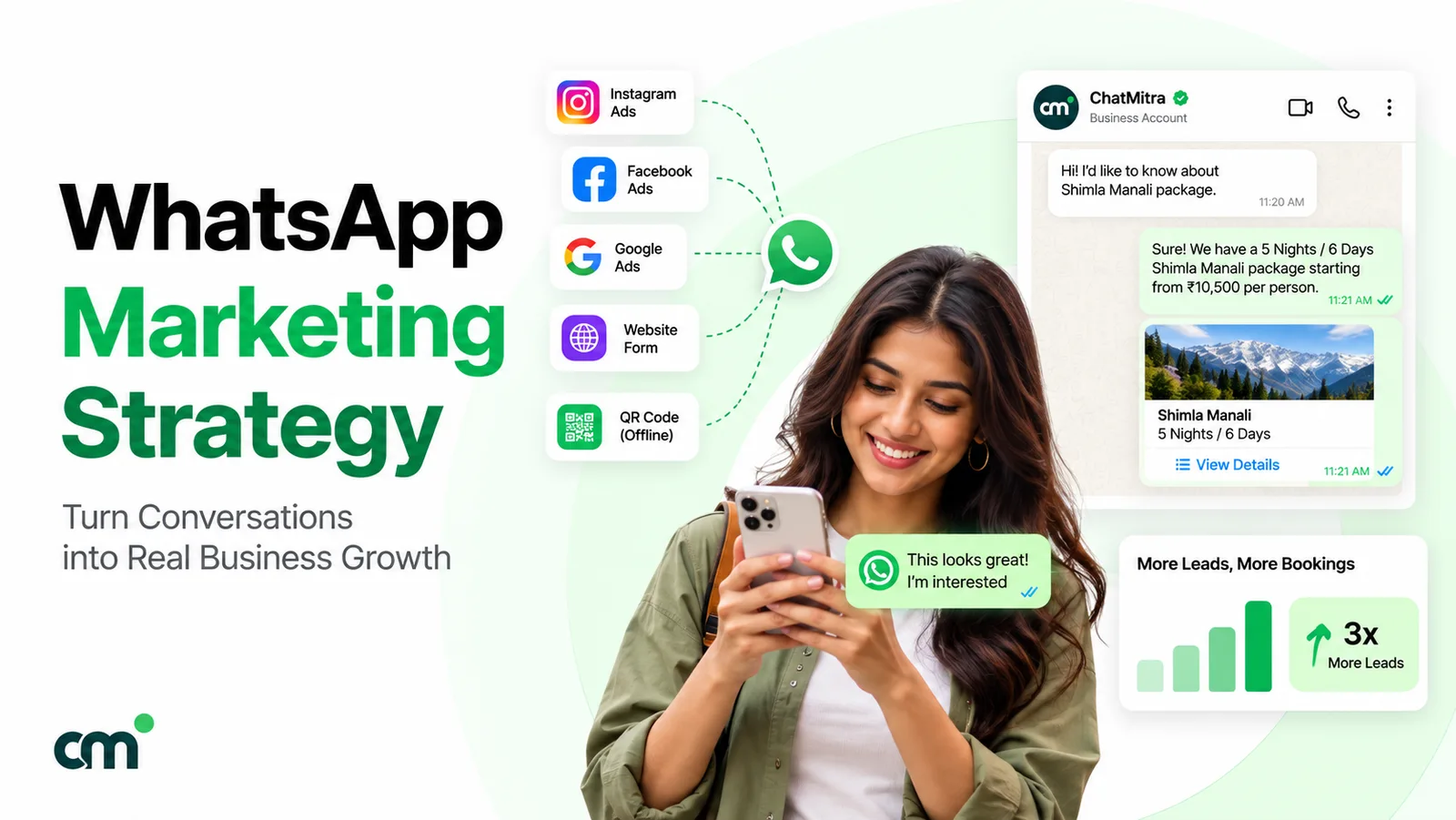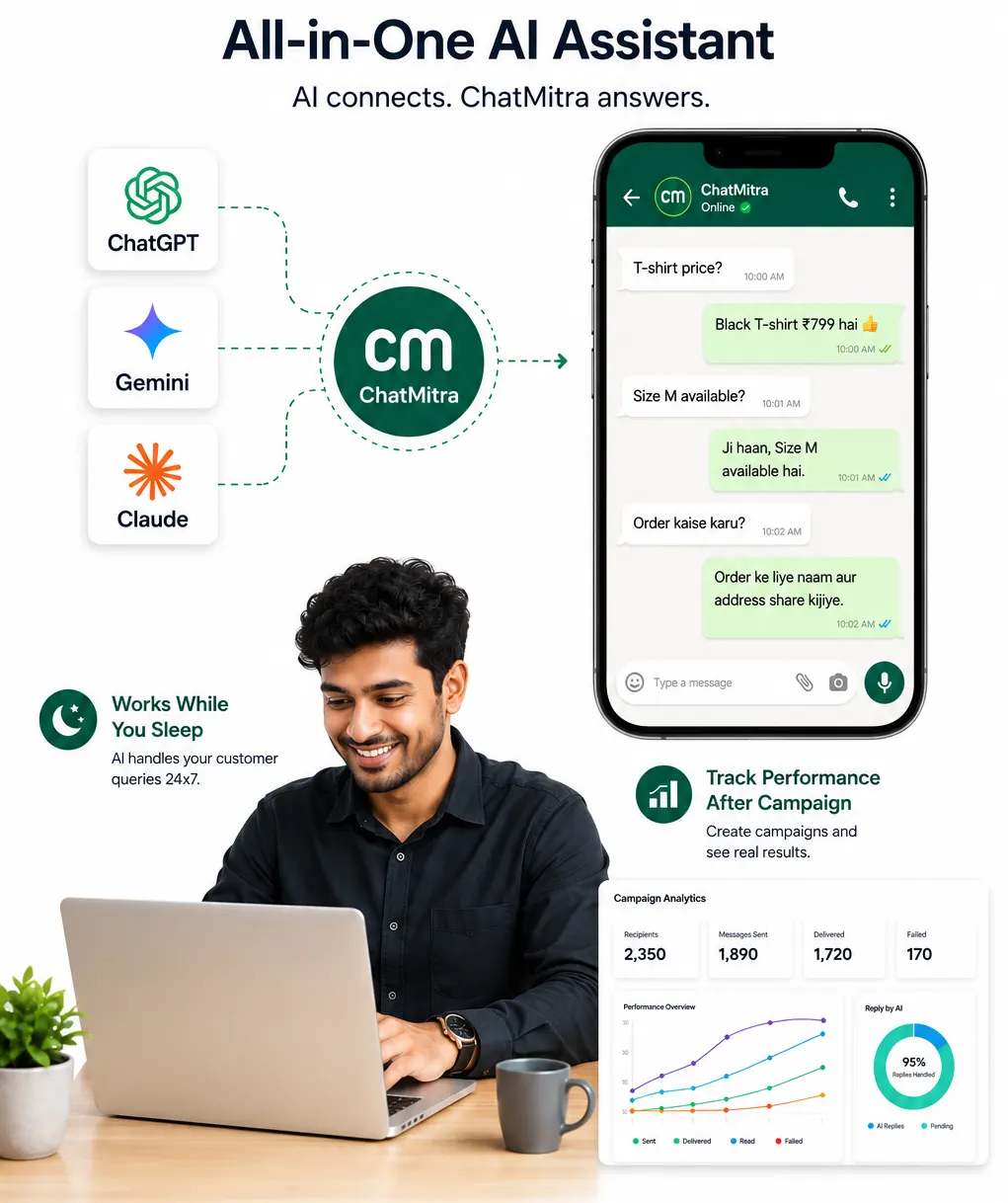
Conversational marketing is marketing that runs on two-way, one-to-one messages: instead of pushing the same offer to everyone, a business invites people to start a chat, asks what they need, answers in real time and follows up only with permission. On WhatsApp the model has a price advantage built in: a conversation the customer starts costs a fraction of a promotional message the business sends first.
The idea isn’t new. Shopkeepers have always asked “what are you looking for?” before showing the shelf. What changed is that the conversation now happens in the same app people use for family and friends, and that each message has a price, a category and rules attached. This guide explains what conversational marketing is, how it differs from blasts and from conversational sales and commerce, why WhatsApp’s pricing rewards it, and how a small business can run it, with costs in rupees.
Using ChatMitra? You can catch conversations from ads, links and QR codes in one shared inbox, greet every new chat with a welcome message, answer common questions with keyword replies on Pro, tag each lead and follow up with opted-in contacts by segment. Starter is free; you pay Meta’s rates at cost plus ₹0.20 per conversation. Jump to setting it up in ChatMitra.
What conversational marketing means
Conversational marketing means using real conversations, usually in chat, to attract, understand and follow up with potential customers. The phrase was popularised in the late 2010s by website-chat software makers, who used it for replacing lead forms with live chat. Messaging apps have since made it far bigger than a website widget. In a YouGov study for Meta of 1,523 adults in India in late 2022, 8 in 10 shoppers used WhatsApp (64%), Instagram or Messenger to engage with a business during Diwali, and 66% said they were more likely to consider buying from a business they could contact by instant messaging (Meta, Aug 2023).
Strip away the vendor language and four traits are left:
- Two-way. The customer can answer, ask and change direction, and the business responds to what they actually said.
- One-to-one. Each person gets their own thread, even when a template started it.
- Timely. Replies come while the person is still interested: minutes, not days.
- Permission-led. The business earns the right to message again by being useful, and stops when asked.
A chatbot is optional. Plenty of conversational marketing is a person with a shared inbox and a good set of saved replies. What makes it conversational is the shape of the exchange, not the technology answering it.
How it differs from blasts, sales and commerce
The term sits in a crowded neighbourhood, and the boundaries matter because they decide who owns the work and how you measure it.
| Approach | What it does | Who speaks first | What success looks like |
|---|---|---|---|
| Broadcast or blast | Sends the same offer to a list | The business | Clicks and orders per send |
| Conversational marketing | Starts and qualifies conversations with people who are interested | Usually the customer, invited by the business | Conversations started, qualified leads, opt-ins |
| Conversational sales | Turns a qualified conversation into a deal | Either | Deals closed, time to close |
| Conversational commerce | Lets people browse, buy and get support in chat | Either | Orders and repeat purchases in chat |
| Conversational AI | The technology that understands and writes replies | — | Accuracy and hand-over rate |
In practice the stages flow into each other on one WhatsApp number. Conversational marketing is the front of that flow: getting the right people to start talking and finding out what they need. Our guides to conversational sales and conversational commerce pick up from there.
Why WhatsApp rewards starting the conversation
On WhatsApp, who speaks first changes the price of everything that follows. That’s the economic case for conversational marketing, and it’s specific to the WhatsApp Business Platform.
| How the conversation starts | What Meta charges in India (from 1 Oct 2026) | Rules that apply |
|---|---|---|
| The customer messages you from a Click-to-WhatsApp ad | Nothing, if you reply within 24 hours: a free entry point window opens and messages are free for up to 7 days | Opens only from Click-to-WhatsApp ads on the WhatsApp Business Platform |
| The customer messages you from a link, QR code or your website | Free-form replies within 24 hours are service messages: 1,000 free a month, then ₹0.115 each | Reply within 24 hours of their last message |
| You message first with an offer | ₹0.8631 per delivered marketing template | Prior opt-in, Meta’s per-user marketing limits, an opt-out the customer can tap |
Two details matter. First, Meta says non-template messages “can only be used to respond - not reach out”, and that “any non-template message that is not powered by Meta Business Agent is a service message” (Meta: non-template messages). So a free-form reply that mentions this week’s offer, sent to someone who messaged you within the last 24 hours, is billed as a service message. Meta Business Agent, Meta’s own AI agent, is priced separately per token. Second, marketing templates have their own route: Meta announced that “Cloud API will stop supporting marketing messages on October 13, 2027”, and from that date they go through its Marketing Messages API (Meta: Marketing Messages API). Service replies stay on the Cloud API.
The pattern is clear. A business that invites people to message first, and then answers well, pays mostly for service messages at ₹0.115 or nothing. A business that only pushes offers pays ₹0.8631 per message and, as covered below, runs into limits on how many marketing messages each person receives. Both have a place, but the conversation-first model is cheaper per interested person and builds the opt-in list you’ll need for the push.
Choosing the channel: WhatsApp, website chat, Instagram or SMS
Conversational marketing works on any channel where people can answer, but the channels behave differently once the first exchange is over.
| Channel | Who can start | What happens after the first chat | Best use |
|---|---|---|---|
| Website chat | The visitor, while on your site | The conversation usually ends when they close the tab, unless you captured a phone number or email | Answering questions on pricing and product pages |
| Instagram DMs | Only the customer (plus one private reply to a comment, within 7 days) | You can reply for 24 hours, longer after a Click-to-Direct ad, but you can’t restart the conversation yourself | Discovery: turning comments and story replies into conversations |
| SMS | The business, mostly | Mostly one-way in practice; replies are rare | Short alerts and codes |
| The customer, or you with an approved template to someone who opted in | Free-form replies for 24 hours, then templates; the thread stays in the customer’s chat list | Following up over days or weeks until they decide |
WhatsApp’s advantage for marketing is the one in the last column: the conversation survives. A parent comparing coaching institutes, a couple choosing a sofa or a buyer deciding on a flat takes days or weeks, and on WhatsApp the thread with all its answers is still there when they’re ready. Many businesses use the other channels to start conversations and WhatsApp to continue them. Our comparison of Instagram and WhatsApp for business covers that hand-off in detail.
The conversational marketing loop
Most good conversational marketing follows the same five steps, whatever the business.
- Invite. Give people an easy, specific reason to message you: “Send ‘FEES’ for this year’s course fees”, “Message us a photo of your skin concern”, “Ask for today’s price”.
- Greet and ask. Reply instantly, even if a person will follow. Ask one question that sorts people: what they’re looking for, for whom, by when, in what budget.
- Answer and recommend. Give the useful answer first: the price, the slot, the product that fits. A brochure link isn’t an answer.
- Hand over or close. When the person is ready, move them to a call, a visit, a booking or a payment, with a person if needed.
- Ask permission to follow up. Before the conversation ends, ask whether they’d like offers or reminders on WhatsApp, and record the answer.
The fifth step is the one most businesses skip, and it’s the one that turns a single chat into a marketing channel. Someone who taps “Yes, send me offers” has given you the opt-in that WhatsApp’s rules require for marketing messages, in their own words.
Entry points: where conversations start
The invite is everything. People don’t message businesses at random; they message when something prompts them and makes it easy.
| Entry point | Best for | What to put in it |
|---|---|---|
| Click-to-WhatsApp ad | New audiences, high-intent offers | A prefilled first message and up to four ice breakers (tap-to-send starter questions, set in WhatsApp Manager) |
| Link (wa.me) with prefilled text | Instagram bio, emails, SMS, your website | A message the customer can send with one tap, such as “Hi, I’d like the fee list” |
| QR code | Shop counters, packaging, flyers, events | A prefilled message that tells you where they scanned (“Hi, from the Diwali stall”) |
| Website chat button | Visitors on pricing or product pages | The page they were on, so the reply can start in context |
| A reply-to-this message to existing customers | Customers who already opted in | One question they can answer with a button |
Prefilled text does double duty: it lowers the effort of the first message and tells you which campaign the person came from. Use a different phrase per channel and you can count conversations by source without any tracking software. ChatMitra’s free WhatsApp link generator and QR code generator create both, and our guide to Click-to-WhatsApp ads strategy covers the ad side in depth.
Writing the first reply
The first reply decides whether the conversation continues. Three rules cover most of it.
Answer the question they asked, or the one the prefilled text implies. If someone sends “Hi, I’d like the fee list”, send the fee list, not “Welcome! How can we help you today?”
Ask one question, with buttons. One clear question with two or three tap-to-answer options gets more replies than an open “tell us more”. A coaching institute might ask “Which course? JEE / NEET / Foundation”. A clinic might ask “Is this for a new consultation or a follow-up?”.
Say who and when. If a person will take over, say so and give a realistic time: “Riya from our admissions team will reply within 15 minutes, 9 am to 7 pm.” Outside those hours, say when you’ll be back.
Ask the important question inside the first 24 hours. For 24 hours after the customer’s last message you can reply freely; after that, you can only send approved templates, and a promotional one costs ₹0.8631. Ask the qualifying question and offer the next step while the window is open, so the customer’s own reply keeps it open.
Here’s how it looks for a few kinds of business:
| Business | Invite | First reply and question |
|---|---|---|
| Coaching institute | Ad: “Send ‘FEES’ for 2027 batch fees” | Fee table for each course, then “Which batch suits you? Morning / Evening / Weekend” |
| Dental clinic | QR at reception: “Book your next check-up” | Next three open slots as buttons, then confirmation |
| Furniture store | Instagram bio link: “Ask for today’s price" | "Which piece are you looking at? Send a screenshot”, then price and delivery time |
| D2C skincare brand | Packaging QR: “Not sure which serum is right? Ask us” | Two questions on skin type and concern, then one product suggestion with why |
| Real-estate developer | Ad: “Get the floor plan on WhatsApp” | Floor plan PDF, then “Would you like a site visit this weekend? Saturday / Sunday / Later” |
Conversational marketing for B2B
The term began in business-to-business software, where the goal was to replace a long lead form with a quick chat. The same logic suits Indian B2B sellers on WhatsApp: manufacturers taking dealer enquiries, software firms, agencies and wholesalers.
- Qualify with three questions, not ten. Usually what they need, roughly how much or how many, and by when. Company size and role can wait for the call.
- Offer something useful for the first reply: a price range, a catalogue PDF, a case study from the same industry. Business buyers message to save time.
- Hand over with context. When a salesperson takes over, they should see the answers in the same thread, so the buyer never repeats themselves.
- Use trade fairs and visiting cards. A QR code on a stall banner or a card, with a prefilled phrase per event, turns a pile of cards into conversations you can follow up while the event is fresh.
- Business contacts still need to opt in. A visiting card is a phone number, not permission. Start with a reply-based invitation or ask at the stall.
Bots, people and AI: who should answer
Conversational marketing doesn’t require a chatbot, but the first reply should be instant, and that usually means some automation.
- Automate the greeting and the sorting question. A welcome message and a few keyword replies handle the first exchange at any hour.
- Let people handle anything that needs judgement: pricing for a custom order, a complaint, a hesitant buyer, a large B2B enquiry.
- Use AI carefully. An AI agent can answer from your product information in natural language, but it can also be confidently wrong about prices and policies. Keep it on questions where a wrong answer is cheap, and give it an easy route to a person.
This isn’t only good manners. WhatsApp’s Business Messaging Policy allows automation inside the 24-hour window but says businesses “must also have available prompt, clear, and direct escalation paths”, such as a transfer to a human agent, a phone number, email or a support form (WhatsApp Business Messaging Policy).
Our guide to conversational AI explains the technology and its limits, and AI lead qualification shows one use in detail.
Consent: what makes it marketing, not spam
Conversational marketing earns its results because people choose to talk. Break that and it becomes spam with extra steps. Four rules keep it on the right side.
A conversation isn’t a marketing subscription. Someone who asked about fees agreed to get an answer, not a promotion every week. Ask before you add them to marketing campaigns, and keep a record of the answer. Meta’s opt-in guidance says businesses “must clearly state the business’s name that a person is opting in to receive messages from” (Meta: getting opt-in); a button in the chat that says “Yes, send me offers from Sharma Coaching” does exactly that.
Each person gets a limited number of marketing messages. Meta says WhatsApp “may limit the number of marketing template messages a WhatsApp user receives from any business” when they’re less likely to engage, based partly on their recent read rate. Marketing messages sent inside an open 24-hour window don’t count towards that limit, and if a message is held back Meta asks you to wait at least 24 hours before retrying (Meta: per-user marketing limits). In other words, a person who talks to you is easier to reach than one who only receives offers.
People can stop promotions with a tap. WhatsApp lets people stop marketing messages from a business, and Meta notifies the business when “a WhatsApp user stops marketing messages” (Meta: user_preferences webhook). Marketing templates sent to them afterwards fail. Respect it everywhere, including your own lists.
Privacy law is catching up. India’s Digital Personal Data Protection Rules, notified in November 2025, bring most consent and notice duties into force in May 2027. Telling people what you’ll send, and letting them withdraw as easily as they agreed, is good practice now and a legal duty then (MeitY: DPDP Rules 2025).
Our WhatsApp opt-in guide covers the wording and the record-keeping.
Seven conversational marketing plays for WhatsApp
- Ask instead of announce. Instead of sending “20% off this weekend” to everyone, put “Message ‘MENU’ for this week’s specials” on your Instagram story, website banner and shop counter, with a link or QR code. Everyone who messages gets the menu as a service reply, and you’ve spent nothing on marketing templates.
- The product finder. Two or three questions (“Who is it for? What’s the budget?”) and one recommendation with a reason. It works for gifts, skincare, insurance plans and courses.
- QR at the moment of interest. A QR code on a shelf, a menu or a delivery box, with a prefilled message tied to that spot. The moment of curiosity is short; the QR catches it.
- Content that invites a reply. A short tip, video or guide that ends with a question: “Want the checklist? Reply YES.” The replies tell you who’s interested enough to follow up.
- Event and webinar sign-ups in chat. Registration, reminder and the joining link in one thread, with the follow-up conversation happening where people already are.
- Win-back with a question, not a coupon. To a customer who hasn’t bought in months and has opted in: “We’ve changed our range since your last order. Want to see what’s new for you?” It’s still a marketing message, but a reply turns the next messages into service.
- After the sale, ask for the next conversation. A delivered order or a completed appointment is the best time to ask: “Would you like a reminder when it’s time to reorder?” The reminder the customer requested is the start of the next conversation.
Our WhatsApp marketing strategy guide fits these plays into a full calendar, and WhatsApp lead generation goes deeper on capturing and qualifying leads.
What it costs: blast first vs conversation first
Take a coaching institute in India that wants 300 qualified enquiries for a new batch. Compare two approaches.
Blast first. It sends a marketing template to 6,000 past enquirers who opted in, and about 5% reply with a real enquiry.
| Item | Count | Meta charge |
|---|---|---|
| Marketing templates delivered | 6,000 | ₹5,178.60 |
| Replies handled within 24 hours (service) | 300 conversations, about 1,500 messages | 1,000 free, then 500 × ₹0.115 = ₹57.50 |
| Total | ₹5,236.10 |
Conversation first. It runs a Click-to-WhatsApp ad and puts QR codes at its centres and on its leaflets. About 600 people message it, and 300 turn out to be qualified.
| Item | Count | Meta charge |
|---|---|---|
| Replies to ad-started conversations | 400 conversations | ₹0 (free entry point window) |
| Replies to QR and link conversations | 200 conversations, about 1,000 messages | 1,000 free service messages: ₹0 |
| One follow-up marketing template to the qualified people who opted in | 300 | ₹258.93 |
| Total Meta charges | ₹258.93 |
The conversation-first route isn’t free: the ad spend goes to Meta separately, and someone has to answer 600 chats. But the per-message cost on WhatsApp drops by about ₹5,000 for the same number of qualified enquiries, and the institute ends with 300 fresh opt-ins instead of a list that’s slowly tiring of offers. The numbers here are assumptions; plug in yours in the WhatsApp pricing calculator.
Your WhatsApp provider adds its own fee. On ChatMitra’s Starter and Pro plans that’s ₹0.20 per conversation, charged once per contact per 24 hours however many messages you exchange: about ₹120 for 600 conversations, or ₹1,200 if the blast reaches 6,000 people. Enterprise, at ₹2,499 a month, has no per-conversation fee.
When conversational marketing isn’t the right fit
Conversations cost attention, yours and the customer’s. They pay off when the purchase needs a question answered. They’re the wrong tool in a few situations:
- Low-consideration, high-volume products. If people buy without questions, such as a ₹99 phone cover, a smooth checkout beats a chat. Use WhatsApp for order updates and support instead.
- No one to answer. A conversation that starts in seconds and stalls for a day does more damage than no invitation at all. Start with one entry point you can staff, then add more.
- Professions that can’t solicit. Some regulated professionals can’t market themselves directly. In India, advocates are bound by Bar Council of India rules on solicitation; our guide to WhatsApp for lawyers explains where the line sits.
- When the list didn’t agree. Conversational marketing can’t fix a contact list bought from a vendor or scraped from a directory. Those people never opted in, and messaging them breaks WhatsApp’s rules.
How to measure conversational marketing
Clicks and opens don’t describe a conversation. Track these instead, by entry point:
| Metric | How to get it |
|---|---|
| Conversations started | New chats per day, by prefilled phrase or ad |
| Reply rate to the first question | Share of new chats that answer it |
| Time to first human reply | From the moment a chat needs a person |
| Qualified conversations | Tag them as soon as they meet your criteria |
| Opt-ins collected | People who said yes to follow-ups |
| Conversations to customers | Orders, bookings or admissions traced to a tagged chat |
| Opt-outs and blocks | Early warning that follow-ups have become pushy |
Cost per qualified conversation is the number to compare with other channels. Our guide to WhatsApp marketing ROI shows how to put it together.
A 30-day plan to start
- Week 1: pick two entry points. One you control fully (a QR code at your counter or on packaging) and one online (your Instagram bio or website). Give each its own prefilled phrase.
- Week 2: write the first replies. One instant answer per phrase, one sorting question with buttons, and a clear line about when a person will reply. Ask for the opt-in at the end.
- Week 3: add a paid source. Run a small Click-to-WhatsApp ad with a specific offer of information (“Send FEES”), and make sure someone can answer within minutes during the hours it runs.
- Week 4: measure and follow up. Count conversations, qualified leads and opt-ins by source. Send one follow-up to the people who opted in, and drop the entry point that produced the least.
Common mistakes
- Calling a blast a conversation. A broadcast with a “reply STOP” footer is still a broadcast.
- Greeting without answering. “How can we help?” in reply to a specific question wastes the customer’s first message.
- Asking five questions before giving anything back. Answer first, then ask.
- Letting the bot trap people. Every automated path needs a way to reach a person.
- Treating a reply as a marketing opt-in. Ask, and record the answer.
- Measuring opens. Count conversations, qualified leads and customers.
- Slow replies to ad conversations. A paid conversation that waits three hours for an answer is money spent twice.
Setting it up in ChatMitra
- Connect your number to the WhatsApp Business Platform through ChatMitra. Ice breakers and Click-to-WhatsApp welcome sequences are set in Meta’s own tools (WhatsApp Manager and Ads Manager), not in ChatMitra.
- Create one entry point per channel with the free link generator and QR code generator, each with its own prefilled phrase: “Hi, I’d like the fee list” for Instagram, “Hi, from the Diwali stall” for the event.
- Set a welcome message (on every plan). It goes to a contact’s first message ever, so keep it general: who you are, your hours and what to expect.
- Add Auto Reply rules on Pro for each prefilled phrase. A rule can match the exact phrase or the start of a message, reply with text, an approved template, media, buttons or a list, and add a tag. Tag every conversation with its source this way, because the inbox doesn’t show which ad a chat came from (the ad details do reach your systems through ChatMitra’s webhook).
- Ask for the opt-in in chat. End the first exchange with a “Yes, send me offers” button, and a keyword rule on that button text that adds an “opted in” tag.
- Answer from the shared inbox. Unlimited team members can reply on the web or the Android app, with saved replies for common answers.
- Follow up by segment. Campaigns can include and exclude tags, so send follow-ups only to “opted in” contacts from the right source. Retarget campaigns can filter by sent, delivered, read or failed.
- Check opt-outs. When someone stops your marketing messages in WhatsApp, ChatMitra marks the contact as opted out. Filter those contacts in Contacts and keep them out of campaigns, because campaigns don’t drop them automatically.
ChatMitra’s advantages for conversational marketing:
| Advantage | What it means |
|---|---|
| Starter is free | Start catching conversations from links, QR codes and ads with no subscription |
| Meta’s rates at cost | A service reply costs Meta’s ₹0.115 after the free 1,000, with no markup; ₹0.20 per conversation on Starter and Pro |
| Unlimited team members on one number | Everyone who sells answers from the same inbox, at no extra seat cost |
| Rules that reply and tag in one step | Each entry point gets an instant, specific answer and a source tag |
| Free link and QR tools | Prefilled phrases per channel, so you can count conversations by source |
Good to know: ChatMitra doesn’t configure ice breakers or Click-to-WhatsApp welcome sequences; set those in Meta’s tools. It has no click analytics for links or buttons, so count conversations and replies instead. Auto Reply matches whole phrases or their start, not words anywhere in a message, and there’s no automatic STOP keyword, so add a rule that tags people who ask to stop. Customer AI chatbots use your own AI provider key and answer text messages only.