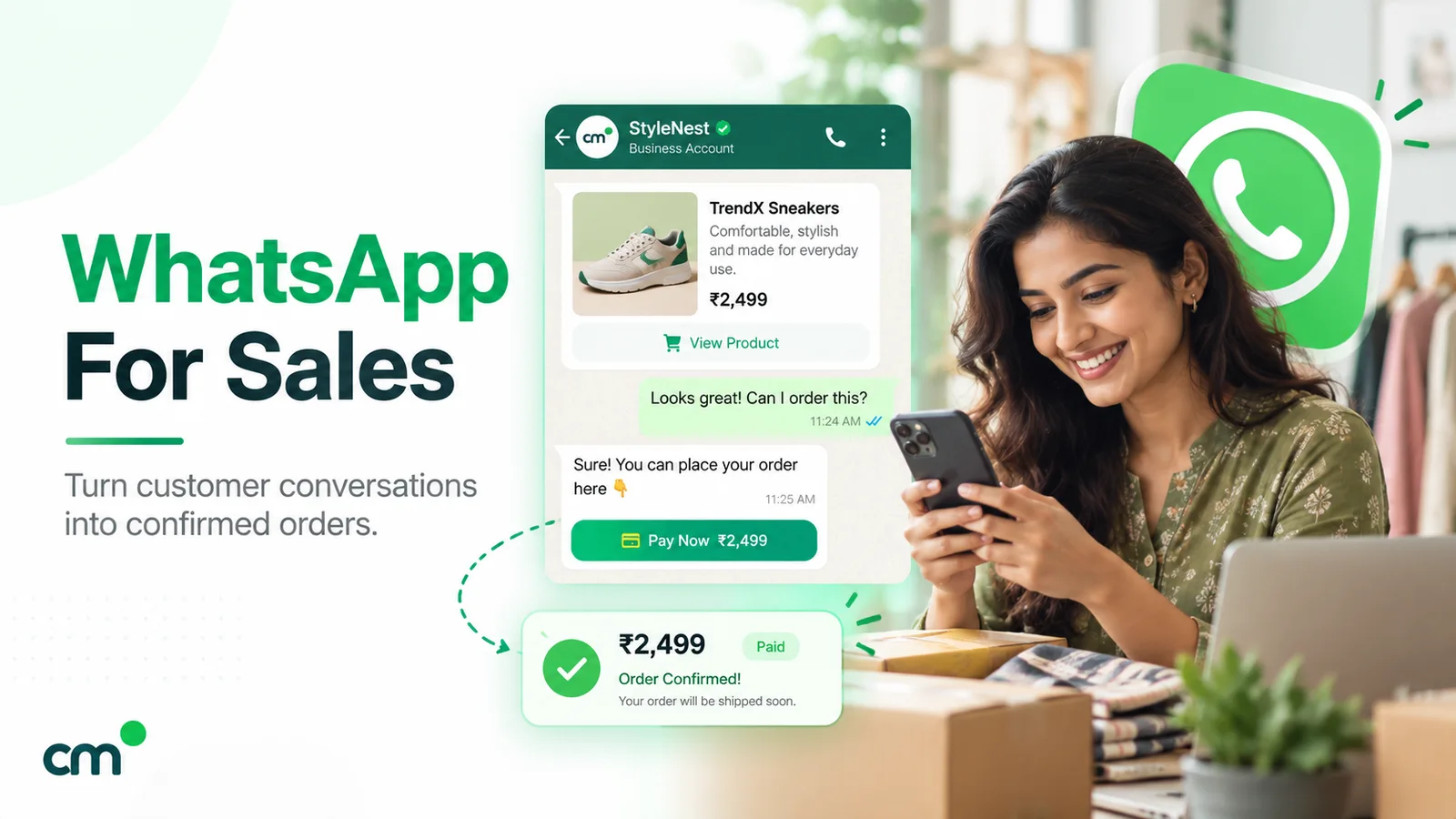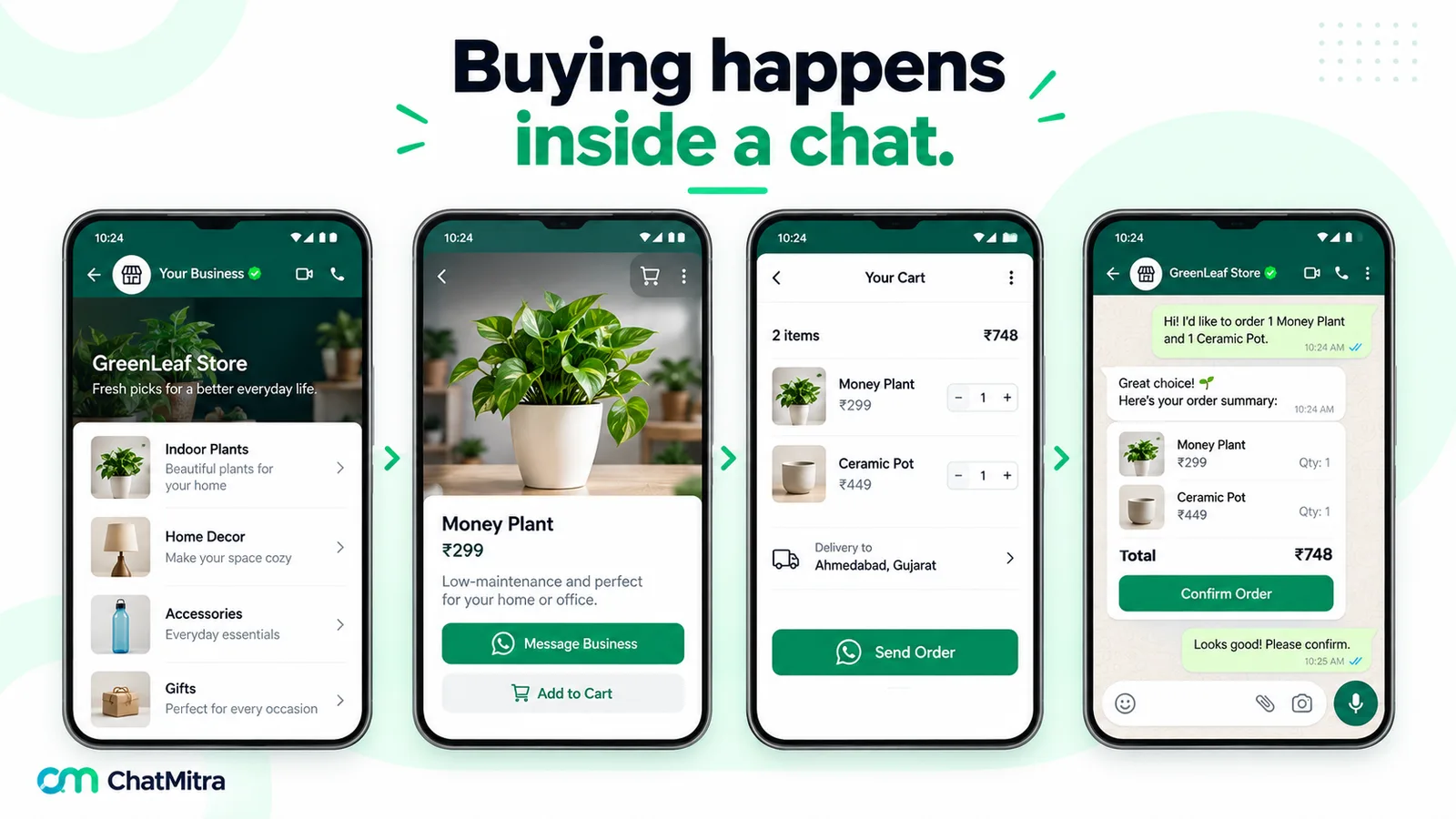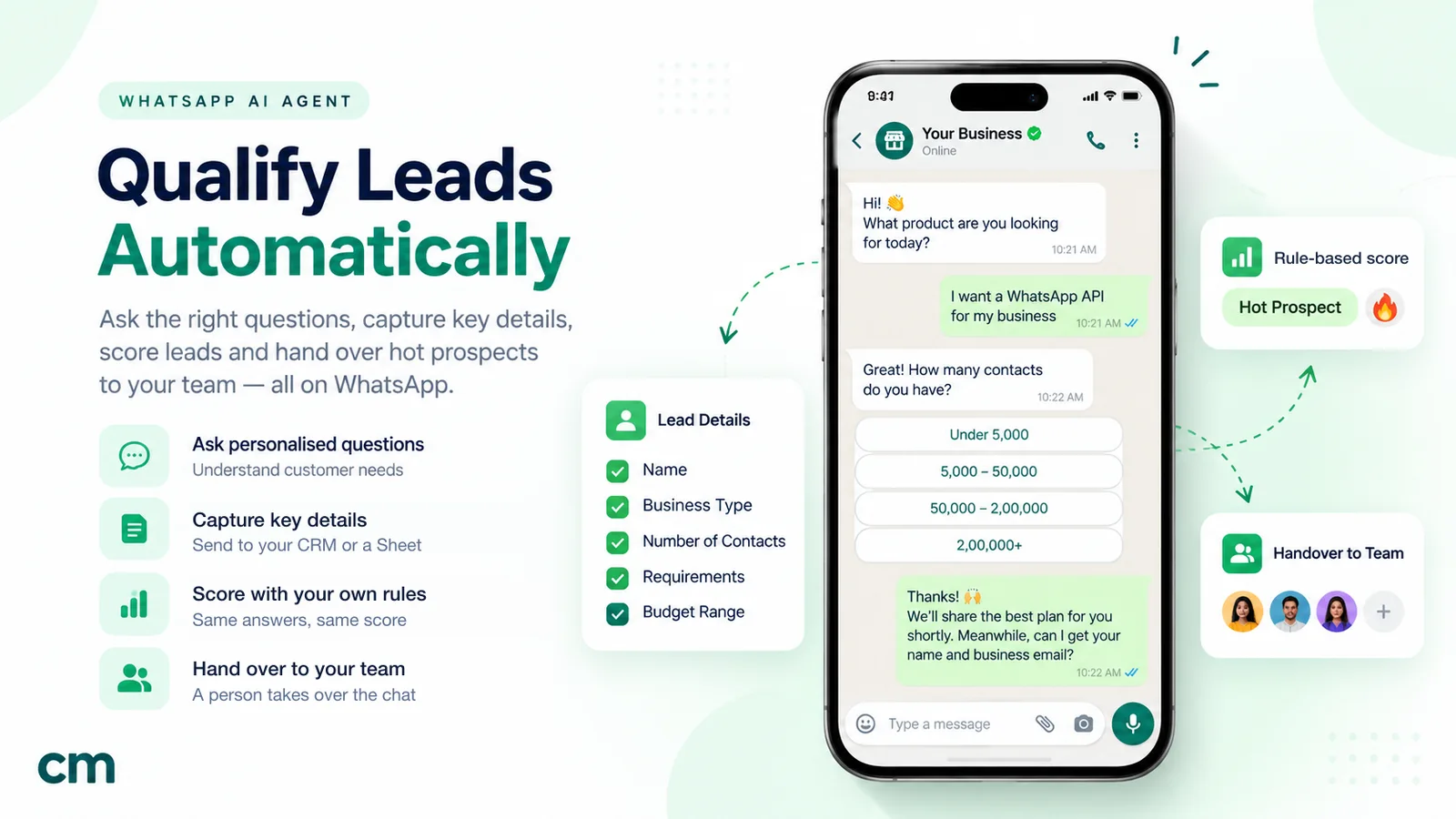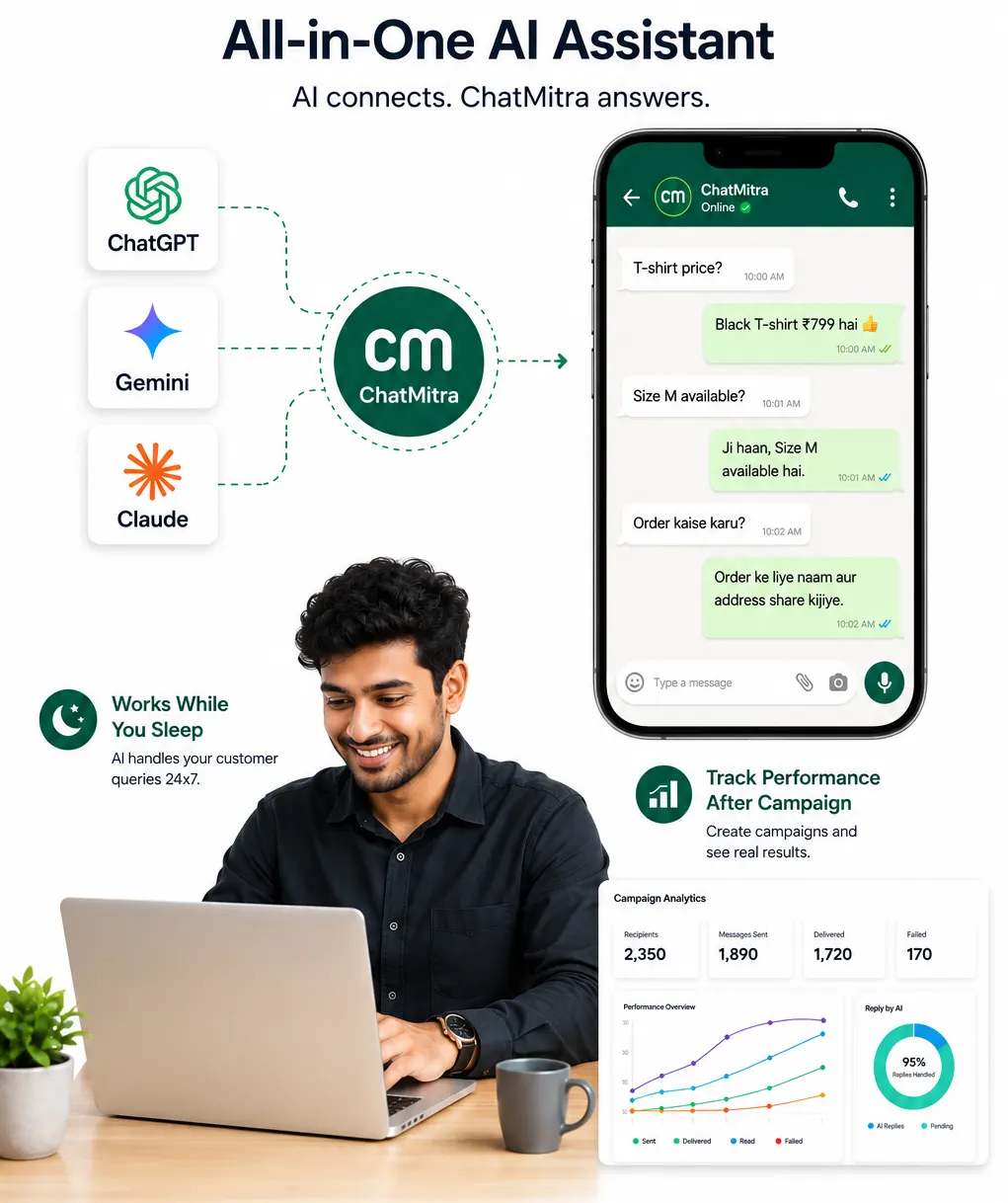
Conversational sales is selling through a two-way conversation, usually in writing, where the buyer asks, the seller answers and asks back, and the decision happens inside the thread. A buyer messages “Do you have this in walnut, and can it reach Pune by the 20th?”, and instead of “Please fill in this form and our team will call you”, they get an answer, one or two useful questions back, a recommendation and an easy next step. It’s how most people already buy from small businesses on WhatsApp. Done deliberately, it works for B2B deals and larger teams too. This guide explains what conversational sales is and isn’t, a five-stage method for running a sales conversation, how to split work between bots and people, and how to measure it.
Selling on WhatsApp specifically?
This article is about the method, on any chat channel. For the WhatsApp playbook (quotes and price lists, payments in India, templates after the 24-hour window and a shared team number), read our WhatsApp for sales guide.
Key takeaways
- It's a way of selling, not a tool. Chat software makes it possible; the method makes it work.
- Answer first, then ask. Earn the right to qualify by being useful in the first reply.
- Ask only what changes the offer. Every extra question costs you replies.
- Recommend one option and make the next step a single tap or sentence.
- Bots open, people close. Hand over visibly, with the context already in the thread.
What is conversational sales?
Conversational sales (also called conversational selling) means running the sale as a dialogue with one buyer, in a channel where they can reply when it suits them: WhatsApp, website chat, Instagram or Facebook DMs, SMS or RCS. Three things set it apart from a traditional sales process:
- The buyer starts on their terms. They ask a question when they’re interested, not when your form or your rep’s calendar allows.
- Qualification happens inside the conversation. Instead of a ten-field form, the seller learns budget, timing and needs from a few natural questions.
- The next step happens in the same thread. A quote, a cart, a booking or a payment link arrives where the conversation already is, so nothing is lost between handoffs.
It’s mostly asynchronous. Unlike a phone call, the buyer can reply in two minutes or two hours, and both sides can share photos, documents and links. That’s its strength (the buyer stays in control) and its risk (the conversation can stall quietly).
Why buyers have moved to conversation
Buyers increasingly want to research alone and talk to a person only when it helps. In a survey of 646 B2B buyers run in August and September 2025, Gartner found that “67% of B2B buyers state that they prefer a rep‑free experience”, and 45% had used AI during a recent purchase (IT-Online, reporting Gartner, March 2026). Yet Gartner also predicts that “by 2030, 75% of B2B buyers will prefer sales experiences that prioritise human interaction over AI”, especially for complex or high-stakes decisions (IT-Online, reporting Gartner, August 2025).
Those findings aren’t contradictory. Buyers don’t want to be chased through a fixed process, but they do want a capable human when a decision gets real. A conversation gives them both: they can ask a quick question without committing to a call, and they get a person the moment they need one.
Conversational sales vs related ideas
The term overlaps with several others. This table separates them:
| Approach | What it is | Who leads | Ends in |
|---|---|---|---|
| Traditional inbound | Form or enquiry, then a scheduled call or email | Seller's process | A meeting |
| Outbound prospecting | Cold calls, emails or messages to people who haven't asked | Seller | A first conversation |
| Conversational sales | One-to-one dialogue in chat with a buyer who is considering a purchase | Buyer and seller together | A quote, order or booking |
| Conversational marketing | Conversations at scale to attract and qualify interest (ads that open a chat, bots, broadcasts) | Marketing and bots | A qualified lead |
| Conversational commerce | Buying and paying inside the conversation, often for retail | Buyer | An order |
| Consultative selling | Understanding the problem before proposing a solution, in any channel | Seller as adviser | A tailored proposal |
In practice they connect. A Click-to-WhatsApp ad (conversational marketing) opens a chat, a bot asks two qualifying questions, a salesperson takes over (conversational sales) and the buyer orders and pays in the thread (conversational commerce). If that last step is your focus, our conversational commerce guide covers it. The difference that matters for your team: conversational sales is where a specific buyer’s decision is made, so it needs your best people and clear rules.
When conversational sales fits, and when it doesn’t
It fits best when buyers have a few questions before buying, when the answer depends on their situation (size, location, quantity, date), and when they already use chat with businesses. That covers most local services, furniture and home improvement, education and coaching, travel, B2B supplies and wholesale, and a lot of software.
It fits less well for very simple purchases (a checkout page is faster) and for complex enterprise deals with many stakeholders, where chat supports the process but meetings and documents carry it. Even there, a shared chat thread with the buyer’s champion often moves faster than email.
Choosing a channel
The method is the same everywhere, but channels differ in who’s there, how long a conversation can last and what you can send. Pick the one your buyers already reply on, then route the others to the same team.
| Channel | Best for | Watch out for |
|---|---|---|
| Markets where buyers already message businesses on WhatsApp, such as India; long, multi-day conversations with photos and documents | Messaging after 24 hours needs an approved, paid template and opt-in | |
| Website live chat | Buyers already on your pricing or product page | The conversation ends when they close the tab, unless you capture a phone number or email |
| Instagram and Facebook DMs | Social-led brands where the product is discovered in posts and reels | Harder to share formal quotes and documents; team access needs a business inbox tool |
| SMS and RCS | Markets or buyers who don't use chat apps; short confirmations | Plain SMS is poor for back-and-forth and media; RCS reach depends on the phone and carrier |
| Formal B2B steps: proposals, contracts, approvals | Too slow for the opening and the questions |
Many businesses use two: a chat app for the conversation and email for the paperwork. For channel comparisons in more depth, see WhatsApp vs SMS and RCS vs WhatsApp.
The five stages of a sales conversation
Most good sales chats follow the same shape, whatever the product. Use these five stages to design your openings, saved replies and bot flows, and to coach the team.
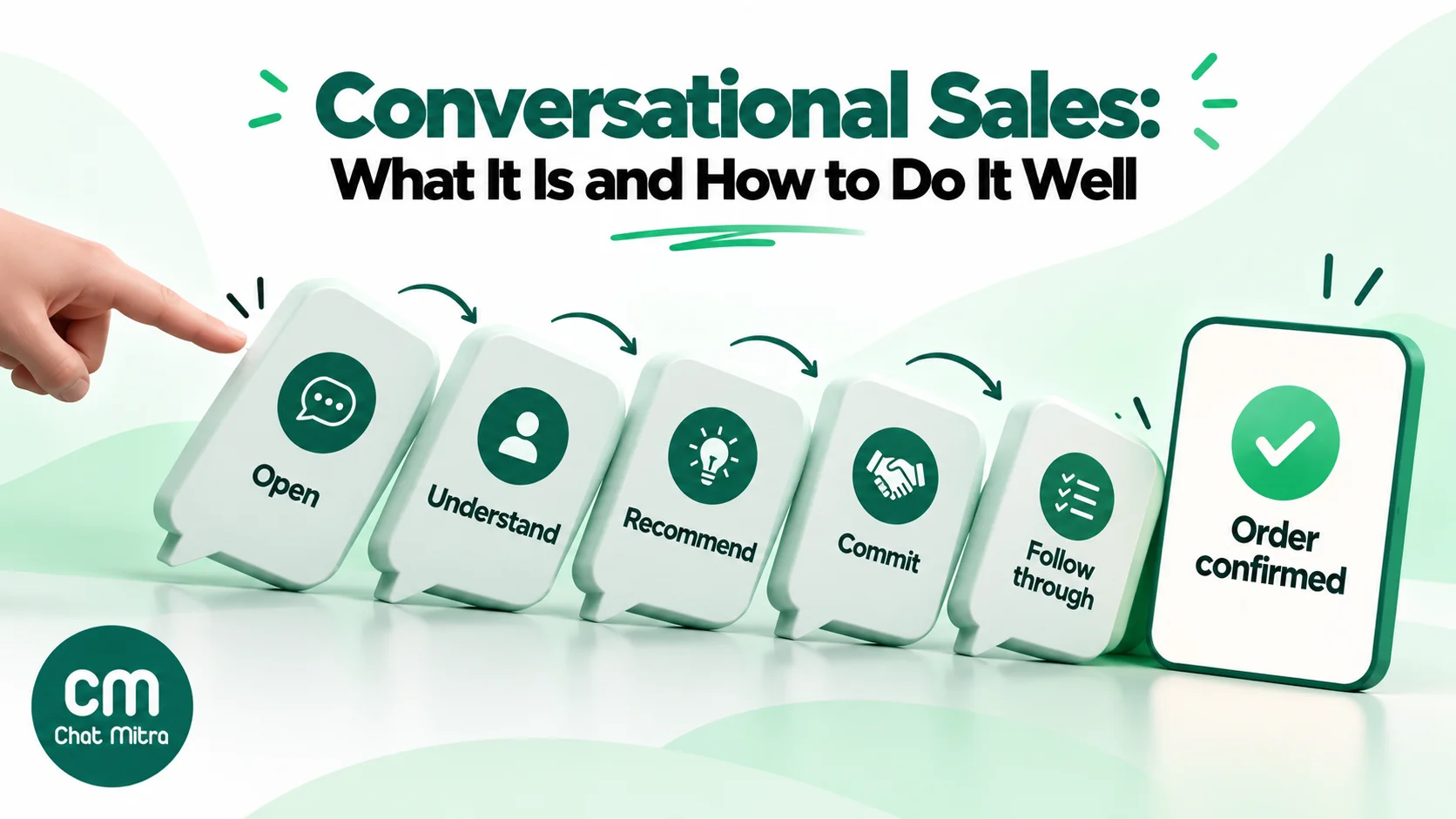
1. Open: answer before you ask
The first reply decides whether there’s a second. Answer the buyer’s question directly, even partly (“Yes, walnut is in stock, and Pune delivery takes 6–8 days”), and then ask your first question. Leading with “May I know your name and city?” before answering feels like a form in disguise.
If you genuinely can’t answer without one detail, say why: “Prices depend on size. Which room is it for, and roughly how big?“
2. Understand: ask only what changes your offer
Qualification in chat has a strict budget. Each question costs a reply, and every reply is a chance for the buyer to drift away. Before writing a question, ask yourself: would a different answer change what I recommend or what it costs? If not, skip it.
A useful pattern is the numbered question set: “Three quick things so I can quote: 1. how many units 2. delivery city 3. by when?” The buyer answers in one message. For B2B, add one question about the decision (“Will anyone else need to approve this?”) because a quote the buyer can’t forward to their manager is a quote that stalls.
3. Recommend: one option, with a reason
Chat is a poor place for a catalogue. Recommend one option that matches what they told you, explain why in one line, and mention one alternative only if it’s genuinely different (“If budget matters more than finish, the oak version is ₹6,000 less”). Attach what helps them decide: a photo of the actual item, a short video, a one-page quote. Long product descriptions belong on a web page you link to.
4. Commit: make the next step a single action
End the recommendation with one clear next step, phrased as a choice the buyer can make in a tap or a word:
- “Shall I reserve it for you? Reply YES and I’ll send the payment link.”
- “Would Tuesday 11 am or Wednesday 4 pm work for a site visit?”
- “Want a formal quote for your records? Send me your company name and billing address.”
Avoid open endings such as “Let me know if you have any questions”. They hand the next move to the buyer and give them nothing to do.
5. Follow through: confirm, deliver, and stay useful
The sale isn’t done when the buyer says yes. Confirm what was agreed in writing, send the invoice or booking, update them when it ships or when the visit is due, and check in afterwards. This is also where repeat sales and referrals come from: a buyer who had a good conversation will message the same thread next time.
If a conversation goes quiet before commitment, follow up once or twice with something new, such as an answer to a question they hadn’t asked yet, a delivery date that’s about to change, or a stock update. Our guide to WhatsApp follow-up messages has timing and wording.
Two short examples
A B2C conversation that works
Buyer: Hi, do you have the 3-seater sofa from your Instagram post in grey?
Seller: Hi! Yes, the Arlo 3-seater comes in two greys, light and charcoal. Delivery to most of Bengaluru takes about a week. Is it for a living room, and do you have a rough width you need to fit?
Buyer: Living room, about 2.2 metres of wall.
Seller: The Arlo is 2.05 m, so it fits with a little space each side. For a living room I’d suggest charcoal; it hides wear better. Here’s a photo of it in a similar room. It’s ₹48,500 delivered. Shall I check the earliest delivery slot for your pincode?
The seller answered the question in the first line, asked two questions that changed the recommendation, recommended one option with a reason, and ended with a one-step next action.
A B2B conversation that works
Buyer: We need water dispensers for our new office. Do you rent or only sell?
Seller: Both. Most offices rent, because servicing and filter changes are included. To suggest the right model: 1. roughly how many people 2. hot and cold, or cold only 3. when do you move in?
Buyer: About 60 people, hot and cold, moving on 1 December.
Seller: For 60 people I’d recommend two floor-standing hot-and-cold units rather than one, so there’s no queue at lunch. Rental is ₹1,800 a month per unit including service. I can install on 28 November. Will anyone else need to sign off on the rental agreement? I can send a one-page quote you can forward.
Here the seller added the approver question, because in B2B the person chatting is often not the person who signs.
Speed: why reply time matters more in chat
On a form, a buyer has given you their details and is waiting. In chat, they’re often waiting on three or four sellers at the same time, and the first useful answer often wins the conversation. That makes first-reply time the single most important operating number in conversational sales.
Practical rules:
- Set a target and measure it. For example, a first reply within five minutes during working hours. Track the median, not just the average, and look at it by hour of day.
- Staff for when leads arrive, not office hours. Look at a month of enquiry timestamps before setting shifts. If a large share arrive in the evening or at weekends, cover those hours.
- Use an honest away message. Outside hours, an automatic reply that says when a person will answer, and offers the most common answers (prices, catalogue link, location), keeps the buyer from moving on.
- Don’t fake speed. An instant “Thanks for your message!” followed by two hours of silence is worse than an honest “We reply between 9 am and 8 pm; it’s 11 pm now, so we’ll answer first thing.”
If your leads come from ads that open a chat, speed matters even more. On WhatsApp, Meta’s pricing also rewards it: when someone messages you from a Click-to-WhatsApp ad and you reply within 24 hours, Meta opens a free entry point window that “may remain open for up to 7 days”, during which your messages to that person aren’t charged (Meta pricing).
Writing for chat
Sales conversations happen on a phone screen, often between other things. A few writing rules make a big difference:
- One idea per message, and keep messages short enough to read without scrolling. If you need more, split it into two.
- Lead with the answer. “Yes, ₹48,500 delivered” beats three lines of context first.
- Use numbers and lists for questions and options so the buyer can reply “2” or “yes to 1 and 3”.
- Send media that does the work: a real photo, a 20-second video or a PDF quote replaces paragraphs.
- Match the buyer’s language and tone. If they write in Hinglish or Tamil, reply in kind if you can; if they’re formal, stay formal.
- Never paste a wall of terms and conditions. Link to them, and summarise the two that matter (delivery time, returns).
Saved replies help with speed and consistency, but personalise the first line every time. A buyer can tell when every message is a template.
Bots and people: who should handle what
Automation can make conversational sales faster, or ruin it. The test is whether the bot helps the buyer get what they came for.
| Stage | Bot is good at | Person is needed for |
|---|---|---|
| Open | Instant greeting, hours, location, catalogue or price-list link, after-hours reply | Questions that don't match a menu |
| Understand | Collecting fixed details (city, quantity, date, budget band) with buttons | Reading between the lines, follow-up questions |
| Recommend | Simple rules ("under 50 people: model A") | Judgement, trade-offs, objections |
| Commit | Booking a slot, sending a standard payment link | Custom quotes, discounts, terms |
| Follow through | Order and delivery updates, reminders | Problems, complaints, upsell conversations |
AI agents can now answer more open questions from your own documents, which stretches what a bot can do in the “open” and “understand” stages. Our guide to qualifying WhatsApp leads with an AI agent shows how to set that up and where to stop it.
Designing the handover
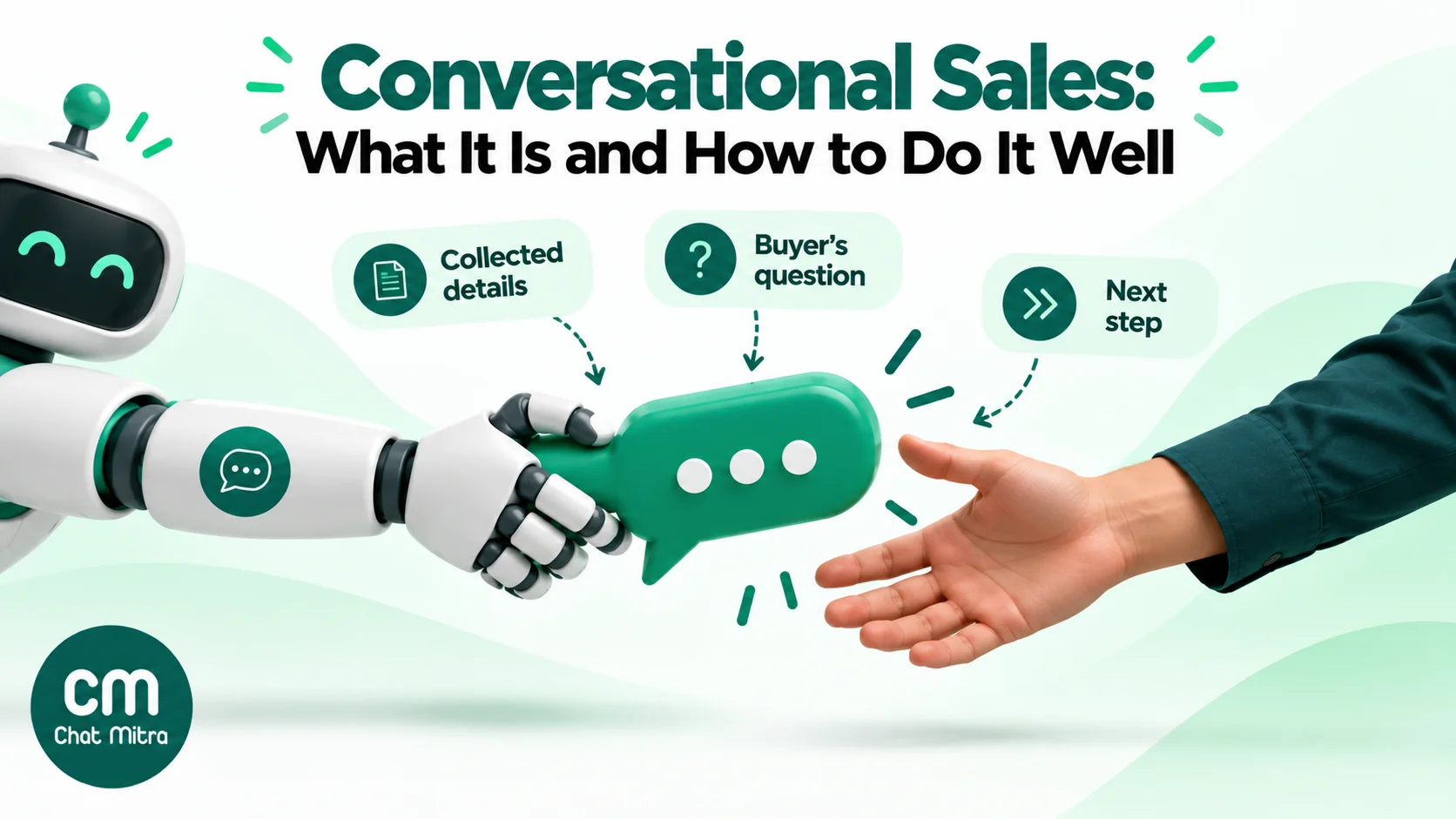
The handover from bot to person is where most automated sales chats lose buyers. Get these right:
- Make it visible. “Thanks, Priya from our team will take it from here” tells the buyer a person is now reading.
- Pass the context. The person should see what the bot collected and read the thread before replying. Never ask the buyer to repeat what they told the bot.
- Offer a person at every step. A “talk to someone” option shouldn’t require getting through the whole menu first. On WhatsApp this is also a policy requirement: when you automate replies, Meta’s Business Messaging Policy requires “prompt, clear, and direct escalation paths” (WhatsApp Business Messaging Policy).
- Set a handover time. If the bot says “someone will reply shortly”, define shortly, and meet it.
Running conversational sales as a team
One person selling from their own phone can do all of this by instinct. A team needs a few rules:
- One shared number, not personal phones. Conversations, history and buyers stay with the business when people change shifts or leave. On WhatsApp, that means the WhatsApp Business Platform (API) with a shared inbox.
- Clear ownership. Decide how chats are split (by region, product, language or shift) and how a colleague knows a chat is taken. Tags such as
quote-sentorsite-visitshow the stage at a glance. - Shared answers. Keep saved replies for facts (delivery times, warranty, payment options) so everyone says the same thing, and review them monthly.
- Notes for the next person. Record what was promised: the price quoted, the date agreed, the approver’s name.
- Rules for outbound messages. Following up inside an open conversation is service; messaging people who never asked is not conversational sales. On WhatsApp, messaging after the 24-hour window requires an approved template and the buyer’s opt-in. Our WhatsApp opt-in guide explains how to collect it.
How to measure conversational sales
Measure the conversation, not just the outcome:
| Metric | What it tells you | How to get it |
|---|---|---|
| First-reply time (median, by hour) | Whether you're answering while the buyer is still interested | Chat timestamps |
| Conversation-to-opportunity rate | How many chats reach a quote, cart, demo or visit | Stage tags |
| Opportunity-to-sale rate | Whether recommendations and commitments work | Tags plus your sales records |
| Time from first message to sale | Where conversations stall | First message date vs order date |
| Revenue by entry point | Which ads, buttons, QR codes or broadcasts bring buyers who buy | Pre-filled messages or ad referral data |
| Silent-drop rate | Chats where the buyer stopped replying before a decision | Open chats with no reply for 7+ days |
To see which entry points bring buyers, give each one its own pre-filled first message (for example, “Hi, I saw the sofa on Instagram” vs “Hi, I scanned the showroom QR code”). Our guide to WhatsApp lead generation shows how to set those up.
Start by comparing conversational sales with your current form-and-call process for the same product over the same month. That comparison, in your own numbers, is more useful than any industry benchmark.
Common mistakes
- Turning the chat into a form. Five questions before any answer reads as a gate, not a conversation.
- Sending the catalogue instead of a recommendation. Choice overload ends conversations.
- Ending without a next step. “Let me know” gives the buyer nothing to do.
- Hiding behind a bot. If buyers can’t reach a person, the bot is costing you sales.
- Following up with “Any update?” Add something new each time, or don’t send it.
- Different answers from different people. Shared saved replies prevent it.
- Selling from personal phones. The buyer’s history leaves with the employee.
- Messaging people who never asked. That’s spam, and on WhatsApp it damages your number’s quality rating.
A 30-day plan to start
- Week 1: Pick one channel your buyers already use and one product line. Read 50 past enquiries and list the ten most common questions.
- Week 2: Write saved replies for those ten, an away message, and your five-stage openings. Agree on stage tags and a first-reply target.
- Week 3: Route all enquiries for that product into chat (website button, QR code, ad), and run it. Review ten conversations at the end of each day.
- Week 4: Measure first-reply time and conversation-to-sale rate against your old process. Decide what to automate (usually the opening and after-hours replies) and where you need more people.
Where ChatMitra fits
ChatMitra runs conversational sales on WhatsApp: one shared number for the whole team on the web and an Android app, tags and custom fields to track stages, saved replies, and broadcasts that can include or exclude tags. On the Pro plan, keyword auto-replies, an away message and an AI chatbot with buttons can handle the opening, and an agent can take over a chat at any point.
It isn’t a pipeline CRM. There’s no deal board or forecasting, chats aren’t assigned to named agents automatically, and payment links come from your own gateway. If those matter, connect ChatMitra to your CRM through its API and webhooks (Pro), or choose a CRM with a WhatsApp connector. Our WhatsApp for sales guide maps each sales step to what ChatMitra does and doesn’t do, and the pricing page lists what each plan includes.
Where to start
Read your last 20 sales conversations, wherever they happened, and mark the moment each one was won or lost. You’ll usually find the same two or three problems: slow first replies, too many questions before an answer, or no clear next step. Fix those first, with saved replies, a reply-time target and a habit of ending every recommendation with one action. Then add automation where it helps the buyer, not where it saves you a reply.