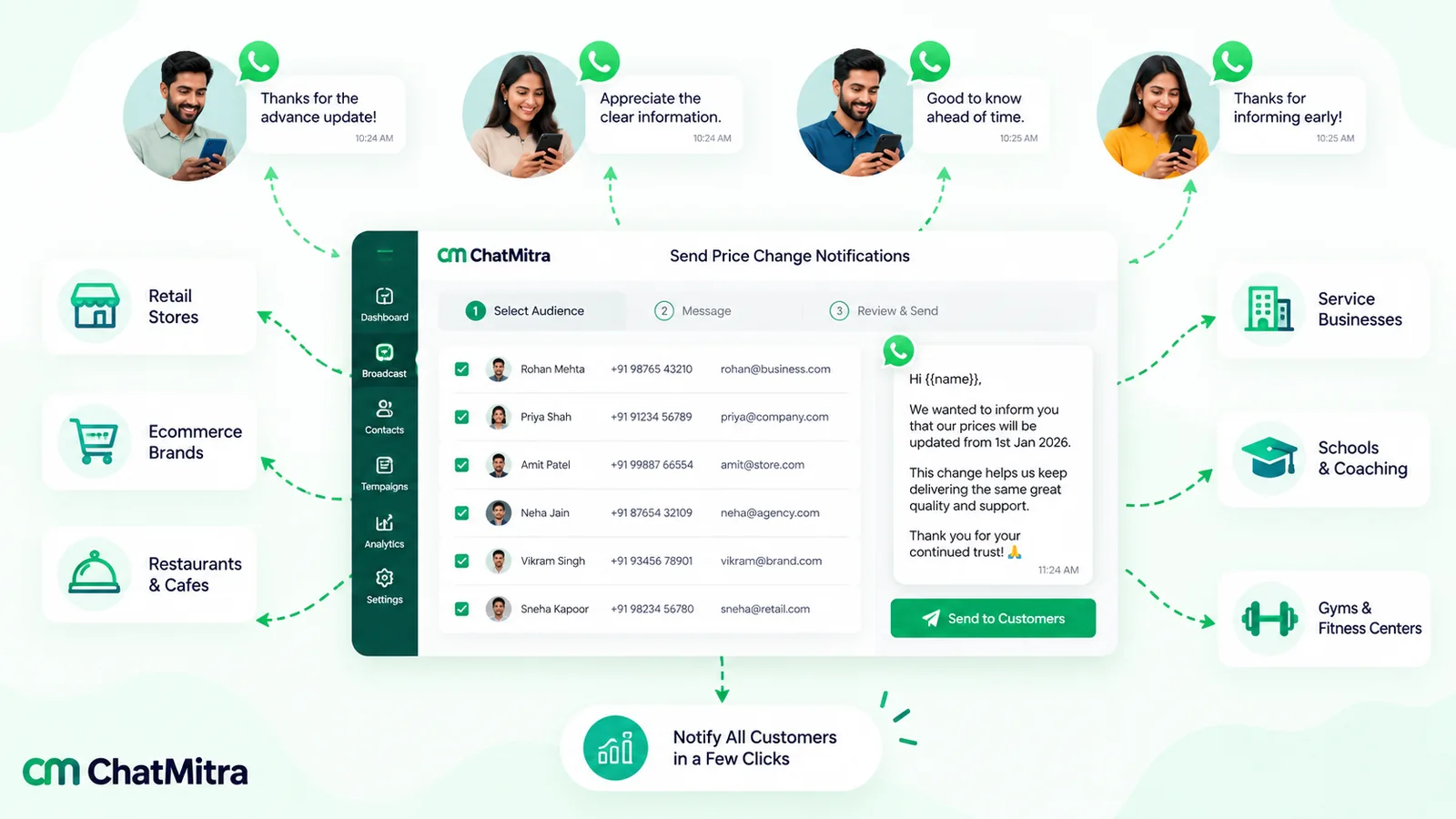
A price increase letter tells customers what’s changing, the old and new price, the date the new price starts and, in a sentence or two, why. It then gives them a choice: accept it, move to another plan, or cancel. Send it with real notice, keep it under 200 words, and follow it with a short reminder.
Below are 30 templates: letters, emails, short WhatsApp and SMS messages, public notices and replies to pushback, followed by notice periods, legal points and WhatsApp rules.
Key takeaways
- Put the new price and the date in the first two lines. Customers who have to hunt for the number assume you're hiding it.
- Give every customer a next step, including an easy way to leave. It costs less trust than a trap.
- Call your largest accounts before the letter arrives.
Legal and platform points were checked on 27 September 2026 against the California Business and Professions Code, Reserve Bank of India circulars, the CCPA's dark-pattern guidelines, WhatsApp's messaging policy and Meta's developer documentation, including its INR rate card. Rupee figures are Meta's India rates and exclude tax. This guide is not legal advice.
What is a price increase letter?
A price increase letter (also called a price increase notice or, in Indian B2B trade, a price revision letter) tells existing customers that a price will go up from a set date. It can be a letter, an email or a WhatsApp or SMS message. The name changes with the business:
| Name | Usually sent by | Usually sent to |
|---|---|---|
| Price increase letter | Product businesses, shops, SaaS | Customers and subscribers |
| Rate increase letter | Consultants, agencies, accountants, tutors, freelancers | Clients on hourly, daily or retainer fees |
| Price revision letter | Manufacturers and distributors | Dealers, retailers and stockists |
| Cost increase letter | Suppliers passing on a cost | Buyers and purchase teams |
| Fee revision notice | Schools, coaching centres, clinics, societies | Parents, patients and members |
What to include in a price increase letter
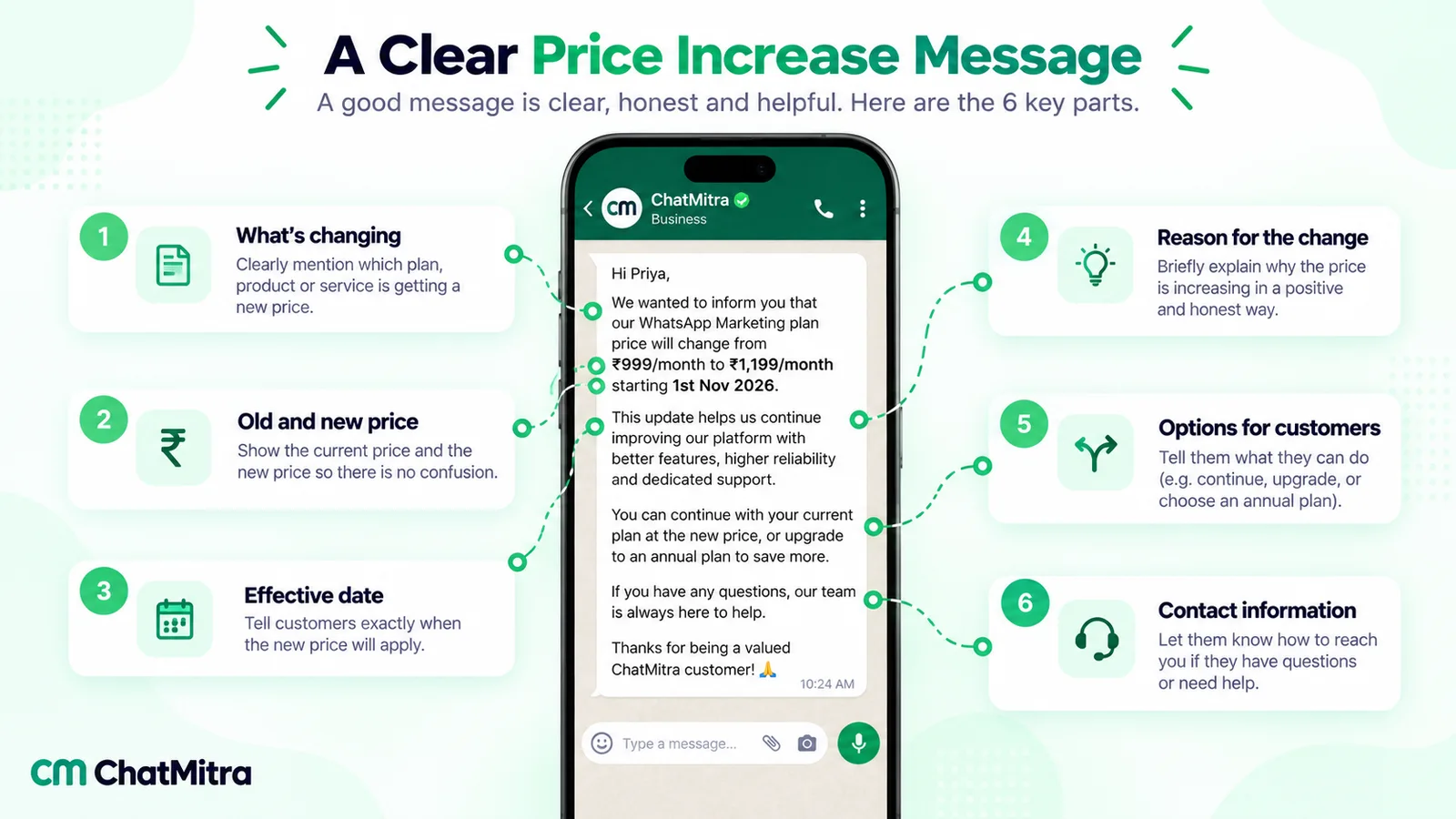
Every template below is built from the same six parts. A short message can drop two of them; a letter to a contract client needs all six.
| Part | What it sounds like | What to avoid |
|---|---|---|
| 1. What's changing | "The monthly price of your Standard plan" | "Some of our prices" when you mean one product |
| 2. Old and new price | "From ₹800 to ₹880 a month" | Only a percentage, or only the new price |
| 3. Effective date | "From your bill on 1 February" | "Soon" or "from next quarter" |
| 4. The reason, briefly | "Our paper and courier costs have risen twice this year" | A paragraph of justification, or no reason at all |
| 5. Their options | "Switch to Basic, pay yearly at today's rate, or cancel here" | Hiding the cancel route |
| 6. A person to contact | "Reply here or call Meera on [number]" | A no-reply address |
Two details make a letter feel fair: say what doesn’t change, and what happens to anything already agreed, such as quotes, open orders and prepaid periods.
In the templates, words in [brackets] are placeholders.
Formal price increase letter templates
Use a full letter for contract clients, distributors and anyone who files paper, on letterhead or as a PDF.
1. Price increase letter to customers (general business)
Dear [Customer name],
Thank you for buying from [Business name] over the past [period].
From [effective date], the price of [product or service] will change from [old price] to [new price]. Our costs for [the main cost, e.g. raw material, fuel, rent] have risen by more than we can absorb without cutting quality.
The [specification], delivery schedule and team stay the same. Orders confirmed before [effective date] will be billed at the current price.
To discuss volumes or payment terms, please contact [name] on [phone] or [email]. Thank you for your continued business.
Yours sincerely, [Name], [Title]
2. Rate increase letter to clients (services)
Dear [Client name],
I’m writing to let you know that my rates will change from [effective date].
Your current rate of [old rate] per [hour/day/month] will become [new rate]. This is the first change since [year], and it reflects [the real reason: more senior staff on your account, new software you now benefit from, rising costs].
Work already agreed under our current statement of work will be billed at today’s rate until [date]. If you’d prefer to reduce the scope to keep your monthly spend the same, I’ve outlined two options in the attached note and I’m happy to go through them on a call.
Kind regards, [Name]
3. Price revision letter to distributors and dealers
To: All authorised distributors and dealers Subject: Revision of trade prices from [effective date]
Dear Partner,
Due to a sustained increase in [input costs, e.g. copper, resin, freight], we are revising our trade prices with effect from [effective date]. The revised price list is attached, with old and new prices shown side by side for each item code.
Purchase orders received and confirmed before [cut-off date] will be supplied at the existing prices. Schemes and credit terms already communicated for this quarter remain unchanged.
Please update your retail price lists. For any clarification, contact your area manager or write to [email].
For [Company name], [Name], [Designation]
4. Fee revision letter to parents (coaching centre or school)
Dear Parents,
From the [month] term, the monthly fee for [course/batch] will change from [old fee] to [new fee].
This lets us keep batches at [number] students and pay our teachers fairly. Timings and study material stay the same.
Fees already paid in advance will not change. If the new fee is a difficulty for your family, please speak to [name] in confidence; we would rather find a way than lose a student.
Warm regards, [Name], [Institute]
Example 4’s last line is deliberate: where a rise could push someone out of education or healthcare, say that help exists.
Price increase email templates
Email suits subscriptions, online stores and recurring clients, because people can find it again when the bill arrives. Keep subject lines plain, such as “Your [plan] price is changing on [date]”. Subjects that look like a promotion (“Act now!”) make readers feel tricked.
5. Subscription or SaaS price change email
Subject: Your [plan] price is changing on [date]
Hi [Name],
From your first bill on or after [date], your [plan] plan will cost [new price] a [month/year], up from [old price].
Since [year], we’ve added [two or three real improvements] without changing the price.
You don’t need to do anything to keep your plan. If you’d rather switch to [cheaper plan] or cancel, you can do it any time before [date] from [where/link], and you won’t be charged the new price.
Questions? Just reply to this email.
Thanks, [Name]
6. Existing customers keep their price for a while (grandfathering)
Subject: New prices for new customers, and what it means for you
Hi [Name],
From [date], new customers will pay [new price] for [product/plan]. As an existing customer, you’ll keep your current price of [old price] until [date], [number] months from now.
We’ll remind you a few weeks before your price changes. Thank you for being an early customer.
[Name]
7. Online store price update
Subject: An update to our prices from [date]
Hi [Name],
From [date], prices on around [number] of our [products] will rise by [range, e.g. ₹20 to ₹60]. [Product families] stay at today’s prices.
Our [main cost] has gone up this year, and we’d rather adjust prices than use cheaper [materials/packaging]. Anything in your cart or already ordered before [date] keeps today’s price.
See you soon, [Store name]
8. Membership or gym renewal price
Subject: Your membership renewal price from [date]
Hi [Name],
When your membership renews on [renewal date], it will cost [new price] for [period], up from [old price]. Your classes and trainer sessions stay the same. To pause, change or cancel before renewal, reply here or ask at the front desk.
See you soon, [Name]
9. Annual contract renewal (B2B)
Subject: [Client company] contract renewal: pricing for [year]
Dear [Name],
Ahead of your renewal on [date], here is our pricing for next year. Your annual fee will be [new amount], compared with [old amount] this year, an increase of [x]%. Service levels and your account team stay the same, and the revised order form is attached.
Happy to walk you through it, or to look at a two-year term at a fixed price.
Best regards, [Name]
10. Reminder email, a week before
Subject: Reminder: your new price starts on [date]
Hi [Name],
A quick reminder that from [date], [plan/product] will cost [new price]. We wrote to you about this on [first notice date].
If you’d like to change or cancel before then, you can do it from [where]. Otherwise, there’s nothing you need to do.
[Name]
Short price increase messages for WhatsApp and SMS
Short messages reach customers who never read email. Keep them to four lines, and send them only to people who agreed to hear from you on that channel. Our WhatsApp opt-in guide covers how to collect that consent.
- Retail shop: “Hi [Name], a note from [Shop]: from [date], prices on some [category] items will go up by ₹[range] because our supplier rates have increased. Everything bought before [date] is at today’s price. Thank you for shopping with us.”
- Restaurant or cloud kitchen: “Hi [Name], from [date] our menu prices will rise by about [x]% to cover higher [ingredient/gas] costs. Your favourites and portion sizes stay the same. Thank you for ordering from us.”
- Salon or spa: “Hi [Name], from [date], a haircut at [Salon] will be ₹500 (currently ₹450). Appointments already booked before [date] stay at the current price. Reply here if you’d like to book.”
- Clinic consultation fee: “Dear [Name], from [date], the consultation fee at [Clinic] will be ₹[new] instead of ₹[old]. Follow-up visits within [days] remain free. For questions, please call us on [number] during clinic hours.”
- Coaching or tuition fees: “Dear Parent, from the [month] term, the [course] fee will be ₹[new] per month (now ₹[old]). Fees already paid stay the same. Please speak to [name] if you have any concerns.”
- Delivery charge or minimum order: “Hi [Name], from [date], delivery on orders under ₹[amount] will cost ₹[charge]. Orders above ₹[amount] still ship free. Thanks for shopping with us.”
- Home services: “Hi [Name], from [date], our standard AC service visit will be ₹[new] (was ₹[old]). Visits booked before [date] keep the old rate. Reply to book yours.”
- Freelancer or agency retainer: “Hi [Name], a heads-up before our next invoice: from [date], my monthly retainer will be [new], up from [old], as discussed in my email today. Happy to talk it through this week.”
- Daily delivery (milk, tiffin, newspaper): “Namaste [Name], from [date], your daily [item] will cost ₹[new] instead of ₹[old] because our supplier has raised rates. Your delivery time stays the same. Reply STOP here to pause.”
- Hinglish, for a local shop: “Namaste [Name] ji, [date] se [product] ka rate ₹[old] se ₹[new] ho raha hai. Supplier rates badhne ki wajah se yeh badlav hai. Aapke saath ke liye dhanyavaad. Team [Shop] ki taraf se.”
- Wholesale rate list: “Dear [Name], our revised rate list is effective from [date]. PDF attached, old and new rates side by side. POs confirmed before [date] will be billed at current rates. Call [name] for any clarification.”
- Three days before: “Hi [Name], a reminder from [Business]: the new price of ₹[new] for [product] starts on [date]. Reply here if you have any questions.”
- On the day: “Hi [Name], our new prices are live from today. Thank you to everyone who wrote to us with questions. We’re always happy to help: just reply here.”
If you use “Reply STOP” (example 19), make sure someone removes the person; not every tool does it automatically.
Notices for your website, counter and invoices
New and walk-in customers need to see the change where they buy.
- Website banner or pricing page note: “Our prices are changing on [date]. Current customers: your price is protected until [date]. See what’s changing.”
- Counter or notice board: “Dear Customers, due to increased [costs], our prices for [category] are revised from [date]. We thank you for your understanding and continued support. — [Shop name]”
- Line on the last invoice at the old price: “Please note: from [date], [service] will be billed at [new rate]. Details were sent to you on [date].”
How to reply when customers push back
A calm, prepared reply keeps most customers who write back. Save these where your team can find them.
- “That’s too expensive.” “I understand, and thank you for telling us. If the new price doesn’t work, [cheaper option] costs [price] and covers [what matters to most customers]. Would that suit you better?”
- “[Competitor] is cheaper.” “They may well be for some things. What you get with us is [one or two concrete differences, e.g. same-day service, a named contact]. If price matters more than those, I’d understand, and you can switch any time.”
- “Can I keep my old price?” “We can’t keep the old price for everyone, but we can hold it until [date] if you [pay yearly / renew for 12 months / place your order before date]. Want me to set that up?”
- “I want to cancel.” “Sorry to see you go, and thank you for being with us. I’ve cancelled your [plan] from [date], and you won’t be charged the new price. If you ever want to come back, just message here.”
Example 30 matters most: a customer who leaves easily may return.
How much notice should you give?
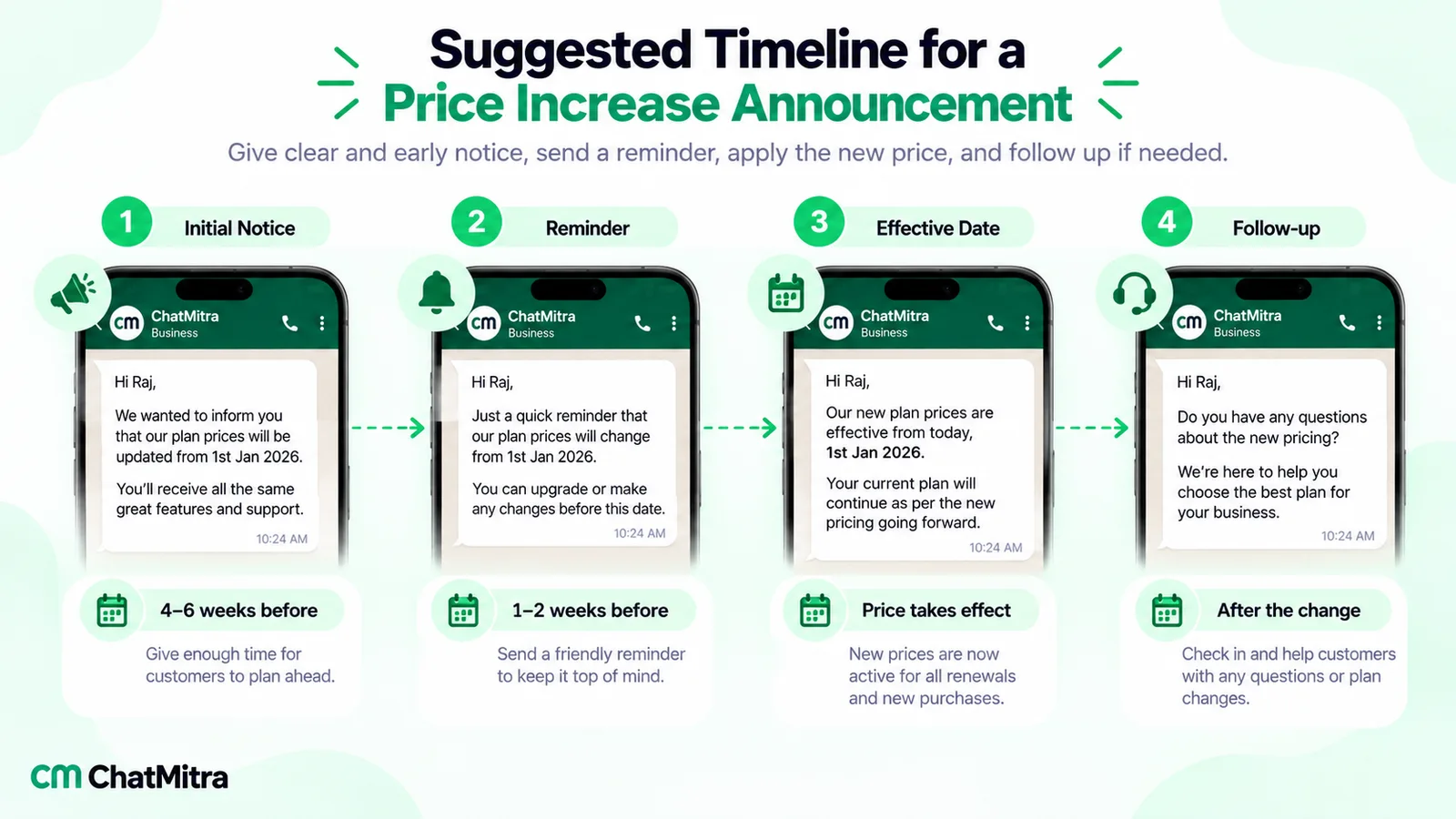
Your contract’s notice period comes first. Beyond that, match the notice to how hard it is for the customer to adjust.
| Situation | Suggested notice | Why |
|---|---|---|
| B2B clients and distributors | 30–90 days, or what the contract says | They need to update budgets, quotes and their own price lists |
| Auto-renewing subscriptions, customers in California | Between 7 and 30 days before the change (legal window) | Set by California law; see below |
| Other subscriptions and memberships | At least one full billing cycle | Gives time to switch plans or cancel before the new charge |
| Retail shops, restaurants, salons | 1–2 weeks | Regulars notice; walk-ins see the board |
| Schools, coaching, clinics | Before the next term or billing month | Families plan these costs in advance |
Then send a reminder message a week or three days before, and a note on the day if the change is large.
Price increases and the law: points to check
The rules depend on where your customers are and how they pay. This isn’t legal advice; check with a lawyer.
California auto-renewals. Under California’s Business and Professions Code section 17602(g)(2), when the fee under an existing automatic renewal changes, the business must give the consumer, “no less than 7 days and no more than 30 days before the fee change takes effect”, a clear and conspicuous notice of the change, and information on how to cancel in a form the consumer can keep. The amendment applies to contracts entered into, amended or extended on or after 1 July 2025. A “60 days’ notice” letter misses that window, so time a second notice inside it.
India card and UPI auto-debits. Under the Reserve Bank of India’s e-mandate framework (first issued for cards in 2019 and since extended to UPI and prepaid instruments), the customer’s bank sends a pre-transaction notification “at least 24 hours prior to the actual charge”, and the customer can opt out of that charge or the whole mandate. At registration, the customer chooses a fixed amount or a maximum amount. If your new price is above what their mandate allows, the charge may need the customer to approve a new or modified mandate, so tell them before the bill fails, and ask your payment gateway how it handles this.
India’s dark-pattern guidelines. India’s consumer regulator, the CCPA, in its Guidelines for Prevention and Regulation of Dark Patterns, 2023, defines drip pricing to include “charging an amount higher than the amount disclosed at the time of checkout”, and a subscription trap to include making cancellation “impossible or a complex and lengthy process” or hiding the cancellation option. In practice: never apply the new price to an order already placed, and make cancelling as easy as the notice says it is.
Contracts. For B2B customers, read the price-change clause first: some fix prices for a term, others allow changes with notice.
Sending price change notices on WhatsApp
On the WhatsApp Business Platform, a notice sent outside a 24-hour customer service window must be an approved template, and its category decides what you pay and who you can reach.
Utility or marketing?
Meta’s template categorisation guidelines say a utility template must be “non-promotional” and “specific to or requested by the user (clearly related to their order, account, services, or transactions)”. One utility objective, Account Alerts or Updates, covers “information specific to purchased or subscribed products/services”, with the condition that these messages “should not promote, recommend, upsell, or cross-sell products; include offers; or attempt to secure renewals”. Meta’s own example is a billing reminder: “Your monthly payment for {{service}} will be billed on {{date}}”.
| Your message | Likely category | Why |
|---|---|---|
| "From [date], your [plan] will cost [new price]. Reply to change or cancel." (to subscribers) | Utility | Specific to their subscribed service, no promotion |
| The same notice plus "Pay yearly now to lock in today's price" | Marketing | An offer and an attempt to secure a renewal |
| "Prices go up next week, stock up now!" (to all past buyers) | Marketing | Intended to drive sales |
| Revised rate list sent to a distributor about their account | Possibly utility | Depends on the wording; any scheme or push makes it marketing |
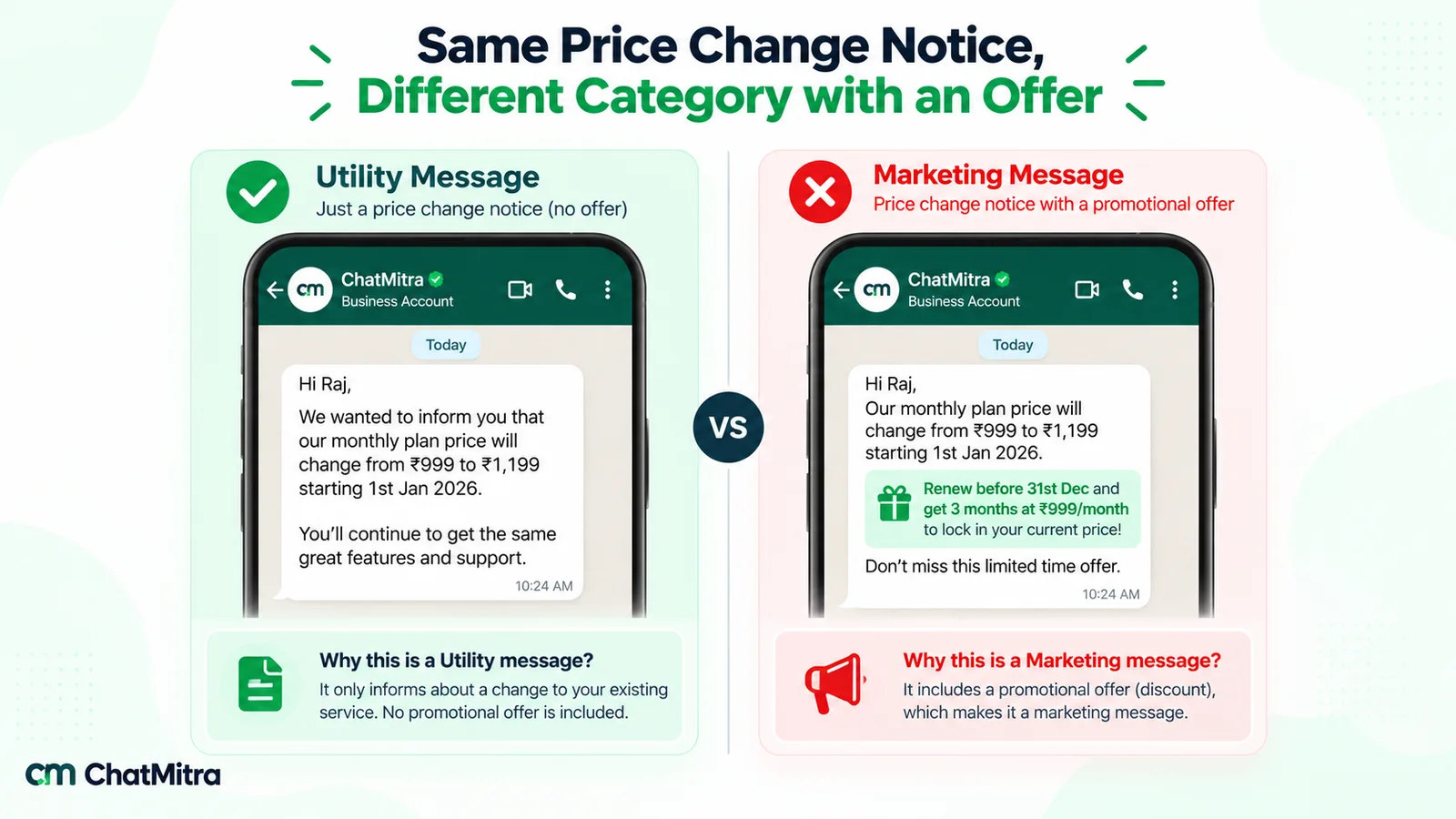
Meta decides from the content, and says automatic category updates can apply to any approved template that breaks its guidelines, including “templates whose category was previously confirmed by a review”. One enforcement level recategorises all of an account’s utility templates to marketing for 7 days, or 30 for repeat violations. Keep a plain notice and any offer as separate templates.
Two practical limits from Meta’s template review page: the text can’t begin or finish with a variable (“dangling parameters are not allowed”), and approval “can take up to 24 hours”. Submit it early.
Who you can reach, and when
- Opt-in: the WhatsApp Business Messaging Policy requires opt-in permission before you message people, and suggests getting separate opt-in by message category.
- Replies don’t need a template: when a customer writes back, you can answer in your own words for 24 hours; the policy says that window “opens and resets with each user message”.
- US numbers: marketing templates currently aren’t delivered to WhatsApp users with US (+1) numbers, according to Meta’s per-user limits documentation. That doesn’t touch a plain utility notice, but a promotional announcement to US customers needs email or SMS.
What it costs in India
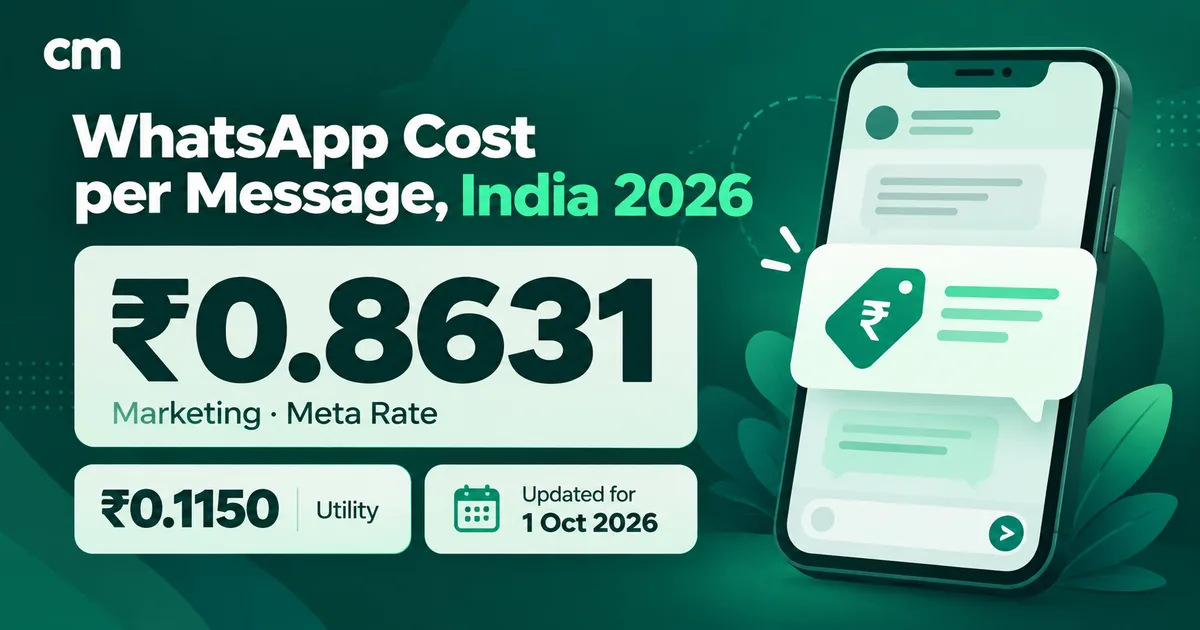
Meta bills each delivered template. Its India rate card lists ₹0.8631 per marketing message and ₹0.1150 per utility message. Since 1 October 2026, service replies also cost ₹0.1150, after 1,000 free service messages per business phone number each month.
| Notice to 500 subscribers | Meta charge per message | Meta total |
|---|---|---|
| Plain notice, approved as utility | ₹0.1150 | ₹57.50 |
| Notice with an offer (marketing) | ₹0.8631 | ₹431.55 |
Platforms add their own fee. ChatMitra’s Starter plan adds up to ₹0.20 for each contact in a 24-hour conversation: up to ₹100 more for 500 people. More worked examples are in our guide to WhatsApp business message costs.
How to announce a price increase, step by step
- Decide the numbers. The percentage change is (new − old) ÷ old × 100, so ₹800 to ₹880 is 10%.
- Choose who it applies to. Everyone, new customers only, or existing customers after a grace period (example 6).
- Check the rules. Contract clauses, the California window, and e-mandate limits for Indian auto-debits.
- Write the notice and the replies. One letter or email, one short message and the four replies above.
- Call your biggest accounts first. A key client should never learn about it from a broadcast.
- Send the first notice by letter or email, plus a message for customers who prefer WhatsApp or SMS.
- Update public prices with the effective date shown.
- Send the reminder.
- Switch on the date, keeping earlier confirmed orders at the old price.
- Follow up. Answer questions fast, process cancellations promptly and note the objections for next time.
Mistakes that make a price increase worse
- Burying the number below paragraphs of values reads as evasive.
- Surprising people on the bill. A higher charge with no notice turns a price change into a complaint. If it happens by mistake, own it quickly; our apology messages for customers cover billing errors.
- Vague reasons. “Market conditions” sounds like an excuse.
- Mixing the notice with a sale. “Prices are going up, but here’s 20% off” confuses customers and, on WhatsApp, turns the notice into marketing.
- Making cancellation hard. It breaks trust and, in India, can look like a subscription trap.
- Forgetting the team. Staff who hear about it from an angry customer can’t answer well.
Where ChatMitra fits, and where it doesn’t
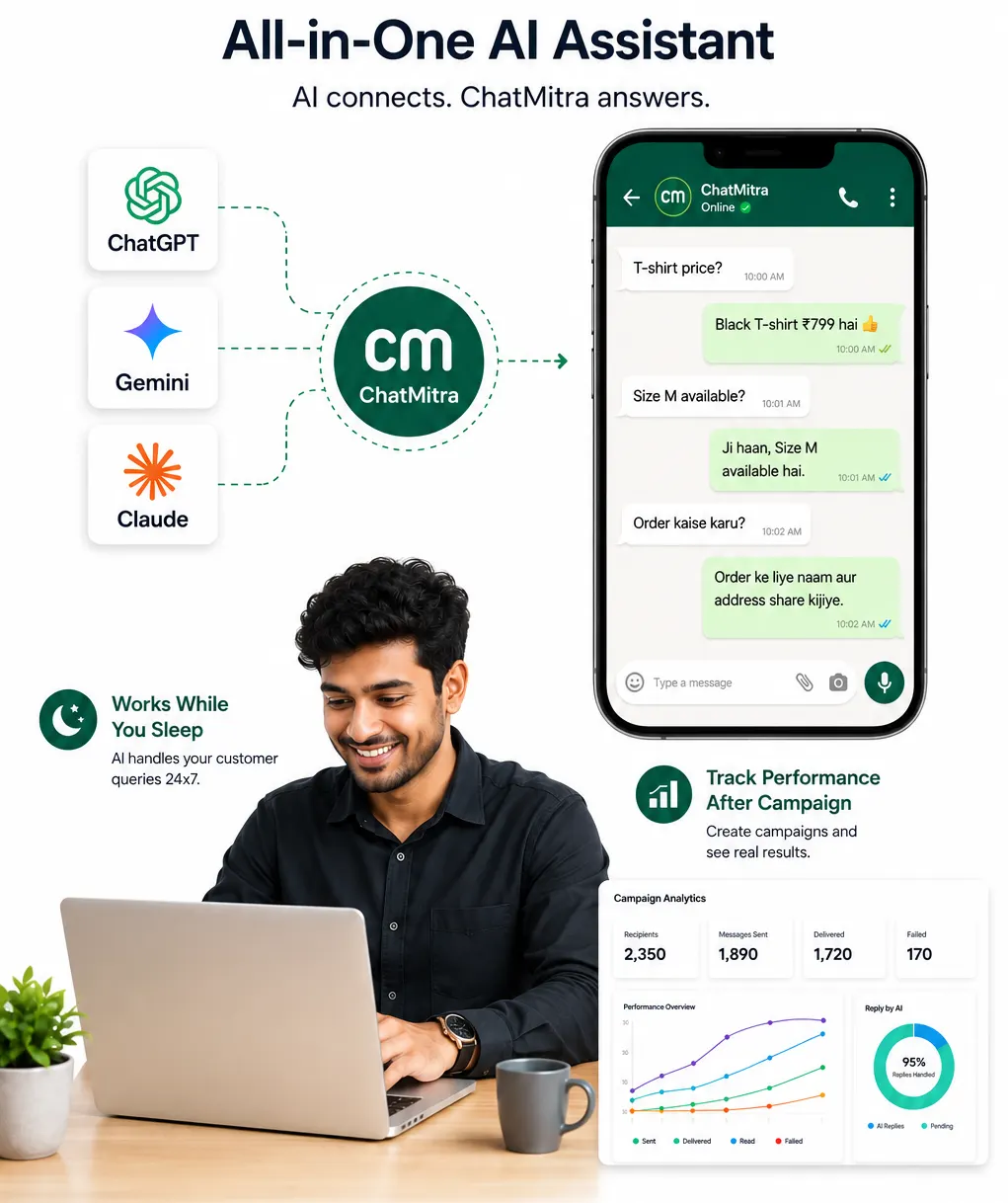
ChatMitra handles the WhatsApp side: sending the notice, answering replies and tracking delivery. It doesn’t change prices in your store or billing system.
| Job | ChatMitra? | How |
|---|---|---|
| Send the notice to one group, such as subscribers or distributors | Yes | Broadcast an approved template to contacts with a tag, or exclude a tag |
| Schedule the notice and the reminder | Yes | Schedule each campaign for a date and time; a scheduled campaign can be stopped before it sends, but not edited |
| Answer replies as a team | Yes | Shared inbox on one number, with saved replies (such as examples 27–30) inserted by typing "/" |
| See whether the notice arrived | Yes | Each campaign's report counts messages sent, delivered, read and failed |
| Ask Meta to review a template's category | Yes | A "Request Review Template Category" link on the template page opens Meta's review |
| Email, SMS or printed letters | No | Use your email or SMS provider alongside |
| Change prices in your store or billing system | No | Update them where you sell and bill |
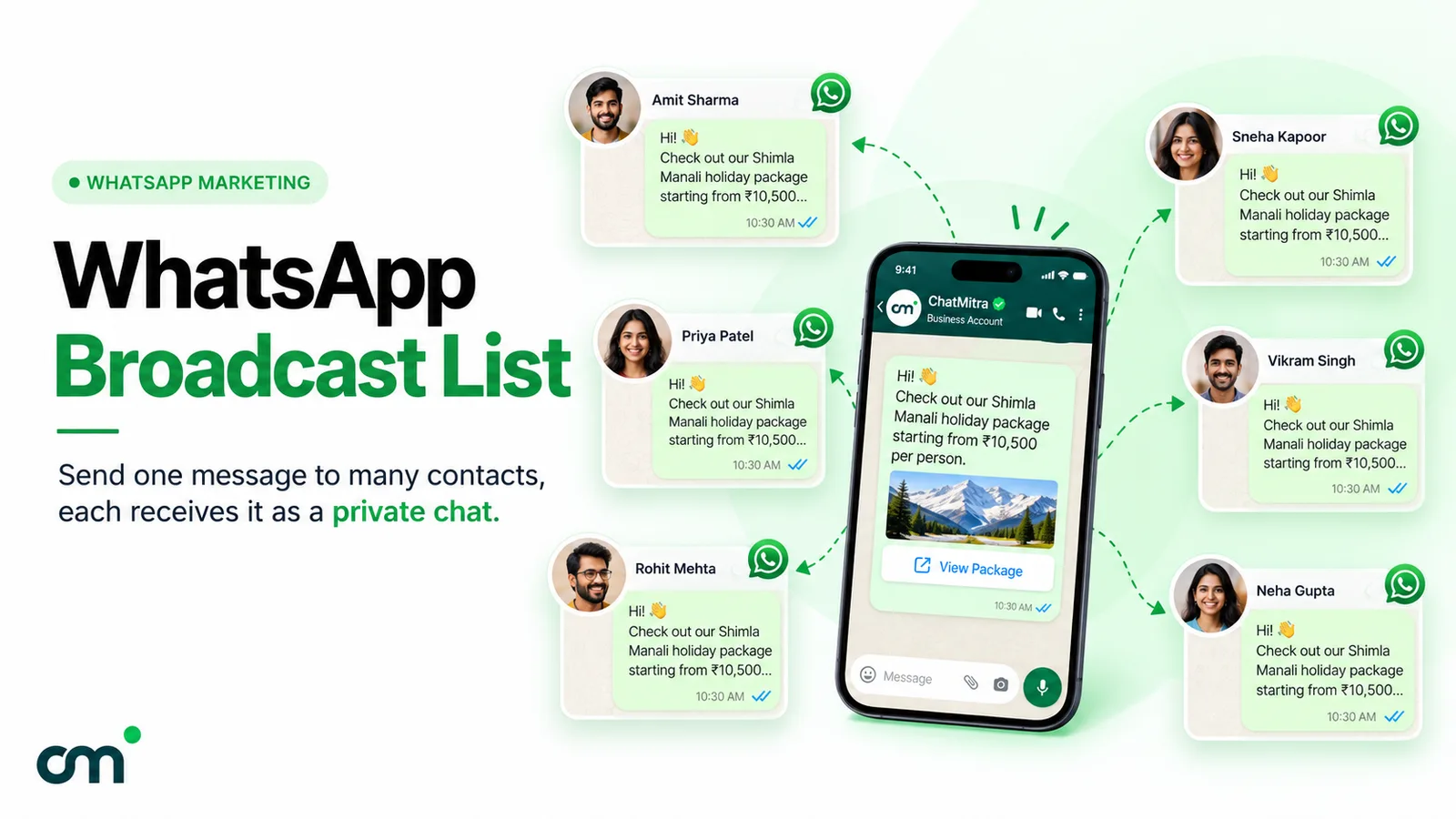
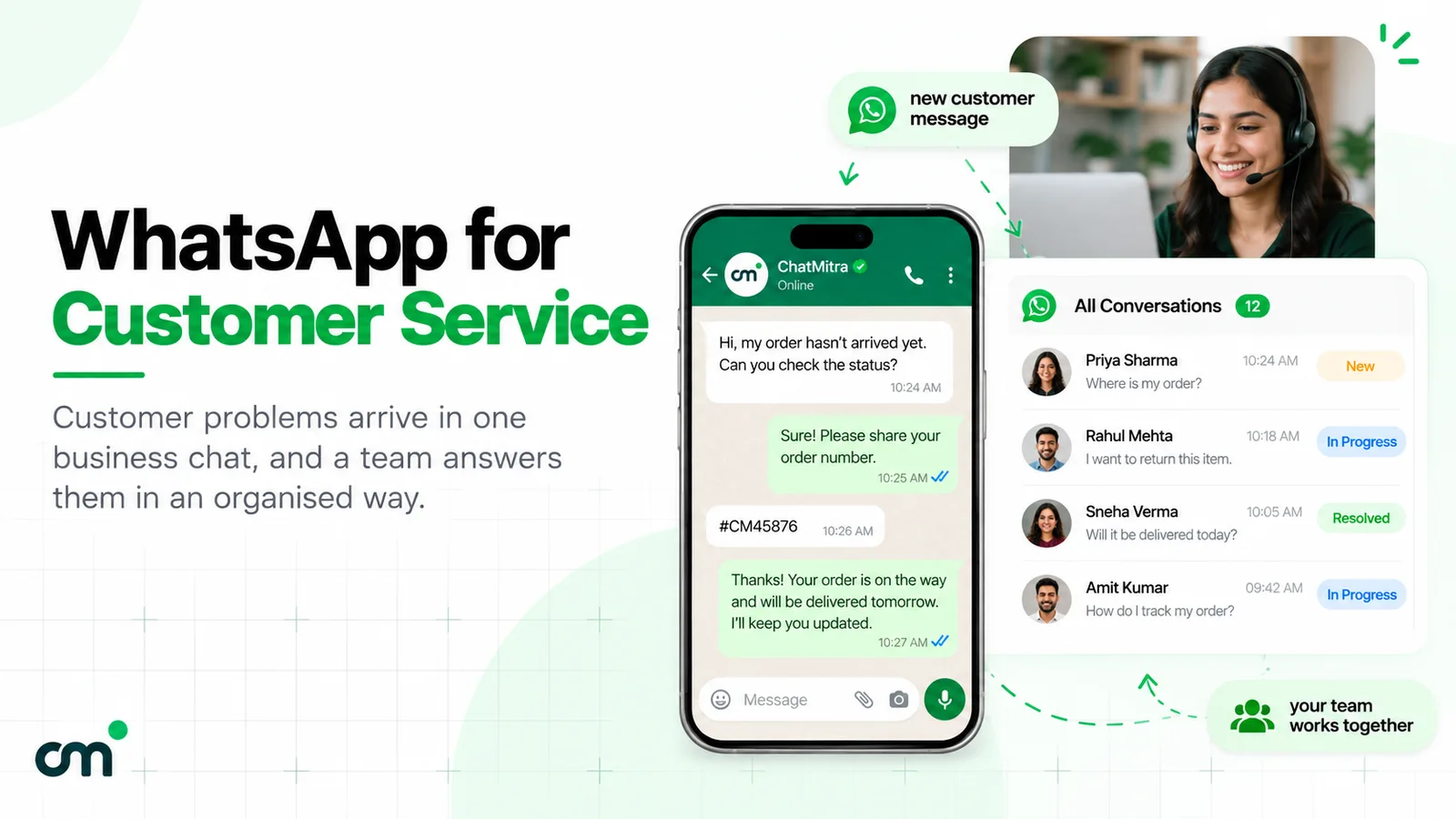
Contacts can be imported from a CSV file with tags. Opted-out contacts are not removed from a broadcast for you; keep them in an “opted-out” tag and exclude it. For handling replies, see our WhatsApp customer service guide; for sending to many customers at once, our guide to WhatsApp broadcast lists; and for timing the reminder, how to schedule WhatsApp messages. ChatMitra’s plans and pricing show what each plan includes.
Where to start
Pick the template closest to your business, fill in the old price, the new price and the date, and cut anything that isn’t one of the six parts. Then write your reply to “Can I keep my old price?” before you send anything, because it’s the first question you’ll get.