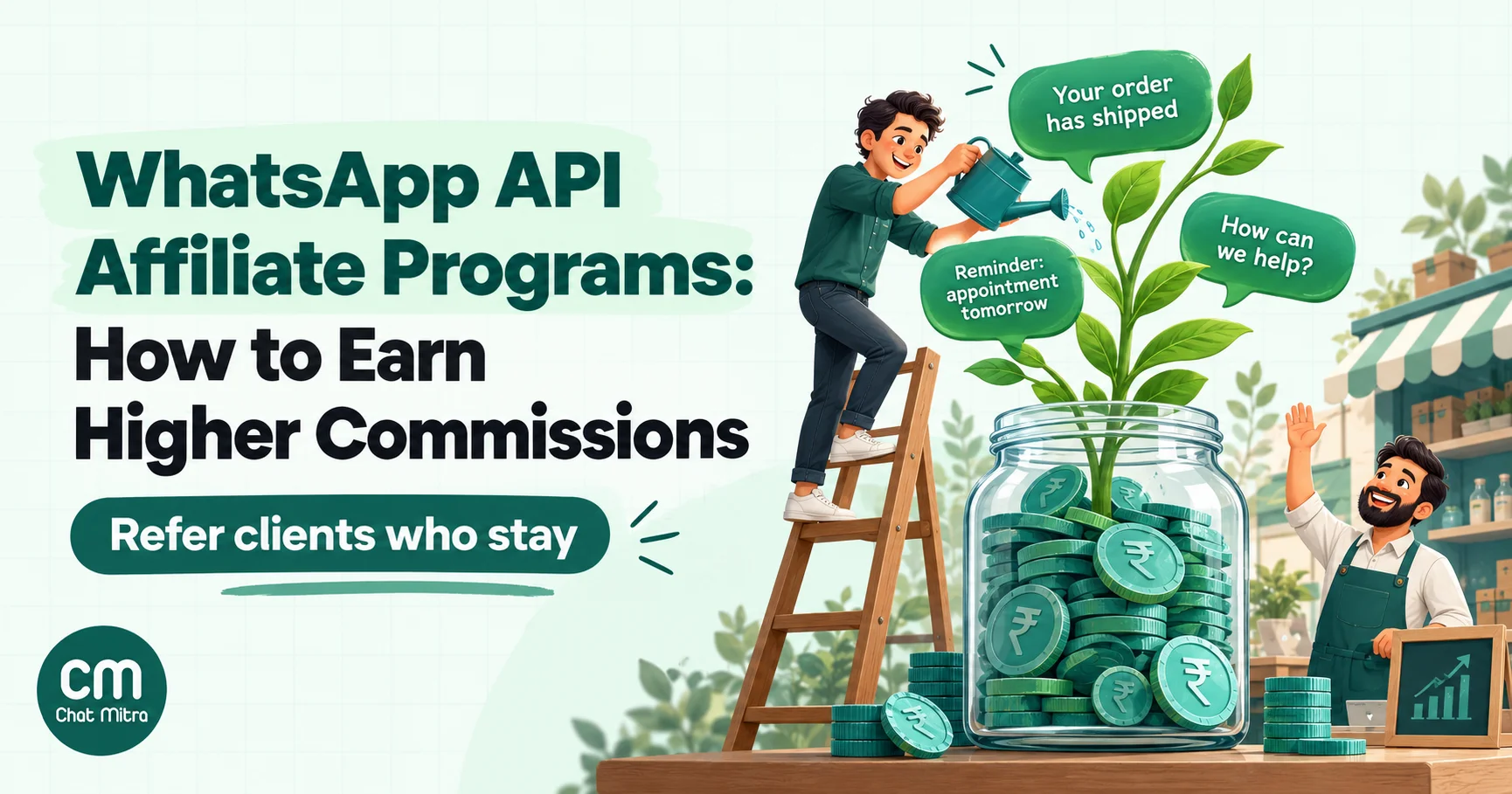
A WhatsApp API affiliate program pays you a commission when a business you refer signs up with a WhatsApp Business Platform provider and pays for it. The provider bills the business and supports it; you make the introduction. How much you earn depends less on the headline percentage than on what the commission is calculated on, how long it lasts, and whether the business you referred actually keeps using WhatsApp.
This guide is for agencies, freelancers, consultants, creators and existing WhatsApp API customers who want to earn from recommending a platform. It explains the four kinds of partner deals, how commissions are really worked out, what published programs offered when we checked them on 30 September 2026, and how to refer businesses that stay. It also covers the rules on promoting a referral link on WhatsApp, and how ChatMitra’s own Invite & Earn program works.
A note on who’s writing: ChatMitra is a WhatsApp Business API platform with its own referral program. We describe it in its own section, and we’ve tried to make the rest of the guide useful whichever program you join.
Key takeaways
- Compare programs on the commission base, the duration, the payout form and the cancellation rules, not only the percentage.
- The client's lifetime is the biggest lever. Refer businesses with a weekly messaging need, and help them go live.
- An affiliate introduces; a reseller sells, bills and supports. Reselling pays more per client and asks far more of you.
- Never bulk-message your referral link on WhatsApp, and always disclose that you earn from the recommendation.
What is a WhatsApp API affiliate program?
It’s an arrangement between you and a company that sells access to the WhatsApp Business Platform, often called the WhatsApp Business API. The company gives you a tracked link or a code. When a business signs up through it and pays, the company pays you a share of that payment.
Three parties are involved, and it helps to keep them straight:
- Meta runs WhatsApp and charges for delivered template messages, at rates that depend on the message category and the recipient’s country. Those charges reach the business either directly or through its provider.
- The provider (ChatMitra, AiSensy, Wati, Gallabox, Interakt and many others) gives the business a dashboard, an inbox, broadcasts, automation and support, and charges for that through subscriptions, per-message fees, wallet recharges or a mix.
- You, the affiliate, bring the business to the provider.
Commission almost always comes out of the provider’s revenue. That’s why most programs calculate it on the provider’s subscription rather than on the whole bill, and why a business that spends heavily on messages may earn you surprisingly little under some programs. We come back to this below, because it’s the most common source of disappointment.
If you’ve never used the API yourself, read how to get the WhatsApp API first. You’ll recommend it more convincingly once you know what a client has to go through to get live.
Affiliate, referral, reseller and Meta partner: four different deals
“Partner” is used loosely across the industry. These four arrangements sound similar but ask very different things of you.
| Affiliate | Customer referral | Reseller / agency partner | Meta Solution Partner or Tech Provider | |
|---|---|---|---|---|
| Who it's for | Anyone with a business audience: agencies, creators, consultants | Existing customers of the platform | Agencies that manage WhatsApp for clients | Software companies that build and run the platform |
| Who bills the client | The provider | The provider | Usually you, or the provider under a partner agreement | You (Solution Partners can invoice clients for platform usage) |
| Who supports the client | The provider | The provider | Usually you, at least first-line | You |
| What you earn | A commission, often recurring for a set period | A reward, often one-time, sometimes as account credit | A margin or discount on what the client pays | Your own revenue from clients |
| Effort | Low | Low | High | Very high (Meta app review, verification, engineering) |
Affiliate programs are the lightest commitment. You don’t touch the product on the client’s behalf, and your earnings stop the moment the client leaves.
Customer referral programs reward people who already use a platform for bringing in others. The rewards are usually smaller or paid as account credit, because the program is designed to lower your own costs rather than to be a second income.
Reseller and agency arrangements suit businesses that already manage marketing for clients. You own the relationship, often bundle WhatsApp with other services, and earn more per client. You also take on onboarding, template writing, troubleshooting and sometimes collections.
Meta’s partner routes are a different world. Meta’s developer documentation describes Solution Partners as Meta Business Partners that provide “a full range of WhatsApp Business Platform services to other businesses (clients), such as messaging services, billing, integration support, and customer support”. It says Solution Partners have credit lines they can extend to clients and can invoice them directly, while Tech Providers can offer the same services but without credit lines, so their clients add their own payment method. Becoming either means building and operating software. It is not a way to earn commission from referrals.
If you’re an agency wondering which of these to pursue, the honest answer is usually to start as an affiliate with one platform you know well. Then move to a reseller agreement once you’re onboarding enough clients each month that the extra margin pays for the support work.
How WhatsApp API commissions are actually calculated
Two programs can both say “20%” and pay wildly different amounts. These are the terms that decide the real number.
1. The commission base
What is the percentage applied to?
- Subscription only. The most common. You earn on the monthly or annual plan, not on messaging spend.
- Subscription plus usage. Some higher tiers also pay on message charges or wallet recharges. For clients who send a lot, this can matter more than the rate itself.
- First payment only. Common in customer referral programs. You earn on one transaction.
Messaging is where much of a WhatsApp API client’s money goes, so a program that pays on usage can be worth more at a lower rate. It depends on how the provider charges. A platform with a small subscription and a large per-message fee is the opposite of one with a large subscription and no per-message fee.
2. The duration
- One-time: paid once, on the first qualifying payment.
- Time-limited recurring: paid on every payment for the first 12 or 24 months.
- Lifetime recurring: paid for as long as the client stays.
3. The payout form
Cash, paid monthly by bank transfer or PayPal, is what most affiliates expect. Some programs pay in account credit or wallet money instead, which is only useful if you’re a customer yourself. Others pay in gift vouchers. Check which you’ll get before you invest time.
4. The rules that can cancel a commission
- Attribution window: how long after a click a signup still counts. Ninety days is common.
- Qualification rules: many programs count a referral only after the client pays, not when it signs up.
- Hold periods: commissions are often locked for a few weeks so refunds and fake signups surface first.
- Minimum payouts or claim thresholds: you may need to reach a balance before you can withdraw or claim.
- Caps: a ceiling on any single reward.
- Clawbacks: a commission can be reversed if the client’s payment is refunded or charged back.
- Self-referral rules: referring your own business, or a second account you control, is almost always excluded.
A worked comparison
The figures below are made up to show the arithmetic. They aren’t any provider’s prices. Imagine a client who pays a platform ₹3,000 a month and stays for 24 months.
| Program structure | How it's calculated | You earn over 24 months |
|---|---|---|
| 20% of the first payment, once | 20% × ₹3,000 | ₹600 |
| 15% recurring for 12 months | 15% × ₹3,000 × 12 | ₹5,400 |
| 20% recurring for 24 months | 20% × ₹3,000 × 24 | ₹14,400 |
| 15% recurring for life | 15% × ₹3,000 × 24 (and beyond) | ₹10,800, and still paying |
Now change one thing: the client leaves after two months. The one-time program still pays ₹600. Every recurring program pays ₹900 or ₹1,200. The spread between programs shrinks from ₹13,800 to ₹600.
That’s the lesson most “earn higher commissions” pitches skip. The rate and the duration only matter if the client stays, and whether the client stays depends mostly on what you refer and how.
What published programs offered (checked 30 September 2026)
These are the terms each provider published on its own pages on the day we checked. Programs change often, and several have more than one tier, so treat this as a snapshot and read the current terms before you join.
| Provider | Published commission | Duration | Other terms stated |
|---|---|---|---|
| AiSensy (Affiliate Partner) | 15% recurring on subscriptions | Monthly, while the client stays | A higher "Prime Plus" tier of up to 30% recurring that also covers conversation charges and Meta ads, according to AiSensy's July 2026 blog post |
| Wati | 15–20% of subscription revenue | First 12 months | 90-day cookie; monthly payouts through PartnerStack to PayPal or a bank account; the client must sign up and pay |
| Gallabox (affiliate) | 20% on a new customer's first purchase and future upgrades | Not stated on the page | 90-day cookie period |
| Interakt (Freemium partner) | Recurring commission; rate not published | "On every active subscription with no cap on earnings" | Monthly payouts; higher tiers offer higher commission and leads |
| ChatMitra (Invite & Earn) | A percentage of the referred business's first qualifying payment, paid as referral wallet money | One-time per referred business | Hold period, claim threshold and per-reward cap; claimed as credits or a plan, not cash. Details below |
Two things stand out. First, most affiliate programs pay on subscriptions only. Second, the published pages rarely say what a typical partner earns, and income totals quoted in marketing are not the same as typical results.
What “higher commissions” really depends on
A higher rate helps. But across every structure above, your income is roughly number of clients × monthly spend × months paid. Rate negotiations touch the second term. The six habits below move all three.
Refer businesses with a repeat messaging need
A WhatsApp API account earns its keep when it sends something every week. The clients who stay are the ones where WhatsApp is part of how the business runs, not a one-off campaign tool:
- online stores sending order confirmations, delivery updates and cart reminders;
- clinics, salons and coaching institutes sending appointment and fee reminders;
- lenders and insurers sending payment reminders and renewal notices;
- real estate, education and automotive businesses following up enquiries from ads;
- any business with a busy support inbox.
Our guide to WhatsApp Business API use cases by industry goes through these in detail and is a useful way to spot fits in your own network.
Businesses that want to “send a festival offer to everyone once” tend to churn quickly, and some of them want to message people who never opted in. Those are poor referrals on both counts.
Qualify before you refer
A two-minute conversation saves a failed signup. Ask:
- Do they have an opted-in customer list? Meta requires opt-in before a business sends template messages. A business planning to message scraped or purchased numbers will get its number restricted, and your referral will leave. See our WhatsApp opt-in guide.
- Which phone number will they use? A number can be connected to the API and, depending on the setup, may no longer work in the regular WhatsApp app the same way. They should decide this before signing up.
- Do they have a Meta business portfolio, and can they verify the business? Verification isn’t needed to start, but it matters as they grow.
- Have they budgeted for message charges? Meta charges per delivered template, on top of whatever the platform charges. Clients who expected “free WhatsApp” leave angry.
- Who will own it day to day? Someone has to write templates, answer replies and watch results.
Help them go live
Most programs pay on a payment, and the first payment usually follows the first useful send. The gap between “signed up” and “first template approved” is where referrals quietly die. If you can help with the practical steps, such as connecting the number, drafting the first two or three templates, and setting up an auto-reply, your conversion rate rises and so does the chance the client stays.
Sell a service, not just a link
Agencies and consultants earn more by charging for their own work and treating the commission as a bonus. Setup, template writing, chatbot flows, campaign management and monthly reporting are all services businesses pay for, and none of them depend on a program’s terms. Bundling also makes the recommendation more credible, because you’re staying involved.
Match the program to your clients’ spending
If your clients are high-volume senders, a program that pays on usage or recharges beats a subscription-only program at a higher rate. If they’re small businesses on entry plans, a long recurring window matters more than the percentage. Look at what your last five clients would actually have paid, and work the numbers before you choose.
Keep your own records
Log every referral: the date, the business, the link or code used, and when they paid. Tracking breaks for ordinary reasons, such as a client signing up on a different device or typing the website address directly. Your notes are what you’ll need if you have to raise a missing commission.
How to promote a referral link without breaking WhatsApp’s rules or the law
This is where affiliates in the WhatsApp space get into trouble, because the product being promoted is itself a messaging channel.
Don’t spam the link on WhatsApp
It’s tempting to paste your link into every group you’re in, or to broadcast it to your contacts. Don’t. WhatsApp’s Business Messaging Policy says businesses may contact people on WhatsApp only if those people have given their mobile number and agreed to be contacted. Unsolicited bulk messages are also a common reason personal and Business app numbers get restricted or banned. Recommending a platform one-to-one to someone who asked, or to a client you already work with, is fine. Mass-forwarding it is not, and it’s a bad look for someone recommending a tool built on consent.
Better places to share it are a resources page on your website, a tutorial or review on YouTube or LinkedIn, your email newsletter to subscribers, client proposals, and onboarding documents.
Disclose the relationship, every time
India. The Advertising Standards Council of India’s guidelines for influencer advertising in digital media apply to promotional content published from 14 June 2021. They require a disclosure label, such as “Ad”, “Sponsored” or “Collaboration”, when there is a material connection with the brand, placed upfront and prominently rather than buried in hashtags or behind “more”. The Department of Consumer Affairs’ “Endorsements Know-hows!”, issued on 20 January 2023, says influencers must disclose material connections, including monetary compensation, and ties the requirement to the Consumer Protection Act, 2019.
United States. The FTC’s Endorsement Guides, revised in 2023, apply to affiliate marketing. The FTC’s guidance says you should disclose your relationship clearly and conspicuously, and that “the closer the disclosure is to your recommendation, the better”. It also warns that consumers might not understand that the phrase “affiliate link” means you’re paid for purchases.
Elsewhere. Most countries with consumer protection rules expect the same thing: say plainly that you benefit.
Plain wording works best. For example:
- In a blog post, before the first link: “I earn a commission if you sign up for [platform] through my link. It doesn’t change your price.”
- In a video, said out loud near the start and shown on screen: “[Platform] runs a referral program, and I’m part of it.”
- In a proposal to a client: “We recommend [platform]. We’re in its partner program and receive a commission on your subscription.”
Don’t promise what the platform or Meta controls
Affiliates sometimes oversell: “guaranteed green tick”, “unlimited free messages”, “approval in one hour”. Meta decides template approvals, verification and message pricing, and no provider can guarantee them. Stick to what the platform actually offers and link to its pricing page rather than quoting prices from memory. Prices and Meta rates change, and a wrong number in your content becomes your problem when a client complains.
ChatMitra’s Invite & Earn program: how it works
ChatMitra runs a customer referral program called Invite & Earn, which you’ll find in the ChatMitra dashboard. It’s built for ChatMitra customers who recommend the platform to other businesses. It isn’t a cash affiliate program, and it’s worth being clear about the difference before you decide whether it suits you.
The steps
- Get your code. Every ChatMitra business account has a referral code in the format CM-XXX-XXXXXX and a signup link. You can copy either, or share the link through WhatsApp from the dashboard to a contact you choose.
- The business signs up with your code or link. The new business pays the normal price. Nothing changes for them.
- They make their first qualifying payment, either a plan or a wallet recharge. A percentage of that payment is added to your referral wallet. The dashboard shows the current rate; at the time of writing it’s 20%.
- The reward is held, then matures into your available balance. The hold gives refunds and fake signups time to surface.
- You claim it once your available balance reaches the claim minimum shown in your dashboard. You can claim it as recharge credits in any project you own, or use it to buy a plan.
The rules in one table
| Rule | How it works |
|---|---|
| What earns | The referred business's first qualifying payment only (a plan, or a recharge at or above the minimum). Later payments don't earn |
| Rate | A percentage of that payment, shown in your dashboard (20% at the time of writing) |
| Minimum recharge | A recharge below the minimum (₹500 at the time of writing) earns nothing, and doesn't use up the referral. The next qualifying payment can still earn |
| Cap | Each reward is capped (₹5,000 at the time of writing) |
| Hold period | Rewards are locked before they become claimable (30 days at the time of writing) |
| Claim minimum | Your available balance must reach the minimum (₹1,000 at the time of writing) before you can claim |
| How it's paid | Referral wallet money, claimed as recharge credits or towards a plan. Not paid out as cash |
| Time limit | The referred business must make its first qualifying payment within a set period after signing up (365 days at the time of writing), or the referral expires |
| Abuse checks | A code can't be used by an account with the referrer's own mobile number, and referrals that look like the same owner can be flagged for review. Rewards can be reversed if the qualifying payment is refunded |
A worked example
You refer a clinic, and its first payment is a ₹5,000 wallet recharge. At 20%, ₹1,000 goes into your referral wallet as a locked reward. After the hold period, it moves into your available balance. That meets the ₹1,000 claim minimum, so you claim it as ₹1,000 worth of recharge credits in your own ChatMitra project.
If the clinic’s first payment had been ₹2,000, you’d earn ₹400 and would need more referrals before you could claim. If it had been ₹40,000, 20% would be ₹8,000, but the per-reward cap would limit it to ₹5,000.
Who it suits, and who it doesn’t
Invite & Earn suits ChatMitra customers, and consultants or freelancers who also run their own messaging on ChatMitra, because the reward reduces what you spend on the platform. It’s a straightforward way to offset your costs by recommending a tool you already use.
It doesn’t suit you if you want recurring cash income from referrals, or if you’re an agency that wants to bill clients and manage their accounts. For partnership or reseller arrangements, contact the ChatMitra team and discuss it directly rather than relying on the referral program.
To see what your referrals would spend, point them to ChatMitra’s pricing page and the WhatsApp Business API pricing calculator instead of quoting figures yourself.
A checklist for judging any WhatsApp API partner program
Before you join, get clear answers to these. Most are in the program terms; if they aren’t, ask.
- What’s the commission base: subscription, recharges, message charges, or the first payment?
- How long does it pay: once, 12 months, 24 months, or for the client’s lifetime?
- How is it paid: cash, account credit or vouchers? How often, and is there a minimum?
- When does a referral count: at signup, first payment, or after a hold period?
- How long is the attribution window, and what happens if the client signs up on another device?
- Are there caps on a single reward or on monthly earnings?
- What reverses a commission: refunds, chargebacks, downgrades, the client moving to another plan?
- Can you see your referrals and their status in a dashboard?
- What materials do you get: demo accounts, case studies you’re allowed to use, brand guidelines?
- What are the promotion rules: are paid search ads on the brand name allowed? Coupon sites? WhatsApp sharing?
- Do you have to be a customer?
- Is the product good enough that you’d use it yourself? Your reputation is attached to every referral.
The last question matters most. A generous program attached to a platform your clients dislike costs you more in lost trust than it pays.
Mistakes that cost affiliates money
- Choosing by headline percentage. A lower rate on a broader base, or for longer, often pays more.
- Referring businesses that aren’t ready. No opted-in list, no one to run it, or no budget for message charges usually means no first payment, or a quick exit.
- Letting the referral stall after signup. A business that never gets its first template approved never pays.
- Using a different link from the one you’re tracked on. Sending clients to the homepage instead of your link loses the attribution.
- Spamming the link. It risks your own WhatsApp number and your reputation, and many programs forbid it.
- Hiding the disclosure. It breaks advertising rules in India, the US and elsewhere, and clients who find out later stop trusting your recommendations.
- Quoting prices you haven’t checked. Link to the provider’s pricing and let it be the source.
- Promising what Meta controls. Approvals, verification and message rates aren’t the platform’s to guarantee, or yours.
A 30-day plan for your first referrals
Week 1: pick one platform and learn it. Sign up, connect a test number if you can, send a template and set up an auto-reply. You’ll recommend it far better after doing it yourself.
Week 2: list twenty businesses you already know that have a weekly messaging need, such as clients, past clients and businesses in your network. Note what each would use WhatsApp for, from order updates and reminders to enquiries and support.
Week 3: have the qualifying conversation with the five best fits. Share your link with a disclosure, and offer to help with setup.
Week 4: help the ones who signed up get their first message out. Then publish one piece of content on your own channel about what you set up and what you learned, with the disclosure at the top.
Repeat the cycle monthly. A few well-matched businesses that stay are worth more than dozens of signups that never pay.
Summary
A WhatsApp API affiliate program pays you for introducing a business to a WhatsApp Business Platform provider, which then bills and supports that business. Programs differ on the commission base, how long they pay, how they pay and what can cancel a commission, and those terms change the real value far more than the headline rate. Affiliates earn the most by referring businesses with a steady messaging need, qualifying them first, helping them go live, and adding their own paid services on top. Promote the link where people chose to hear from you, never in bulk on WhatsApp, and disclose the commission every time. ChatMitra’s Invite & Earn is a customer referral program that pays a one-time share of a referred business’s first qualifying payment as wallet money you can use on ChatMitra. It suits customers who want to offset their own costs rather than earn cash.
Sources: Meta for Developers: Solution Partners and Tech Providers. WhatsApp: Business Messaging Policy. Advertising Standards Council of India: guidelines for influencer advertising in digital media. Department of Consumer Affairs, Government of India: "Endorsements Know-hows! for celebrities, influencers and virtual influencers on social media platforms" (20 January 2023). US Federal Trade Commission: FTC's Endorsement Guides: What People Are Asking. Program terms from each provider's own page on 30 September 2026: AiSensy, Wati, Gallabox and Interakt. ChatMitra Invite & Earn terms from the ChatMitra product. Facts checked 30 September 2026.