Reselling WhatsApp Business API is one of the few software businesses you can start without writing software. Agencies, IT consultants, SMS resellers and CRM implementers already have the clients; a provider already has the platform and the Meta connection. The reseller joins the two and gets paid for it.
The phrase “low investment” in most reseller pitches hides the real question, though: low investment in what? This guide sets out what a reseller actually does, the four ways to resell, what you really spend, how a month’s money works with Meta’s real rates, how to price, what to put in the contract and which Meta rules apply to you. It ends with a 90-day plan and the signs that it’s time to move up to white-label.
Using ChatMitra?
ChatMitra doesn't run a reseller program. Agencies can manage several client businesses from one ChatMitra login, each as its own project with its own WhatsApp Business Account, and clients pay Meta directly for messages. ChatMitra charges ₹0.20 per conversation, never per message. Existing users can earn wallet credit through Invite & Earn, and partnership enquiries go to [email protected]. See Where ChatMitra fits.
What a WhatsApp API reseller does
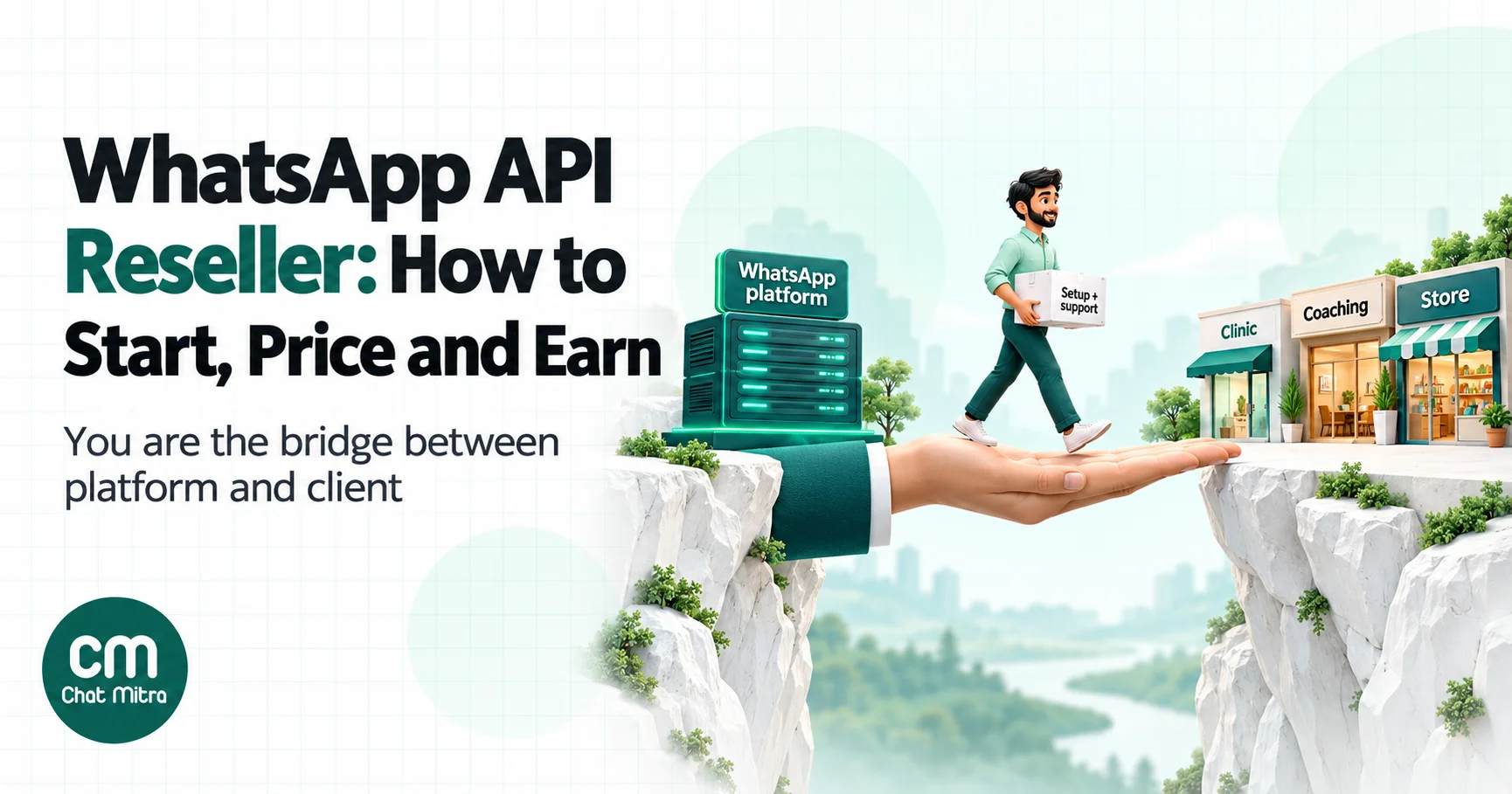
A WhatsApp API reseller sells a WhatsApp Business Platform provider’s service to clients and earns the difference between what the client pays and what the service costs. In practice the reseller:
- finds and closes clients, usually in a niche it already knows;
- onboards them: Meta business verification, connecting the number, choosing a display name and getting the first templates approved;
- sets prices and often sends the invoice;
- answers first-line questions, escalating platform problems to the provider;
- sells services on top: templates, chatbot flows, campaigns and integrations.
The provider runs the software, keeps it online, maintains the Meta integration and handles anything the reseller can’t fix.
One distinction matters from day one: you resell a provider’s platform and your own services, not WhatsApp. Meta’s WhatsApp Business Platform terms describe businesses using the platform “either directly or through a third party authorized to use these APIs on such business’ behalf”, which Meta calls a Solution Provider. The same terms list among the client business’s restrictions that it must not “distribute, sell, resell, or rent the WhatsApp Business Platform to third parties” (Meta Terms for WhatsApp Business Platform, sections 1.1 and 4.1(c)).
So the working model is always the same: each client gets its own WhatsApp Business Account, onboarded through your provider. You never send clients’ messages through your own account, and you never hand out access to one account to several businesses.
The four ways to resell WhatsApp API
“Reseller” is used loosely. There are four distinct arrangements, and providers often offer more than one.
| Referral | Provider-branded reseller | White-label | Managed service | |
|---|---|---|---|---|
| What the client buys | The provider’s platform, directly | The provider’s platform, through you | A platform under your brand | An outcome: you run WhatsApp for them |
| Brand on the dashboard | The provider’s | The provider’s | Yours | Usually the provider’s; the client may never log in |
| Who invoices the client | The provider | You, or the provider under your agreement | You | You |
| Who supports the client | The provider | You, first line | You | You, fully |
| How you earn | Commission | Margin or discount | Your price minus licence and costs | A monthly retainer |
| Up-front commitment | None | Low to moderate | Moderate to high | Low (your time) |
| Best when | You have contacts but no time | You want to own client relationships | Your brand matters to clients | Clients want results, not software |

Referral is the gentlest start: you introduce, the provider does everything else. Our guide to WhatsApp API affiliate programs covers how commissions are calculated and what to watch for.
Provider-branded reselling is what most people mean by “reseller”. The client knows the platform’s name, but you sold it, you onboarded them and you’re the person they call. You earn a margin, either as a discount off the provider’s list price or as the gap between the provider’s partner price and yours.
White-label puts your brand on the dashboard. It’s covered in depth in our guide to white-label WhatsApp API, including what Meta won’t let any partner rebrand.
Managed service is often the most profitable and the least discussed. The client pays you a retainer to run its WhatsApp: templates, broadcasts, chatbot changes, monthly reports. The platform is a tool you use on the client’s account, and the platform cost is either passed through or included in your fee.
What “low investment” really costs
You don’t need developers, servers or Meta approvals to resell. That’s real, and it’s why the model attracts agencies. But the money you don’t spend on software goes somewhere else.
Your time before revenue. Every client needs a sales conversation, a demo and an onboarding. Business verification and display name approval can take days and need follow-up. Budget the hours for your first five clients before you count any income.
A demo setup. You need a working WhatsApp Business Account of your own, with templates and a chatbot in your niche, to show prospects what they’re buying. A dental clinic owner who sees a working appointment reminder decides faster than one who reads a feature list.
Support capacity. In the first month, clients ask why a template was rejected, why a broadcast didn’t reach everyone and why a customer can’t reply. If you’re the first line, someone on your team has to answer the same day.
Provider commitments. Some providers ask resellers for a minimum monthly purchase, prepaid credits, a partner fee or a minimum number of clients. Others ask for nothing until you bring business. Get the minimums in writing before you compare margins; a generous discount with a large minimum can cost more than a smaller discount with none.
Payment collection and paperwork. If you invoice clients, you need a way to collect payments, follow up on late ones and keep records. Add your accountant’s time to the plan.
Contracts. One agreement with your provider and one template agreement with clients. A lawyer’s review once is cheaper than one dispute.
Where the money comes from: a worked month
Here is one client’s month, worked through. The Meta charges use Meta’s real rates for India. The reseller’s prices are example figures for illustration, not any provider’s price list. Replace them with your own.
The client is a diagnostic lab in Pune. In a typical month it sends:
| Message type | Volume | Meta rate (India) | Meta charge |
|---|---|---|---|
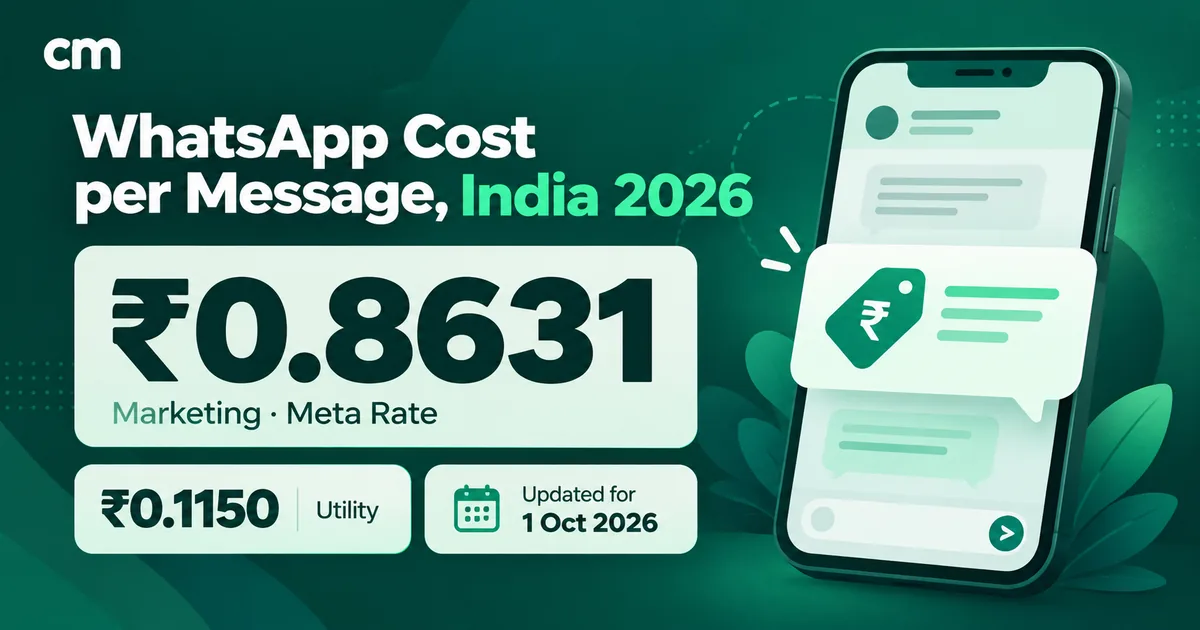
| Utility templates: appointment confirmations and “report ready” alerts | 2,000 | ₹0.115 per delivered message | ₹230 |
| Marketing templates: one health-package campaign | 3,000 | ₹0.8631 per delivered message | ₹2,589.30 |
| Service replies inside the 24-hour window | 800 | First 1,000 a month free per number | ₹0 |
| Total Meta charges | ₹2,819.30 |
Meta has charged per delivered message since 1 July 2025, and from 1 October 2026 each WhatsApp business number gets its first 1,000 service messages a month free, with later service messages charged at the utility rate (Meta for Developers: Pricing). Check the current rates for your clients’ countries in the WhatsApp pricing calculator.
Now your side of the month, with example figures:
| Line | Example amount |
|---|---|
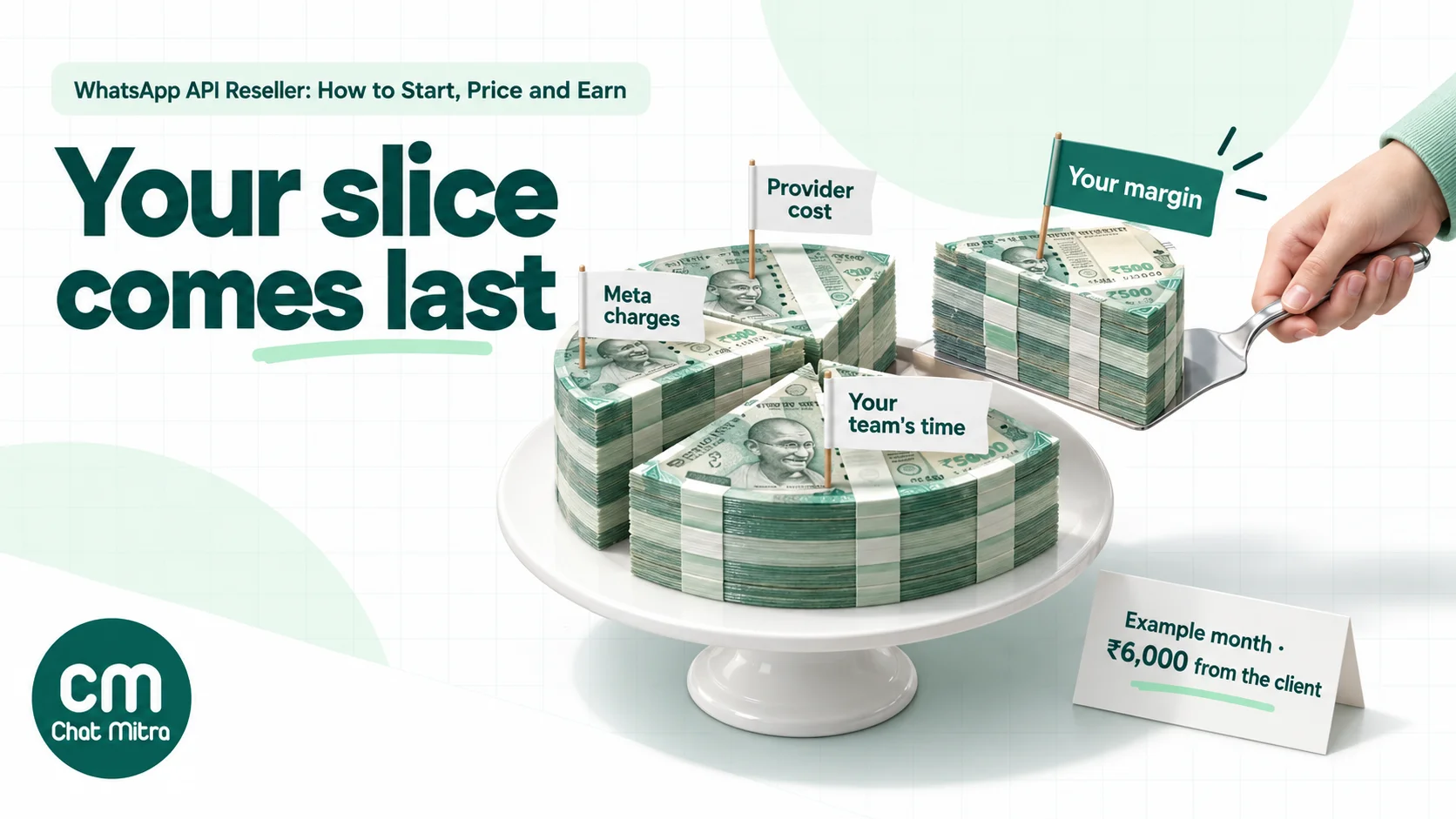
| Client pays you: platform access plus monthly management | ₹6,000 |
| You pay the provider for the client’s platform access | −₹2,500 |
| Your team’s time: one campaign, template updates, support (about 3 hours) | −₹1,500 |
| Your gross margin | ₹2,000 |
Three lessons from even a simple example:
- Meta’s ₹2,819.30 isn’t part of your margin. Whether Meta bills the client directly or the provider passes it through, it’s the client’s message cost. Show it as a separate line. Clients can see their own billing in WhatsApp Manager, and a hidden markup is the fastest way to lose trust.
- Your time is the biggest variable. If the same client needs eight hours instead of three, the margin disappears. Price your services by the work, not by the platform.
- Most of the value is the service, not the licence. The client’s ₹6,000 minus the provider’s ₹2,500 leaves ₹3,500, and your team’s time takes almost half of it. Without the management work, the platform margin alone would barely cover onboarding.
How to price your reseller offer
Good reseller pricing is simple for the client and protects your time. Common structures:
- Setup fee plus monthly fee. A one-time charge for verification, number connection, first templates and a starter chatbot, then a monthly fee for platform access and support. It pays you for the heaviest work up front.
- Tiered packages. For example, “Starter” with platform access and email support, “Growth” with two campaigns a month, and “Managed” with full campaign and chatbot management. Clients choose by how much help they want, not by feature lists.
- Retainer with platform included. Common for managed service. You quote one monthly figure and treat the platform as your cost.
- Annual prepayment. A discount for paying a year ahead improves your cash flow and reduces churn, if your provider agreement allows annual terms.
Whatever the structure, keep three things separate on the invoice or in the proposal: Meta’s message charges, the platform, and your services. If a provider adds its own fee per message or per conversation, decide whether you pass it through or include it, and say which.
Price by niche. “WhatsApp for diagnostic labs: report alerts, appointment reminders and health-package campaigns, set up in a week” sells better and at a higher price than “WhatsApp API at low cost”. A niche also lets you reuse templates, chatbot flows and onboarding documents, which cuts your time per client.
Niches that suit a WhatsApp reseller
The best niches have three things in common: customers who already expect to hear from the business, messages that repeat every week, and owners who would rather pay someone than learn template rules themselves. A few that fit, with the work you’d sell:
| Niche | Messages that repeat | What you can package |
|---|---|---|
| Clinics and diagnostic labs | Appointment confirmations, reminders, “report ready” alerts | Utility templates, a booking chatbot, a monthly health-package campaign |
| Coaching institutes and schools | Admission enquiries, fee reminders, class changes, results | Enquiry chatbot, reminder templates, campaigns before each admission season |
| Real estate developers and brokers | Site-visit bookings, project brochures, payment-milestone reminders | Click-to-WhatsApp ad replies, brochure flows, follow-up sequences |
| D2C and ecommerce brands | Order confirmations, shipping updates, abandoned carts, offers | Store integration, order-update templates, festival campaigns |
| Salons, spas and gyms | Bookings, reminders, membership renewals, offers | Booking flow, reminder templates, win-back campaigns |
| Restaurants and cloud kitchens | Orders, delivery updates, loyalty offers | Menu flow, order updates, weekend campaigns |
Pick the niche where you already know the owners and their busy season. A reseller who knows that coaching institutes fill seats between March and June will sell admission-season packages in January, long before a general agency calls. Reminders are the most dependable earner in almost every niche, because they replace phone calls the business is already making; our guide to WhatsApp reminder messages has templates you can adapt.
Avoid niches where messaging rules are tighter or the stakes are higher until you have experience: lending and collections, pharmaceuticals, gambling-adjacent offers, and anything that depends on cold outreach to people who never opted in.
How to choose a provider to resell
The provider becomes part of your reputation. Ask each one these questions in writing:
- Is it Meta’s official WhatsApp Business Platform? Some products sold to resellers connect by scanning a QR code with a phone, automating the WhatsApp app instead of using Meta’s Business Platform and Cloud API. You want clients onboarded through Meta’s Embedded Signup.
- Which Meta partner type sits behind it? A Solution Partner can extend a credit line and invoice clients for message usage; a Tech Provider’s clients pay Meta with their own payment method (Meta for Developers: Solution Providers overview). This decides how Meta’s charges reach your clients.
- What is the margin or discount, exactly? As a number, with any volume tiers and minimums.
- Does the provider add its own fee on top of Meta’s charges? Per message, per conversation or none.
- Who owns each client’s WhatsApp Business Account? Clients onboarded through Embedded Signup own their WhatsApp assets (Meta for Developers: Embedded Signup). Confirm that’s how the provider does it.
- Can you see and manage all your clients in one place? A multi-client view, per-client team access and usage reports save hours each week.
- What support do you get? A named partner contact, response times and escalation to Meta when an account is restricted.
- Will the provider contact your clients directly? Agree whether it markets to clients you brought in, and what happens if a client approaches it to go direct.
- How does a client leave? Number migration, data export and notice periods, for when a client moves on or you change providers.
- Is there a partner agreement? If the answer is “just sign up and refer”, it’s a referral program, not a reseller arrangement.
Meta’s rules apply to your clients and to you
Reselling doesn’t put you outside Meta’s rules. It puts you in charge of explaining them.
One account per business. As above, Meta’s terms stop a client business reselling the platform. Each client needs its own WhatsApp Business Account and business portfolio.
Opt-in comes first. The WhatsApp Business Messaging Policy requires businesses to get people’s permission before messaging them on WhatsApp (WhatsApp Business Messaging Policy). If a client uploads a bought list, the account takes the damage. Make opt-in part of your onboarding checklist; our WhatsApp opt-in guide explains how to collect it.
The display name is the client’s brand. Meta’s display name guidelines require the name to represent the business accurately and match its external branding. If you sign up a client as an agency or partner, the relationship between your business and the client “must be evident on the business website” (Meta Business Help Centre: Display name guidelines).
Template categories decide the price. Meta’s template categorisation rules treat mixed or unclear content as marketing, and Meta can recategorise a template whose content doesn’t match the category it was submitted under (Meta for Developers: Template categorization). A promotional message submitted as utility ends up charged at the marketing rate: in India, ₹0.8631 instead of ₹0.115 per delivered message. Teach clients the difference before their first campaign.
Messaging limits start low. New numbers can message only a limited number of unique customers in 24 hours, rising as the business is verified and keeps good quality. A client who expects to message 20,000 people on day one needs to hear this from you first. See WhatsApp messaging limits.
Don’t promise what Meta decides. Template approval, the Official Business Account badge and limit increases are Meta’s calls. Promise the work you’ll do to get there.
Don’t borrow Meta’s titles. Meta’s own partner table lists which partners are Meta Business Partners. Reselling a provider’s platform doesn’t make you one, and saying so in a proposal misleads clients.
What to put in the reseller contract
You need two agreements: one with your provider and one with each client. Neither has to be long, but both should cover these points.

With your provider:
- Margin and pricing: your discount or partner price, minimums, how changes are notified.
- Who invoices whom: for the platform, and for Meta’s message charges.
- Client ownership: whether the provider may approach clients you brought, and what happens if a client asks to go direct.
- Support split: what you handle, what the provider handles and how fast.
- Data: who may access client message data, and for what.
- Termination: notice period, and how your clients keep their numbers and data if the agreement ends.
With each client:
- Scope: platform access, setup work, services included and services charged extra.
- Fees: setup, monthly, and how Meta’s message charges are billed.
- Account ownership: the client owns its WhatsApp Business Account and business portfolio.
- Data roles: in India, the Digital Personal Data Protection Act separates a Data Fiduciary, who decides the purpose and means of processing personal data, from a Data Processor, who processes it on the fiduciary’s behalf (sections 2(i) and 2(k)). Typically the client is the fiduciary for its customers’ data, and you and the provider process it for the client. Write that down.
- Client responsibilities: opt-in, message content and compliance with WhatsApp’s policies.
- Support hours and response times.
- Exit: notice period, data export and help moving the number.
Your first 90 days as a WhatsApp API reseller
Days 1 to 15: choose and set up.
- Pick one niche where you already have clients or contacts.
- Shortlist two or three providers and send each the questions above.
- Sign the provider agreement and set up your demo account with niche templates and a short chatbot.
- Write your client agreement and onboarding checklist.
Days 16 to 45: pilot.
- Onboard one or two friendly clients at a pilot price in exchange for honest feedback.
- Time every step: verification, number connection, display name, templates, first campaign.
- Note every question they ask; those become your help documents.
Days 46 to 90: sell.
- Turn the pilot results into a one-page case study, with the client’s permission and only the numbers you actually measured.
- Set your packages and prices based on the hours you recorded.
- Approach 20 to 30 prospects in the same niche with a demo, not a brochure.
- Review margin per client at the end of the month and adjust prices or scope.
A per-client onboarding checklist
Use the same checklist for every client, so nothing depends on memory. Most first-month problems trace back to a skipped step here.
- Business portfolio: the client logs in with its own Meta credentials and uses or creates its own business portfolio, not yours.
- Business verification: documents ready in the legal name that matches the website. Verification affects how fast the account’s messaging limits can rise.
- Phone number: a new number, or the client’s existing WhatsApp Business app number connected through coexistence if it wants to keep using the app, and someone available to receive the verification code.
- Display name: the client’s brand exactly as it appears on its website, with no “Official” or promotional words.
- Payment method for Meta: added in Meta’s billing settings if the client pays Meta directly, or confirmed with the provider if a credit line is used.
- Opt-in proof: where the client’s contacts came from and how they agreed to receive WhatsApp messages.
- First templates: two or three utility templates the client needs every week, plus one marketing template, each in the right category.
- Team access: who at the client logs in, and what each person may do.
- Test send: every template sent to the client’s own phone before any campaign.
- Handover: a one-page guide to replying within the 24-hour window, reading delivery reports and asking you for help.
Mistakes new resellers make
Competing on price alone. If your only offer is “cheaper WhatsApp API”, the next reseller undercuts you. Compete on getting clients live fast and running campaigns that work.
Burying Meta’s charges. Clients find them in WhatsApp Manager. Show them.
Onboarding without opt-in checks. One client blasting a bought list can get its number restricted and blame you.
Promising approval dates. Business verification, display names and templates go through Meta. Give ranges and explain why.
No written agreement. Handshake reselling works until a client leaves, a provider changes prices or an account is restricted.
Spreading across every industry. Ten clients in one niche are easier to serve than ten clients in ten.
When to move from reseller to white-label
Reselling is a complete business, not just a stepping stone. But some signs suggest it’s time for white-label:
- Clients ask for your brand on the dashboard, or prospects choose a competitor because the platform carries someone else’s name.
- You have enough clients that a white-label licence costs less than your current margins give away.
- Your support team already handles nearly everything, so the provider’s brand adds little.
- You want to sell the platform as part of your own software or services under one name.

Before you switch, read what white-label does and doesn’t change in our white-label WhatsApp API guide. Your clients’ WhatsApp accounts, display names and Meta billing work the same way under either model.
Where ChatMitra fits
ChatMitra is a WhatsApp Business API platform for businesses in India and elsewhere. It doesn’t run a reseller program or publish reseller pricing, and this guide won’t pretend it does. Here is what it offers people who manage WhatsApp for others:
| What you need | What ChatMitra does |
|---|---|
| Run several client businesses | One login can manage several projects, each with its own WhatsApp Business Account |
| Give your team access | Add team members and choose which projects each one can work in |
| Connect client numbers | Meta’s Embedded Signup, or manual connection by WABA ID for existing accounts |
| Keep Meta’s charges transparent | Each client adds its own payment method in Meta, and Meta bills the client directly for messages |
| Predictable platform cost | A plan fee plus ₹0.20 per conversation, charged once per customer per 24 hours, never per message |
| Earn from introductions | Invite & Earn pays a share of a referred business’s first qualifying payment as ChatMitra wallet credit, not cash |
| A formal partnership | Discussed directly: write to [email protected] |
If you want to bill clients for ChatMitra access itself, rather than for your own services on their accounts, agree that with the ChatMitra team in writing first. Compare plans on the pricing page, or contact the team.
Before you sell to your first client
- Your provider runs on Meta’s official WhatsApp Business Platform, and you know which Meta partner type is behind it.
- Your margin, minimums and any provider fee per message are in writing.
- Each client will get its own WhatsApp Business Account in its own business portfolio.
- Meta’s charges appear as their own line in every proposal.
- Your client agreement covers scope, fees, data roles, opt-in responsibility and exit.
- Your demo account shows real templates and a chatbot from your niche.
- Someone on your team can answer a client the same day.
A reseller business is built on trust more than on software. Be clear about what Meta charges, what you charge and who owns what, and clients will stay long after the first campaign.
Sources
- Meta: Meta Terms for WhatsApp Business Platform (last modified 23 September 2026), sections 1.1 and 4.1.
- Meta for Developers: Solution Providers overview, Embedded Signup, Template categorization and Pricing (rates effective 1 October 2026).
- Meta Business Help Centre: Display name guidelines for the WhatsApp Business Platform.
- WhatsApp: WhatsApp Business Messaging Policy.
- Government of India: Digital Personal Data Protection Act, 2023, sections 2(i) and 2(k).
- All sources read on 23 October 2026.