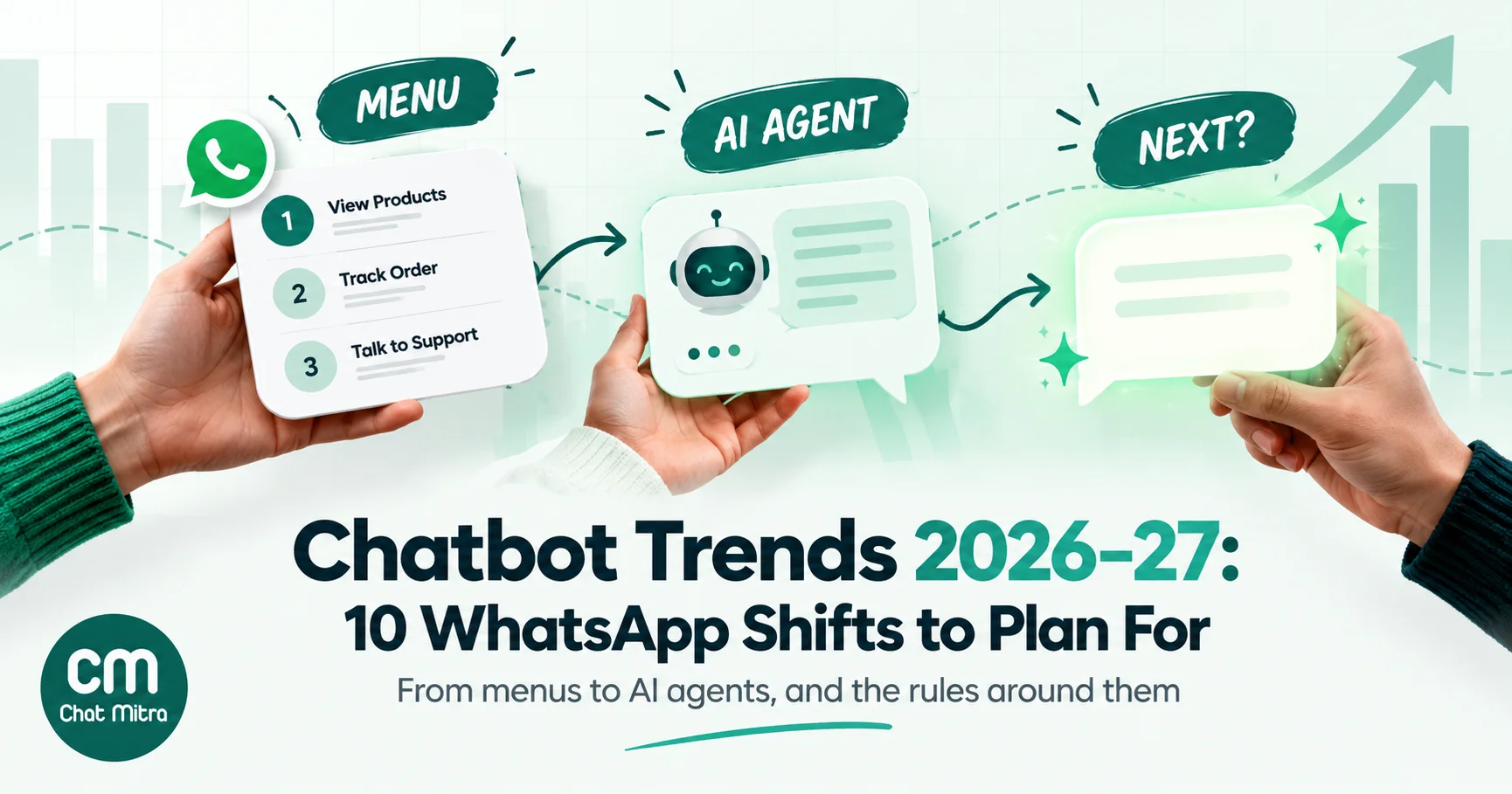
The chatbot trends that matter in 2026–27 are less about smarter AI than about the rules around it. Bots are moving from scripted menus to AI agents that complete tasks, and on WhatsApp, the channel where much of that happens in India and many other markets, Meta has changed what bot replies cost, who may run a bot, how several bots share one number and how customers are identified. If you plan only for the AI and ignore those changes, your bot will be expensive, non-compliant or both.
This article covers ten shifts. Each one has a date and a primary source, an explanation of what changed, and what to do about it. It’s written for business owners, support leads and marketers who run, or are about to run, a WhatsApp chatbot. Facts were checked on 15 October 2026, and we refresh the post every year.
Key takeaways
- Plan for hybrid bots: buttons for fixed choices, an AI agent for free text, a person for judgement.
- Every reply beyond 1,000 service messages a month per number now costs money, so design for fewer messages per answer.
- Meta's own Business Agent is both an option and a competitor. Know what it costs and how it changes routing before you switch it on.
- Keep your bot about your business. General-purpose AI assistants are banned from the WhatsApp Business Platform in most countries.
- Get ready for customers without phone numbers, and for disclosure and data rules that start in 2026 and 2027.
The 10 chatbot trends at a glance
| # | Trend | What changed, and when | What to do |
|---|---|---|---|
| 1 | Menus give way to AI agents that act | Agents now book, look up and qualify; Meta's own agent launched 3 June 2026 | Move free-text questions to AI, keep buttons for fixed choices |
| 2 | Bot replies have a price again | Service messages charged from 1 October 2026 after 1,000 free a month | Count messages per resolved question and cut them |
| 3 | Meta becomes a bot vendor | Meta Business Agent at $2 per million tokens on the Business Platform | Compare its per-message cost and control with your own bot |
| 4 | Several responders share one number | Conversation Routing documented 23 September 2026 | Decide who owns each entry point and design the handover |
| 5 | General-purpose AI assistants are out | Terms clause 4.7 in force from 15 January 2026 | Keep the bot scoped to your business; check your vendor's data terms |
| 6 | Customers without phone numbers | BSUIDs in webhooks from April 2026; usernames rolling out | Stop treating the phone number as the only customer key |
| 7 | More happens inside the chat | Flows on WhatsApp Web (December 2025); Calling API rate cards (October 2026) | Use forms and calls where they save a step, not for show |
| 8 | Voice notes and photos become inputs | AI models accept audio and images; customers already send them | Give every non-text message a clear path, even if it's a person |
| 9 | Marketing and service bots split | Cloud API stops marketing messages on 13 October 2027 | Separate proactive (marketing) flows from reactive (service) ones |
| 10 | Disclosure and data rules arrive | EU AI Act Article 50 from 2 August 2026; DPDP Rules from 13 May 2027 | Say the bot is automated, record consent, plan data deletion |
How we chose these trends
Most “chatbot trends” lists repeat the same predictions every year: emotional intelligence, hyper-personalisation, conversational everything. We used a narrower test. A trend made this list only if it met all three conditions:
- It has a date and a primary source, such as Meta’s developer documentation, WhatsApp’s terms, a regulator’s text or a named research firm, not a vendor’s claim.
- It changes a decision you make, such as which bot to build, what it costs, what it may say or how it hands over.
- It applies to WhatsApp business messaging, the channel most of our readers use for bots.
That rules out a lot of noise. It also means some trends are about money and rules rather than technology, because on WhatsApp those now move faster than the models do.
1. From menu trees to AI agents that take actions
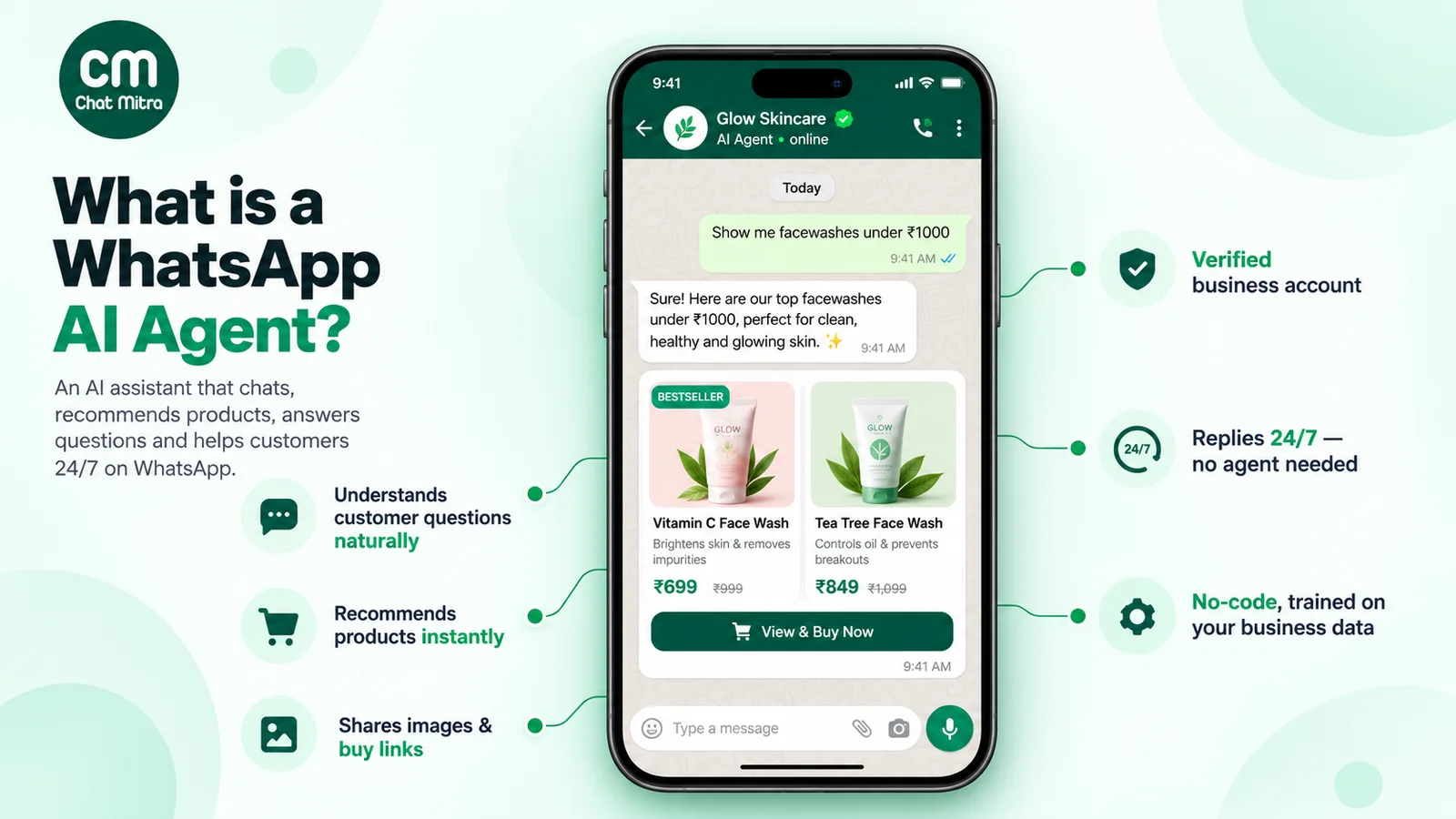
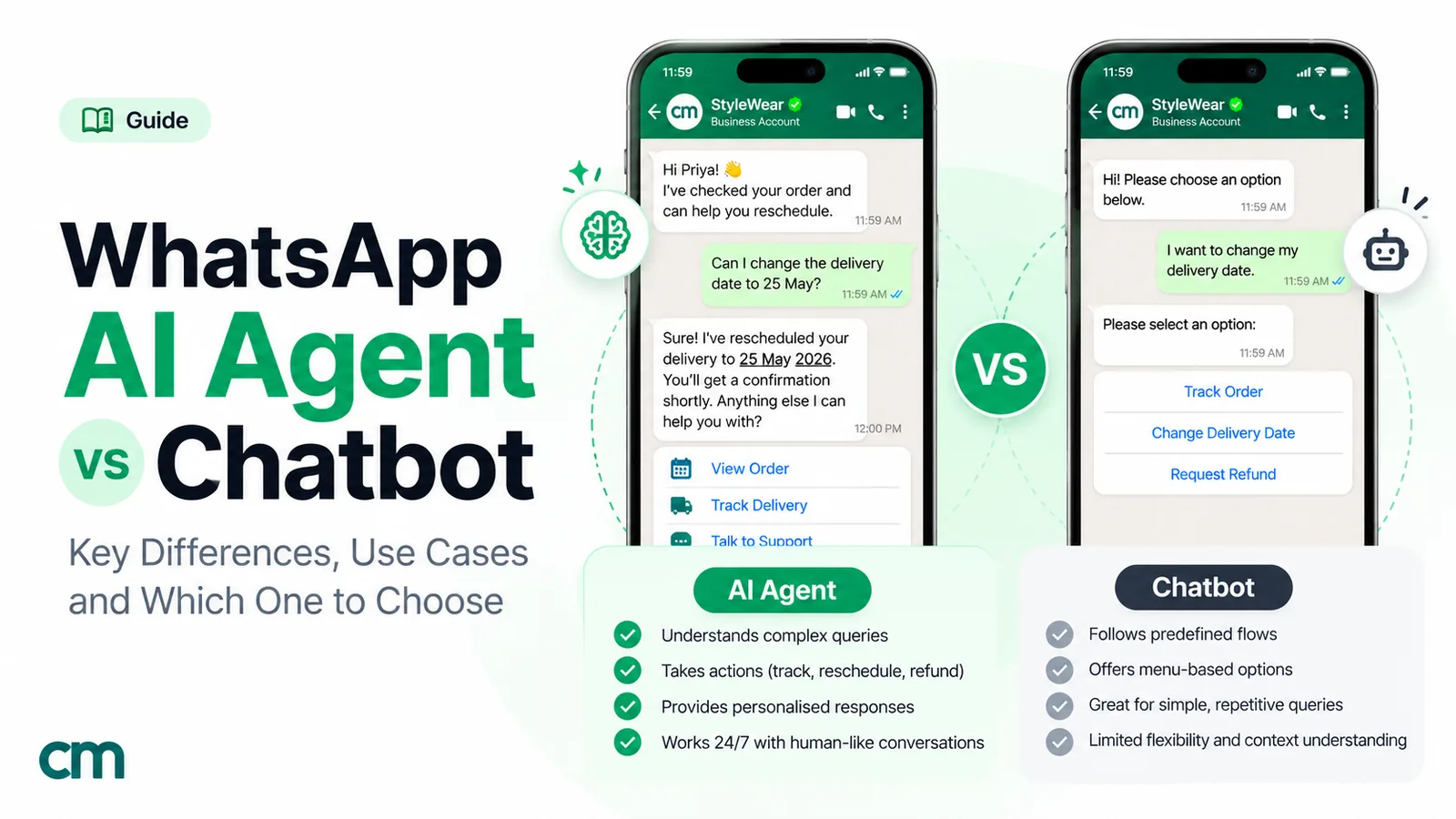
What’s changing. For a decade, a WhatsApp chatbot meant a menu: “Reply 1 for orders, 2 for returns.” In 2026 the default is an AI agent that reads the customer’s own words, looks up what it needs and does the task. Meta’s launch of its own agent on 3 June 2026 made this mainstream. Meta says the agent answers business-specific questions, recommends products from your catalog, books appointments, qualifies leads and closes sales, and that more than one million businesses already use one on WhatsApp and Messenger.
Analysts expect the shift to go further. In March 2025 Gartner predicted that by 2029 agentic AI will autonomously resolve 80% of common customer service issues without human intervention. Treat that as a forecast, not a result. It tells you the direction investment is going, not what your bot can do today.
What it means in practice. An agent is a better answer to open questions (“Do you have this in a size up and can it reach Pune by Friday?”). It isn’t automatically better at fixed choices. Picking one of four branches is faster with four buttons than with a typed sentence the AI has to interpret, and buttons can’t hallucinate.
What to do.
- Split your conversations by type. Fixed choices (branch, slot, order number) go to buttons and lists. Open questions go to the AI. Anything involving money, complaints or exceptions goes to a person.
- Give the agent tools, not just text. The value of an agent is in what it can look up: order status, stock, appointment slots. An agent that only paraphrases your FAQ is a slower FAQ.
- Limit what it may do on its own. Let it read freely, but require a confirmation step before it books, cancels or changes anything. Our WhatsApp AI agent guide covers tools and guardrails in detail, and AI agent vs chatbot helps you choose between them.
2. Every bot reply now has a price again
What’s changing. From November 2024 to September 2026, Meta didn’t charge for service messages, the free-form replies a business sends within 24 hours of a customer’s message. That made bot replies effectively free on the WhatsApp Business Platform. On 1 October 2026 Meta resumed charging. Each business phone number now gets 1,000 free service messages a month, which don’t roll over, and Meta charges from the 1,001st. The India rate is ₹0.115 per service message.
There are three exceptions worth knowing:
- Reactions (emoji reactions to a customer’s message) are still free and don’t count toward the 1,000.
- Click-to-WhatsApp ad conversations open a free entry point window that can now stay open for up to 7 days, up from 72 hours. Messages in that window are free, except Meta Business Agent messages.
- Eligible government departments and non-profits keep free service messages beyond the monthly tier until 31 December 2027.
What it means in practice. Message count is now a cost driver, and menu depth is the hidden cost. A bot that needs three messages to answer “Where’s my order?” (a greeting, a menu, then the answer) costs three times as much as one that answers in one message.
Here’s a worked example for a business that gets 3,000 bot-handled questions a month on one number in India:
| Bot design | Messages per question | Service messages a month | Charged after 1,000 free | Meta charge a month |
|---|---|---|---|---|
| Three-level menu | 3 | 9,000 | 8,000 | ₹920 |
| Two-level menu | 2 | 6,000 | 5,000 | ₹575 |
| Direct answer (buttons or AI) | 1.3 (some need a follow-up) | 3,900 | 2,900 | ₹333.50 |
Meta's India service rate of ₹0.115 per message, effective 1 October 2026. Excludes your platform's fees and, for an AI bot, your AI model's usage charges.
The amounts are modest for one number, but the ratio holds at any volume, and it multiplies across numbers and brands.
What to do.
- Measure messages per resolved question, not just conversations. Most platforms show messages sent; divide by the questions your bot closed.
- Flatten menus. Put the three most common answers one tap away from the first message.
- Answer in one message. Combine the confirmation and the next step (“Your order shipped today; track it here”) instead of sending them separately.
- Use reactions for acknowledgements where a full reply isn’t needed. They’re free.
3. Meta becomes a chatbot vendor
What’s changing. Meta Business Agent is no longer a test. Meta announced its global launch at its Conversations conference in London on 3 June 2026, alongside a Meta Business Agent Platform for enterprises that connects to systems such as Shopify and Zendesk. In the WhatsApp Business app, Meta says getting started is free and that access will move to paid subscriptions. In India, Meta introduced Business AI for small businesses in the Business app in May 2026.
On the WhatsApp Business Platform (the API), Meta prices the agent per token:
- One global rate of $2.00 per million tokens, counting input and output tokens but not cached tokens.
- Meta says a message typically uses 20,000–25,000 tokens, about 4–5 US cents a message, more for complex answers.
- No free tier and no volume discounts, and agent messages are charged even inside the free entry point window.
At the European Central Bank’s reference rates for 14 October 2026 (about ₹95 to the dollar), 4–5 US cents is roughly ₹3.80–4.75 per message. That’s about 33–41 times the India service-message rate. For 3,000 questions at 1.3 messages each, the agent’s messages would cost about ₹14,800–18,600 a month, against ₹333.50 for the same number of ordinary service replies, before your own platform and AI model costs.
What it means in practice. Meta’s agent is easy to start and tightly integrated with its own apps and catalog, but on the API it’s priced like a premium product. Running your own AI on your own platform means you pay ordinary service-message rates plus your AI model’s token charges, and you decide the model, the instructions and the data it sees.
What to do.
- Price both options on your real volume. Count monthly questions and messages per question, then compare Meta’s per-message estimate with your platform fee plus model charges.
- Compare control, not just cost. Who writes the instructions, which data the agent can read, how it hands over, and whether you can export transcripts.
- Test before you enable it on a live number. Enabling the agent changes message routing for every integration on that number (see trend 4).
4. Several responders share one number, and handover becomes a protocol
What’s changing. Until recently, every integration connected to a WhatsApp account received every inbound message. If you had a support platform and a marketing tool on the same number, both saw everything and both could answer. On 23 September 2026 Meta documented Conversation Routing, which gives each conversation one owner:
- The business chooses a primary responder for each entry point, such as an ad, a link or an organic message.
- Other integrations become standby partners. They can observe the conversation but don’t own it.
- Ownership moves through thread control: pass, release and take. An app that isn’t the owner (or the designated escalation partner) gets error 131070 if it tries to send a service message.
- On handover, Meta can deliver an AI-generated conversation summary so the next responder doesn’t start from zero.
- Enabling Meta Business Agent makes it the primary responder for new conversations, and previous responders move to standby.
Routing only applies when an account has more than one responder and a routing configuration.
Why it matters beyond the technology. Handover has become the part of a bot that customers judge. In a 2024 Gartner survey of 5,728 customers, 64% said they would prefer companies didn’t use AI for customer service, and their main worry was that AI would make it harder to reach a person. WhatsApp’s own Business Messaging Policy requires “prompt, clear, and direct escalation paths” whenever you automate. A transfer to a human in the chat, a phone number, an email address, a support page or a store visit all qualify.
What to do.
- List every app connected to your number. Decide which one owns which entry point before routing decides for you.
- Write the handover rules first. Hand over when the customer asks, when the bot fails twice, when money or a complaint is involved, and when the bot isn’t confident.
- Tell the customer what happens next. “A team member will reply by 10 am” is better than a silent transfer.
- Pass context. Whether it’s Meta’s summary or your inbox’s chat history, the person who takes over should never ask the customer to repeat themselves.
5. General-purpose AI assistants are out; business bots are in
What’s changing. Since 15 January 2026, clause 4.7 of the WhatsApp Business Solution Terms has prohibited “AI Providers” from using the WhatsApp Business Platform to offer AI as the “primary (rather than incidental or ancillary) functionality”. Meta’s example is a general-purpose AI assistant. Meta permits them only where it is legally required to:
- Italy, from 16 February 2026.
- Brazil and the EU/EEA countries, from 11 March 2026.
- Türkiye, from 15 October 2026.
In those markets, Meta charges AI Providers for service messages in Brazil, has not charged them in Italy and the EU/EEA since 13 May 2026, and won’t charge them in Türkiye until at least 11 April 2027. India isn’t on the list.
What isn’t affected. A bot that serves your own customers, such as answering product questions, tracking orders or taking bookings, is “incidental or ancillary” to your business. You can power it with any AI model you choose.
The clause most businesses miss. You may still hire an AI company as your solution provider, but then Business Platform data, including anonymised, aggregated or derived data, may not be used to create, train or improve AI models. Your customers’ chats shouldn’t end up training your vendor’s model.
What to do.
- Keep the bot’s scope narrow. Tell it in its instructions to answer only questions about your business and to decline everything else politely.
- Read your vendor’s data terms. Confirm in writing that chats aren’t used to train models.
- Watch the market list. Meta updated this policy four times in 2026, each time where the law required it.
6. Customers without phone numbers: usernames and BSUIDs
What’s changing. WhatsApp has always been tied to phone numbers, and most business systems use the number as the customer’s ID. That’s ending. In June 2026 WhatsApp opened username reservations ahead of a launch later in the year, with a gradual rollout by country. Once a user turns on a username, a business they message for the first time won’t see their phone number.
On the Business Platform, Meta prepared for this with business-scoped user IDs (BSUIDs):
- BSUIDs have been in webhooks for every user since early April 2026, and businesses have been able to send messages to a BSUID since July 2026.
- For users who hide their number, the phone fields are left out of the webhook. The number is still included in some cases, for example if the user is already in your contact book.
- One-tap, zero-tap and copy-code authentication templates can’t be sent to a BSUID (error 131062). A bot that sends OTPs still needs a phone number.
In India the timing is uncertain. On 1 July 2026 MeitY told Meta not to launch usernames in India until consultations conclude, and Meta has replied. Check the current status before you plan around it.
What to do.
- Store the BSUID next to the phone number for every contact, so you can match a customer whichever one arrives.
- Don’t let the bot fail when there’s no number. If you need it, for delivery or verification, the bot should ask for it and explain why.
- Review OTP and login flows. They’re the one place where a BSUID can’t replace the number.
7. Forms, calls and payments move inside the chat
What’s changing. A chatbot used to collect details one question at a time. WhatsApp now offers richer tools inside the chat, so the bot can hand the customer the right tool instead of asking question after question:
- WhatsApp Flows show a multi-screen form (a booking, an application, a survey) inside the chat. Since December 2025 they work on WhatsApp Web as well as phones.
- The Calling API lets customers call a business on WhatsApp, and lets a business call customers who have agreed to it. Meta published new Calling API rate cards effective 1 October 2026.
- Payments inside the chat keep expanding market by market. In October 2026, for example, Meta added one-click card payments to payment request templates in Brazil.
What it means in practice. The best bots in 2027 will be routers more than talkers. They’ll decide whether the next step is a typed answer, a form, a call or a payment link, and open it.
What to do.
- Replace long question sequences with a form where your platform supports Flows. Five questions in one screen beat five messages, and since service messages are charged again, they’re also cheaper.
- Offer a call when typing is the wrong medium, such as complex troubleshooting or high-value sales, if your provider supports WhatsApp calling. Our Business Calling API guide covers permissions and per-minute costs.
- Keep the payment step deterministic. Never let an AI agent make up an amount. Generate payment links from your order system.
8. Voice notes and photos become inputs
What’s changing. Customers have always sent voice notes and photos on WhatsApp: a damaged parcel, a skin concern, a quick “is this available?” while driving. Most bots ignored them or replied “Sorry, I didn’t understand.” Current AI models can transcribe audio and describe images, so voice and photo input is moving from a nice-to-have to an expectation.
The trend to treat with care. Understanding a photo is not the same as acting on it. An AI that reads a damage photo can route the claim faster, but it shouldn’t approve the refund. Accuracy also drops with background noise, regional accents and code-mixed speech, which is common in Indian voice notes (“Mera order kab aayega, it was supposed to come yesterday”).
What to do.
- Give every message type a path. If your bot handles only text, reply to voice notes and photos with a clear message (“Our assistant reads text only, so a team member will check your photo”) and route them to a person.
- Use AI on media to sort, not to decide. Transcribe and tag, then let a person or a fixed rule take the action.
- Test with your customers’ real voice notes, including the languages and mixes they actually use, before you trust transcription.
9. Marketing and service bots split
What’s changing. Meta is separating the two jobs a business messaging bot does:
- Reactive service, answering what the customer asked, runs in the customer service window on Cloud API.
- Proactive marketing, starting a conversation to sell, is moving to the Marketing Messages API for WhatsApp. Meta has announced that Cloud API will stop supporting marketing messages on 13 October 2027, and that messaging accounts created on or after 13 April 2027 won’t be able to send marketing messages through Cloud API at all.
The Marketing Messages API is gaining features that Cloud API doesn’t have. In September and October 2026 Meta added landing-page view events and opened the beta of a maximum price per marketing message.
What it means for bots. A bot that sends a cart reminder, a re-engagement nudge or a “new arrivals” message is a marketing bot, whatever you call it. Its messages are marketing templates, priced at marketing rates and sent through the marketing route. Meta also treats retargeting as marketing even when the user asked for it.
What to do.
- Separate proactive and reactive flows in your bot design and reporting, because they now differ in route, price and rules.
- Check your platform’s sending route for each proactive flow before April 2027, especially for new numbers.
- Keep opt-in records for every proactive flow. See our guide to WhatsApp opt-in.
10. Disclosure and data rules arrive for bots
What’s changing. Regulation is catching up with chatbots, and two dates matter in the next year:
- EU AI Act, Article 50, from 2 August 2026. AI systems that interact directly with people must be designed so that people are told they are interacting with an AI system, unless that’s obvious from the context. It applies if you serve people in the EU, wherever your business is based.
- India’s Digital Personal Data Protection Rules, 2025. They were notified on 13 November 2025, and most of their obligations, including notice, consent and data-retention duties, apply from 13 May 2027. A chatbot that collects names, numbers, addresses or health details is processing personal data.
WhatsApp’s Business Messaging Policy does not require a bot to say it’s a bot, and India has no chatbot-specific disclosure rule. The policy does require opt-in for business-initiated messages and the escalation paths described in trend 4.
What to do.
- Say it’s automated in the first message (“I’m the automated assistant for Sharma Opticals; type ‘agent’ at any time to reach the team”). It’s required in the EU and costs nothing anywhere else.
- Collect only what the bot needs, and tell customers why you’re asking.
- Decide how long you keep chats, and make sure you can delete a customer’s data when asked.
- Write down what the bot may and may not do. It’s useful for audits and for the person who maintains the bot after you.
Trends to treat with caution
Not every popular prediction holds up on WhatsApp in 2026–27:
- “Bots will replace support teams.” Even Gartner’s ambitious forecast is about common issues by 2029, and customers still say access to a person is their biggest worry. Plan for fewer repetitive tickets, not zero staff.
- “Emotion-aware chatbots.” Sentiment detection can help route an angry customer to a person faster. It isn’t a reason to let a bot handle complaints alone.
- “Proactive AI that messages customers first.” On WhatsApp every business-initiated message outside the 24-hour window needs an approved template and opt-in, and promotions are marketing messages at marketing prices. Proactive doesn’t mean unrestricted.
- Big engagement statistics. Figures like “98% open rates” circulate without a source or date. Measure your own read and reply rates instead.
A 90-day plan to get your bot ready for 2027
| When | Task | Trend it answers |
|---|---|---|
| Weeks 1–2 | Export a month of chats. Count questions by type and messages per resolved question | 1, 2 |
| Weeks 1–2 | List every app connected to your WhatsApp number and what each one does | 3, 4 |
| Weeks 3–4 | Flatten the menu: top three answers one tap away; combine confirmation and next step | 2 |
| Weeks 3–4 | Write the handover rules and the "what happens next" message | 4 |
| Weeks 5–6 | Move open questions to an AI agent with a narrow scope and a confirmation step for actions | 1, 5 |
| Weeks 5–6 | Price Meta Business Agent against your own setup on your real volume | 3 |
| Weeks 7–8 | Add a BSUID field to contacts and a "no phone number" path to the bot | 6 |
| Weeks 7–8 | Give voice notes and photos a clear reply and a route to a person | 8 |
| Weeks 9–10 | Separate proactive (marketing) flows from reactive (service) ones and check their sending route | 9 |
| Weeks 11–12 | Add the automation disclosure, a data-retention period and a deletion process | 10 |
Where ChatMitra stands on each trend
We’d rather you plan with accurate information, so here’s where ChatMitra stands as of October 2026:
| Trend | ChatMitra today |
|---|---|
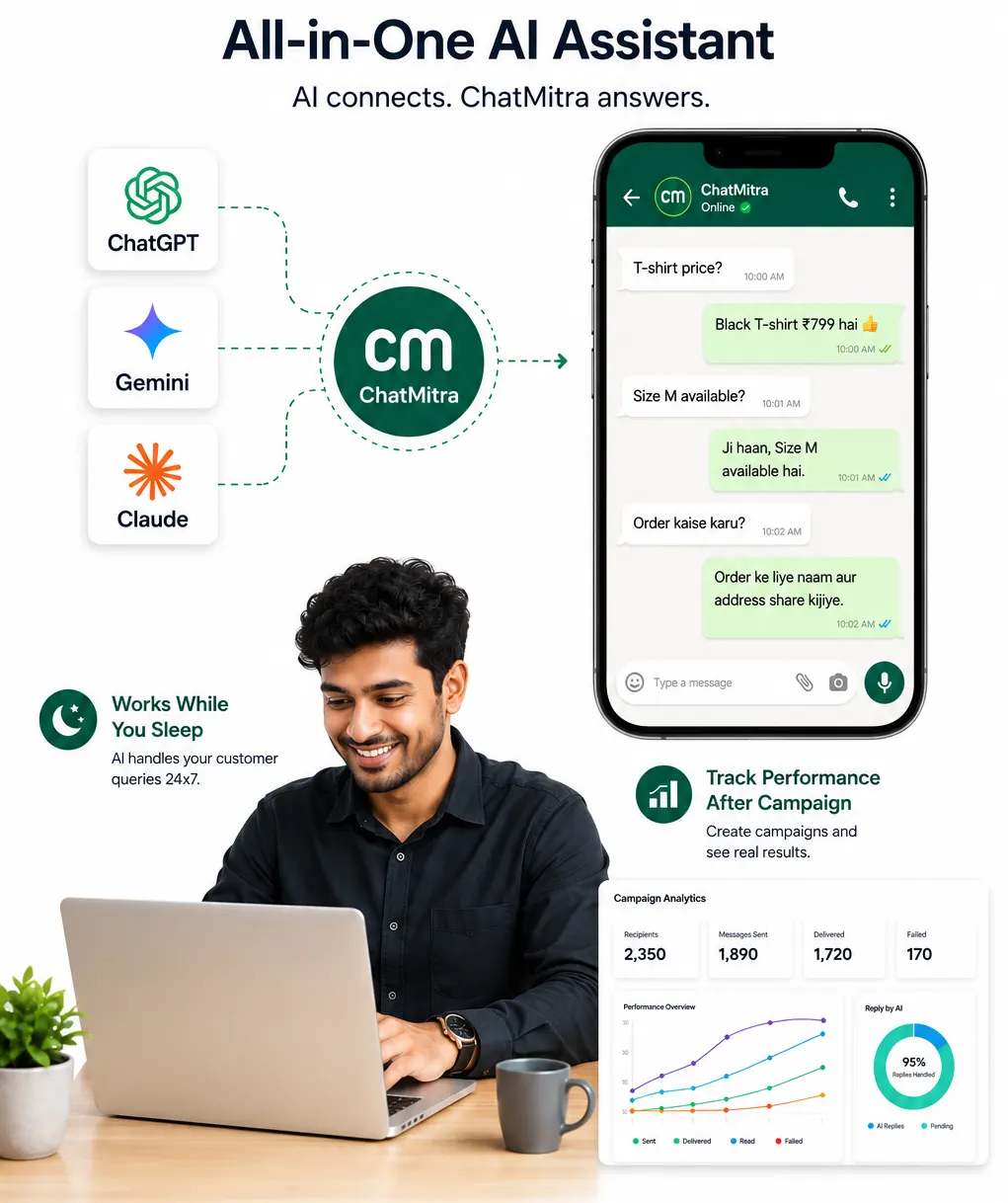
| AI agents | The AI Chatbot answers free-text messages with the AI model you choose, using your own API key and your own instructions. Auto Reply rules handle keywords, buttons, lists and product messages, and can call up to two external APIs. |
| Paid bot replies | Meta's charges are billed separately from ChatMitra's fee of ₹0.20 per conversation (one customer, 24 hours, however many messages). Pro is ₹999 a month and includes 1,000 credits. Fewer bot messages lower the Meta part of the bill. |
| Meta Business Agent and Conversation Routing | Not integrated. ChatMitra doesn't support thread control or standby routing yet. |
| Handover | A team member takes over from the shared inbox, and you can pause automated replies for one contact for 30 minutes to 24 hours, or until you turn them back on. There's no automatic "talk to a person" switch, so put a phone number or your team's hours in the bot's fallback message. |
| Scope and data | The AI answers within the instructions you write, so you control its scope. |
| Usernames and BSUIDs | Not supported yet. Contacts are identified by phone number. |
| Flows and calling | ChatMitra doesn't build WhatsApp Flows or offer WhatsApp calling. |
| Voice notes and photos | The AI Chatbot reads text messages only. Voice notes and photos reach your inbox for a person to handle. |
| Marketing vs service | Campaigns use the Marketing Messages API endpoint; bot replies are service messages. |
One thing to design around: if Auto Reply and the AI Chatbot are both switched on, a typed message that matches a keyword rule gets a reply from both. Use buttons and lists for menus, keep keyword rules for exact commands, and test the combination before launch.
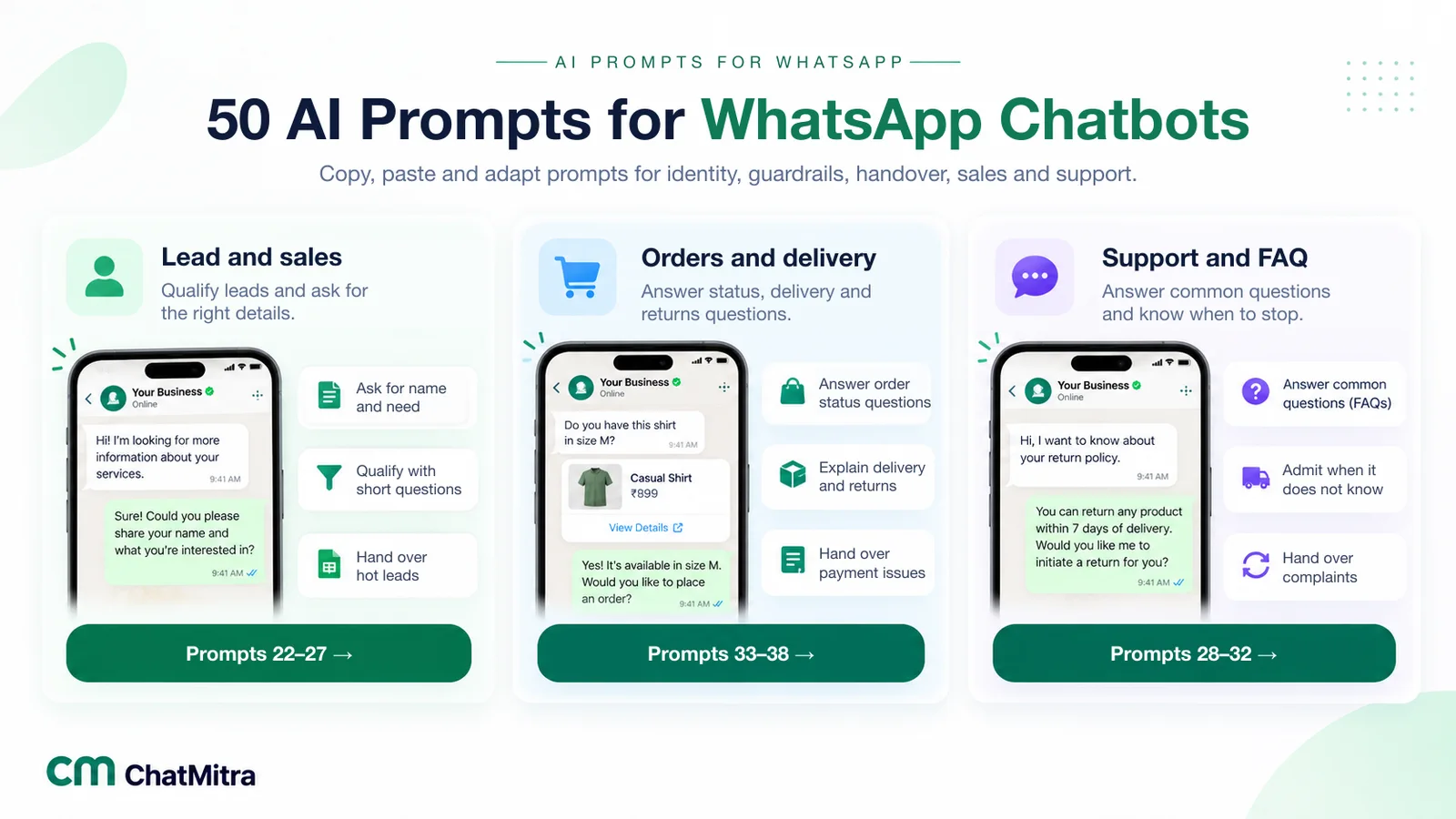
See pricing, Auto Reply and the AI Chatbot. For the instructions that keep an AI bot on topic, use our AI prompts for WhatsApp chatbots.
Summary
The chatbot trends for 2026–27 point the same way: from scripted menus to AI agents that act, inside rules that Meta and regulators are now writing quickly. On WhatsApp, bot replies cost money again after a monthly free tier, Meta sells its own agent at a premium per-message price, several responders can share one number with a formal handover, general-purpose AI assistants are banned in most markets, and customers will start arriving without phone numbers. Build a hybrid bot that answers in as few messages as possible, hands over cleanly, stays within your business’s scope and says what it is. Then review it every year, because the platform will keep changing.
Sources: Meta, Pricing on the WhatsApp Business Platform (updated 30 September 2026), pricing for AI Providers (updated 15 October 2026), Conversation Routing overview (updated 8 October 2026), preparing before enabling Meta Business Agent, business-scoped user IDs, Marketing Messages API overview (updated 13 October 2026) and the WhatsApp Business Platform changelog; WhatsApp, Business Solution Terms, clause 4.7 and Business Messaging Policy (updated 23 September 2026); WhatsApp Business blog, introducing Meta Business Agent (3 June 2026); Meta Newsroom, reserve your WhatsApp username (June 2026) and Business AI for small businesses in India (May 2026); MediaNama, MeitY notice on WhatsApp usernames (July 2026); Gartner, agentic AI prediction (5 March 2025) and survey on AI in customer service (9 July 2024); EU AI Act, Article 50; MeitY, Digital Personal Data Protection Rules, 2025; European Central Bank, euro reference rates (14 October 2026). ChatMitra product behaviour as verified in ChatMitra's code (October 2026).