WhatsApp for car wash businesses means using one business number to take bookings by chat, tell customers when their car is ready, reschedule when it rains, remind them when their next wash is due and ask for an honest review. For most washes, the first three are good service. The last two are where the money is: a regular who comes back every few weeks is worth many one-off visits, and a reminder costs well under a rupee.
This guide follows a car wash customer from the first message to the tenth visit: what to say at each step, which Meta category each message falls into and what it costs in India, how to time reminders, and how to ask for reviews within Google’s rules. It’s written for automatic and hand-wash sites, detailing studios and doorstep or society-wash services, and it says plainly where ChatMitra can help and where it can’t.
Key takeaways
- Booking confirmations, "car ready" updates, rain-day reschedules and feedback on a specific wash are utility messages: ₹0.115 each in India from 1 October 2026.
- A wash-due nudge with no booking behind it, and any pack renewal, is marketing at ₹0.8631: about 7.5 times the utility rate. Send fewer, better-timed ones.
- Time each reminder from the customer's own visit history, then adjust for monsoon, dust and festivals.
- Photograph existing scratches at check-in and send them to the customer. It takes a minute and settles damage questions before they start.
- Ask every customer for a review in the same words, with no reward attached. Google forbids incentives and asking only happy customers.
Why car washes struggle to get the second visit
Car washes don’t usually lose customers because the wash was bad. They lose them because nothing reminds the customer to come back, and a wash is easy to put off. The car gets dusty, the weekend fills up, and the next wash happens wherever is convenient that day.
The everyday problems look like this:
- The phone rings when everyone’s hands are wet. Bookings come in by call during the busiest hours, and the calls that go unanswered are lost bookings.
- Nobody knows who’s due. The owner remembers the regulars. Everyone else is a number in a notebook or a phone’s contact list.
- Rain wipes out a day. Bookings for a wet morning become no-shows, and nobody has an easy way to move them.
- Damage disputes cost more than the wash. A customer notices a scratch two days later, and there’s no record of whether it was there before.
WhatsApp fixes most of these because it’s where customers already reply quickly. It doesn’t replace a good wash; it makes the good wash easier to book, trust and remember.
The car wash customer journey on WhatsApp
Before choosing tools, map the messages. This table covers a typical customer, with the Meta category each message falls into and its India rate from 1 October 2026. “Service” means a free-form reply inside the 24-hour window that opens when the customer messages you; each number gets 1,000 of those free a month, then ₹0.115 each.
| Moment | Message | How it’s sent | Meta category | India cost |
|---|---|---|---|---|
| Customer asks for prices or a slot | Price list, service menu, booking questions | Reply in the open window | Service | Free up to 1,000/month, then ₹0.115 |
| Booking agreed | Confirmation with day, time window, service, address | Template, or a reply if the window is open | Utility (template) | ₹0.115 |
| Evening before | Reminder with a Reschedule button | Template (window has usually closed) | Utility | ₹0.115 |
| Check-in | Photos of existing marks and the job card | Reply in the window | Service | As above |
| Job done | ”Your car is ready” with the bill | Reply in the window, or a template for walk-ins | Service or utility | As above, or ₹0.115 |
| Next day | Feedback on that wash and a review link | Template | Utility if plain and specific (see below) | ₹0.115 |
| Weeks later | ”Your car is due for a wash” | Template | Marketing | ₹0.8631 |
| Pack about to run out | Renewal offer | Template | Marketing | ₹0.8631 |
Two rules from Meta decide the categories. A utility template must be non-promotional and specific to the customer’s order, account or transaction. Meta’s guidelines also say messages that try to renew a subscription are marketing “even if requested by users”. So a reminder about a booking is utility. A nudge to come back, or to renew a pack, is marketing.
One change matters for car washes in particular: since 1 October 2026, Meta charges for utility templates sent inside an open customer service window. Before that they were free. If the customer is already chatting with you, a plain reply (a service message) is cheaper than a template.
WhatsApp Business app or the WhatsApp API?
A one-bay wash run by the owner can do a lot with the free WhatsApp Business app: a business profile with hours and location, a catalog for your packages, quick replies for the price list, greeting and away messages, and labels for regulars. It works well while one person answers every chat.
The app starts to strain when:
- two or three staff need to reply from the same number at the same time;
- you want reminders to go out automatically, timed per customer;
- you run more than one site or a fleet of doorstep washers;
- you want buttons and lists, so customers tap rather than type;
- you want to connect a booking sheet, your POS or your website.
That’s the point to move to the WhatsApp Business API through a provider. For the full comparison, see WhatsApp Business app vs API, and for the steps, how to get the WhatsApp API.
Taking bookings by chat
The aim is a booking in under a minute, with as few questions as possible.
What to ask
Ask only what changes the price or the plan:
- Vehicle type: hatchback, sedan, SUV or MUV, two-wheeler. This sets the price and the time the job takes.
- Service: exterior wash, interior and exterior, foam wash, detailing, ceramic maintenance, or whatever is on your menu.
- When: a day and a time window, such as “Saturday, 9 to 11”, not an exact minute.
- Where, for doorstep washes only: the address and a location pin.
Skip the vehicle number, email and full name unless you need them: every extra question loses some people.
On the API you can make these questions tappable. A reply-buttons message offers up to three options (labels of up to 20 characters), and a list message offers up to 10 rows, which suits a service menu. “SUV · Foam wash · Saturday morning” takes three taps.
Doorstep and society washes
For doorstep services and daily washes in housing societies, the address is the hard part. Ask the customer to send their location from WhatsApp’s attachment menu (Location → Send your current location). The pin arrives in your inbox with the map, which beats parsing “near the second gate, opposite the temple”.
How booking works in ChatMitra
ChatMitra has no built-in slot calendar, and it doesn’t support WhatsApp Flows, so it can’t show a live grid of free slots. What it does support:
- Auto Reply rules (Pro plan). A rule triggered by a keyword such as “book” can reply with a list of services, then a set of buttons for the day. A tap on a button or list row is matched like a typed keyword, so one rule can lead to the next. Rules match keywords exactly, by “starts with” or by a pattern, and each rule can add a tag such as
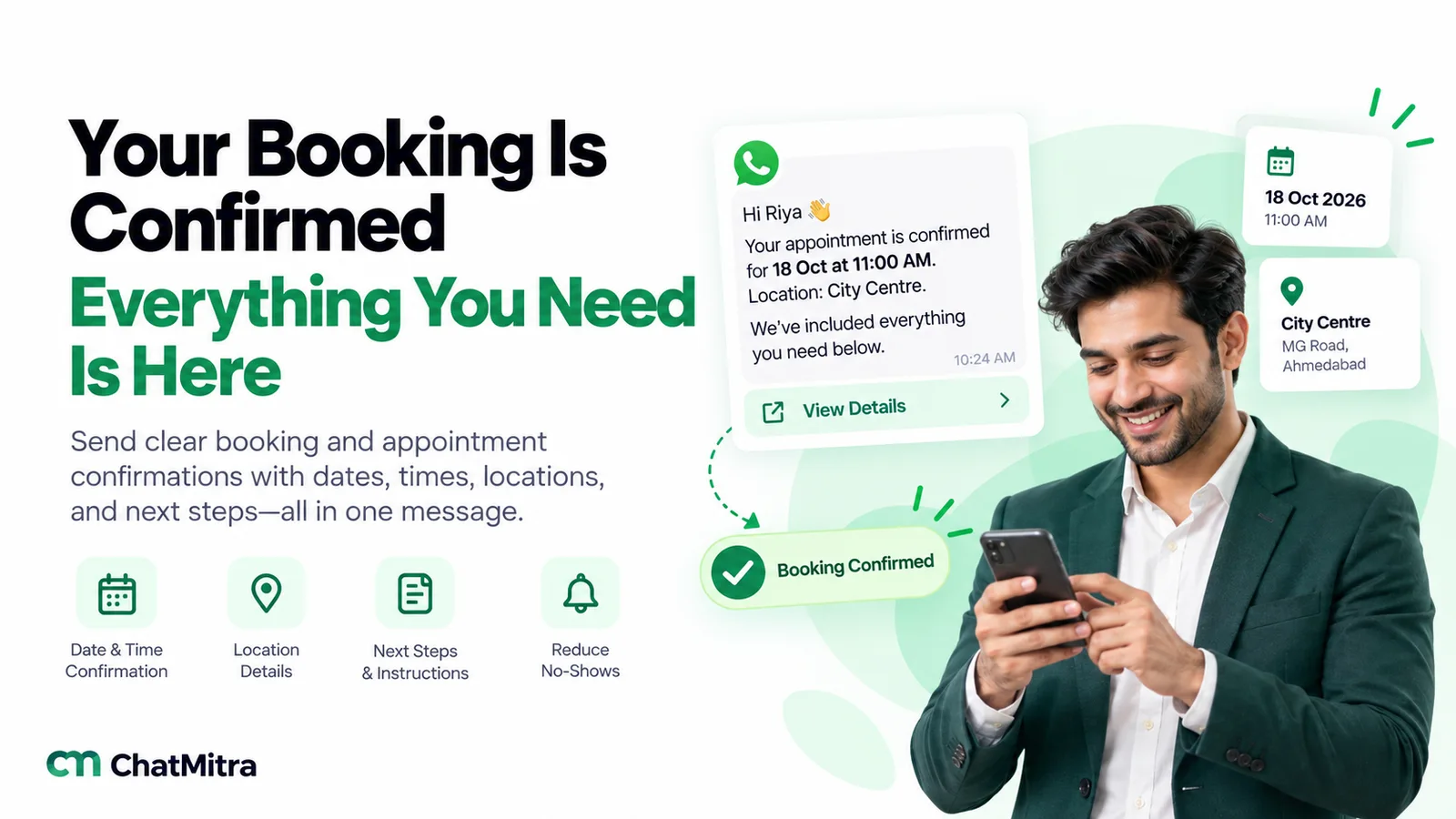
booking-requested. - A person confirms the slot. Booking requests land in the inbox, where staff check the day’s plan and reply “Confirmed: Saturday, 9 to 11, SUV foam wash.” The window is open, so it’s a service message. For wording ideas, see booking confirmation messages.
- Your own booking tool, if you have one. A booking system can send events to an automation webhook, and the automation can send the confirmation template.
Set an away message for when you’re closed. In ChatMitra it’s one daily window (for example, 8 pm to 7 am) in your time zone, so tell people in it when you’ll reply and how to book in the meantime.
Check-in photos, job updates and “your car is ready”
This is where WhatsApp earns trust with almost no effort.
At check-in, walk round the car and photograph anything that’s already there: scratches, dents, a cracked mirror, stone chips on the bonnet. Send the photos to the customer with a one-line note: “Before we start: these marks were already on the car. Reply if anything looks wrong.” Both of you now hold a time-stamped record, so a question about damage two days later has a clear answer.
When the job is done, send “Your car is ready” with the amount due. For customers who booked by chat, the window is usually still open, so a plain reply is enough. For walk-ins who never messaged you, use a short utility template, and collect their opt-in at check-in first (see the consent section).
For detailing jobs, a short before-and-after video or a few photos is worth sending even when the customer is waiting on site. It shows the work they’re paying for, and many will forward it.
In ChatMitra, staff can send photos, videos, documents and locations from the inbox, and the owner can do the same from the mobile app while standing at the bay. Note that push notifications go to the owner’s account only, so staff should keep the inbox open on a shared screen during working hours.
The wash-due reminder: your repeat-business engine
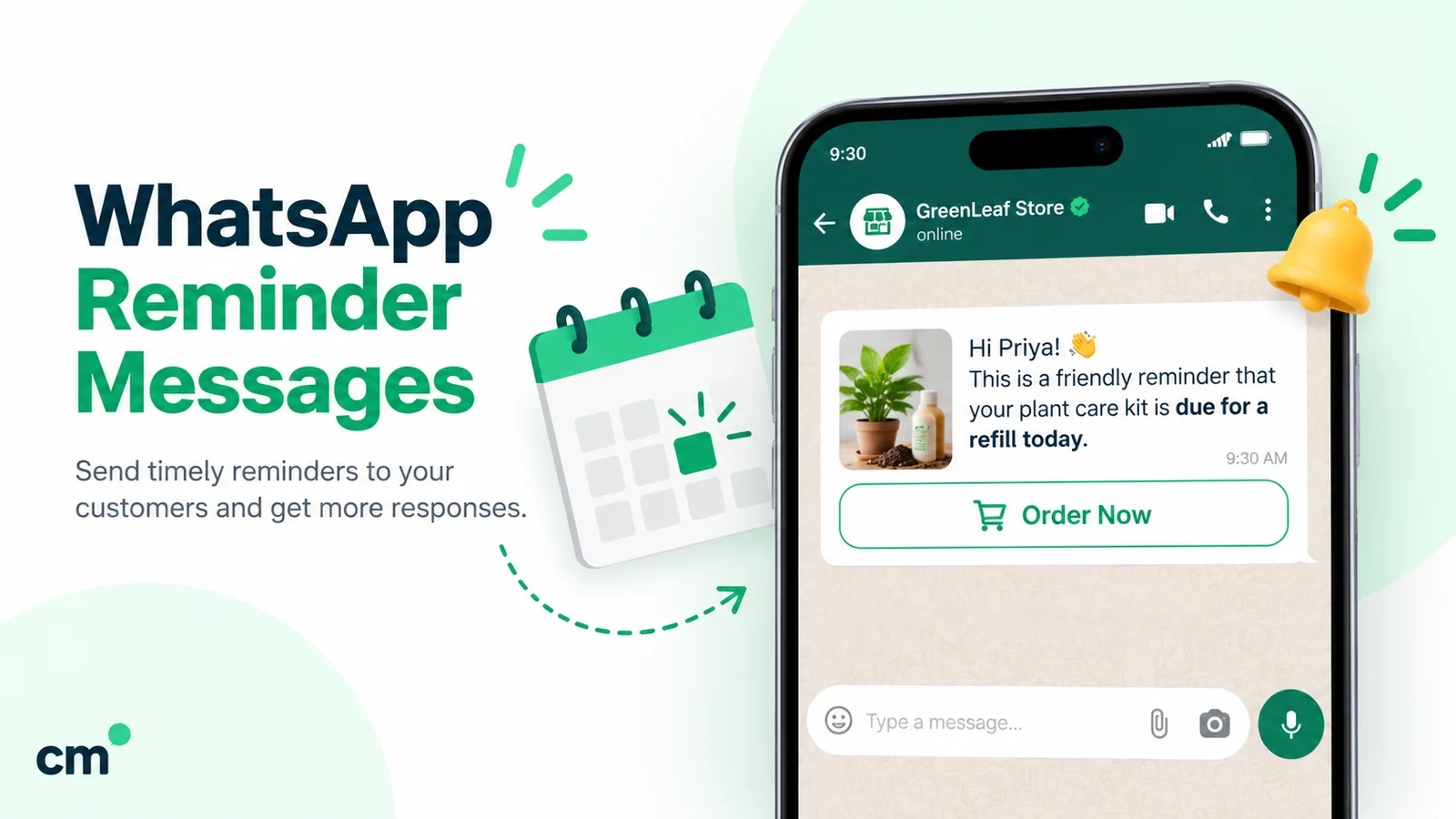
If you build only one automation, build this one. A customer who would have come back “some time” comes back this week.
Pick the interval from each customer’s history
Resist the urge to message everyone every two weeks. Jon Linkov of Consumer Reports puts it simply: “It’s not about doing it on a schedule,” and when the car has mud, salt or grime on it, “that’s the time to wash it.” People’s real habits vary a lot: a daily commuter on a dusty road and a weekend driver with covered parking don’t need the same reminder.
A simple method that works with a notebook or a spreadsheet:
- For each regular, note the dates of their last three or four visits.
- Work out their usual gap. If they came on the 2nd, the 23rd and the 15th of the next month, their gap is about three weeks.
- Set their reminder a couple of days before the next visit would fall due.
- For customers with only one visit, use your shop’s typical gap until you have more data.
If that’s too much work, group customers into a few intervals (say 14, 21, 30 and 45 days) instead.
Adjust for season, weather and festivals
Some moments justify an extra message to everyone who’s opted in:
- Before the monsoon, an underbody wash and wax are a natural offer, and mud and standing water are what people worry about.
- After a dust storm or the last of the rains, when every car in town needs it.
- Before major festivals and weddings, when people want the car looking its best.
These are marketing messages, so keep them few, useful and specific. “Underbody wash before the rains, ₹X this week, reply BOOK” beats “Big monsoon sale!!!”.
Setting it up in ChatMitra
ChatMitra’s automations can send a reminder a set number of days before (or after) a date stored on each contact. The cleanest way to handle different intervals with one automation is to store the date each customer is next due:
- Add a due date to your contacts. When you import contacts from a CSV, any column beyond the standard ones (Mobile, Name, Email, Tags and so on) becomes a custom field. Add a
next_wash_duecolumn, worked out as the last visit plus that customer’s usual gap, in the format2027-09-23(or23/09/2027). - Get a reminder template approved. Keep it short, with a Book button (see the templates below).
- Create the workflow. Open Integrations → Google Sheets → Workflows, create a workflow and pick the trigger N Days Before a Date. Leave the sheet blank so it reads your contacts, choose the
next_wash_duefield, set the offset (for example, 2 days) and the time it should run each day. Add a Send WhatsApp Template step. - Move the date after every visit. When a car is washed, set
next_wash_dueon that contact to the visit date plus their gap. If you don’t, the reminder fires once and never again, because it matches an exact date.
If you’d rather not work out gaps per customer, store the last_wash date instead and use N Days After a Date with one offset (say 21 days) for everyone. It’s simpler and less precise.
Two limits to know. Each run handles up to 2,000 matching contacts, which is plenty for a single site. And if you point the date trigger at a Google Sheet’s date column instead of a contact field, it compares only the day and month, so it behaves like a yearly birthday reminder. For wash cycles, use the contact field.
For more reminder wording across industries, see WhatsApp reminder messages.
Packages and memberships
Prepaid packs (“10 washes for the price of 8”) and monthly plans (“unlimited exterior washes” or “daily society wash”) smooth out your cash flow and make customers come back to use what they’ve paid for. In the US, where wash clubs are common, the International Carwash Association’s Q1 2026 survey found nearly 90% of members planned to renew. WhatsApp keeps packs visible, because customers forget what they’ve prepaid.
Useful pack messages:
- Balance after each visit: “Wash 6 of 10 used on your Swift. 4 left, valid until 31 December.” This is an update about the customer’s own account, so it fits the utility description; Meta makes the final call when it reviews the template.
- Payment reminders for a monthly plan: a factual note of the amount and date fits Meta’s account-alert examples for utility.
- Renewal: “Your pack ends next week. Renew now and get one wash free.” Meta’s guidelines say renewal messages are marketing, so budget ₹0.8631 for each.
Taking payment. For most car washes, the simplest route is to send your UPI ID or a payment link in the chat; see the WhatsApp payment link guide. If you list your packs as products in ChatMitra’s catalogue, catalogue orders can be paid through a Razorpay payment link on your own Razorpay account. Packs then show as products with a price, since the catalogue has no separate “service” type.
Society daily-wash plans work best with a monthly cycle: a utility payment reminder a few days before the due date, a confirmation when it’s paid, and a short message when a washer can’t make it (“No wash tomorrow, Tower B: water supply off. We’ll add a day to your month.”).
Rain, water cuts and other bad days
Bad days are when a car wash with a WhatsApp list looks professional and one without it looks absent.
Rain. When the forecast turns, message the day’s bookings early: “Heavy rain expected this morning. Want to move your wash to Thursday? Tap Reschedule or Keep.” A message about a booking the customer made is utility. Don’t wait for no-shows.
Water restrictions. In March 2024, during Bengaluru’s water shortage, the city’s water board banned using drinking water to wash vehicles, with a ₹5,000 fine for a first offence and ₹500 a day after that. Rules like these can stop you washing for days. If it happens to you, tell customers exactly what you can still offer (waterless or rinseless wash, interior cleaning, a later date) rather than going quiet.
Breakdowns and staff shortages. Move bookings before customers arrive, not after.
Queues. On a busy Saturday, a short reply to anyone who asks (“about 40 minutes’ wait right now, or book 2 pm”) turns a walk-away into a booking.
Asking for reviews without breaking Google’s rules
Reviews are one of the signals behind which car washes show up when someone searches “car wash near me”, and they’re what people read before choosing one. WhatsApp is a good way to ask, but Google’s rules are strict, and many guides get them wrong.
Google’s contribution policy says merchants may not:
- “offer incentives – such as payment, discounts, free goods and/or services - in exchange for posting any review”;
- “discourage or prohibit negative reviews, or selectively solicit positive reviews from customers”;
- “require or pressure users to leave ratings or write reviews while on the premises”.
In practice that rules out three common car wash tactics: “Review us 5 stars and get ₹50 off your next wash”; sending a feedback question first and passing only the happy customers on to Google (review gating); and having staff stand over customers while they write a review at the counter.
What you can do:
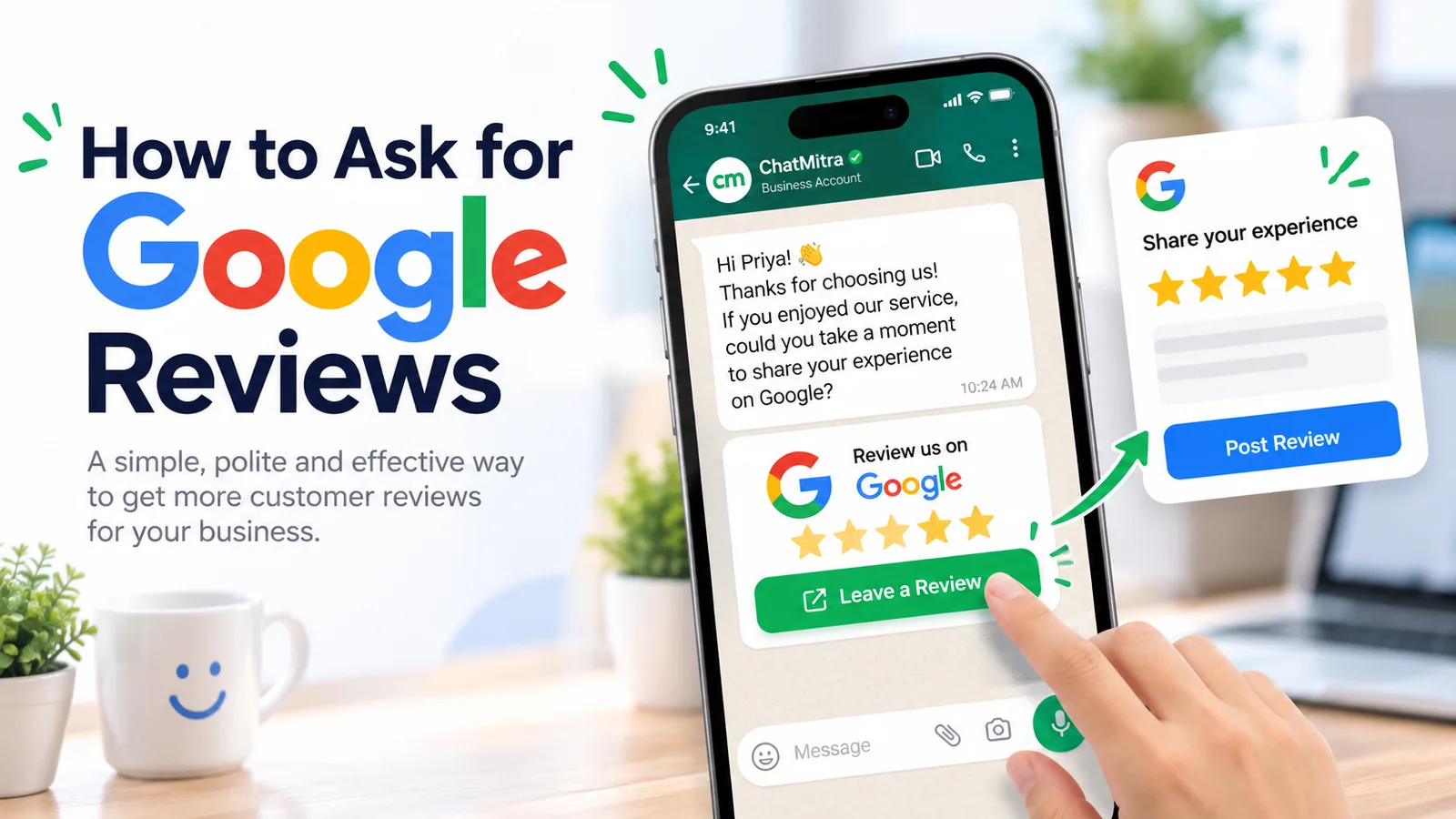
- Ask everyone, the same way. Send every customer the same message the day after their wash, with your review link and no reward.
- Keep the question neutral. “How was your wash? If you have a minute, an honest review helps other drivers find us” is fine. “Please give us 5 stars” is not.
- Make complaints easy too. Add “or reply here if something wasn’t right” and fix what people tell you.
On the Meta side, a feedback request about the customer’s own wash, with no promotional content, can qualify as utility. A generic survey, or one that carries an offer, will be classed as marketing, and Meta may also treat a request to post a public review as marketing. If it does, that message costs ₹0.8631 instead of ₹0.115.
For more detail on wording and timing, read how to ask for Google reviews. ChatMitra doesn’t have a review-management feature, so you collect the link from your Google Business Profile and put it in the template’s URL button.
Message templates for a car wash
Here are nine templates you can adapt. Variables appear as {{1}}, {{2}} and so on. Meta reviews every template and has the final say on its category. In ChatMitra, a template body can’t start or end with a variable, so each one below begins and ends with plain text.
1. Booking confirmation (utility)
Hi {{1}}, your {{2}} for the {{3}} is booked for {{4}}. Reply here if you need to change it. See you then.
2. Day-before reminder (utility)
Reminder: your car wash is tomorrow, {{1}}, at our {{2}} branch. Buttons: Keep booking · Reschedule
3. Washer on the way, for doorstep services (utility)
Your washer {{1}} is on the way and should reach {{2}} by {{3}}. Please keep the car keys ready.
4. Car ready (utility, for walk-ins with no open chat)
Your {{1}} is ready for pickup. Amount due: ₹{{2}}. Thank you for choosing us.
5. Rain reschedule (utility)
Heavy rain is expected during your wash on {{1}}. Would you like to keep it or move it? Buttons: Keep · Move to another day
6. Pack balance (utility, if kept purely factual)
Wash {{1}} of {{2}} used on your pack. Washes left: {{3}}, valid until {{4}}. Thank you.
7. Feedback on this wash (utility if Meta accepts it as feedback; otherwise marketing)
Thanks for visiting us on {{1}}. How did we do? If you have a minute, an honest Google review helps other drivers find us. Button: Write a review (URL)
8. Wash-due reminder (marketing)
Hi {{1}}, it’s been about {{2}} weeks since your last wash with us. Want us to book you in this week? Buttons: Book a wash · Not now
9. Monsoon prep (marketing)
Rains are on the way. Book an underbody wash and wax this week to keep mud and water off your car. Button: Book now
Put a Not now or Stop offers button on every marketing template and act on it (see the consent section). For the full category rules, see WhatsApp utility templates. The automobile templates in our template library also cover service reminders.
What a month of WhatsApp costs a car wash
Here’s an illustrative month for a busy single-site wash, using Meta’s India rates from 1 October 2026.
| Messages | Count | Category | Rate | Meta charge |
|---|---|---|---|---|
| Booking confirmations (templates) | 320 | Utility | ₹0.115 | ₹36.80 |
| Day-before reminders | 200 | Utility | ₹0.115 | ₹23.00 |
| Feedback requests | 280 | Utility | ₹0.115 | ₹32.20 |
| Wash-due reminders | 250 | Marketing | ₹0.8631 | ₹215.78 |
| Replies inside open chats | 1,400 | Service (first 1,000 free) | ₹0.115 on the 400 above 1,000 | ₹46.00 |
| Total | ₹353.78 |
Two things stand out:
- The whole month is about ₹354 in Meta charges. For most washes, one or two extra repeat visits cover it.
- Reminders are the big line. 250 marketing messages cost more than all the utility messages and replies together. That’s why the interval method matters: a reminder that arrives when the car actually needs a wash has a far better chance of becoming a booking.
Your provider’s fee comes on top. On ChatMitra’s Starter plan there’s no monthly fee: you pay ₹0.20 per conversation (once per customer in a 24-hour period, not per message) plus Meta’s charges. The Pro plan is ₹999 a month and includes 1,000 conversations, plus Auto Reply rules, the API and webhooks. To model your own numbers, use the WhatsApp pricing calculator or see pricing.
Consent and customer data
To message someone first, with a reminder, an offer or a “car ready” note to a walk-in, you need their opt-in.
What Meta requires. Opt-in can be collected in many ways (online, by SMS, in person or on paper) and doesn’t have to be specific to WhatsApp. But it must clearly say the person is agreeing to receive messages, and it must name your business. A line on the job card works well: ”☐ Send me booking updates and offers from [Your Car Wash] on WhatsApp.” See the WhatsApp opt-in guide for more methods.
What India’s DPDP Act adds. Under section 6(1), consent must be “free, specific, informed, unconditional and unambiguous with a clear affirmative action”. Under section 6(4), withdrawing it must be as easy as giving it. The DPDP Rules were notified in November 2025, with an 18-month phase-in for most obligations. Practically, for a car wash:
- collect only what you need: name, number, vehicle type and, for doorstep work, address;
- treat vehicle numbers and addresses as personal data, and don’t share customer lists between franchisees or partners;
- make stopping easy: a “Stop offers” button or reply keyword, honoured the same day.
One ChatMitra-specific step. ChatMitra’s campaigns don’t automatically skip people who’ve turned off marketing messages through WhatsApp’s own controls. Keep a do-not-message tag, add it whenever someone asks to stop, and exclude that tag from every campaign. For date-based reminders, also clear that person’s next_wash_due date so the workflow stops matching them.
Setting it up in ChatMitra: a one-week plan
- Day 1: connect your number. Use a dedicated business number, not the owner’s personal one. How to get the WhatsApp API covers verification and the display name.
- Day 1: write the welcome message. It goes to each customer the first time they message you: your services, prices or a link to them, hours and how to book.
- Day 2: build the booking rules (Pro). Create Auto Reply rules for “book”, “price” and “location”. Send the service list as a list message, the day options as buttons, and your shop location as a pin. Set the away window for your closing hours.
- Day 2: save quick replies for the questions staff answer twenty times a day: wait times, payment methods, what’s included in each service.
- Day 3: submit templates. Start with booking confirmation, day-before reminder, car ready, rain reschedule, feedback and wash-due. Match each template’s category to its content to avoid rejections.
- Day 4: import your customers. Upload a CSV with Mobile, Name, Tags (several separated by
|, such assedan|monthly-pack) and anext_wash_duecolumn. Only import people who’ve opted in. - Day 5: create the reminder workflow as described above, and test it on your own number.
- Day 6: brief the team: check-in photos for every car,
next_wash_duemoved after every wash,do-not-messagefor anyone who asks. - Day 7: plan one seasonal campaign. Campaigns in ChatMitra are one-off sends, now or at a scheduled time, with tags to include and exclude. There’s no repeat schedule, so plan each seasonal message as its own campaign.
For a broader look at what to automate first, see WhatsApp automation and these auto-reply examples for small businesses. Dealerships and service centres can also see WhatsApp for automotive businesses.
What to measure
Track a few numbers monthly, in a simple sheet:
- Bookings that came through WhatsApp, as a share of all bookings.
- Repeat rate: customers with two or more visits in the last 60 days.
- Reminder response: of the customers who got a wash-due reminder, how many booked within a week. ChatMitra’s campaign stats show sent, delivered, read and failed, but not button taps or replies, so count bookings from the inbox or your register.
- No-show rate before and after the day-before reminder.
- Disputes over damage, before and after check-in photos.
- New Google reviews per month, and the average rating.
If the reminder response is low, change the timing first and the wording second.
Common mistakes
- Writing a promotion and calling it utility. Meta will re-categorise or reject it. A booking reminder must not carry an offer.
- Sending a template when a reply would do. Inside an open chat, a plain reply is cheaper than a utility template.
- Using a personal number for the business. When that phone is lost or that person leaves, the customer history goes too.
- Messaging everyone on the same day every month. It’s your most expensive message; time it to each customer instead.
Summary
A car wash runs on repeat visits, and WhatsApp is the cheapest way to earn them. Make booking quick, photograph cars at check-in, move bookings before bad weather does, time wash-due reminders from each customer’s own history, and ask everyone for an honest review with no reward attached. A busy month costs a few hundred rupees in Meta charges.
To set up your number, see how to get the WhatsApp API, or start free with ChatMitra.
Sources: Meta, WhatsApp pricing and INR rate card (effective 1 October 2026), template categorisation guidelines, getting opt-in, customer service window, reply buttons and list messages; Google, Maps user-contributed content policy: fake engagement; International Carwash Association, CAR WASH Pulse Q1 2026; Consumer Reports' Jon Linkov, quoted by ABC7 News; Business Today, Bengaluru bans potable water for car washing (8 March 2024); Digital Personal Data Protection Act, 2023 and PIB, DPDP Rules, 2025 explainer (November 2025). ChatMitra product behaviour as verified in ChatMitra's code (October 2026).