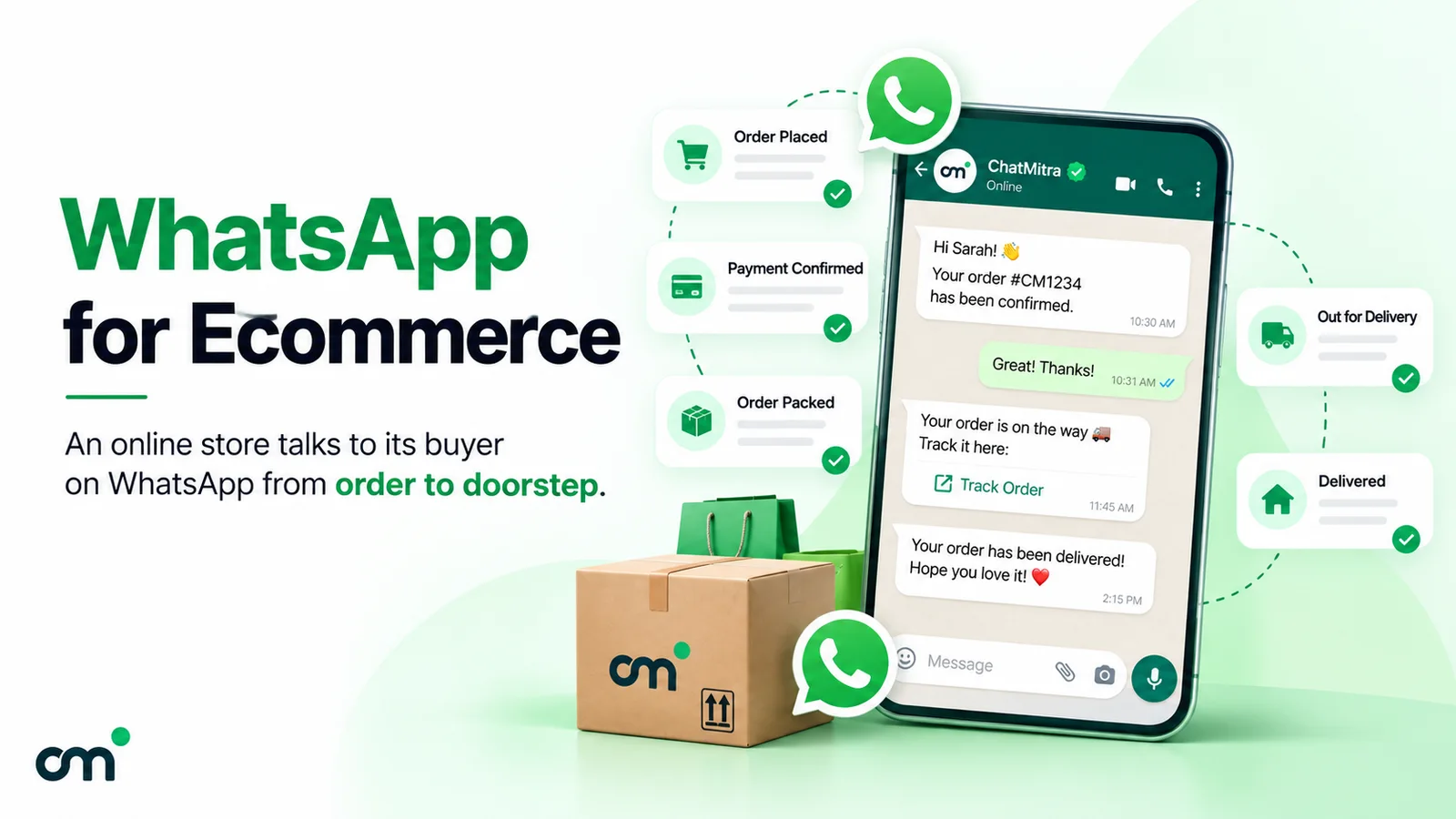
WhatsApp for D2C brands is an owned, one-to-one channel that does three jobs: it turns paid clicks into conversations, it carries the order, cash-on-delivery and shipping messages customers already expect, and it brings first-time buyers back for a second order. For most direct-to-consumer brands the third job matters most, because every customer was paid for once and the profit arrives with the repeat purchase.
That changes how you plan. A D2C brand shouldn’t start with “what can we send?” but with “which number are we trying to move?”: cost per acquisition, conversion rate, return-to-origin (RTO) on COD orders, repeat purchase rate. This playbook maps WhatsApp programmes to those numbers, gives you twelve templates written for D2C, prices the whole thing with Meta’s current rates, and ends with a 90-day rollout.
Key takeaways
- Choose WhatsApp programmes by the metric they move, not by the feature list.
- Order, COD and shipping messages are cheap utility messages in India (₹0.1150) and are the right first step.
- Marketing messages (₹0.8631 in India) are most of the bill, so every campaign needs a break-even number and a holdout group.
- Opt-in, relevance and frequency decide whether WhatsApp keeps working, because WhatsApp limits marketing messages to people who stop engaging.
Meta’s rates, limits and rules in this guide were checked on 1 October 2026. Check them again before you budget, because Meta updates its rate card several times a year.
Why WhatsApp fits the D2C model
A D2C brand sells through its own website or app instead of through retailers or marketplaces. That gives it the margin and the customer data, and it also gives it the bill for finding every customer, usually through paid social and search.
WhatsApp helps at the three points where that model leaks money.
Paid clicks that don’t buy. Most ad visitors leave a product page with a question: will this suit my skin, what size am I, how long does delivery take? A click-to-WhatsApp ad sends them into a chat instead of a page, where someone (or a bot) answers. When a customer messages you from one of these ads or from a Facebook Page button, Meta opens a free entry point window that can last up to 7 days, and every message in it is free.
Orders that don’t stick. Cash on delivery is still common in India, and orders nobody accepts come back as RTO, costing you shipping both ways. A confirmation message right after the order catches many of them before you ship.
Customers who buy once. Email open rates and organic social reach have both made it hard to reach your own buyers. WhatsApp reaches them in the app they check most, which is why it works well for reorders, launches and reviews, as long as you don’t abuse it.
Two of Meta’s published WhatsApp success stories show the pattern. TriHealth, a Malaysian probiotics and gut-health brand, sent WhatsApp marketing messages through Meta Ads Manager to shoppers who had left its checkout, and reports a 49% lower cost per purchase, 48% higher sales and a 51% better return on ad spend than its usual approach (Meta case study). The Little Farm Co, an Indian maker of pickles and farm foods, ran click-to-WhatsApp ads built around family recipes and reports 46% more customer messages at 32% lower cost (Meta case study). One brand used WhatsApp to rescue paid traffic; the other used content to start conversations. Both are D2C problems.
If you run a store and want the stage-by-stage view of WhatsApp commerce, our guide to WhatsApp for ecommerce covers it. This guide is narrower: what a D2C brand should do first, and how to tell whether it’s paying off.
The D2C metric map: which WhatsApp programme moves which number
| Metric you want to move | WhatsApp programme | Template category | What to measure |
|---|---|---|---|
| Cost per acquisition | Click-to-WhatsApp ads, product quiz or consult in chat | Free entry point window, then service replies | Cost per conversation, conversations that become orders |
| Conversion rate | Guided selling, cart reminders | Service replies; cart reminders are marketing | Orders from chats, recovered checkouts |
| RTO on COD orders | COD confirmation, COD-to-prepaid nudge | Utility (the prepaid offer makes it marketing) | Cancelled before shipping, RTO rate, prepaid share |
| Support cost | Order confirmation, shipping updates, FAQ bot | Utility, service | "Where is my order?" tickets per 100 orders |
| Average order value | Bundles and add-ons in chat, post-purchase cross-sell | Marketing | AOV of WhatsApp orders vs others |
| Repeat purchase rate | Replenishment reminders, launches, VIP early access | Marketing | Second-order rate within 60 or 90 days |
| Reviews and social proof | Review request for a delivered order | Utility if it's only about that order | Reviews per 100 delivered orders |
| Lifetime value | Win-back, referral, subscription reminders | Marketing | Revenue per opted-in customer over 6–12 months |
Two things stand out. First, everything around the order is cheap utility or free service messaging, so it pays for itself through fewer support tickets and fewer failed deliveries. Second, everything that grows revenue after the first order is marketing, which costs about 7.5 times more per message in India. That’s where your judgement and your measurement go.
12 WhatsApp use cases for D2C brands
Grouped by where they sit in the customer’s life with your brand. Each links to a deeper guide where we have one.
Before the first order
1. Click-to-WhatsApp ads with a reason to chat. “Message us” alone rarely works. Give people something they want: a skin-type quiz, a size check, a recipe, a “which variant is right for me” consult. The Little Farm Co’s recipe creative is a good model. Staff the chats in the hours your ads run, because an ad that lands in an empty inbox wastes the click.
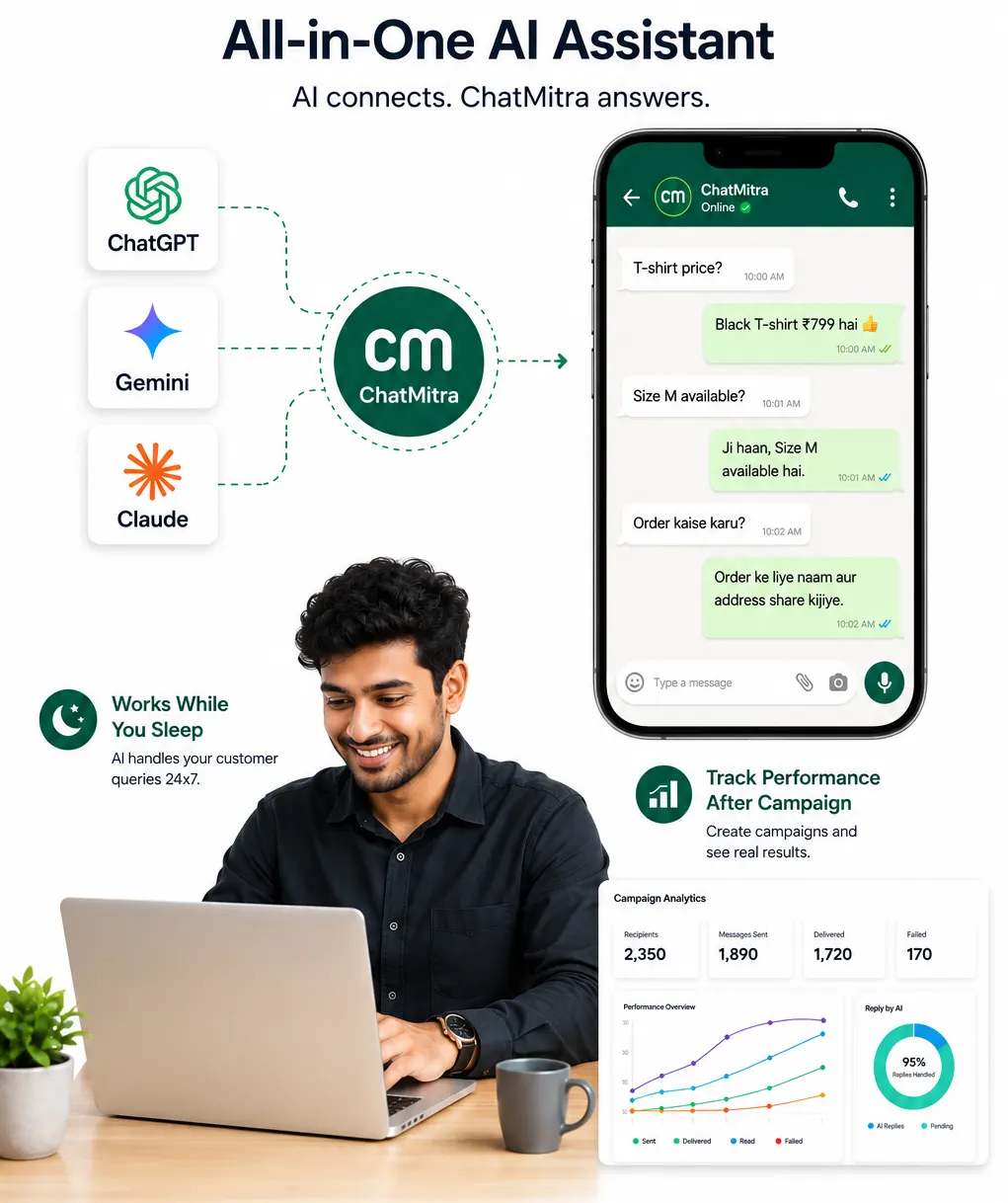
2. Guided selling for considered products. Mattresses, supplements, skincare routines and baby products all generate questions before purchase. A product specialist on WhatsApp (or an AI assistant that hands over to one) answers them and sends a product link or catalogue item. The WhatsApp catalogue helps when people want to browse inside the chat.
3. Waitlists and drop alerts. For limited runs and launches, collect WhatsApp opt-ins on the product page (“Get a WhatsApp alert when it’s back”) and message only the people who asked. Our out-of-stock message guide has wording for both sides of a stockout.
Around the order
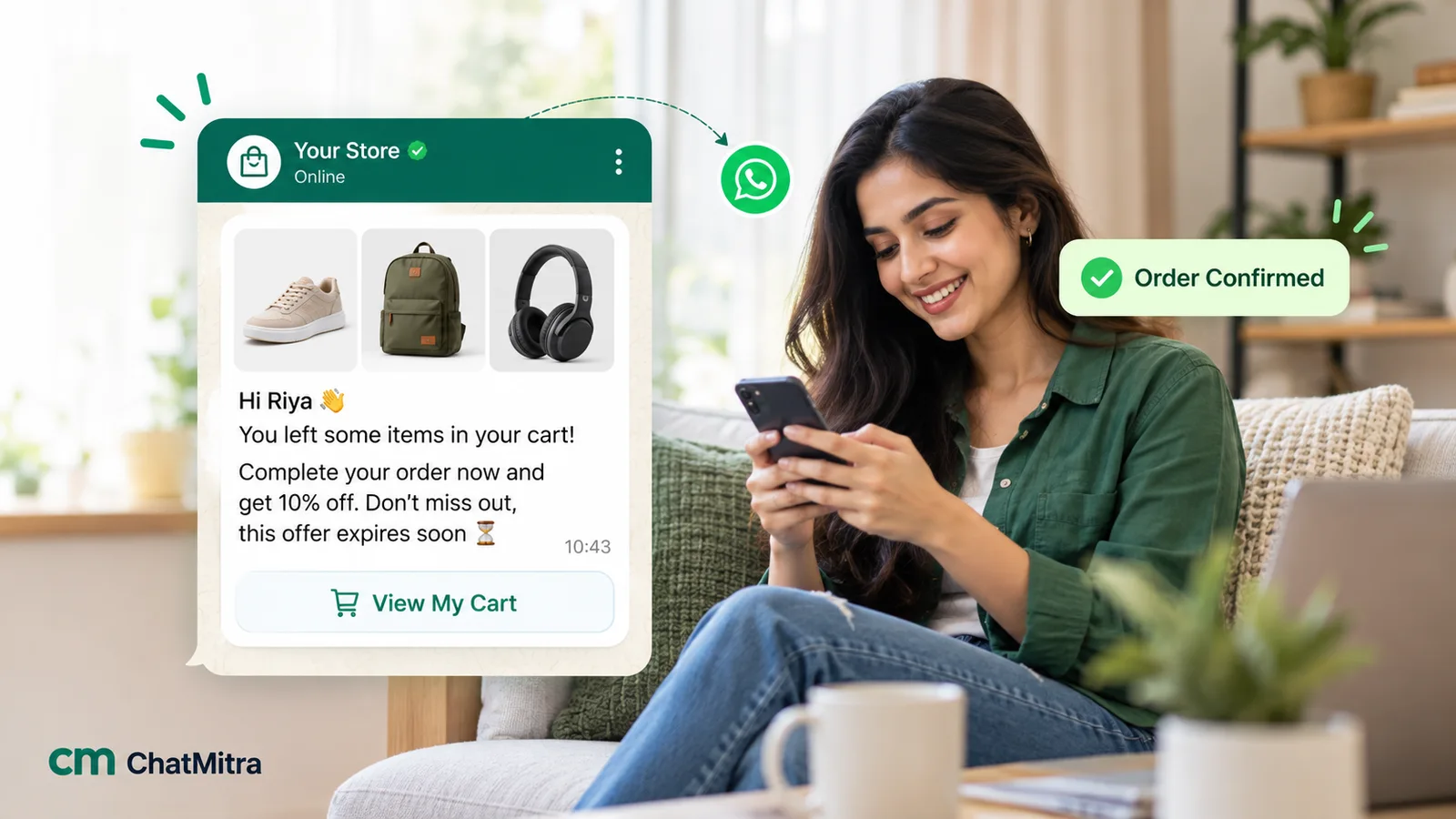
4. Cart reminders. A shopper who reached checkout and gave a phone number is the warmest lead you have. One to three reminders, the first within an hour, recover a share of them. Meta’s categorisation guide lists cart reminders as marketing “even if requested by users”, so they need marketing opt-in. Timing and wording are in our abandoned cart recovery guide.
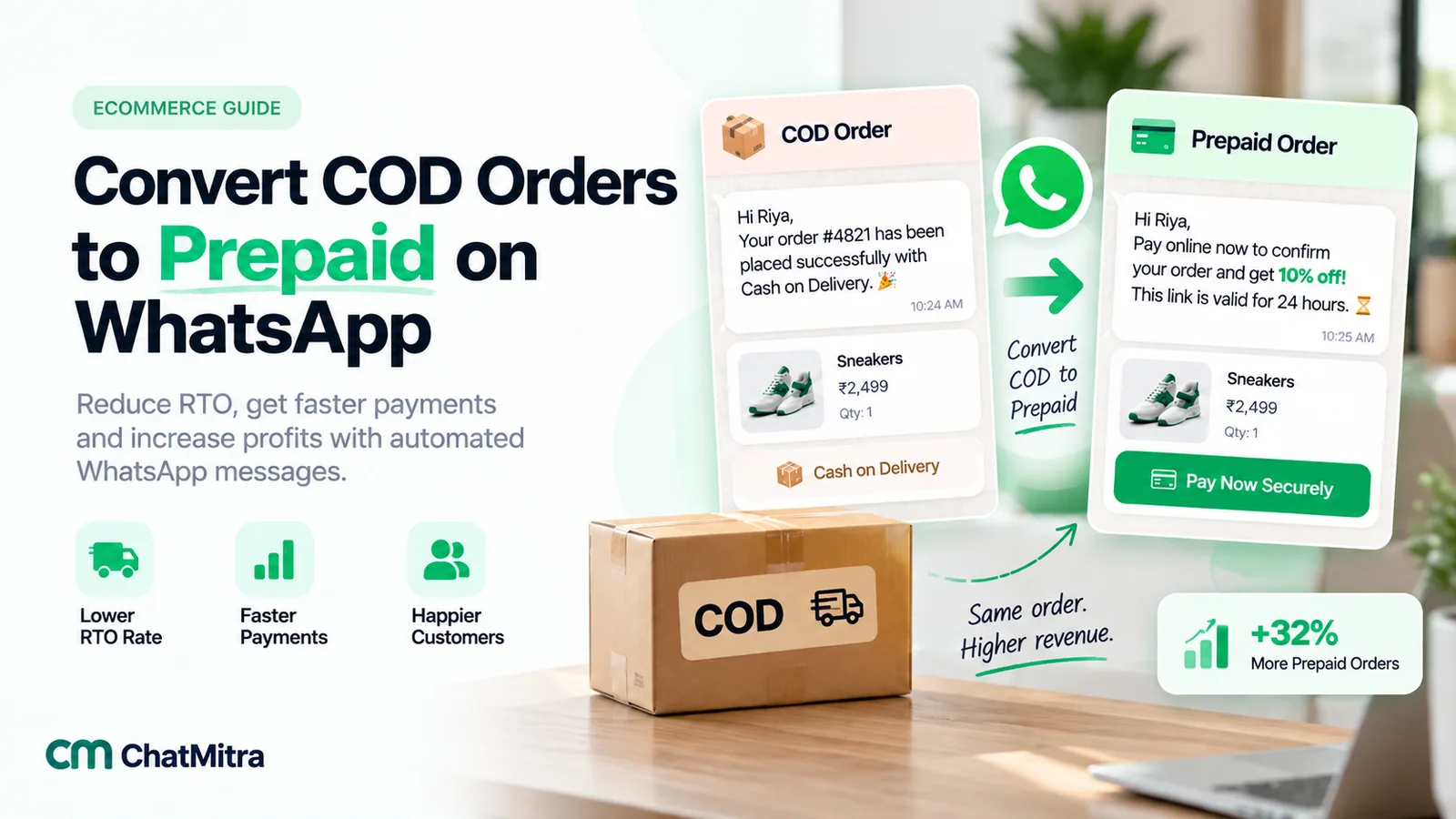
5. COD confirmation. Send a utility template with “Confirm order” and “Cancel” buttons right after a COD order. Confirmed orders ship, cancelled ones don’t, and silent ones get a follow-up call or a hold. It’s the single biggest RTO lever on WhatsApp, and our guides to RTO in ecommerce and COD to prepaid conversion go further.
6. Order confirmation and shipping updates. The messages customers check most. Keep them strictly transactional so they stay utility, and include the tracking link. Our order confirmation message examples cover the wording rules.
After delivery
7. How-to-use and onboarding content. A D2C product that’s used wrongly gets returned or not rebought. A short “how to get the best from your order” message a day after delivery, about the product they bought and nothing else, reduces that. Meta judges each template on its content: product guidance tied to the customer’s own order can pass as utility, while anything that recommends another product makes it marketing.
8. Review and photo requests. Ask for a review of the specific order, a few days after delivery, and send the same link to everyone, whatever they’re likely to say. Our Google review request guide explains why gating reviews by score backfires.
9. Replenishment reminders. The best retention message in D2C, because it’s timed by the product. A 30-day supply gets a reminder around day 24; a 60 ml serum at two drops a day lasts a predictable number of weeks. Use the product’s real usage cycle, not a fixed monthly blast.
Bringing customers back
10. VIP early access and launches. Give your best customers the new drop or the sale a day early. It rewards them, and a smaller, more engaged audience reads more and blocks less.
11. Win-back. For customers who haven’t bought in two or three replenishment cycles, send one well-targeted message with a reason to return: a new formula, a bundle, a reminder of what they liked. If they don’t respond, stop. Repeated win-back messages to people who’ve stopped reading are what WhatsApp’s per-user limits are designed to cut off.
12. Referrals and community. Happy repeat buyers will share a referral link if you make it easy. Send it after a second order, not the first, when you know they like the product. Our subscriber list guide covers how referrals feed opt-ins.
For campaign ideas beyond these twelve, see WhatsApp marketing campaign ideas. Vertical-specific set-ups are on our industry pages for beauty and cosmetics, health and wellness and home decor brands.
Segments that work for D2C brands
A D2C brand’s best targeting data is its own order history, and WhatsApp campaigns should use it. Six segments cover most needs:
| Segment | Who's in it | What to send |
|---|---|---|
| First-time buyers | One order, delivered in the last 30 days | How-to-use content, a review request, a gentle second-order reason |
| Replenishment due | Bought a consumable whose usage cycle is ending | A reorder reminder timed to that product |
| Repeat buyers | Two or more orders | VIP early access, launches, referral invites |
| Lapsed | No order in two or three product cycles | One win-back message, then stop |
| COD buyers | Paid cash on delivery last time | A prepaid reason at the next checkout |
| Browsers and cart leavers | Gave a number but haven't bought | Cart reminders, answers to questions, no blasts |
Build these from your store’s order data, keep each contact tagged with what they bought and when, and refresh the segments before every send. The smaller and more specific the segment, the higher the read rate, and read rate is one of the signals WhatsApp uses when it decides whether to limit marketing messages to someone.
WhatsApp templates for D2C brands
Every message you start, outside a conversation the customer opened, must be an approved template. Below are twelve written for D2C. Numbered variables such as {{1}} are filled in when you send. Each body begins and ends with fixed text, because Meta rejects templates that start or end with a variable.
The category shown is what Meta is likely to assign, not a guarantee. Meta judges the final wording, and any promotional line makes a template marketing. Our guide to writing utility templates explains the test in detail.
| # | Template | Likely category | Buttons |
|---|---|---|---|
| 1 | Opt-in confirmation | Marketing | Quick reply: Stop offers |
| 2 | COD confirmation | Utility | Quick replies: Confirm order, Cancel |
| 3 | Order confirmed (prepaid) | Utility | URL: View order |
| 4 | Shipped | Utility | URL: Track order |
| 5 | How to use your order | Utility if only about the product bought | URL: Watch the 1-minute guide |
| 6 | Review request | Utility | URL: Write a review |
| 7 | Cart reminder | Marketing | URL: Return to checkout |
| 8 | Replenishment reminder | Marketing | URL: Reorder; quick reply: Remind me later |
| 9 | Back in stock (for people who asked) | Marketing | URL: Buy now |
| 10 | VIP early access | Marketing | URL: Shop early |
| 11 | Win-back | Marketing | URL: See what's new; quick reply: Stop offers |
| 12 | Referral invite | Marketing | URL: Share your link |
1. Opt-in confirmation (marketing)
Hi {{1}}, thanks for joining {{2}} on WhatsApp. We’ll send order updates here, plus new launches and member offers a few times a month. Reply STOP anytime and we’ll only send order updates.
2. COD confirmation (utility)
Hi {{1}}, we’ve received your cash-on-delivery order {{2}} for ₹{{3}}. Please confirm it so we can pack and ship it today. If you didn’t place this order, tap Cancel.
3. Order confirmed (utility)
Hi {{1}}, thank you for your order {{2}}. Your payment of ₹{{3}} is received and we’ll share tracking details as soon as it ships.
4. Shipped (utility)
Good news, {{1}}: order {{2}} has shipped with {{3}}. Expected delivery is {{4}}. Use the button below to track it.
5. How to use your order (utility, if nothing is promoted)
Hi {{1}}, your {{2}} was delivered yesterday. For the best results, {{3}}. The short guide below shows how in under a minute.
6. Review request (utility)
Hi {{1}}, how is your {{2}} working for you? Your honest review of order {{3}} helps other customers choose, whatever your rating.
7. Cart reminder (marketing)
Hi {{1}}, you left {{2}} in your cart. It’s saved for you, and delivery to {{3}} usually takes {{4}} days. Tap below to finish your order.
8. Replenishment reminder (marketing)
Hi {{1}}, your {{2}} from {{3}} should be running low soon. Reorder now so you don’t run out, or tap Remind me later.
9. Back in stock (marketing)
Hi {{1}}, you asked us to tell you when {{2}} was back. It’s in stock again today, and we’ve set some aside for people on the list.
10. VIP early access (marketing)
Hi {{1}}, as one of our regular customers you get early access: {{2}} opens for you today, a day before everyone else. The link below works until {{3}}.
11. Win-back (marketing)
Hi {{1}}, it’s been a while since your last order. We’ve {{2}} since then, and thought you’d want to know. Reply STOP if you’d rather not hear from us.
12. Referral invite (marketing)
Hi {{1}}, thanks for ordering again. If a friend would like {{2}}, share your link below: they get {{3}} off their first order and you get {{4}} for yours.
Templates 7 to 12 need marketing opt-in, and the variables that hold offers (such as {{3}} and {{4}} in template 12) should stay specific and true. For more wording, browse ChatMitra’s WhatsApp template message library.
What WhatsApp costs a D2C brand: a worked example
Meta charges per delivered template. On the rate card we checked on 1 October 2026, messages to Indian numbers cost:
- Marketing: ₹0.8631
- Utility and authentication: ₹0.1150
- Service replies (inside a conversation the customer opened): free for the first 1,000 a month per business phone number, then ₹0.1150. Meta started charging for service messages on 1 October 2026.
Since 1 October 2026 utility templates are charged inside an open customer service window too. Everything is free inside a free entry point window, which can last up to 7 days after someone messages you from a click-to-WhatsApp ad.
Here’s a month for an illustrative D2C brand in India with 5,000 orders and 10,000 opted-in customers. All messages are delivered and sent to Indian numbers.
| Programme | Messages | Category | Meta cost |
|---|---|---|---|
| Order or COD confirmation, shipped, review request (3 per order) | 15,000 | Utility | ₹1,725.00 |
| Cart reminders | 3,000 | Marketing | ₹2,589.30 |
| Replenishment reminders | 1,500 | Marketing | ₹1,294.65 |
| Two campaigns to 10,000 opted-in customers | 20,000 | Marketing | ₹17,262.00 |
| Service replies (4,000, of which 1,000 free) | 3,000 billable | Service | ₹345.00 |
| Total | ₹23,215.95 |
That’s about ₹4.64 of Meta charges per order. The utility messages around each order cost ₹0.345 together. Marketing is ₹21,145.95, about 91% of the bill.
Your platform adds its own charges. On ChatMitra’s Starter and Pro plans, a ₹0.20 platform fee applies whenever a send opens a new 24-hour conversation with that customer, so at most ₹7,900 for the 39,500 templates above, and less when several messages reach the same customer within a day. On Enterprise there’s no per-conversation fee and the plan is ₹2,499 a month. Compare providers on the total for your volume, using our cost per message guide or the pricing calculator.
Break-even: how many orders must a campaign create?
Divide what a programme costs by your margin per order. Suppose your average order is ₹1,200 and your contribution margin after product, shipping and payment costs is 30%, or ₹360 an order:
- Cart reminders: ₹2,589.30 ÷ ₹360 = 7.2, so 8 recovered orders out of 3,000 reminders pay for them.
- Two campaigns: ₹17,262 ÷ ₹360 = 47.95, so they need 48 extra orders from 20,000 messages.
Those bars look low, and for well-targeted messages they usually are. The catch is the word “extra”. Some of those customers would have ordered anyway, which is why the next section matters.
How to measure WhatsApp for a D2C brand
Attributed revenue flatters every channel. Three habits keep WhatsApp honest.
- Tag every link. Add UTM parameters (source
whatsapp, campaign = template name) so your store analytics can attribute orders. - Keep a holdout group. For each campaign, hold back a random 10% of the eligible audience who get nothing. Compare orders per customer in the two groups over the following 7 to 14 days. The difference is what the campaign added. TriHealth’s results in Meta’s case study are stated against its usual approach, which is the same idea at ad-platform scale.
- Watch the cost of attention. Track blocks, opt-outs and read rates per template. A campaign that earns orders but doubles opt-outs is borrowing from next month. Our guide to A/B testing WhatsApp campaigns covers test design.
Watch the repeat purchase rate monthly, measured as the share of first-time buyers who place a second order within 60 or 90 days, depending on your product’s cycle. It’s the number WhatsApp retention should move.
How D2C brands build an opt-in list
You can’t buy a WhatsApp audience, and you shouldn’t import an old phone list that never agreed to hear from you. A D2C brand has better sources:
- Checkout. Two separate checkboxes: one for order updates on WhatsApp and one for offers and launches. Most of your list will come from here.
- Click-to-WhatsApp ads. Everyone who messages you from an ad has started a conversation. Ask, inside that chat, whether they’d like launches and offers too.
- Packaging. A QR code on the box or insert (“Scan for how-to videos and refills on WhatsApp”) opens a chat with a pre-filled message. Our free WhatsApp QR code generator and chat link tool create both.
- Product pages. “Notify me on WhatsApp” for out-of-stock items and launches, which collects people who asked for one thing and tells you exactly what they want.
- Order confirmation page. Right after purchase, when trust is highest, invite buyers to join for care tips and early access.
Record where and when each person opted in, and what they agreed to. If a customer complains or Meta asks, that record is your evidence, and it lets you send promotions only to the people who chose them.
Rules D2C brands must plan around
Opt-in comes first. Meta requires opt-in before you message people on WhatsApp, and opt-in for order updates isn’t opt-in for promotions. Ask clearly at checkout (“Send me order updates on WhatsApp” and, separately, “and offers and launches”). Our WhatsApp opt-in guide has wording and placement ideas.
WhatsApp may cap your marketing messages per person. Meta’s per-user limits page says WhatsApp may limit how many marketing templates someone receives from any business “when they are less likely to be receptive”, based partly on their recent read rate. Blocked sends return error 131049. Sending less, to people who engage, keeps your reach.
No marketing to US numbers. Meta hasn’t delivered marketing messages to WhatsApp users in the United States since 1 April 2025, and it says the restriction applies across all its business messaging APIs. If you sell into the US, use WhatsApp there for order updates, support and conversations customers start, and use email or SMS for promotions.
One brand, one number customers recognise. Put the same WhatsApp number on your site, packaging and ads, with your brand name and logo as the display name and profile picture. Customers are rightly wary of unknown senders.
A 90-day WhatsApp rollout for D2C brands
| Weeks | Build | Done when |
|---|---|---|
| 1–2 | WhatsApp Business Platform number, verified business profile, opt-in checkboxes at checkout, store integration, utility templates 2–4 | Every new order gets a confirmation or COD message |
| 3–4 | COD confirmation workflow with your ops team, shipping updates, a shared inbox with reply hours | COD cancellations happen before shipping; tickets are answered in hours, not days |
| 5–6 | Cart reminders (one to three), review requests | Recovered checkouts and reviews tracked weekly |
| 7–9 | Segments from order data (first-time, repeat, lapsed), replenishment reminders by product cycle, first campaign with a holdout | A measured incremental lift, or a clear "not yet" |
| 10–12 | Click-to-WhatsApp ads with a reason to chat, VIP early access, win-back for lapsed buyers | Cost per conversation and repeat purchase rate reported monthly |
Don’t skip the first four weeks. The utility messages earn trust and opt-ins, and they cost very little. Brands that start with campaigns to an old, cold list are the ones that end up blocked.
Mistakes D2C brands make on WhatsApp
- Treating WhatsApp like an email list. Daily promotions to everyone lead to blocks, per-user limits and a damaged number.
- Mixing a discount into an order update. It turns a ₹0.1150 utility template into a ₹0.8631 marketing one, and order updates get delayed while you fix it.
- Running ads with nobody answering. Click-to-WhatsApp ads need replies within minutes during ad hours.
- Reminding customers who already bought. Make sure cart reminders stop when the order is placed. Test it with a real purchase.
- Measuring attributed revenue only. Without a holdout you can’t tell whether a campaign created orders or just took credit for them.
- Ignoring opt-outs. Every STOP reply has to remove that person from marketing sends straight away.
- Copying a competitor’s frequency. Your customers’ read rates decide how often you can message, not someone else’s calendar.
Where ChatMitra fits, and where it doesn’t
ChatMitra is a WhatsApp Business API platform built for Indian businesses, with Meta’s rates passed through. For a D2C brand on Shopify, it covers the order side of this playbook: COD confirmation on new cash-on-delivery orders, order confirmation for prepaid orders, cancelled and fulfilled messages with the tracking link, feedback requests 2 to 40 days after fulfilment, and up to three cart reminders from Shopify’s checkout, Razorpay Magic Checkout or Shiprocket checkout. Shopify customers arrive as tagged contacts you can segment for broadcasts, with scheduling, retargeting by delivery and read status, and a shared inbox for replies. The Shopify integration page has the setup, and our guide to integrating WhatsApp with Shopify compares it with other routes.
Know its limits before you plan around it:
- COD replies don’t update Shopify. Confirm and Cancel replies land in the inbox, and your team updates the order.
- No out-for-delivery, delivered, return or refund messages. Only the fulfilment event triggers a shipping message.
- Keep an order flow switched on. Cart reminders are cancelled after a purchase only when an order confirmation or COD flow is active, so switch one on before you start cart recovery.
- Campaign reports show delivery and read status, not clicks or replies, and there’s no built-in A/B split. Use UTM links and your own holdout lists.
- Opted-out contacts aren’t excluded from broadcasts automatically. Filter them out of each audience before you send.
- Shopify only. There’s no WooCommerce integration.
If those gaps matter more than a low entry price, choose a tool that documents the features you need and test it with a real order. Our comparison of the best WhatsApp apps for Shopify is a good place to start.
Summary
WhatsApp works for D2C brands when it’s run against numbers, not as another place to post offers. Start with the messages customers already expect: order and COD confirmations and shipping updates. They’re cheap utility messages that cut RTO and support tickets. Add cart reminders and review requests. Then build retention (replenishment, VIP launches, win-back) for the customers who opted in, with a break-even number and a holdout group for every campaign. In India, marketing messages cost about 7.5 times as much as utility ones and usually make up most of the bill, so sending fewer, better-targeted messages is both the cheaper path and the one WhatsApp’s limits reward.
Sources: Meta for Developers: pricing and rate cards (rendered page updated 28 September 2026; INR rate card effective 1 October 2026), per-user marketing limits, Marketing Messages API get-started (US restriction) and template categorisation, read on 1 October 2026. WhatsApp Business success stories: TriHealth and The Little Farm Co, read on 1 October 2026. ChatMitra product details were checked in the product on the same date.