WhatsApp marketing benefits come from one fact: your message arrives in the same app your customers use to talk to friends and family, and they can answer it. That brings reach, two-way conversation, rich tappable content, useful automation and a price you pay only when a message is delivered. Each benefit also has a condition attached, such as opt-in, approved templates, delivery limits and per-message costs, and the businesses that gain most are the ones that plan around those conditions.
This guide sets out ten benefits you can actually rely on in 2026, the evidence behind each one, what it costs in India, where WhatsApp marketing falls short and a simple way to decide whether it will pay off for your business. If you have already decided and want a plan, go straight to our WhatsApp marketing strategy guide.
Key takeaways
- The strongest benefits are reach, replies in the same thread and rich messages that let customers act without leaving the chat.
- You pay per delivered template, by category and country. A utility message in India costs less than a seventh of a marketing one.
- The limits are real: opt-in only, Meta-approved templates, per-user marketing limits, starting messaging limits of 250 and no marketing delivery to US numbers.
- Ignore "98% open rate" claims. Judge WhatsApp by replies, bookings and orders.
Facts checked against Meta's and WhatsApp's documentation and Meta's earnings calls on 30 September 2026. Rupee figures are Meta's India rates from 1 October 2026.
What WhatsApp marketing means in 2026
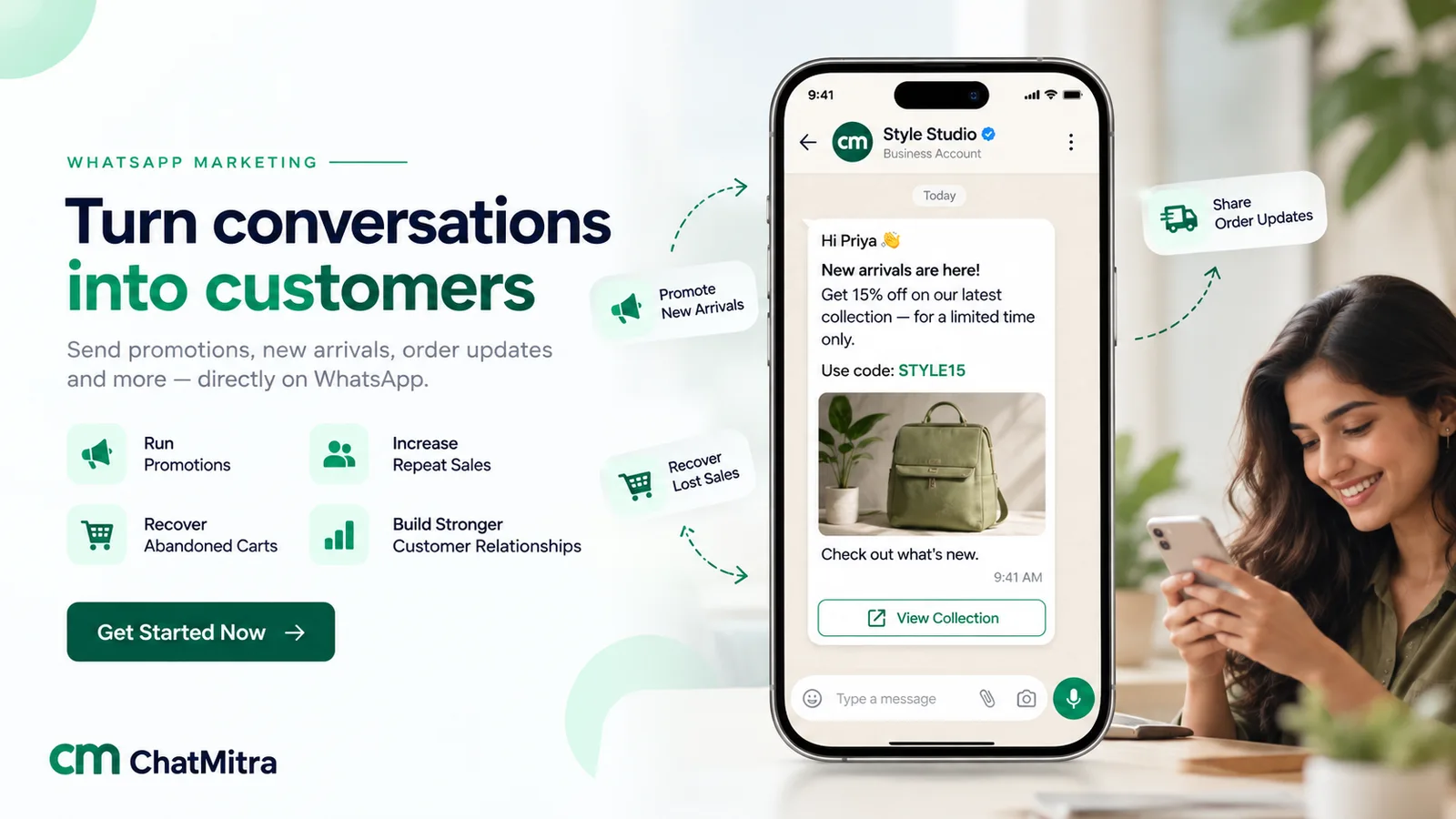
WhatsApp marketing is the use of WhatsApp to reach customers who have agreed to hear from you: offers, launches, reminders, restock alerts, win-backs and the conversations that follow. It is a permission channel. You can’t buy a list and message it, and the platform is built to punish businesses that try.
There are two ways to do it, and the benefits differ between them:
| WhatsApp Business app | WhatsApp Business Platform (API) | |
|---|---|---|
| Who it suits | Sole traders, local shops, early-stage brands | Growing businesses, ecommerce, teams, anyone automating |
| Who you can message first | People who saved your number (broadcast lists) | Any opted-in customer, with an approved template |
| Cost | Free app; some extras are paid | Meta charges per delivered template; provider fees on top |
| Automation | Greeting and away messages, quick replies | Triggered templates, chatbots, AI agents, integrations |
| Team use | One phone plus four linked devices on the free tier | Shared inbox on one number through a provider |
Most of the benefits below apply to both, but a few, such as reaching customers who haven’t saved your number, automation at scale and measurement per message, need the platform. Our WhatsApp Business features guide covers the app in detail.
10 benefits of WhatsApp marketing
1. You reach people inside an app they already open every day
The simplest benefit is also the biggest. Meta’s CEO said in April 2025 that WhatsApp has “more than 3 billion monthly actives”, and in January 2026 that it has “more than 2 billion daily actives”. Customers don’t need to install anything, create an account or remember a password to hear from you.
The numbers need care, though. Meta publishes only one current country total, more than 100 million monthly actives in the US, and India’s only official figure (53 crore, from a 2021 government release) is years old and was itself quoted from third-party portals. The honest version of this benefit is: in markets where WhatsApp is the everyday messenger, and India is widely reported as the largest, most of your customers are likely to be on it already. Our WhatsApp statistics guide explains which numbers you can safely quote.
Where it doesn’t hold: in the US, Meta doesn’t currently deliver marketing templates to US phone numbers at all, so reach for promotions there is close to zero.
2. Customers can reply, and the reply lands in the same thread
Email and SMS campaigns are mostly one-way. A WhatsApp campaign is the start of a conversation. A customer who sees a new collection can ask “Is this available in size 8?” and get an answer in the same thread, with the original offer still visible above it.
That reply matters commercially. When a customer messages you, a 24-hour customer service window opens, and inside it you can send free-form text, images, voice notes and interactive messages without a template. From 1 October 2026 Meta gives each business phone number a free tier of 1,000 delivered service messages a month, after which service messages are charged at the utility rate. A campaign that starts conversations therefore creates selling time at little or no extra cost.
What to plan for: replies need people or automation to answer them. A campaign sent at 8 pm to 5,000 people, with one person on the inbox, will turn a benefit into a pile of unanswered questions.
3. Rich, tappable messages let customers act without leaving the chat
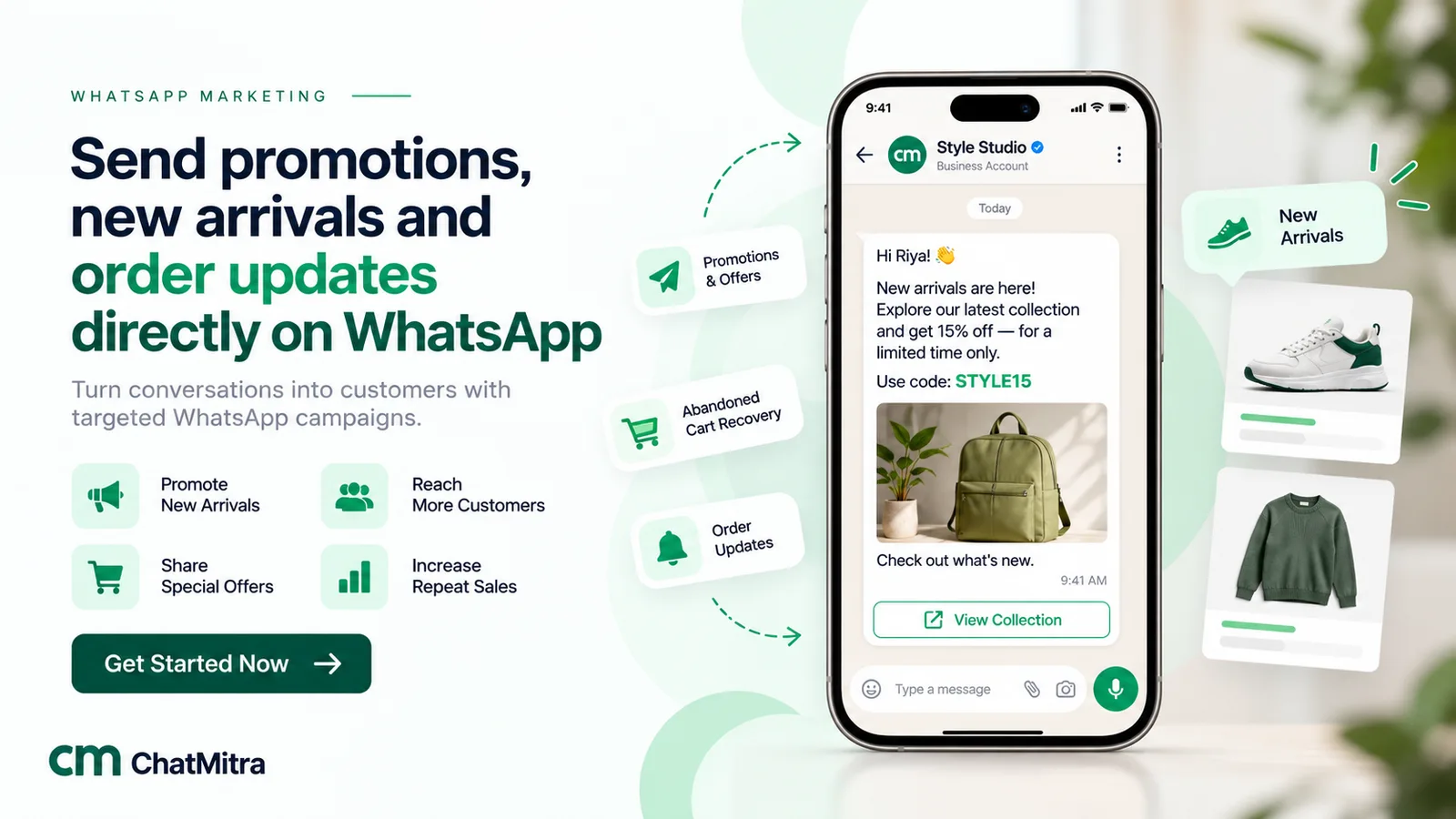
A WhatsApp message can carry an image, video or document, up to three quick-reply buttons, a list of up to ten options, a link button, product cards from your catalog, a carousel or a WhatsApp Flow: a short form inside the chat for booking a slot or qualifying a lead. Marketing templates can include buttons too, such as “Shop now”, “Copy code” or “Stop promotions”.
The benefit is fewer steps. Instead of “click, open a browser, find the product, log in”, a customer taps a button or picks a size from a list. For a walkthrough of each type and its limits, see our guide to WhatsApp interactive messages.
What to plan for: interactive messages (buttons, lists, Flows) go out as free-form replies inside a service window. Outside the window, you’re limited to what an approved template contains.
4. Your audience is opted in, and the rules keep it that way
Opt-in sounds like a cost, and it is: you have to ask. It is also a benefit. Meta’s policy says a business may start a conversation only with people who gave their number and agreed to receive messages from that business. The result is a list of people who chose to hear from you, rather than a bought database.
WhatsApp then protects that audience. It “may limit the number of marketing template messages a WhatsApp user receives from any business” when that person is less likely to engage, based partly on their recent marketing read rate and how busy their inbox is. From a single business’s view, that’s a limit. From the channel’s view, it’s why WhatsApp hasn’t filled up with spam the way many email inboxes have. Our WhatsApp opt-in guide explains what counts as valid consent.
5. You pay only for delivered messages, at a price you know in advance
Meta has charged per message since 1 July 2025, and only “when a template message is delivered”. The rate depends on the template’s category (marketing, utility or authentication) and the recipient’s country code. In India, from 1 October 2026:
| Message type | Meta charge in India | Typical use |
|---|---|---|
| Marketing template | ₹0.8631 per delivered message | Offers, launches, win-backs, restock promotions |
| Utility template | ₹0.1150 per delivered message | Order updates, payment reminders, booking confirmations |
| Service message (reply inside the 24-hour window) | First 1,000 a month free per number, then charged at the utility rate | Answers, quotes, follow-ups while the chat is open |
Failed and undelivered messages cost nothing, and you can price a campaign before sending it: 5,000 opted-in customers × ₹0.8631 = ₹4,315.50 in Meta charges if every message is delivered. Providers add their own fees on top, so check both. Our cost per message guide breaks this down by country.
6. You can measure every message, not just the campaign
Through the Business Platform, each message reports its status back to your software: sent, delivered, read or failed, with an error code when it fails. Add tracked links, replies and order data, and you can see which campaign produced which sales.
Read status needs one caution. WhatsApp marks a message “read” only when the recipient has read receipts switched on, so read rates undercount. That’s why claims such as “WhatsApp has a 98% open rate” should be ignored: Meta publishes no platform-wide engagement rate, and our WhatsApp vs email marketing comparison explains why open and read rates mislead on both channels. The measurable benefit is delivery certainty (you know which messages failed and why) plus replies and conversions you can count.
7. A verified business identity builds trust
On the Business Platform your display name is reviewed by Meta, and customers see a business profile with your description, address, hours and website. Eligible businesses can also subscribe to Meta Verified for a verified badge, although WhatsApp says a subscription doesn’t guarantee one and availability varies by country.
Trust matters because customers are rightly wary of messages from unknown numbers. A consistent, named business number that also sends their order updates is far more believable than a new SIM that suddenly offers a discount. Use the same number for service, updates and marketing so the thread builds a history.
8. Automation that still feels personal
Templates accept variables, so “Hi {{1}}, your {{2}} is back in stock” becomes a message about a specific customer and product. Utility templates can fire automatically on events: an order placed, a payment due, an appointment tomorrow. Inside the service window, chatbots and AI agents can answer common questions and hand over to a person when needed.
This is where WhatsApp marketing and customer experience overlap. Meta said in July 2026 that more than 1 million businesses a week were using its Business Agents on WhatsApp and Messenger to talk to customers or complete sales. You don’t need Meta’s agent to get the benefit, but the direction is clear: automated, relevant, one-to-one messages rather than generic blasts.
What to plan for: automation multiplies whatever you give it. A badly categorised template or a bot that can’t hand over to a person annoys customers at scale.
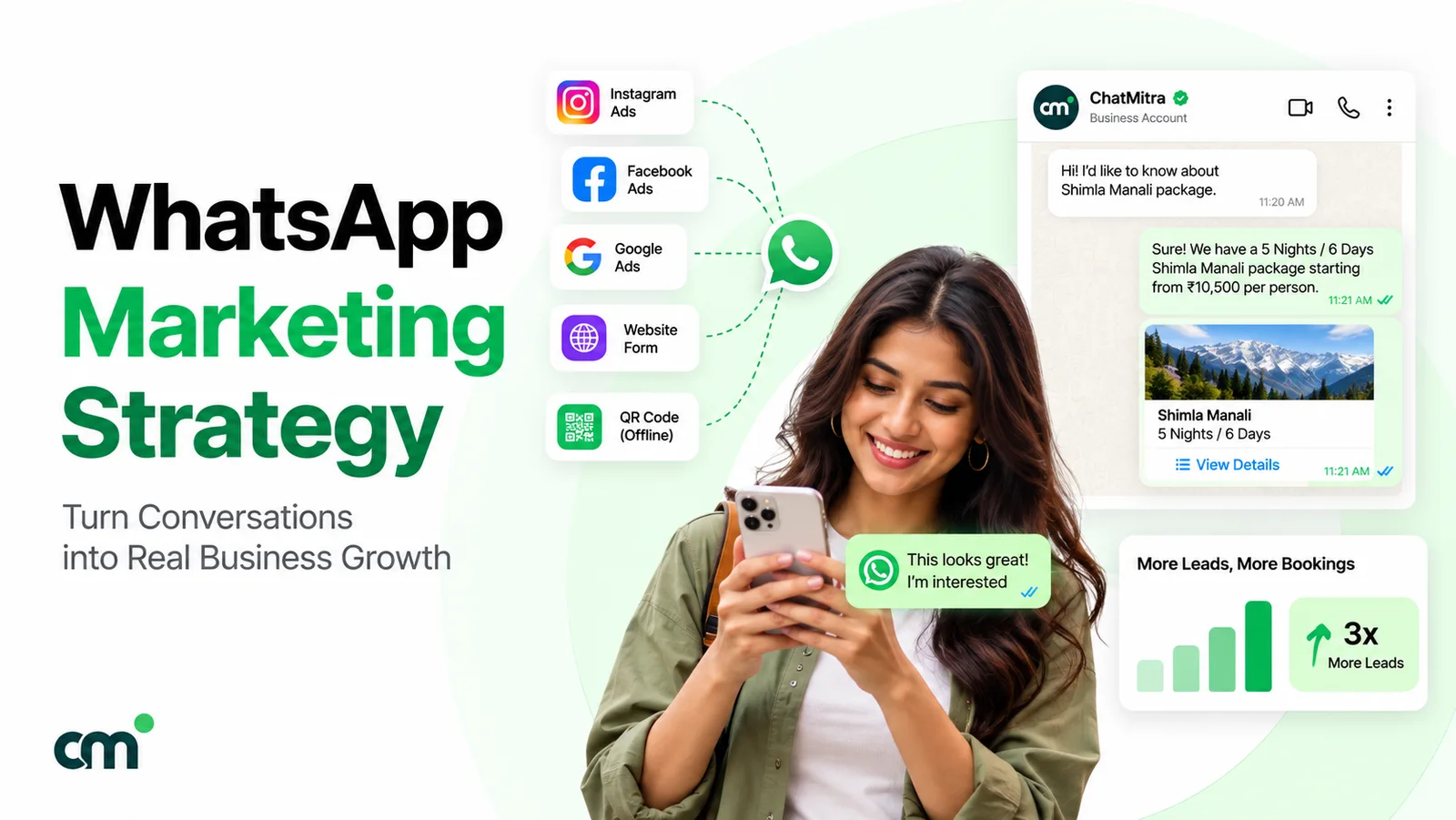
9. Ads that open a chat instead of a form
Click-to-WhatsApp ads on Facebook and Instagram open a WhatsApp conversation when someone taps them. The customer lands in a chat, not a landing page, and you get their number with their permission to reply.
There’s a direct cost benefit too. Meta’s pricing page says all messages are free within the free entry point window, which “may extend up to 7 days” when a customer starts the chat from a click-to-WhatsApp ad on the Android or iOS app, provided you reply within 24 hours. Meta reported in October 2025 that click-to-WhatsApp ad revenue had grown 60% year on year, a sign of how many advertisers find chats convert better than forms. Our click-to-WhatsApp ads guide explains the setup.
10. Repeat sales get cheaper to generate
Acquiring a customer is expensive. Bringing one back through a thread they already have with you is not. Reorder reminders, refill alerts, back-in-stock notices, post-purchase tips and loyalty offers all go to people who have bought before. Most of them are marketing templates, but some, such as a reminder about a subscription or refill the customer set up, can be utility when they are factual, tied to the customer’s own order and free of any offer.
This is often the benefit that makes the numbers work. A food brand selling a monthly pack, a pharmacy with refill customers or a salon with regulars can earn more from one reminder flow than from a year of broadcasts to cold contacts. For sales-led businesses, our WhatsApp for sales guide covers the whole path from enquiry to reorder.
WhatsApp marketing benefits by business type
The same ten benefits weigh differently depending on what you sell. Here is where each type of business usually gets the most value first:
| Business type | Biggest benefit | Best first use | Watch out for |
|---|---|---|---|
| Local shops and services | Replies in the same thread | Booking confirmations, reminders, festive offers to regulars | Answering fast enough on busy days |
| Ecommerce and D2C | Pay per delivery plus automation | Order updates (utility), cart reminders, restocks | Mixing offers into utility messages, which makes them marketing |
| B2B and high-ticket sales | Two-way conversation | Quote follow-ups, meeting reminders, document sharing | Nudging too often after the 24-hour window |
| Education and coaching | Rich messages | Batch schedules, class reminders, lead qualification with a Flow | Messaging parents or students who never opted in |
| Clinics and healthcare | Trust and utility messages | Appointment confirmations and reminders | Keeping health details out of marketing templates |
| Travel and hospitality | Click-to-WhatsApp ads | Enquiry handling, itineraries, check-in details | Seasonal peaks that swamp one inbox |
If your business sits across two rows, start with the one that already generates the most WhatsApp messages today. For worked campaign ideas by goal, see our WhatsApp marketing campaign ideas.
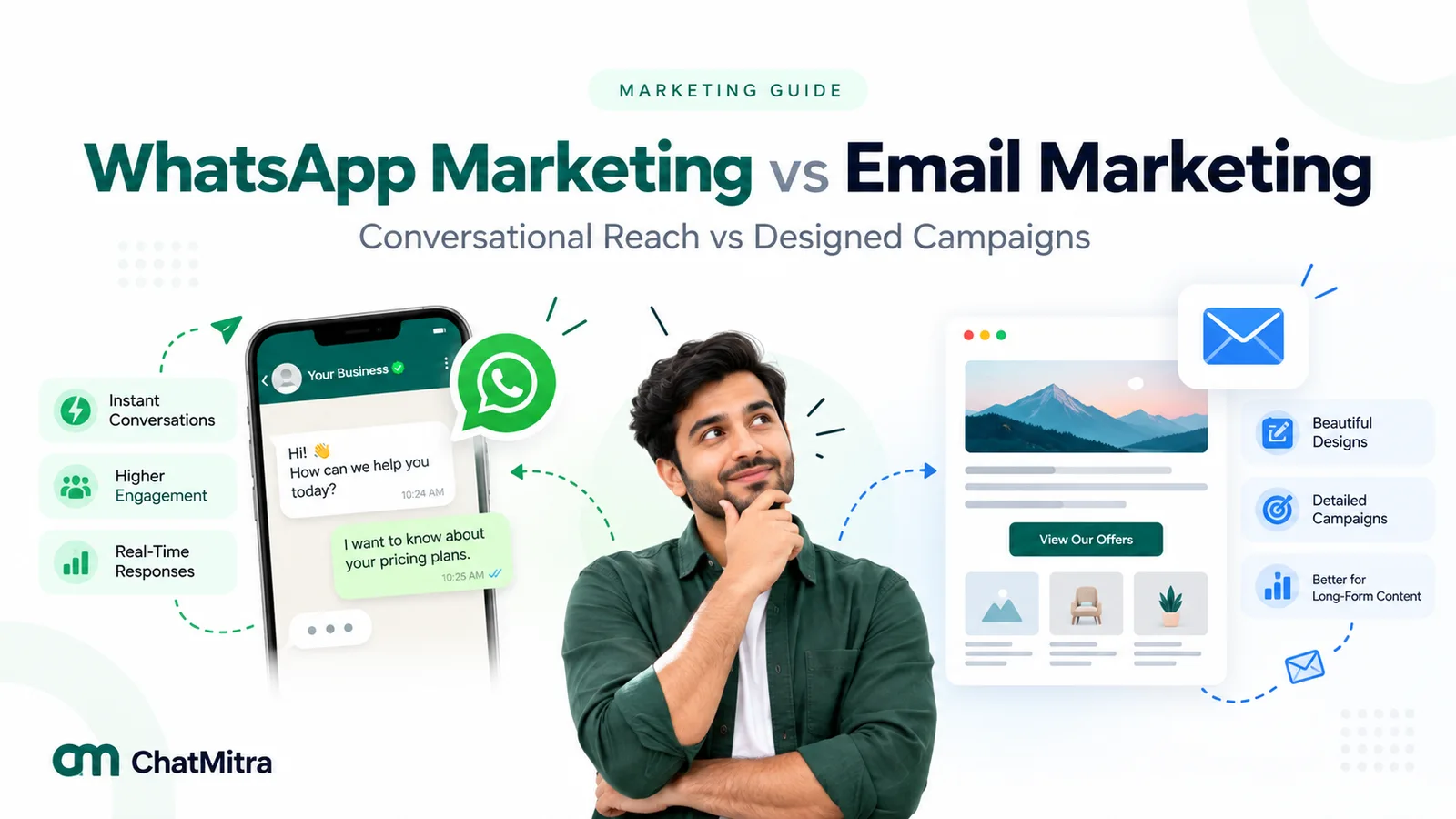
WhatsApp marketing vs email and SMS
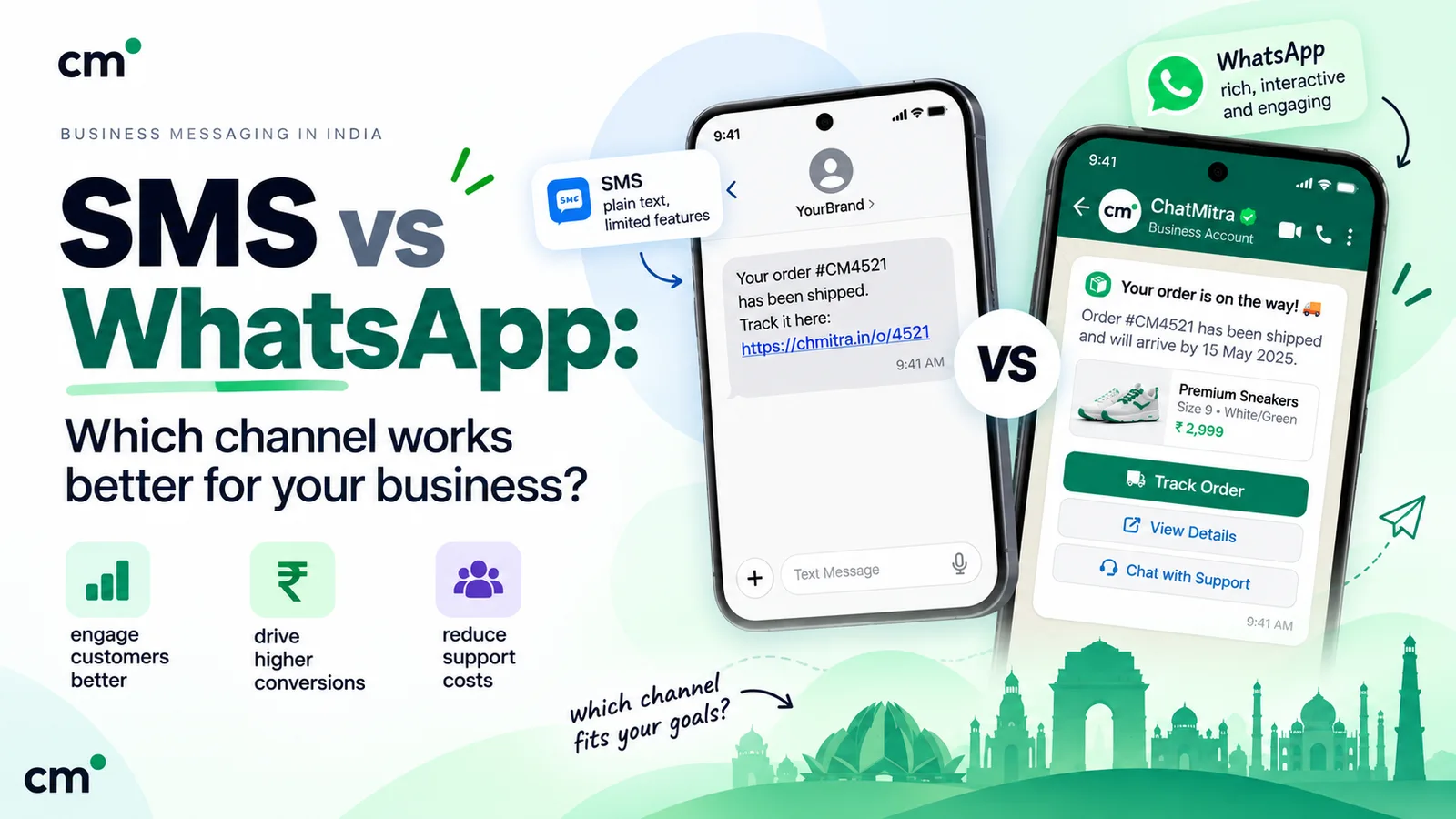
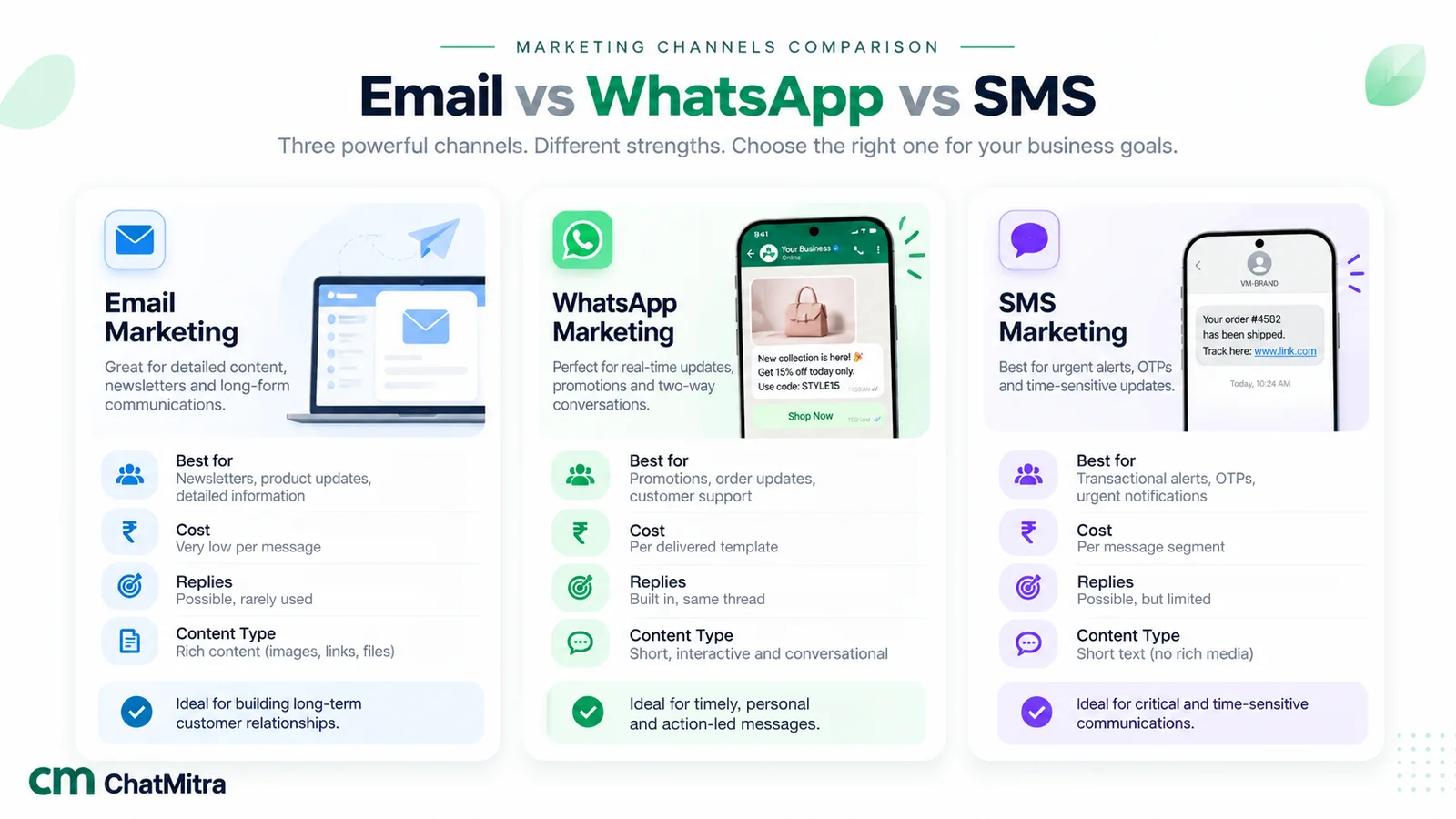
WhatsApp doesn’t replace email or SMS for most businesses. It does some jobs better and some worse:
| Factor | SMS | ||
|---|---|---|---|
| Who you can reach | Opted-in WhatsApp users | Anyone with an email address who consented | Almost any mobile number |
| Cost model | Per delivered template, by category and country | Usually by contacts or sends; very low per message | Per 160-character segment, from your SMS provider |
| Two-way replies | Built in, same thread | Possible, but rarely used | Possible, but limited |
| Rich content | Images, video, buttons, lists, catalogs, forms | Full HTML design | Plain text (RCS adds rich features where supported) |
| Pre-approval | Meta approves templates | None by default | India: TRAI DLT registration; US: 10DLC for standard numbers |
| Best for | Timely, personal, action-led messages | Long content, newsletters, receipts | OTP fallback, customers without WhatsApp |
A practical split is WhatsApp for time-sensitive and conversational messages, email for long-form content and records, and SMS as a fallback. Our WhatsApp vs SMS and WhatsApp vs email guides compare costs in detail.
What WhatsApp marketing costs: a worked example
Take a skincare brand in India with 4,000 opted-in customers. In one month it sends:
- one marketing campaign to 3,000 customers who engaged recently;
- 1,200 utility messages (order confirmations and shipping updates);
- about 1,500 free-form replies to customers who wrote back.
| Line | Messages | Meta rate | Meta charge |
|---|---|---|---|
| Marketing campaign | 3,000 | ₹0.8631 | ₹2,589.30 |
| Utility updates | 1,200 | ₹0.1150 | ₹138.00 |
| Service replies | 1,500 (1,000 free) | ₹0.1150 after the free tier | ₹57.50 |
| Total Meta charges | ₹2,784.80 |
This assumes every message is delivered; in practice you pay less. Provider fees come on top and vary by plan. ChatMitra, for example, passes Meta’s rates through and adds ₹0.20 per contact per 24-hour conversation on its Starter and Pro plans, while Enterprise removes that fee, per its pricing page.
The more useful number is cost per result. If the campaign produces 45 orders, the marketing line costs about ₹57.54 per order. Whether that’s cheap depends on your margin, not on WhatsApp. You can model your own mix with the pricing calculator.
Two levers change the bill most. Segmenting the campaign to recent buyers, rather than everyone, cuts the marketing line directly. And moving genuinely factual messages, such as order and payment updates, into utility templates cuts the per-message price by about 87%, as long as they contain no promotional content.
The limits of WhatsApp marketing, and how to work around them
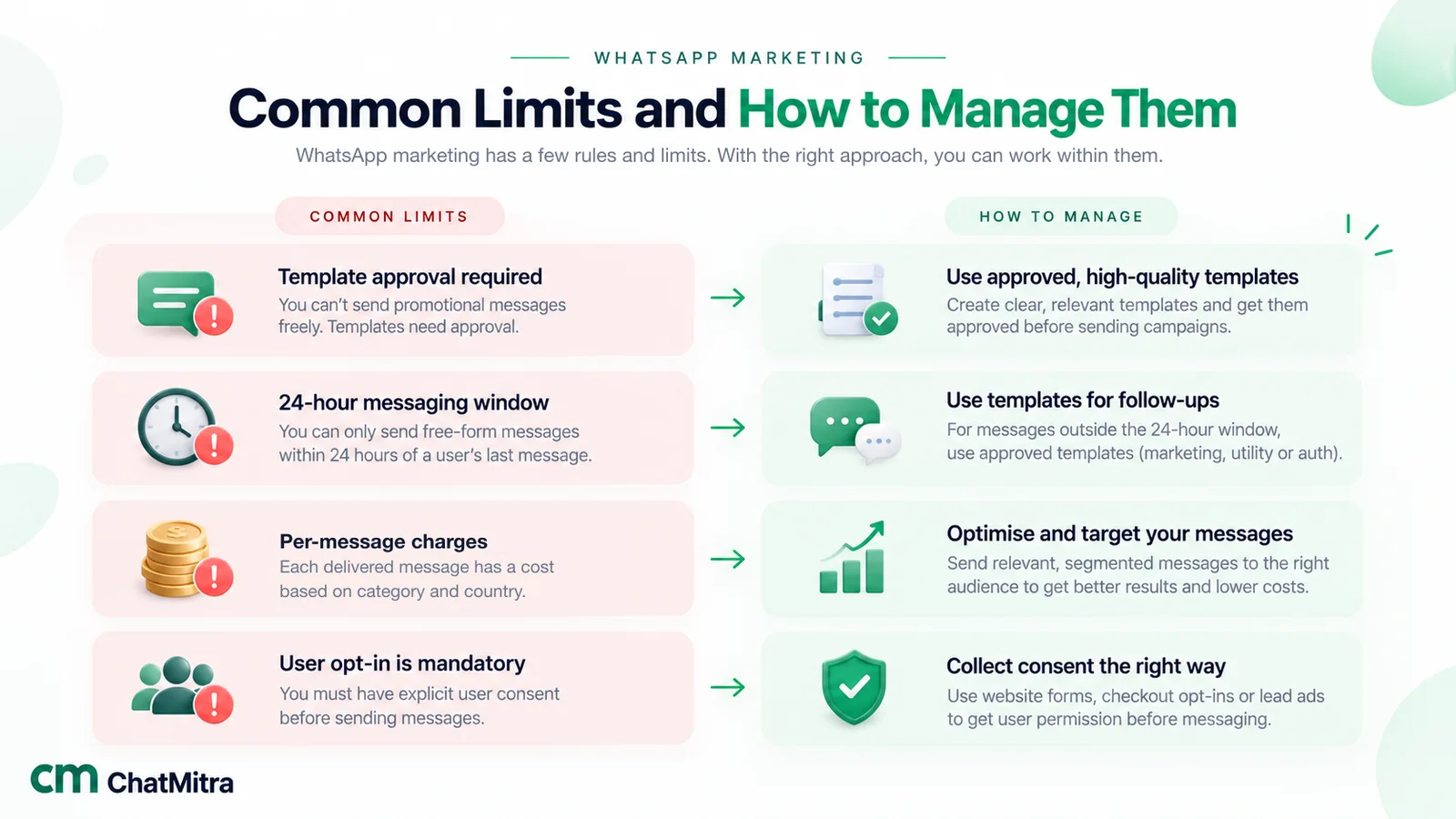
Most “benefits of WhatsApp marketing” articles skip this part. These are the constraints that decide whether the benefits show up in your numbers:
| Limit | What it means | How to work with it |
|---|---|---|
| Opt-in only | You can’t message people who haven’t agreed to hear from you | Collect consent at checkout, in store, on forms and through click-to-WhatsApp ads |
| Template approval | Messages outside a service window must use a Meta-approved template, and Meta can change its category | Write clear, specific templates; keep offers out of utility messages |
| Per-user marketing limits | WhatsApp may not deliver a marketing template to someone who has had many and engaged little; the error is 131049 | Segment by recent engagement; don’t retry the same person within 24 hours |
| Messaging limits | New business portfolios can message 250 unique customers outside a service window per rolling 24 hours | Complete a scaling path, such as business verification, to move to 2,000; limits then rise to 10,000, 100,000 and unlimited as quality holds |
| Quality rating | Blocks and reports lower your template and number quality, which can pause templates | Send less, to the right people; watch quality in WhatsApp Manager |
| No US marketing delivery | Marketing templates aren’t delivered to US (+1) numbers | Use email or SMS for US promotions; WhatsApp for service and utility |
| Cost per message | Higher than email per send | Judge by cost per order; use utility where honest; segment |
Messaging limits and quality ratings work together. Meta’s messaging limits page says automatic increases need high-quality messages and use of at least half your current limit over the last 7 days. For how to keep your account healthy, see our guide to WABA health and quality rating.
Is WhatsApp marketing legal?
In India, yes, when you follow Meta’s rules and the law on personal data:
- Meta’s policy. The WhatsApp Business Messaging Policy requires opt-in that names your business, and requires you to respect requests to stop. Breaking it can get templates paused or the account restricted.
- No DLT registration. TRAI’s DLT registration covers commercial SMS and voice. WhatsApp templates are approved by Meta instead.
- DPDP Act. India’s Digital Personal Data Protection Act, 2023 covers the phone numbers and names you hold. Its notice and consent duties apply from around 13 May 2027, eighteen months after the DPDP Rules were notified on 13 November 2025. From then, consent must be free, specific, informed and easy to withdraw.
Elsewhere, local consent and privacy law applies on top of Meta’s policy, such as the GDPR and ePrivacy rules in the EU. And in the US the question is mostly academic for promotions, because marketing templates aren’t delivered to US numbers. This is general information, not legal advice.
Will WhatsApp marketing pay off for you? A five-question check
Before you invest in a platform, templates and a team, answer these honestly:
- Do customers already message you on WhatsApp? If enquiries arrive there today, you have demand to build on. If nobody does, start by adding WhatsApp to your website, packaging and ads.
- Do repeat purchases or bookings matter? WhatsApp’s economics are strongest when a customer buys more than once.
- Can you collect opt-in where customers already are? A checkout checkbox, a counter QR code or a click-to-WhatsApp ad are the usual routes.
- Is one order or booking worth much more than a few messages? At ₹0.8631 per marketing message, a ₹50 product with thin margins needs a very well-targeted list. A ₹2,000 order has more room.
- Can you track orders by campaign? Tagged links, coupon codes per campaign or order data from your store make the benefit visible. Without them, you are left arguing about read receipts.
Four or five yes answers: WhatsApp should be a core channel. Two or three: start with utility flows and one monthly campaign, then measure. One or none: fix opt-in collection and demand first, because campaigns won’t fix either.
How to measure whether the benefits are real
A benefit you can’t see in your numbers is a belief, not a benefit. Pick one or two metrics per goal before the first campaign goes out, and write down today’s baseline:
| Goal | Primary metric | Supporting signal | Where it comes from |
|---|---|---|---|
| Repeat orders | Orders from customers who received the message | Revenue per recipient | Store orders matched by phone number or campaign coupon |
| Bookings | Confirmed bookings per 100 recipients | No-show rate after reminders | Booking system or calendar |
| Lead qualification | Qualified leads per campaign | Time to first reply | Inbox tags such as “qualified” and “quote sent” |
| Cart recovery | Recovered orders after the reminder | Revenue recovered minus message cost | Store checkout data |
| List health | Block and opt-out rate | Share of failed sends and error 131049 | Delivery reports and inbox |
Three habits keep the measurement honest.
Keep a holdout. Leave a small, random slice of the segment out of each campaign, say 10%, and compare its orders with the group you messaged over the same period. Without it, you’ll credit WhatsApp with purchases that would have happened anyway, especially from loyal customers.
Count cost per result, not cost per message. A campaign that costs ₹2,589 and brings 45 orders is cheaper per order than an email that costs ₹200 and brings two. The reverse can also be true, so run the sum for both channels.
Watch the downside metrics. Blocks, “stop” requests and rising failure rates are the early signs that a campaign is spending your quality rating. A campaign with good sales and a sharp rise in blocks is borrowing from next month.
Review the numbers after the first four campaigns, not after one. Early results swing with timing, offers and the size of the segment, and a single strong campaign can hide a list that’s getting tired.
How to get these benefits in your first 30 days
- Pick one goal. Repeat orders, bookings or recovered carts, not “engagement”.
- Decide app or platform. Stay on the app while your list is small and has saved your number. Move to the platform when you need volume, automation or a team.
- Collect opt-in. Add consent to checkout, forms and in-store QR codes, and record where each opt-in came from.
- Set up utility flows first. Order and booking updates are cheap, welcome and build the thread your marketing will later use.
- Send one segmented campaign. Recent buyers or recent enquirers only, with one clear action.
- Measure orders, replies and blocks. Compare against a small group you didn’t message.
The WhatsApp marketing strategy guide turns this into a full plan with a calendar and budget.
Where ChatMitra fits
ChatMitra is a Meta Business Partner that gives Indian businesses the official WhatsApp Business Platform with a shared team inbox. For the benefits above, it provides:
- Broadcasts to segments. Campaigns can include or exclude contacts by tag, and you can retarget based on earlier campaigns.
- Per-message reporting. Campaign stats show recipients, sent, delivered, read and failed, and reports can be exported.
- Templates and a template library to start from, submitted to Meta for approval.
- A shared inbox for replies on one number, with saved replies, tags, custom fields and a contact note.
- Automations. Shopify order flows, and Google Sheets automations that send templates on triggers such as a new row, a date or a birthday.
- Pro plan extras. Auto-replies, an AI chatbot using your own AI provider key, API access and webhooks, per ChatMitra’s pricing page.
It doesn’t currently assign chats to specific agents, track deal stages, or attribute conversations to the click-to-WhatsApp ad that started them, so teams that need those should pair it with other tools. Meta’s message charges pass through at Meta’s rates.
Mistakes that cancel out the benefits
- Messaging a list that never opted in. It breaks Meta’s policy, drives blocks and damages your quality rating.
- Treating WhatsApp as a cheaper SMS blast. Sending every offer to everyone triggers per-user limits and blocks, and costs more than email.
- Hiding promotions in utility templates. Meta can recategorise them as marketing, and customers notice.
- Launching without people to answer. The reply is the benefit. Staff the inbox for the hours after a campaign.
- Judging success by read rate. Reads undercount and don’t pay the bills. Count orders and bookings.
- Ignoring the US rule. If a large share of your list has +1 numbers, promotional sends to those contacts will fail.
Summary
The benefits of WhatsApp marketing are real: reach inside an app customers already use, replies in the same thread, rich messages they can act on, automation that stays personal, ads that start conversations and a price paid only for delivered messages. None of them is automatic. Each depends on opt-in, sensible template categories, relevant messages and someone ready to answer.
If your customers already talk to you on WhatsApp and repeat purchases matter, start with utility flows and one segmented campaign, and measure orders rather than reads. That’s where the benefits turn into revenue.
Sources: Meta Q1 2025 and Q4 2025 earnings calls (WhatsApp monthly and daily actives, US monthly actives), Meta Q3 2025 earnings call (click-to-WhatsApp ad revenue growth) and Meta Q2 2026 earnings call (Business Agents), as cited in our WhatsApp statistics guide. Press Information Bureau, 25 February 2021 (India user figure). Meta for Developers: pricing (updated 28 September 2026), per-user marketing limits (updated 17 June 2026), messaging limits, template categorization. WhatsApp Business Messaging Policy. WhatsApp Help Center on read receipts and Meta Verified. Digital Personal Data Protection Act, 2023 and DPDP Rules, 2025. Facts checked 30 September 2026.