WhatsApp has “more than 3 billion monthly actives”, Meta CEO Mark Zuckerberg said on 30 April 2025, and “more than 2 billion daily actives”, he said on 28 January 2026. Those are Meta’s latest WhatsApp-only user figures. Meta’s only current country total is for the US (more than 100 million monthly actives), and there is no current official figure for India.
This page collects the WhatsApp statistics that come from a primary source: Meta’s earnings calls and filings, WhatsApp’s own blog and reports, Indian government releases and TRAI data. Every number carries its date and the exact wording used, because “users”, “monthly actives”, “daily actives” and “accounts” measure different things. Figures we couldn’t trace to a primary source are listed separately, with what the primary sources actually say.
Key takeaways
- Meta rounds WhatsApp's user numbers ("more than 3 billion"). Any more precise global figure is someone else's estimate.
- Meta's 3.60 billion "daily active people" covers all its apps, not WhatsApp alone.
- WhatsApp's India reports count banned +91 accounts each month, which is the most regular official India data there is.
- Engagement claims such as open rates have no primary source. Measure your own.
Every figure below was checked against Meta's investor materials and newsroom, WhatsApp's blog and India reports, and Indian government sources on 25 September 2026.
WhatsApp statistics at a glance
| Metric | Latest figure | Exact wording | Date | Source |
|---|---|---|---|---|
| Monthly users, worldwide | 3 billion+ | "more than 3 billion monthly actives" | 30 Apr 2025 | Meta Q1 2025 earnings call |
| Daily users, worldwide | 2 billion+ | "more than 2 billion daily actives each on Facebook and WhatsApp" | 28 Jan 2026 | Meta Q4 2025 earnings call |
| Meta Family daily active people (all apps) | 3.60 billion | "DAP was 3.60 billion on average for June 2026" | 29 Jul 2026 | Meta Q2 2026 results |
| US monthly users | 100 million+ | "more than 100 million monthly actives in the US" | 29 Jan 2025 | Meta Q4 2024 earnings call |
| India users | 53 crore (530 million) | "WhatsApp users: 53 Crore", quoted from third-party portals | 25 Feb 2021 | PIB (Government of India) |
| WhatsApp Business app | 200 million+ | "more than 200 million monthly users" | 26 Jul 2023 | Meta Q2 2023 earnings call |
| Updates tab (Status and Channels) | 1.5 billion a day | "used by 1.5 billion people per day globally" | 16 Jun 2025 | Meta Newsroom |
| Indian accounts banned | 5,364,000 | accounts banned, 1–31 July 2026 | 1 Sep 2026 | WhatsApp India monthly report |
How many people use WhatsApp?
More than 3 billion a month, on Meta’s own count. Mark Zuckerberg told analysts on 30 April 2025 that “WhatsApp now has more than 3 billion monthly actives, with more than 100 million people in the US and growing quickly there” (Meta Q1 2025 call transcript). WhatsApp’s About page uses the same round figure: “More than 3 billion people in over 180 countries use WhatsApp.”
The count has been announced as milestones, not as a regular metric. Here are the milestones we could trace to WhatsApp or Meta, with the wording each one used:
| Date | Figure | Exact wording | Source |
|---|---|---|---|
| 19 Dec 2013 | 400 million | "400 million monthly active users" | WhatsApp blog |
| 22 Apr 2014 | 500 million | "half a billion people around the world are now regular, active WhatsApp users" | WhatsApp blog |
| 1 Feb 2016 | 1 billion | "one billion people are using WhatsApp" ("each month") | WhatsApp blog |
| 26 Jul 2017 | 1 billion daily | "1 billion people now using WhatsApp daily" | Facebook Q2 2017 call |
| 31 Jan 2018 | 1.5 billion monthly | "WhatsApp recently crossed 1.5 billion monthly actives" | Facebook Q4 2017 call |
| 12 Feb 2020 | 2 billion | "WhatsApp supports more than two billion users around the world" | WhatsApp blog |
| 26 Oct 2022 | 2 billion daily | "WhatsApp has more than 2 billion daily actives" | Meta Q3 2022 call |
| 30 Apr 2025 | 3 billion monthly | "WhatsApp now has more than 3 billion monthly actives" | Meta Q1 2025 call |
| 28 Jan 2026 | 2 billion daily | "more than 2 billion daily actives each on Facebook and WhatsApp" | Meta Q4 2025 call |
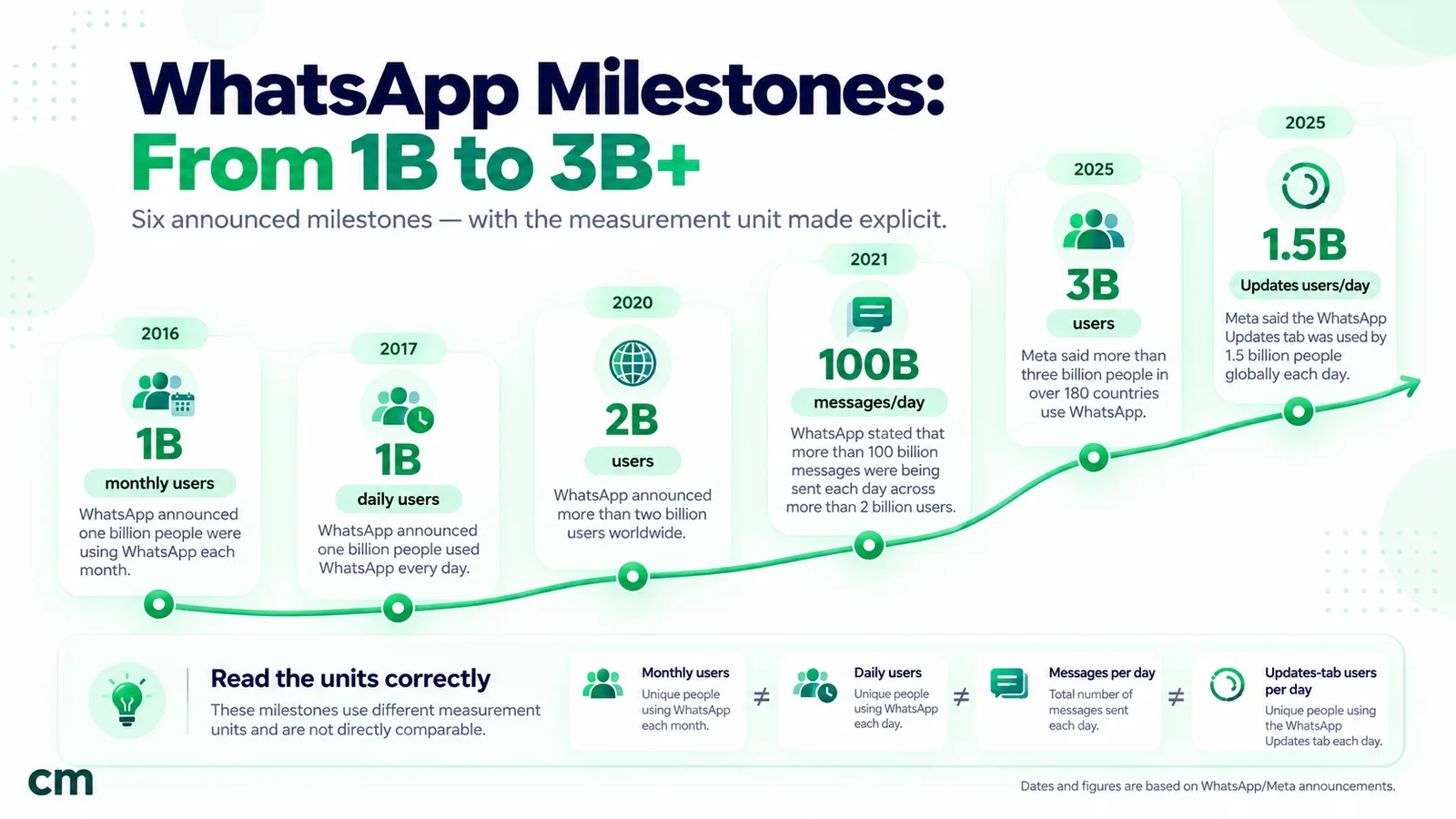
Two things stand out. The jump from 2 billion to 3 billion took about five years, against four years from 1 billion to 2 billion. And the unit wanders: “monthly active users” in 2013, “regular, active” users in 2014, people using it “each month” in 2016, “monthly actives” in 2018, plain “users” in 2020 and “monthly actives” again in 2025, with a daily figure first given in 2017. All of them are WhatsApp’s or Meta’s own counts, not independent measurements. WhatsApp’s business site still told visitors on 25 September 2026 that the platform has “more than 2 billion users” (WhatsApp Business), a figure the About page has since overtaken. When two Meta pages disagree, use the most recent dated statement, which today is the April 2025 earnings call.
Monthly users, daily users and “people”: what each number measures
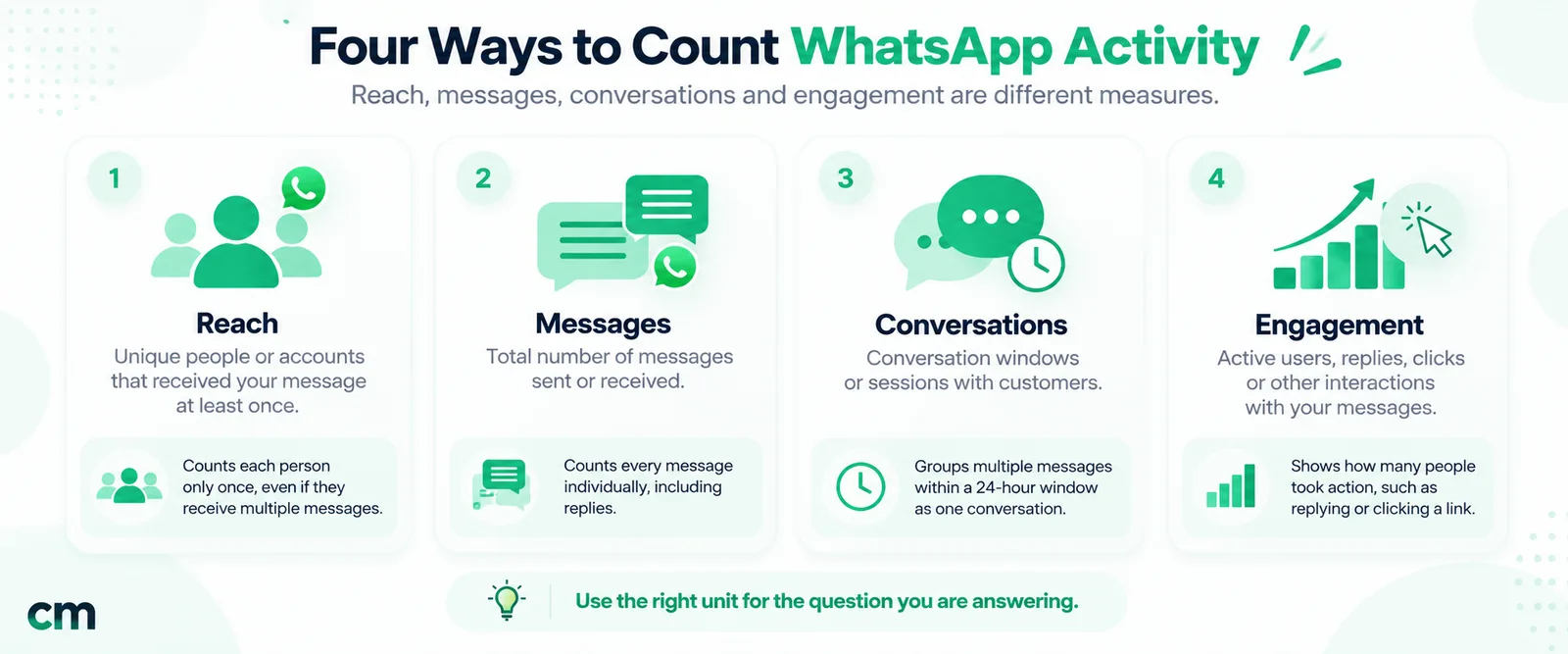
Most confusion in WhatsApp statistics comes from mixing units. This table sets out what each published number counts.
| Term | What it counts | Example | Mix-up to avoid |
|---|---|---|---|
| Monthly actives | People who used WhatsApp at least once in a month | 3 billion+ (Apr 2025) | Quoting it as daily use |
| Daily actives | People who used it on a given day | 2 billion+ (Jan 2026) | Adding it to the monthly figure |
| Family daily active people (DAP) | Unique people using at least one of Facebook, Instagram, Messenger or WhatsApp on a day | 3.60 billion (June 2026) | Calling it WhatsApp's user count |
| Users (older posts) | Not defined in the 2020 post | 2 billion+ (Feb 2020) | Treating it as monthly actives |
| Accounts (India reports) | Accounts with a +91 phone number | 5,364,000 banned (July 2026) | Reading accounts as people |
| Subscriptions (TRAI) | Telecom connections, including machine connections | 1,094.48 million broadband (July 2026) | Reading connections as internet users |
Meta explains the Family figure in its Q2 2026 earnings presentation: a daily active person is “a registered and logged-in user of Facebook, Instagram, Messenger, and/or WhatsApp” who visited one of them on a given day. Because the apps don’t share a login, Meta estimates unique people with models that are “calibrated against user survey data”, and it says “there is necessarily some margin of error in our estimates”. Meta publishes no method for its WhatsApp-only figures, so treat them with at least the same caution.
How many WhatsApp messages are sent each day?
The most recent daily message total we found in Meta’s earnings calls came from Mark Zuckerberg on 29 October 2020: “roughly 100 billion messages exchanged every day on WhatsApp alone” (Q3 2020 call). Since then Meta has published narrower measures:
- Voice messages: “Every day on WhatsApp, our users send 7 billion voice messages on average” (WhatsApp blog, 30 March 2022).
- Peak rate: during the 2026 World Cup, WhatsApp passed 29 million messages a second in a Round of 16 match and then went “over 30 million messages per second” in the final, per a post updated on 21 July 2026 (Meta Newsroom).
- Status views: “tens of billions of views of Status posts on WhatsApp each day”, per CFO Susan Li on 30 April 2025.
- Passkeys: “More than 1 billion people now use a passkey” to log in to WhatsApp (WhatsApp blog, 25 August 2026).
We found no Meta source for any current “messages per day” figure above 100 billion, so treat one as an estimate.
WhatsApp users by country: what is actually published
Meta doesn’t publish WhatsApp users by country, so a reliable country-by-country table doesn’t exist. Primary sources give numbers for two countries, the US and India, and a third country appears only as an event.
United States
- Meta’s count. “WhatsApp now serves more than 100 million monthly actives in the US,” Mark Zuckerberg said on 31 July 2024 (Q2 2024 call), and repeated the figure in January 2025 (Q4 2024 call) and April 2025. In 2022 he called North America WhatsApp’s “fastest growing region”.
- A survey view. Pew Research Center found that 32% of US adults said they use WhatsApp, surveyed between 5 February and 18 June 2025, “up from 23% in 2021” (Pew, 20 November 2025). By age, Pew’s social media fact sheet gives 37% (18–29), 40% (30–49), 30% (50–64) and 20% (65+) for the same survey. This is self-reported use, not Meta data.
- Why it isn’t bigger. Zuckerberg answered that himself in April 2025: “we’re clearly not the primary messaging app in the United States at this point, iMessage is.”
For businesses there is a sharper limit. Meta’s per-user limits page (updated 17 June 2026) says WhatsApp “does not currently deliver marketing template messages to WhatsApp users with United States phone numbers”. Those 100 million people can still receive utility and authentication templates and can chat with you, but WhatsApp promotions to them aren’t possible for now. The WhatsApp vs SMS guide covers what US businesses use instead.
India
Covered in the next section. The short version: one government figure from 2021, quoted from third parties.
Russia
Meta’s CFO said on 29 April 2026 that family daily users “declined slightly from December due to internet disruptions in Iran and a restriction on access to WhatsApp in Russia” (Q1 2026 call). Meta gave no Russian user count.
Where the other country numbers come from
Country tables in other articles, including India figures from 500 to 850 million, come from research firms’ models, app-download panels or surveys. They can be useful as estimates, but they aren’t Meta counts, they use different methods and they rarely agree with each other. If you use one, name the firm and its date, and don’t mix it with Meta’s numbers in the same table.
How many WhatsApp users are there in India?
No current official figure exists. The only government number is in the Press Information Bureau release of 25 February 2021 announcing the IT Rules, 2021, which listed “WhatsApp users: 53 Crore” (PIB). The release said “Some portals, which publish analysis about social media platforms and which have not been disputed, have reported the following numbers”. The government reported a third-party estimate. It didn’t measure the user base itself.
We also searched questions in the current (18th) Lok Sabha with WhatsApp in the subject. The two answers we found, on SIM binding for messaging apps (25 March 2026) and on Andhra Pradesh’s use of WhatsApp for civic services (19 March 2025), give no user count (Lok Sabha questions).
What Meta has said about India instead:
- Business messaging habit: “every week now, more than 60% of people on WhatsApp in India message a business app account” (Mark Zuckerberg, 25 October 2023, Q3 2023 call). In the same call: “Revenue from Click-to-Message ads in India has doubled year-over-year.”
- A survey Meta cites: “91% of online adults in India chatting with businesses weekly (Kantar 2025 report)”, in Meta’s post on its India business summit, 18 September 2025 (Meta Newsroom). We haven’t seen the Kantar report itself, so treat this as Meta’s summary of it.
- Government services: the same post says Andhra Pradesh’s “Mana Mitra” WhatsApp chatbot “now offers over 700 citizen services and has been used by 4 million citizens”.
- Meta AI: on 31 July 2024 CFO Susan Li said promising Meta AI retention on WhatsApp had “coincided with India becoming our largest market for Meta AI usage”.
For internet context, TRAI’s data for the end of July 2026 shows 1,094.48 million broadband subscriptions, or 1,005.72 million without machine-to-machine connections, and 1,204.01 million active wireless subscribers (TRAI press release 116/2026). Those are connections, not people: one person can hold two SIMs. They set an outer limit for WhatsApp’s reach in India, not a user count.
How many accounts does WhatsApp ban in India each month?
This is the most regular official India data. Under Rule 4(1)(d) of India’s IT Rules, 2021, WhatsApp publishes a monthly report (WhatsApp Monthly India Reports), about 30 days after each month ends. An “Indian account” means one with a +91 phone number. “Proactively banned” means banned “before any reports from users”.
| Month | Accounts banned | Banned proactively | Proactive share |
|---|---|---|---|
| August 2025 | 8,257,498 | 1,648,396 | 20% |
| September 2025 | 10,021,232 | 2,057,370 | 21% |
| October 2025 | 9,126,723 | 2,179,365 | 24% |
| November 2025 | 8,431,911 | 2,160,400 | 26% |
| December 2025 | 8,362,961 | 2,039,975 | 24% |
| January 2026 | 8,179,740 | 1,983,760 | 24% |
| February 2026 | 5,482,423 | 1,386,846 | 25% |
| March 2026 | 5,978,096 | 1,376,357 | 23% |
| April 2026 | 5,470,958 | 1,347,995 | 25% |
| May 2026 | 7,214,702 | 1,379,438 | 19% |
| June 2026 | 5,104,127 | 1,369,080 | 27% |
| July 2026 | 5,364,000 | 1,790,800 | 33% |
Our sum of these twelve reports is 86,994,371 accounts banned, an average of about 7.2 million a month, with 23.8% banned proactively. The reports don’t say how many of these were business accounts, bulk senders or repeat registrations. The July 2026 report also lists 19,112 grievances received from users in India, with action taken on 476 accounts, and 25 orders from the Grievance Appellate Committee, all complied with.
For a business, the lesson is practical. WhatsApp bans at this scale, and its detection runs “at registration, during messaging, and in response to negative feedback”, in the reports’ words. Numbers used with bulk-sending tools that automate the consumer app are the obvious risk. The guide to official vs unofficial bulk WhatsApp senders explains the difference.
WhatsApp for business: the numbers Meta has published
The WhatsApp Business app
Meta’s earnings calls have given only occasional figures for the free Business app, the last one in 2023:
| Date | Exact wording | Speaker |
|---|---|---|
| 25 Jul 2018 | "more than 3 million people actively using it" | Sheryl Sandberg (Q2 2018 call) |
| 30 Jul 2020 | "WhatsApp Business now has 50 million people using it" | Mark Zuckerberg (Q2 2020 call) |
| 26 Jul 2023 | "the WhatsApp Business App, which now has more than 200 million monthly users" | Susan Li (Q2 2023 call) |
Note the wording: “monthly users” of the app, not “businesses”. One business can run the app on several numbers. What the app can do today is in the guide to WhatsApp Business features.
People messaging businesses
- 175 million a day: “More than 175 million people message a WhatsApp business account every day” (Mark Zuckerberg, 27 January 2021, Q4 2020 call).
- Catalogues: “more than 40 million people viewing a Business Catalog every month” (Sheryl Sandberg, 29 October 2020, same Q3 2020 call).
- API volume: “Businesses using the WhatsApp Business API are already sending more than 100 million messages per day” (Zuckerberg, 28 April 2021, Q1 2021 call). The API those businesses use today is explained in the WhatsApp Cloud API guide.
- Across Meta’s apps: Meta estimated that “one billion users are messaging with a business each week across WhatsApp, Messenger and Instagram” (Sandberg, 27 July 2022, Q2 2022 call), and, on 3 June 2026, “more than one billion active threads with businesses on WhatsApp, Messenger and Instagram every day” (WhatsApp Business blog).
The first three are five or more years old and Meta hasn’t updated them. The last two are Family-wide, not WhatsApp-only.
Business messaging revenue
Meta doesn’t report WhatsApp revenue on its own. The closest line is “Family of Apps other revenue”, which Meta says is “driven primarily by WhatsApp paid messaging and subscriptions revenue”. In Q2 2026 it was $1,007 million, against $583 million a year earlier (Meta Q2 2026 results). Other figures Meta has given:
- Paid messaging within WhatsApp crossed “a $2 billion annual run-rate in Q4” 2025 (Susan Li, 28 January 2026).
- Click-to-WhatsApp ads were “already at a multi-billion dollar annual run-rate” in October 2023, and their revenue grew 60% year over year in Q3 2025 (Q3 2025 call).
- US click-to-message revenue grew “more than 40%” in Q2 2025 (Q2 2025 call) and “more than 50%” in Q4 2025.
If you plan to buy ads that open a chat, the WhatsApp lead generation guide covers tracking and follow-up. For what each message costs, see the WhatsApp Business cost per message guide.
Channels, Status and the Updates tab
- Channels “quickly scaled to over 500 million monthly active users since we rolled it out globally in September” (Susan Li, 1 February 2024, Q4 2023 call).
- The Updates tab is “used by 1.5 billion people per day globally” (Meta Newsroom, 16 June 2025).
- Ads in Status reached “hundreds of millions of people now viewing them daily” (Susan Li, 29 April 2026).
The WhatsApp Status marketing guide explains how Status ads are bought and where they send people.
AI on WhatsApp
- Business AI conversations: “over 1 million weekly conversations between people and Business AIs” in January 2026, then “more than 10 million conversations each week” by 29 April 2026 (Susan Li). Both figures cover Meta’s messaging apps, not WhatsApp alone.
- Business Agents: “more than 1 million businesses using them to talk to their customers or complete sales every week”, on WhatsApp and Messenger (Mark Zuckerberg, 29 July 2026, Q2 2026 call).
- Meta AI: “More than a billion monthly actives already use Meta AI” across Meta’s apps (October 2025), and “WhatsApp is already the leading surface where people engage with Meta AI” (July 2026).
What an AI agent on WhatsApp involves, and the rules around it, is covered in the WhatsApp AI agent guide.
Numbers you’ll see elsewhere that we couldn’t verify
These figures circulate widely in articles, slide decks and AI answers. For each, we checked what Meta, WhatsApp or a government source actually says.
| Claim you'll see | What the primary sources say | Status |
|---|---|---|
| WhatsApp has 3.3 billion (or another precise number) monthly users | Meta says "more than 3 billion" (April 2025) | Estimate, not Meta data |
| 2.3 billion (or similar) daily users | Meta says "more than 2 billion daily actives" (January 2026) | Estimate |
| 150 billion messages a day | Latest Meta figure we found: "roughly 100 billion" (October 2020) | No primary source found |
| India has 535 million, 550 million or 850 million users | Only official figure: 53 crore (2021), itself quoted from portals | Research-firm estimates |
| Business app has several hundred million monthly users | Last Meta figure: "more than 200 million monthly users" (July 2023) | No primary source for anything higher |
| WhatsApp Status is used by 500 million people a day | A 2019 figure ("more than half a billion daily actives" for WhatsApp's stories format); in 2025 Meta said the Updates tab has 1.5 billion daily users | Outdated |
| 98% open rate, 45–60% conversion, 15–60% click-through | Meta publishes no platform-wide engagement rates | No primary source |
| Age and gender split of WhatsApp users, minutes per day | Meta publishes no WhatsApp-only demographics | Panel or survey estimates |
Two notes. First, some widely quoted figures are real but old. “175 million people message a business every day” and “40 million catalogue viewers a month” are genuine Meta statements from 2020 and 2021; the problem is presenting them as current. Second, open rates can’t come from Meta’s delivery data in the way people assume. WhatsApp reports a “read” status per message, and only when read receipts are on, so a platform-wide open rate isn’t something any business can see. Your own read rate is.
What these numbers mean for a business choosing WhatsApp
This section is ChatMitra’s analysis, not Meta data.
- Reach isn’t your constraint. Permission is. Three billion monthly users tells you your customers are probably on WhatsApp. It doesn’t tell you that you may message them. That depends on opt-in, which the WhatsApp opt-in guide covers.
- Check the market before the channel. India and the US look very different: in India, Meta says most WhatsApp users message a business weekly; in the US, marketing templates aren’t delivered at all today.
- Plan around enforcement. Millions of Indian accounts are banned every month. Use the official Business Platform, keep your quality high, and avoid tools that automate the consumer app.
- Business messaging is where Meta is investing. Paid messaging past a $2 billion run-rate, Business Agents at more than a million businesses a week and Status ads rolling out all point the same way: expect more features and more competition in the inbox.
- Measure your own engagement. Replace borrowed benchmarks with your delivered, read and replied counts over several campaigns. If you use ChatMitra, campaign reports show sent, delivered, read and failed for each broadcast, and the ticks themselves are decoded in ChatMitra’s webhooks and message status page.
The WhatsApp marketing strategy guide turns these points into a plan.
How to cite WhatsApp statistics correctly
- Quote the wording. Write “more than 3 billion monthly actives (Meta, 30 April 2025)”, not “3 billion users”.
- Keep units apart. Don’t put monthly actives, daily actives, Family DAP and banned accounts in one column.
- Date every figure, and say who said it: an earnings call, a blog post or a government release.
- Label third-party estimates with the firm’s name and date, and keep them out of tables of official figures.
- Link the primary source, not an article that quotes it. Meta’s transcripts are on its investor relations site.
How we built this page. We read Meta’s earnings call transcripts from Q2 2017 to Q2 2026, the Q2 2026 results release and presentation, the WhatsApp blog posts that announced each milestone, Meta Newsroom and WhatsApp Business posts, WhatsApp’s India monthly reports from August 2025 to July 2026, the PIB release of 25 February 2021, Lok Sabha answers mentioning WhatsApp, TRAI’s July 2026 subscription data and Pew Research Center’s 2025 survey and fact sheet. We included a number only if one of these sources states it.
Using WhatsApp for your business
If these numbers have you weighing WhatsApp for customer messages, ChatMitra is a WhatsApp Business Platform tool with templates, broadcasts and a shared team inbox on one number, plus API and webhook access on the Pro plan, per ChatMitra’s pricing page. Compare ChatMitra’s plans to see what fits.
Sources: Meta Platforms earnings call transcripts (2017–2026), Q2 2026 results and earnings presentation; WhatsApp blog; WhatsApp Monthly India Reports; Meta Newsroom; WhatsApp Business blog; Meta for Developers; Press Information Bureau, Government of India; Lok Sabha questions; TRAI press release 116/2026; Pew Research Center.
Facts checked against Meta's investor materials, WhatsApp's own publications and Indian government sources on 25 September 2026.