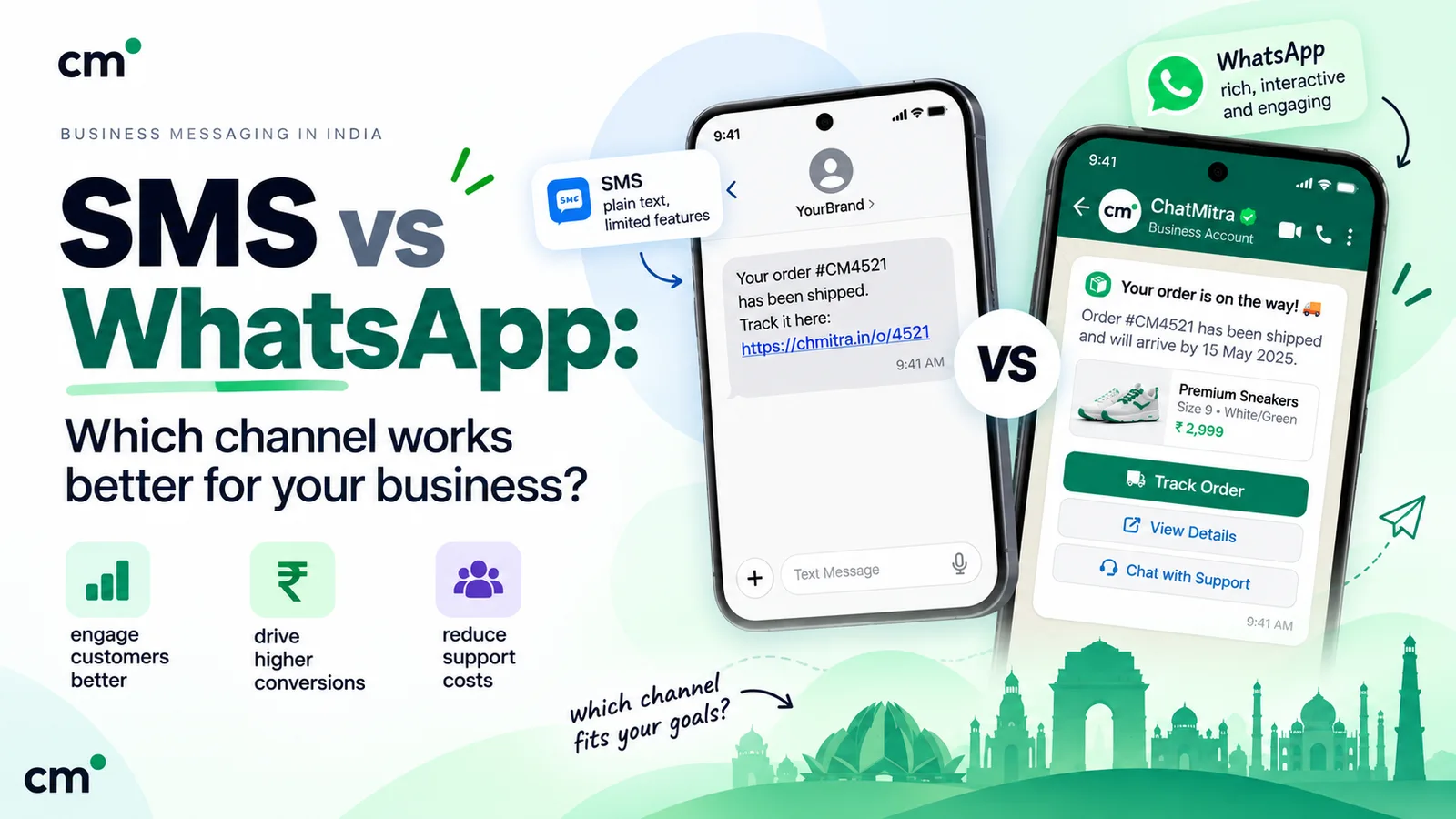
WhatsApp vs SMS comes down to reach versus richness. SMS reaches almost any mobile number through the carrier, with no app needed, and is priced per 160-character segment. WhatsApp reaches people who use the app and have opted in to hear from you, and it adds buttons, media, two-way chat and read receipts. Meta prices it per delivered message, by category and country.
This guide is for businesses choosing a channel for one-time passwords, alerts, reminders, support and promotions. It compares reach, pricing, rules (with an India section), OTPs, measurement and RCS, then gives a decision matrix and a pattern for using both.
Key takeaways
- Pick by message and audience, not by channel loyalty. OTPs, alerts and promotions can each land on a different answer.
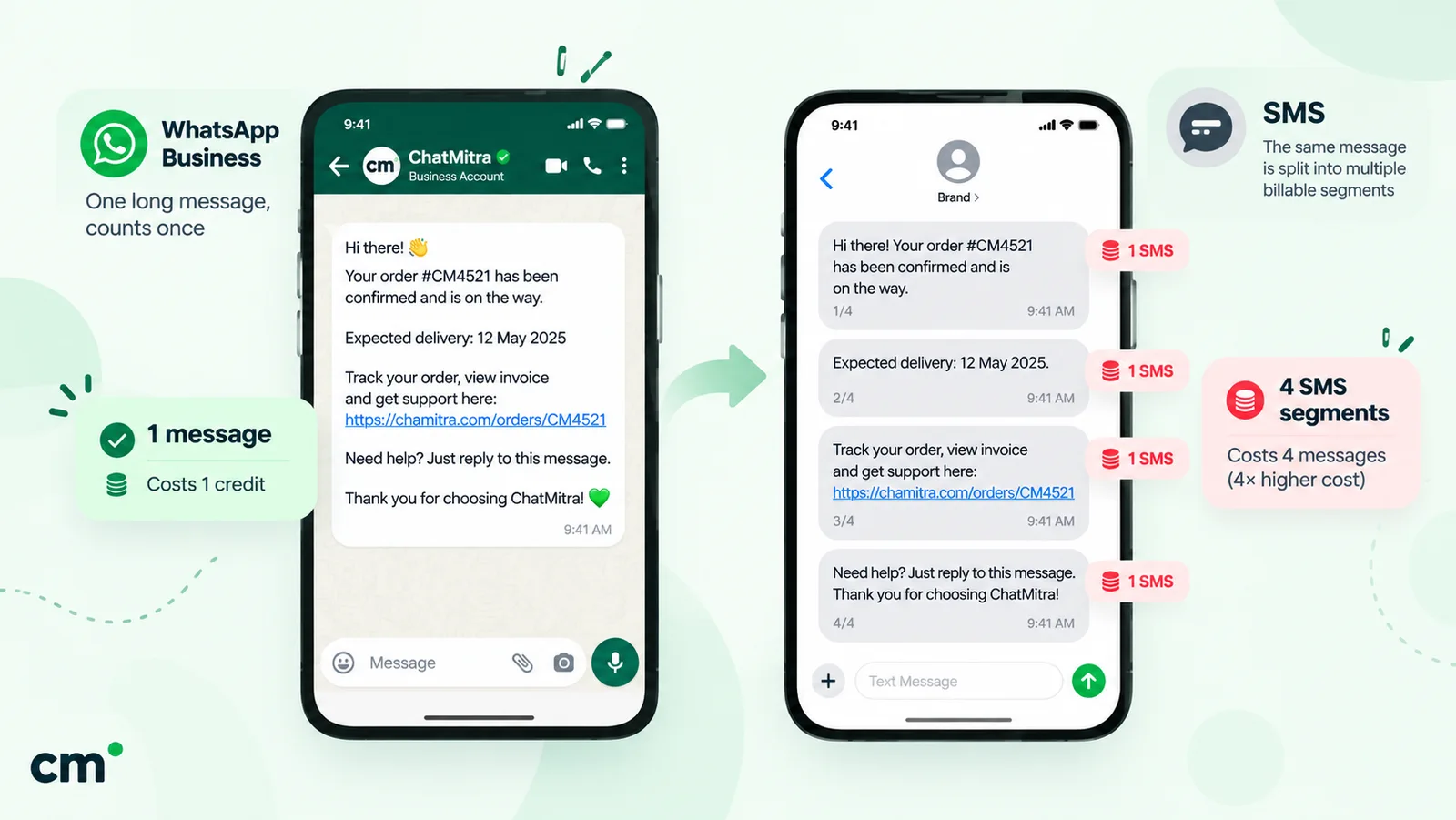
- WhatsApp charges per message, whatever the length. SMS charges per segment, and a single emoji or Hindi word can double or triple the segment count.
- The strongest setup for many businesses is WhatsApp first, SMS on a timer if WhatsApp can't deliver.
Facts checked against Meta's and WhatsApp's documentation, TRAI's regulations and Google's and Apple's RCS documentation on 25 September 2026. Rupee figures are Meta's India rates and exclude tax.
WhatsApp vs SMS vs RCS at a glance
WhatsApp here means the WhatsApp Business Platform (the API), which businesses use for automated alerts and campaigns; the free WhatsApp Business app isn’t built for that.
| Criterion | SMS | WhatsApp Business Platform | RCS for Business |
|---|---|---|---|
| What the customer needs | Any mobile number on a cellular network | The WhatsApp app, an internet connection and an opt-in to your messages | A phone and carrier that support RCS, with RCS switched on |
| Who can start the chat | Either side, if your sender type accepts replies | Either side; outside a 24-hour window you must use an approved template | Only the business; the customer can reply after that |
| How it's priced | Per segment of 160 GSM-7 or 70 Unicode characters, at your provider's rate | Per delivered message, by category (marketing, utility, authentication, service) and the recipient's country | Set by carriers and your RCS provider; get a quote |
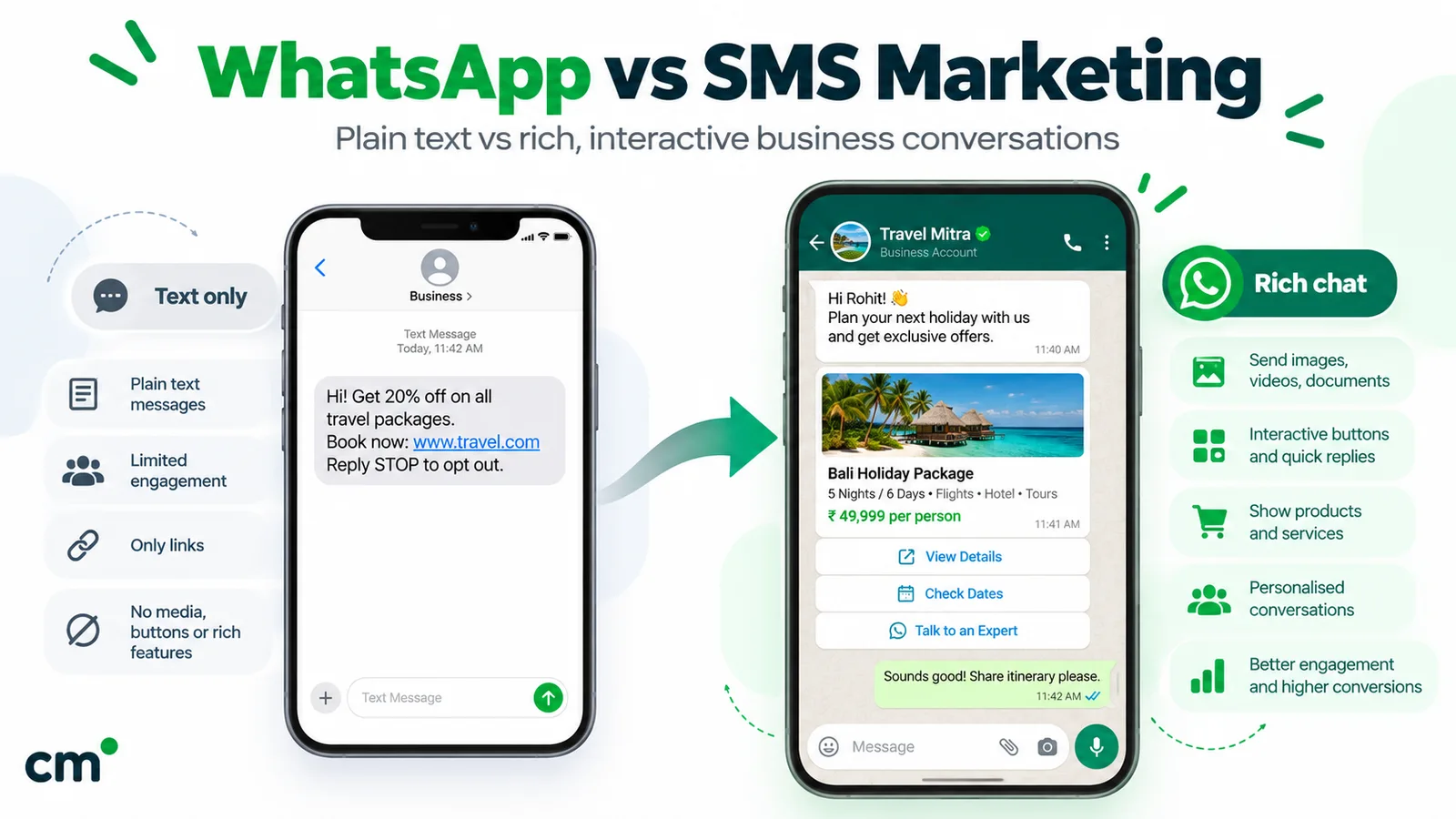
| Content | Plain text | Text, images, video, documents, buttons, lists, catalogues, Flows | Text, media, rich cards and suggestions |
| Sender identity | A header (India), short code, toll-free or 10-digit number | Your business profile and display name; a blue checkmark for Official Business Accounts | A brand name and logo, with a verified checkmark after verification and launch |
| Registration before sending | India: TRAI DLT (entity, headers, templates). US: 10DLC brand and campaign for 10-digit numbers | Meta business account, a registered number and Meta-approved templates | Brand verification and carrier launch approval |
| Status you get back | Sent, delivered or undelivered (no read status) | Sent, delivered, read, failed | Delivery status and read receipts |
Who can you reach on each channel?
SMS travels over the mobile operator’s network. It needs no app, works on basic feature phones and doesn’t need mobile data. For audiences that include older or rural customers, or people who switch data off, that is still the strongest reason to keep SMS.
WhatsApp needs three things on the customer’s side:
- The app, on a supported phone, with an internet connection. If the number isn’t on WhatsApp, Meta returns error 131026, “Unable to deliver message”, and its listed reasons include “The recipient phone number is not a WhatsApp phone number” (Meta error codes). Meta’s advice for that error begins “Using a non-WhatsApp communication method”.
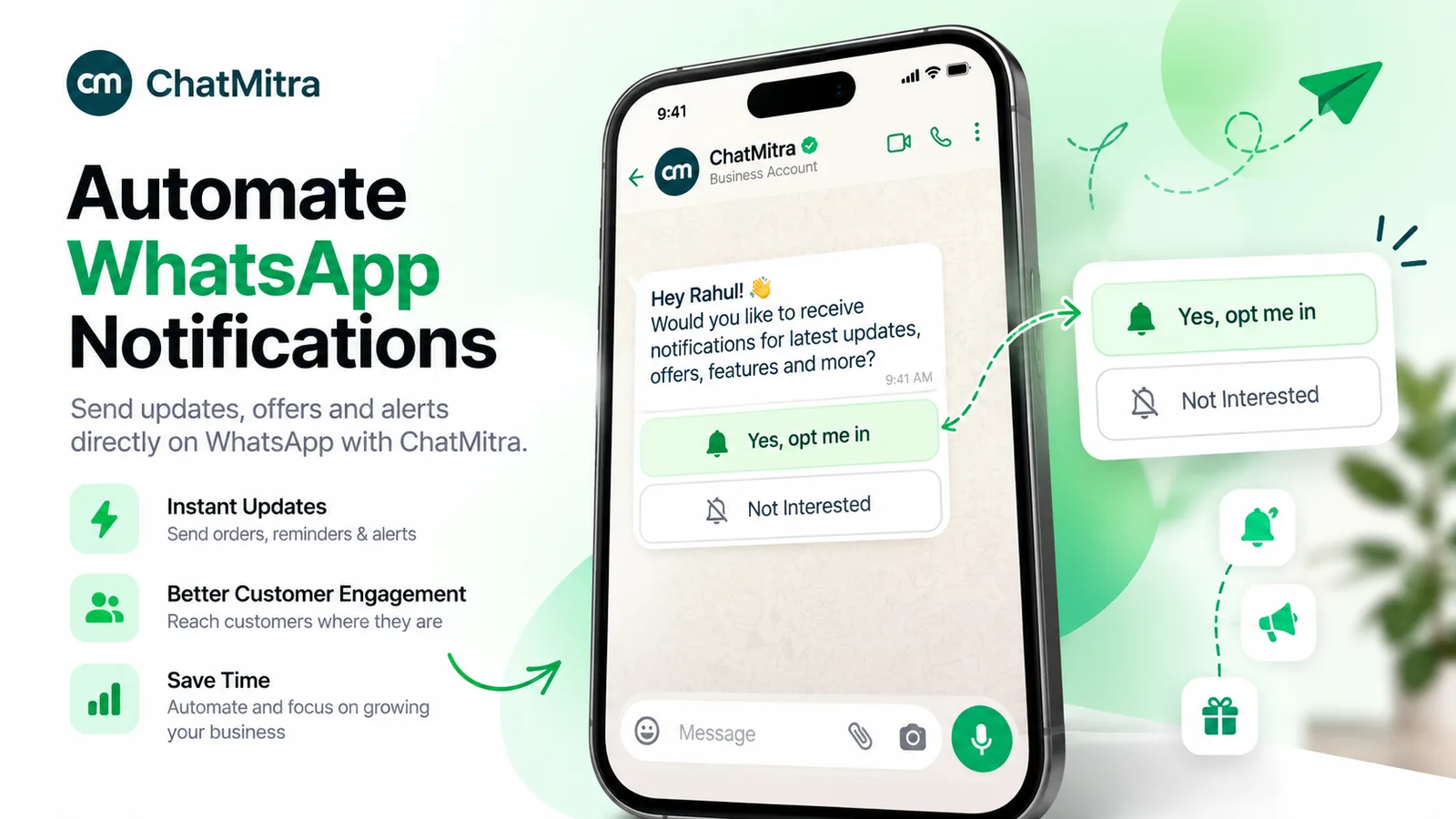
- Opt-in. WhatsApp’s Business Messaging Policy says you may contact people only if “they have given you their mobile phone number or username” and “you have received opt-in permission from the recipient”. Meta’s opt-in guide lists SMS itself as a supported way to collect that opt-in, so the older channel can recruit people to the newer one. The WhatsApp opt-in guide covers wording and proof.
- A market where Meta delivers the message type. Meta’s per-user limits page says WhatsApp “does not currently deliver marketing template messages to WhatsApp users with United States phone numbers”. Utility and authentication templates are not covered by that line. If your promotional audience is in the US, WhatsApp is not an option for promotions today.
WhatsApp may also deliver fewer marketing messages to a person, based partly on “an individual’s recent marketing message read rate” (same page); blocked sends fail with error 131049.
RCS reaches only phones and networks that support it. Google’s RCS for Business documentation says: “If the device doesn’t support RCS, the RCS for Business platform returns a 404 error, and the agent should fall back to another technology, such as SMS” (Google, how RCS for Business works).
How WhatsApp and SMS pricing work
The two channels are priced on different units, so compare structures first, then plug in your own quotes.
WhatsApp: per delivered message, by category and country
Meta says “Effective July 1, 2025, Meta charges on a per-message basis for messages businesses deliver to WhatsApp users” (Meta pricing). What you pay depends on four things:
- Category. Marketing, utility, authentication, or service (a free-form reply). Meta’s review confirms or changes the category you pick.
- The recipient’s country. Rates are set per market on Meta’s rate card.
- The 24-hour customer service window. When a customer messages you, “a 24-hour timer called a customer service window starts”, and when it closes “you can only send pre-approved template messages” (Meta, send messages).
- Since 1 October 2026, service replies are charged too, at the utility rate, but “Each business phone number has one shared free tier of 1,000 delivered service messages per month”, and unused ones “do not roll over”. Utility templates sent inside an open window are now charged as well.
Length doesn’t change the price. A 900-character order summary with an image and two buttons is one message.
Here are Meta’s rates from the card effective 1 October 2026, per delivered message:
| Recipient market | Marketing | Utility | Authentication | Service (after 1,000 free) |
|---|---|---|---|---|
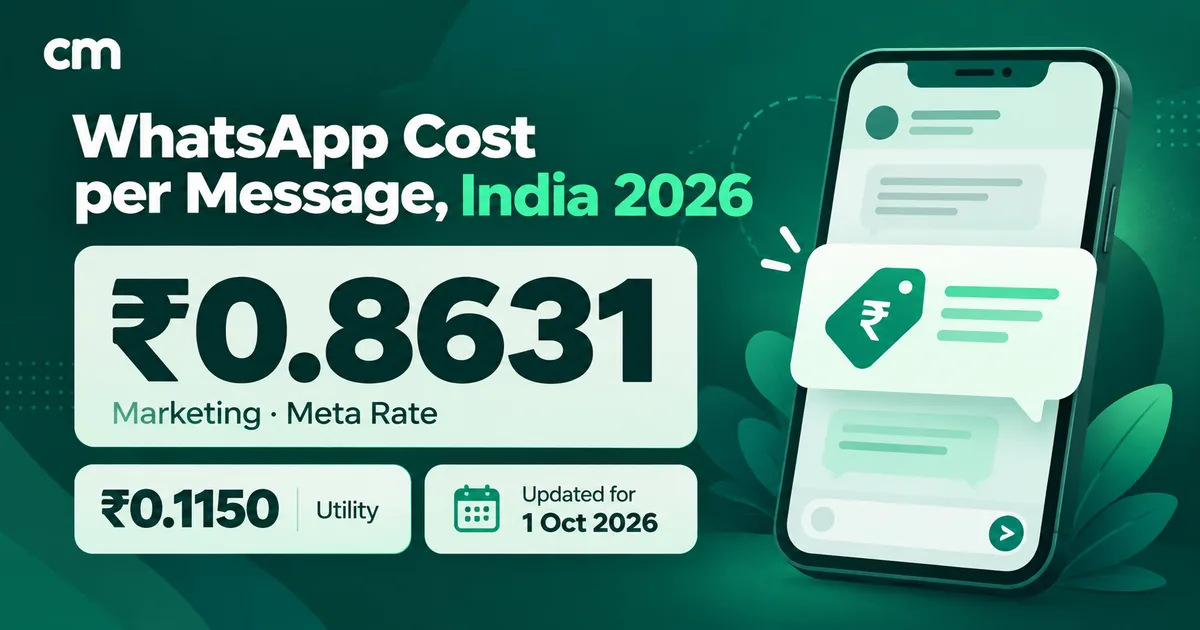
| India (INR card) | ₹0.8631 | ₹0.1150 | ₹0.1150 | ₹0.1150 |
| India (USD card) | $0.0118 | $0.0014 | $0.0014 | $0.0014 |
| North America (USD) | $0.0250 (not delivered to US numbers) | $0.0034 | $0.0034 | $0.0034 |
| United Kingdom (USD) | $0.0635 | $0.0220 | $0.0220 | $0.0220 |
| Brazil (USD) | $0.0625 | $0.0068 | $0.0068 | $0.0068 |
| Germany (USD) | $0.1365 | $0.0550 | $0.0550 | $0.0550 |
The WhatsApp Business cost per message guide walks through volume tiers and provider fees in detail.
SMS: per segment, at a rate your provider quotes
SMS pricing is built on segments. A single SMS holds 160 characters in the standard GSM-7 alphabet. Once a message is longer, each part carries a small header for reassembly, so each segment holds 153 characters. If the text includes any character outside GSM-7 (an emoji, a curly quotation mark, or any Indian-language script), the whole message switches to UCS-2 encoding: 70 characters for a single SMS, 67 per segment after that (Twilio, SMS character limit). Twilio’s page also notes that it “bills SMS per message segment sent”.
| The same alert, written as… | Encoding | Characters | Segments billed |
|---|---|---|---|
| Plain English, 150 characters | GSM-7 | 150 | 1 |
| Plain English, 200 characters | GSM-7 | 200 | 2 (153 + 47) |
| The 150-character version with one emoji added | UCS-2 | 151 (most emoji count as 2) | 3 (67 + 67 + the rest) |
| Hindi or Gujarati, 120 characters | UCS-2 | 120 | 2 (67 + 53) |
We don’t quote SMS prices here: there is no single official rate, and quotes vary by provider, route, destination, volume and message type. Ask two or three providers for a written price per segment and destination, plus any DLT or 10DLC charges.
A worked example: 1,000 messages
Take one alert sent to 1,000 different customers, none of whom has messaged you in the last 24 hours.
| Scenario | Meta charge | With ChatMitra's ₹0.20 fee (Starter, Pro) |
|---|---|---|
| WhatsApp utility template to 1,000 Indian numbers (a delivery update) | 1,000 × ₹0.1150 = ₹115.00 | ₹115.00 + ₹200.00 = ₹315.00 |
| WhatsApp marketing template to 1,000 Indian numbers (a festive offer) | 1,000 × ₹0.8631 = ₹863.10 | ₹863.10 + ₹200.00 = ₹1,063.10 |
| WhatsApp utility template to 1,000 UK numbers | 1,000 × $0.0220 = $22.00 | Meta charge plus the fee |
| WhatsApp utility template to 1,000 US numbers | 1,000 × $0.0034 = $3.40 | Meta charge plus the fee |
| SMS to 1,000 numbers | 1,000 × segments per message × your provider's per-segment rate for that country, plus any registration or platform fees | |
How to read it:
- ChatMitra’s fee is ₹0.20, charged once per contact per 24-hour conversation, not per message, on the Starter and Pro plans. Enterprise (₹2,499 a month) has no per-conversation fee, so only Meta’s charge applies. Current plan details are on ChatMitra’s pricing page.
- Replies are cheap on WhatsApp. If 200 customers reply to the delivery update and your team answers in the window, those service replies come out of the number’s 1,000 free service messages that month.
- On the SMS side, count segments first. A 200-character English alert is 2 segments, so 1,000 alerts means 2,000 billed segments; in Hindi it is 3 or more.
In short: for plain, short alerts, compare your SMS quote with Meta’s utility rate for that country. For long, rich, conversational or Indian-language messages, the per-message model usually works in WhatsApp’s favour.
What can WhatsApp do that SMS can’t?
- Buttons and lists. Reply buttons let the customer answer with a tap; Meta allows “up to three predefined replies” in an interactive reply-button message. List messages, call-to-action URL buttons and location requests are also available (Meta, send messages). The guide to WhatsApp interactive messages covers each type and its limits.
- Media, catalogues and Flows. An invoice PDF, a product photo, product messages or a booking form stay inside the chat.
- Two-way conversation in one thread. A customer who replies “wrong address” to a delivery update is already in a support chat. Whether an SMS can be answered depends on your sender type and provider.
- Read status, covered under measurement below.
SMS keeps one advantage: it lands in the default inbox of any handset.
Sender identity and trust
WhatsApp shows your business profile. Meta’s display name documentation says the display name “appears in your business phone number’s WhatsApp profile” and can appear at the top of chat threads and the chat list once the number passes display name verification. An Official Business Account goes further: Meta says such numbers “have a blue checkmark beside their name in the contacts view” (Official Business Accounts).
SMS in India shows a header. TRAI’s regulations define a header as “an alphanumeric string of maximum eleven characters or numbers”, and the February 2025 amendment says recipients should be able to identify the message type by the suffixes “-P”, “-S”, “-T” and “-G” for promotional, service, transactional and government messages (TRAI, Second Amendment Regulations 2025). SMS in the US comes from a short code, a toll-free number or a registered 10-digit number.
RCS shows a brand name and logo. After brand verification and launch, Google says Messages “automatically displays a verification checkmark next to the agent’s name” (Google, brand verification).
The rules: consent and registration for each channel
WhatsApp’s rules are global; SMS rules come from each country’s regulator. This is a summary, not legal advice.
WhatsApp, everywhere
- Opt-in first. Meta’s opt-in guide says that since November 2024 the permission “can be general and not specifically for WhatsApp, as long as businesses comply with all local laws”, and must name your business.
- Honour opt-outs on or off WhatsApp. The policy says you “must respect all requests (either on or off WhatsApp) by a person to block, discontinue, or otherwise opt out of communications from you via WhatsApp”.
- Quality enforcement. “Users can block or report businesses. Our systems may limit the amount of messages a business can send or calls a business can initiate, based on this user feedback.”
India: TRAI’s TCCCPR and DLT for SMS
Commercial SMS in India is governed by TRAI’s Telecom Commercial Communications Customer Preference Regulations, 2018 (TCCCPR), as amended, which run on a distributed ledger (DLT) operated through the telecom operators. With your SMS provider and an operator’s DLT platform, you:
- Register the entity (the business itself).
- Register headers, the sender IDs customers see.
- Register content templates; the regulations define separate “Content Template for Transaction” and “Content Template for Promotion” registers.
- Register consent templates where you collect explicit consent.
Every message is then scrubbed against its registered content template and the recipient’s preferences; TRAI says a message that fails “is not allowed to go forward”. Customers set preferences, including blocked time bands, by calling or texting 1909.
Three rules deserve attention because they catch businesses out:
- Default time bands. The regulations make the bands 00:00–06:00, 06:00–08:00, 08:00–10:00 and 21:00–24:00 “default OFF for all customers” unless a customer registers a preference and switches them on. For customers who haven’t changed their settings, that leaves 10:00–21:00 for promotional SMS. The 2025 amendment adds that promotional messages sent with explicit digital consent are delivered “irrespective of their preferences registered”. Ask your SMS provider how operators apply this to your traffic.
- Mixed content is promotional. The 2025 amendment says “if promotional content is mixed with any type of Transactional or Service Message, such Message shall be treated as a Promotional Message”. Meta applies the same logic to WhatsApp: an order update with a promo line becomes a marketing template.
- Opt-out in every promotional SMS. The same amendment requires the sender to “give an opt-out mechanism to the Recipient in the same Message”.
WhatsApp templates don’t go through DLT; Meta approves them. Opt-in and opt-out rules still apply whichever channel you use, and the consent duties of India’s Digital Personal Data Protection Act start around May 2027.
United States: TCPA consent and 10DLC registration
- Consent. The FCC’s rules under the Telephone Consumer Protection Act bar autodialed telemarketing or advertising to mobile numbers “other than a call made with the prior express written consent of the called party”, and a person “may revoke prior express consent… by using any reasonable method to clearly express a desire not to receive further calls or text messages” (47 CFR 64.1200).
- 10DLC registration. Twilio’s documentation says “Anyone sending SMS/MMS messages over a 10DLC number from an application to the US must register for A2P 10DLC” (Twilio, A2P 10DLC). Registration sits with The Campaign Registry, which describes 10DLC as a channel “in which Brands and Campaign Service Providers (CSPs) are verified prior to being allowed to send messages”; brands register through their messaging provider, not directly.
EU, UK and elsewhere
In the EU, the ePrivacy Directive allows electronic mail for direct marketing, a definition that covers “any text, voice, sound or image message sent over a public communications network”, only for people “who have given their prior consent”, with a limited exception for existing customers and similar products (Directive 2002/58/EC, Article 13). The GDPR governs the personal data. Other countries have their own sender-ID registration and consent rules, so check with your SMS provider for each destination.
OTPs: SMS codes vs WhatsApp authentication templates
One-time passwords are the most common reason businesses keep SMS, but WhatsApp has a dedicated template type for them.
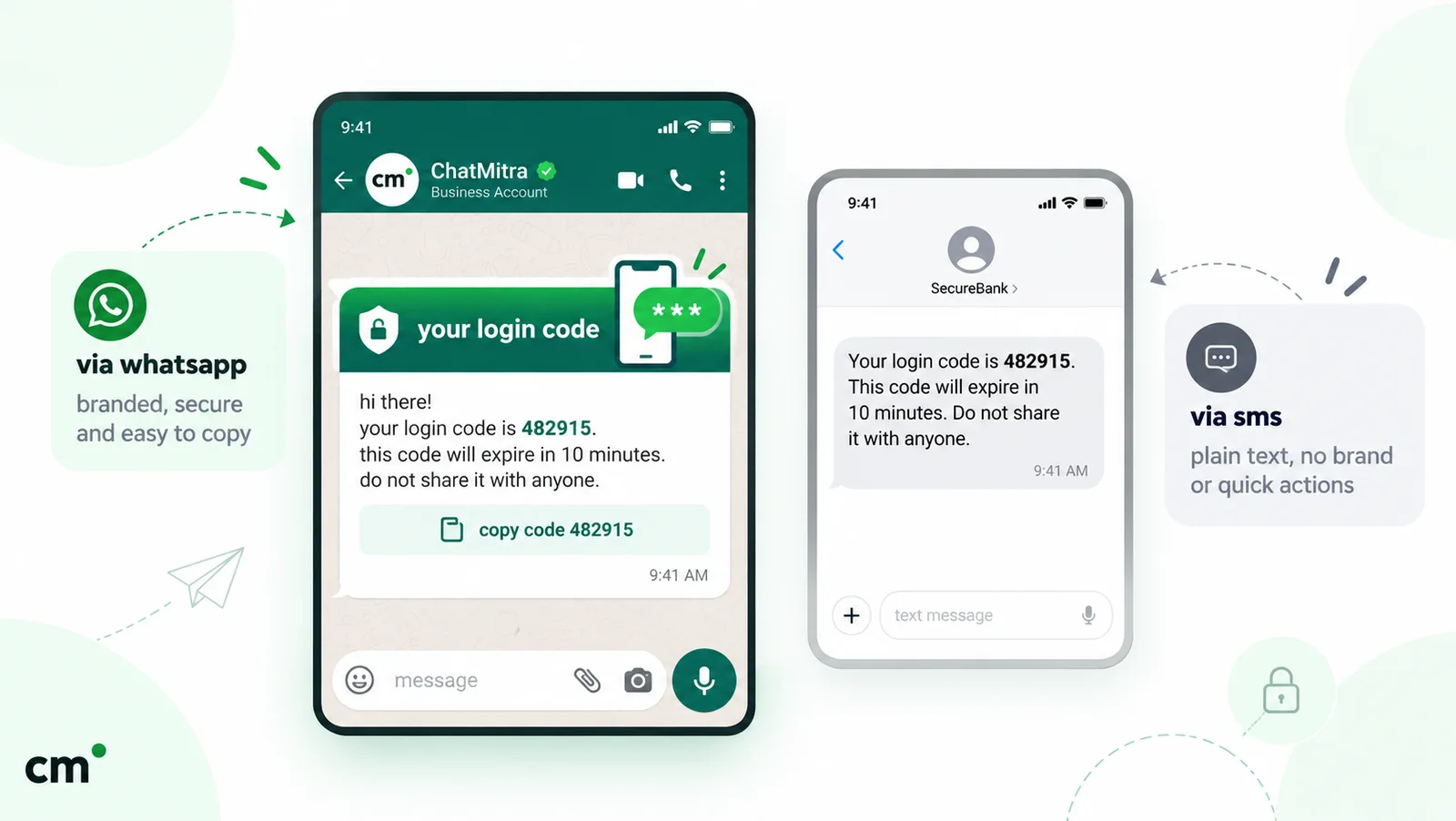
On WhatsApp, codes must use authentication templates. Meta says: “If your mobile app offers users the option to receive one-time passwords or verification codes via WhatsApp, you must use an authentication template” (Meta, authentication templates). The template has fixed text (“<VERIFICATION_CODE> is your verification code”), an optional security line, an optional expiry line, and one of three delivery styles:
| Delivery style | What the customer does | Where it works |
|---|---|---|
| Copy code | Taps a button that copies the code, then pastes it into your app or site | Any device; also what non-Android phones see when zero-tap is used |
| One-tap autofill | Taps a button that opens your app with the code filled in | Android apps with extra code; on iOS 26 and later, keyboard suggestions offer autofill from the notification |
| Zero-tap | Nothing; your app receives the code automatically | Android only |
- Linked device security. Authentication messages “are only delivered to a user’s primary WhatsApp device”; linked devices see a prompt to check the primary one.
- A short retry window. Meta retries undelivered messages for a time-to-live period. The default is 30 days for most messages but 10 minutes for authentication templates (Meta, send messages). An OTP that can’t be delivered expires quickly rather than arriving an hour late.
SMS OTP reaches any phone, but the code is plain text in the default inbox, and in India it must match a registered DLT content template.
A sensible design: let the user choose WhatsApp or SMS on the login screen, remember the choice, and offer “send by SMS instead” after a short wait. Meta charges ₹0.1150 per authentication message to Indian numbers. A business based outside India that Meta deems eligible (more than 750K messages outside customer service windows in a moving 30-day period to users in authentication-international markets) pays India’s authentication-international rate instead, ₹2.4971, after 30 days’ notice (Meta). ChatMitra’s short explainer on WhatsApp authentication messages compares the three delivery styles in plain language.
Measuring delivery: receipts on each channel
WhatsApp reports four statuses through webhooks. Meta defines them as: sent (“successfully sent from our servers”), delivered (“successfully delivered to the WhatsApp user’s device”), read (“displayed in an open chat thread in the WhatsApp user’s device”) and failed (Meta, status webhooks). Meta also notes that a message read while the chat is open can skip the separate “delivered” event. ChatMitra’s guide to webhooks and message status explains the ticks.
SMS stops at delivery. Twilio’s status documentation lists sent or failed, then delivered or undelivered, and says a message reaches “read” only on channels that support read receipts: “RCS and WhatsApp support read receipts” (Twilio, message status).
Two cautions. A missing “read” doesn’t prove a message went unseen, since Twilio notes read status depends on the recipient’s read-receipt setting. And SMS has no read signal at all, so any SMS “open rate” is an estimate, not a report. Compare what both channels can show: delivery, replies, clicks on your tracked links and conversions.
Where RCS fits
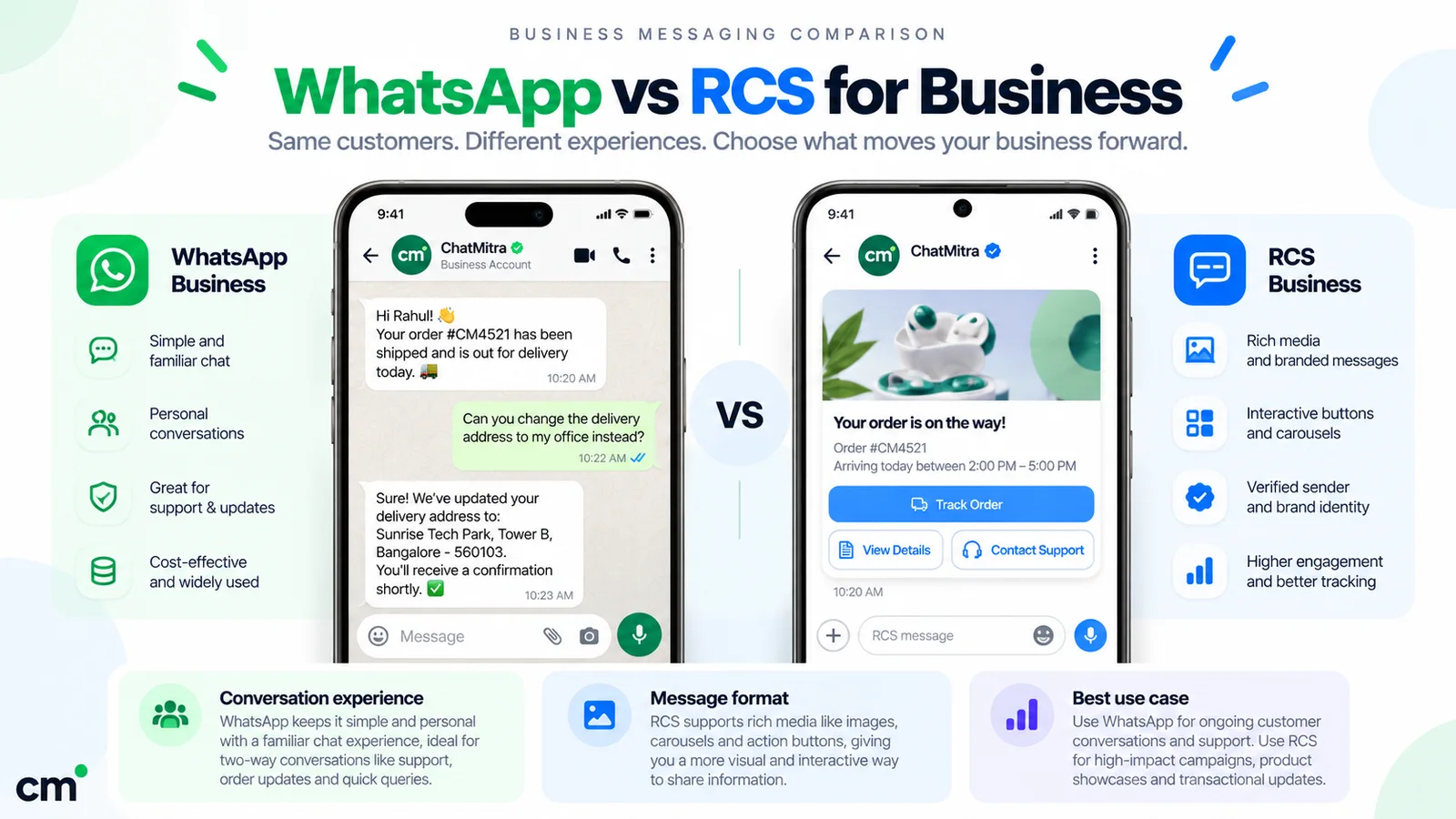
RCS (Rich Communication Services) upgrades carrier messaging with branded senders, rich cards and read receipts in the phone’s default messaging app. Google says its RCS for Business platform reaches customers “on Android and iOS”. What’s documented today:
- The business must start the conversation. Google says “Users can’t start conversations with your agent, but once the agent starts a conversation, the user can reply at any time.”
- Approval per network. A business verifies its brand, then submits the agent for launch “on one or more carrier networks”; once approved, it can “reach RBM-capable users on the approved carrier networks” (Google, launch). Some launches are managed by Google, others directly by carriers.
- iPhone support depends on the carrier. Apple says “To use RCS, you need iOS 18 and a cellular plan from a carrier that supports RCS messaging on iPhone”, that “Availability varies by region and carrier”, and that users can switch RCS business messages off (Apple Support).
So RCS vs WhatsApp is a question of audience. RCS suits a richer SMS in the default inbox, after carrier approvals, with SMS behind it. WhatsApp suits audiences already on WhatsApp, where customers can start the conversation too.
Which channel for which message? A decision matrix
A starting point; test it with your own audience.
| Message | First choice | Why | Fallback |
|---|---|---|---|
| Login or payment OTP | Let the user choose; SMS as the default for unknown users | Universal reach matters most; WhatsApp adds one-tap and copy-code convenience for app users | The other channel after a short wait |
| Order, shipping and delivery updates | WhatsApp (utility) | Rich content, tracking buttons and replies in one thread, at the utility rate | SMS if WhatsApp isn't delivered in time |
| Appointment and payment reminders | WhatsApp (utility) | Confirm and reschedule buttons turn a reminder into an answer | SMS the day before for people not on WhatsApp |
| Customer support | Two-way chat, media and a shared inbox; the first 1,000 service replies per number each month are free | Phone or email | |
| Promotions in India | WhatsApp (marketing) to opted-in customers | Media and buttons; no segment limits | DLT-registered promotional SMS within the allowed time bands |
| Promotions to US numbers | SMS (10DLC, written consent) or email | Meta doesn't deliver marketing templates to US numbers | None on WhatsApp |
| Emergency or safety alerts | SMS, plus WhatsApp | Carrier delivery doesn't depend on mobile data or an app | Voice call for the most critical |
| Rural or feature-phone audiences | SMS | Works without a smartphone or data | Voice (IVR) |
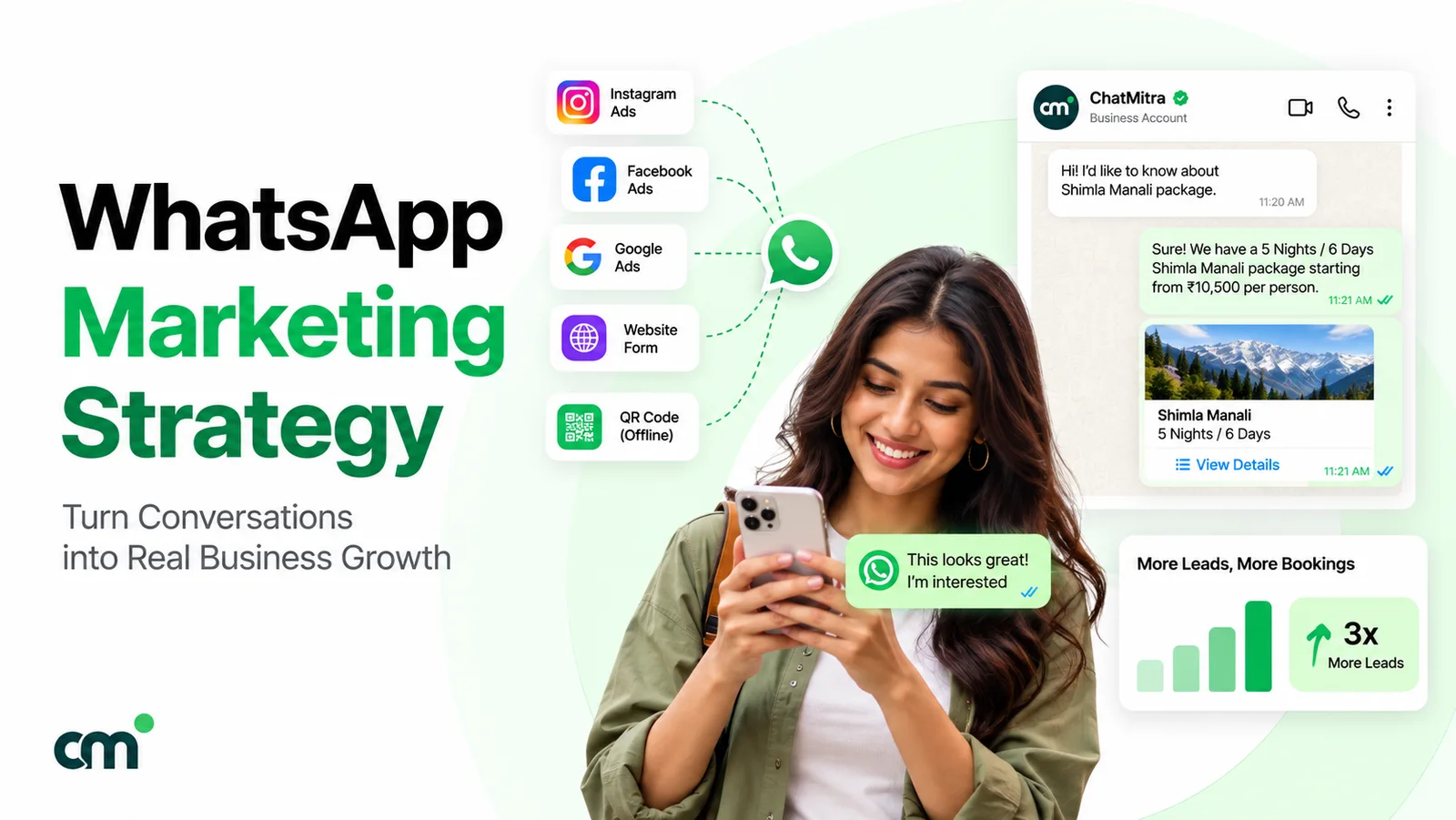
For reminder wording and timing, see the WhatsApp reminder messages guide. If you’re weighing WhatsApp against other marketing channels more broadly, the WhatsApp marketing strategy guide sets out the full plan.
Using both: a WhatsApp-first, SMS-fallback setup
For many businesses the answer is “WhatsApp, then SMS if needed”. The details decide whether that saves money or doubles your costs.
- Collect consent for both channels. Your sign-up form should name your business and say you’ll send updates by WhatsApp and SMS. In India, register the SMS side on DLT as usual.
- Send the WhatsApp template first. Record the message ID your platform returns.
- Listen for status webhooks. A “failed” status (for example error 131026, whose reasons include a number not on WhatsApp) should trigger the SMS at once.
- Set a timer for everything else. Meta keeps retrying undelivered messages for up to 30 days by default, so a phone that is switched off may never produce a quick “failed”. Decide how long the message is useful (a few minutes for an OTP, a few hours for a delivery slot) and send the SMS if no “delivered” status arrives in that time.
- Don’t send both by default, and use the same reference number in both versions so a customer who gets both knows they’re one alert.
- Remember who isn’t on WhatsApp. If a number returns 131026, send SMS directly next time and re-check occasionally.
- Keep opt-outs per channel and per message type. Stopping SMS doesn’t automatically mean stopping WhatsApp, or the reverse.
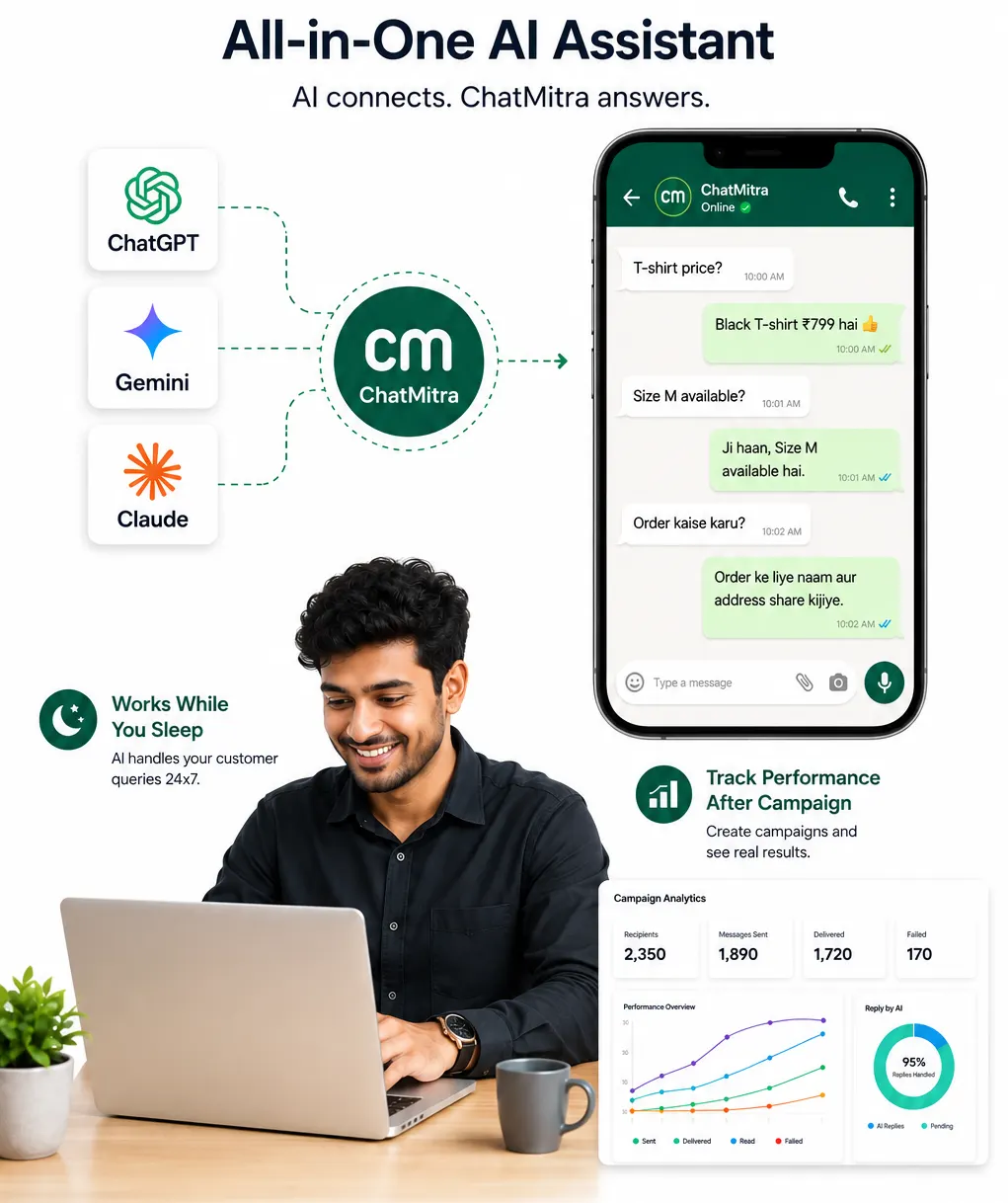
ChatMitra handles the WhatsApp half of this pattern and doesn’t send SMS or RCS itself. On the Pro plan, per ChatMitra’s pricing page, its webhooks send a message.status.updated event with the status (sent, delivered, read or failed, with a failure reason), and its REST API sends templates. Your own system or an SMS provider’s API does the SMS step.
Mistakes to avoid when comparing or combining channels
- Trusting channel-wide open-rate claims. Figures like “98% of SMS are opened” circulate without a primary source you can check. Measure your own delivery, replies and conversions.
- Comparing one WhatsApp message with one SMS. Long or Indian-language SMS costs several segments.
- Adding an offer line to a transactional message. It becomes promotional under TRAI’s rules and marketing under Meta’s, with different time windows, prices and consent needs.
- Using a plain SMS list for WhatsApp without checking its consent. Meta accepts general opt-in collected by SMS, but it must name your business and meet local law.
- Waiting for a “failed” status that never comes. Build the fallback on a timer.
- Planning US promotions on WhatsApp. Marketing templates aren’t delivered to US numbers.
- Treating RCS as a drop-in SMS replacement. It needs brand verification and approval per carrier network, and only the business can start the chat.
Where ChatMitra fits
ChatMitra is a WhatsApp Business Platform tool for businesses that want WhatsApp templates, broadcasts, a shared team inbox and API or webhook access on one number. It is not an SMS or RCS gateway.
| Need | In ChatMitra? | Detail |
|---|---|---|
| Send SMS or RCS | No | Use an SMS or RCS provider alongside it |
| WhatsApp authentication templates | Yes (copy code) | The template builder creates authentication templates with a copy-code button, an optional security line and an expiry of 1 to 90 minutes. One-tap and zero-tap aren't offered. |
| Send OTP templates from your app | Yes, with the API | The REST API normally sends approved authentication templates on a faster, unqueued path |
| Delivery and read tracking | Yes | Campaign reports show sent, delivered, read and failed; webhooks report each status change |
| Automatic SMS fallback | No | Build it from the status webhook and your SMS provider |
| Automatic STOP unsubscribe | No | Set up a keyword rule and an opted-out tag, and exclude that tag from broadcasts |
If you only need the WhatsApp side, compare ChatMitra’s plans. Whatever tool you pick, use an official Business Platform provider rather than a bulk-sender app; the guide to official vs unofficial bulk WhatsApp senders explains the risk.
Sources: Meta for Developers (pricing, rate cards effective 1 October 2026, messaging, templates, webhooks, error codes, opt-in); WhatsApp Business Messaging Policy; TRAI TCCCPR 2018 and its 2025 amendment; 47 CFR 64.1200; EU Directive 2002/58/EC; The Campaign Registry; Twilio documentation; Google RCS for Business; Apple Support. ChatMitra behaviour verified in ChatMitra’s code on 25 September 2026.
Facts checked against Meta's and WhatsApp's documentation on 25 September 2026.