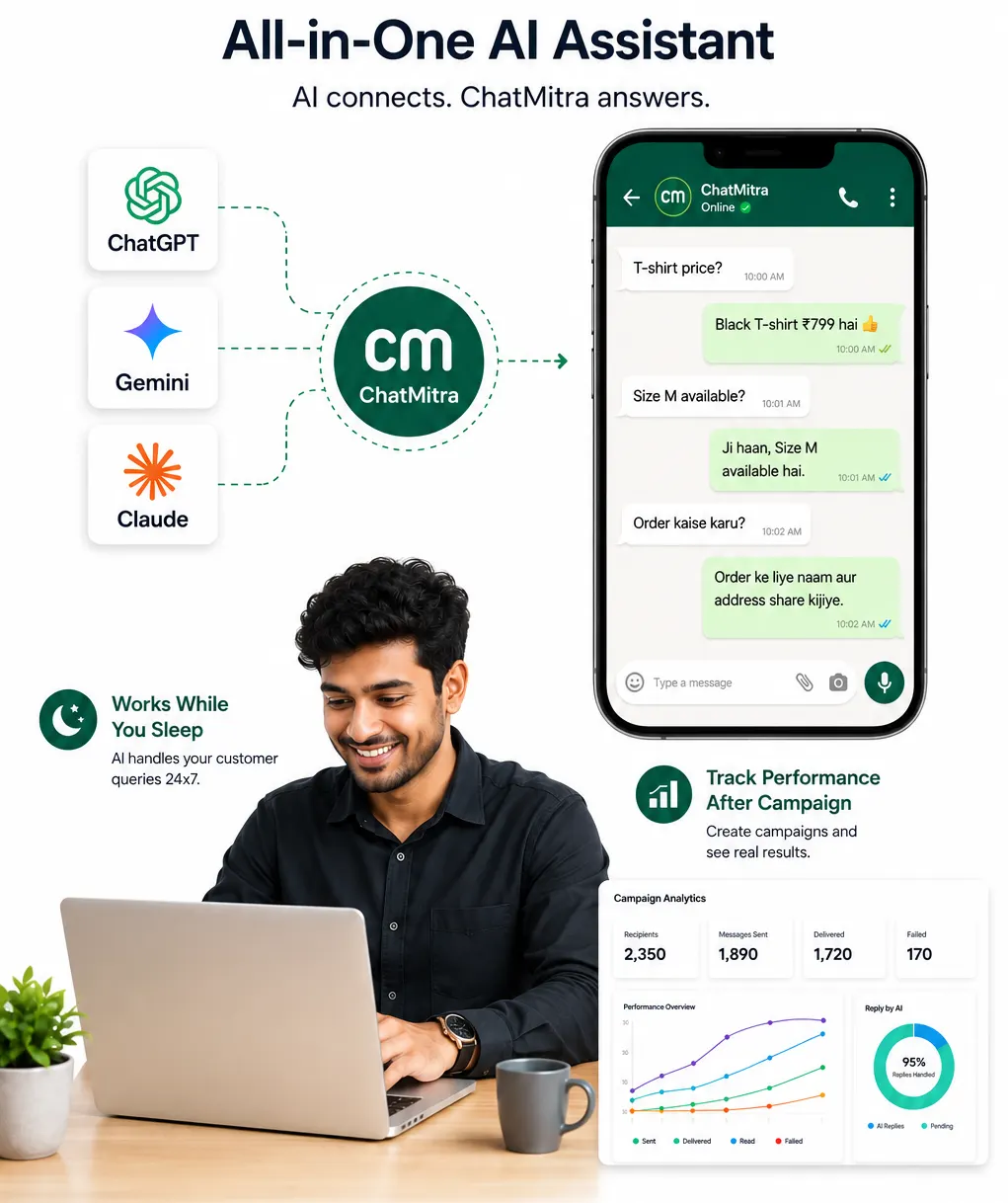
Marketing messages are how you promote on WhatsApp — a sale, a new product, a newsletter, or a nudge to a customer who has gone quiet. They are the most powerful and most regulated message type: they need opt-in, an approved template, and they cost the most (₹0.86 each in India).
What marketing messages cover
Marketing templates carry all the promotional work a business does on WhatsApp. They fall into five rough buckets:
- Awareness — telling people about your brand, a launch or an event.
- Sales — offers, discounts and “shop now” nudges.
- Retargeting — winning back customers who browsed but didn’t buy, or who’ve gone quiet.
- App promotion — getting people to download or open your app.
- Customer relationships — newsletters, invitations and ongoing updates people opted into.
If you’d run it as an ad, it’s a marketing message — the category is about intent, not how the message looks.
Two ways to send: Cloud API vs MM API
There are two routes for marketing messages, and they matter for cost and delivery:
- Cloud API is the default route. It works fine, but marketing sends through it carry a 7% surcharge.
- Marketing Messages API (MM API) is an opt-in route built just for marketing templates. It skips that surcharge, often delivers as well or better, and unlocks extras like time-to-live (TTL) control and richer performance metrics.
The switch is small: your templates don’t change — you just point at the MM API endpoint after a one-time onboarding. Note that MM API optimisation is limited or unavailable in some regions (for example the EEA, UK, Japan, South Korea, and a few sanctioned countries), so check availability for where you send.
Guides in this section
- Onboarding and sending messages — get set up on the MM API and send your first marketing message correctly.
- Expected errors & programming languages — the common send errors (and what they mean) plus the template language codes you’ll use.