"Chat Mitra offers excellent service and customer support. An outstanding solution for businesses utilizing WhatsApp API."
5.0

indlead (Rishabh Pal)
Lead Generation Company
Ghaziabad, Uttar Pradesh
✓ Verified API Expert Solution
15-Day Free Trial + Free Credits!
Get Started for FreeOfficial Meta-partner setup for Surat businesses — Ring Road dispatch desks to the Katargam and Pandesara processing sheds. Go live in 30 minutes on an account built around consignments rather than campaigns, starting free at ₹0.20 per conversation.
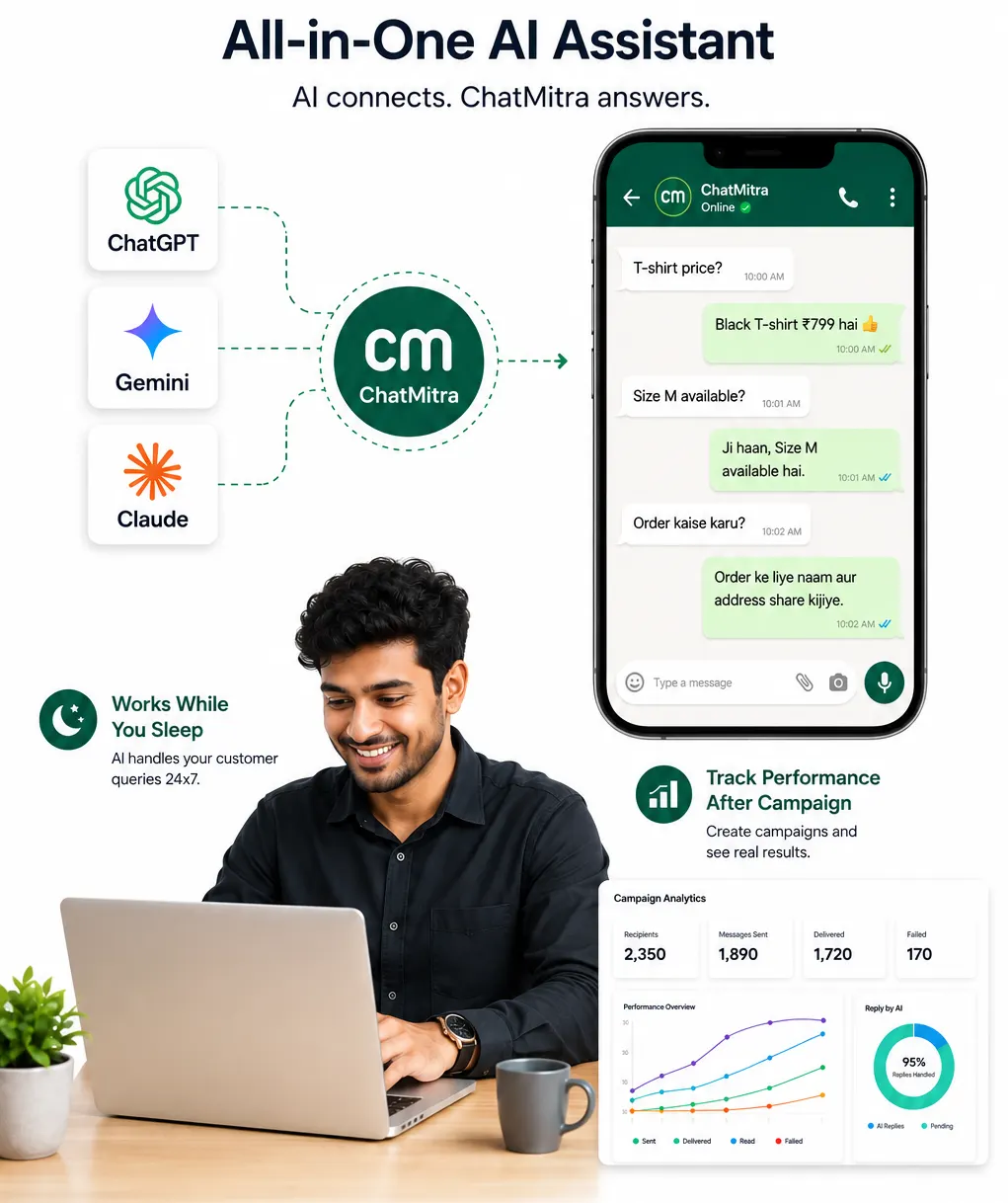
ChatMitra is an official Meta Business Partner providing WhatsApp Business API access to Surat businesses. Setup takes 30 minutes once your GST certificate and a dedicated number are ready. Starter is free — you pay ₹0.20 per conversation plus Meta's charges. Pro is ₹999 a month and adds AI chatbot, auto-reply and API access.
Loved by 10,000+ big and small brands. World-famous and local across 21+ Countries





















Have questions? We've got answers. Connect with our product expert for a personalized demo and discover the best WhatsApp Business setup for your business.
Book a Free Demo
Figures from live ChatMitra accounts registered in Gujarat, measured over the last 90 days.
0+
Gujarat businesses
0%
Delivery rate, Surat accounts
0%
Of volume is utility
0 minute
Median time to go live
Why ChatMitra
Most Indian competitors start at ₹1,500–₹5,000 a month and charge extra for chatbots, API access and integrations.
Listed in Meta's partner directory — not a reseller working off a shared number.
One platform fee per conversation. Meta's rates pass through at cost, and Enterprise waives the fee entirely.
No separate add-on bill. The builder, AI replies and lead flows are all part of ₹999.
Add your whole team on Pro without a per-seat charge.
Rejected by Meta? We rewrite and resubmit it for you, included in the plan.
Most businesses are sending on the third working day from documents to first message.
The account sits under your own Meta portfolio. Leave whenever you like and keep everything.
Monthly, quarterly or yearly billing. No minimum term and no exit charge.
Ranked for Surat
Same platform in every city. What changes is which features earn their keep, so this list is ordered by what actually moves the needle for Surat.
Push the lorry receipt number, transporter name and expected delivery date straight from your dispatch desk.
Why Surat: A buyer eighteen hundred kilometres away judges a supplier almost entirely on whether they know where their parcel is. The LR number is the single most-requested piece of information in this trade, and answering it before it is asked removes most of the inbound traffic a dispatch desk handles.
Worked example A wholesaler attaches the transporter and LR number to every dispatch confirmation, and the calls asking 'maal kahan hai' drop away almost entirely.
Short structured updates against a job card — received, in process, ready, challan raised.
Why Surat: A processing unit and the trader whose goods it holds need a running state, not a conversation. The messages are brief, frequent and factual, and they go to somebody who already has an account and is tracking six other lots at the same time.
Worked example An embroidery unit sends a ready notice with the lot number and piece count, and the agent collects without a phone call in between.
Raised send pacing for a defined release window, with live delivery counts as the campaign runs.
Why Surat: A residential launch here can move a large share of its inventory in the first two days, which puts the entire messaging load into one compressed window. That is a throughput requirement on a specific weekend rather than a monthly volume.
Worked example A Vesu launch clears its inventory-release campaign to 30,000 contacts across a single morning, then returns to a few hundred booking-document messages a day.
Approve the same notice in Gujarati, Hindi and English and select the variant from a contact attribute.
Why Surat: The trade runs in Gujarati while a large share of the buying base is in the eastern states and works in Hindi. One dispatch notice therefore needs both approved and routed off the buyer's own record, not off any assumption about where an order came from.
Worked example A rate-list circular goes out in Gujarati to the local agent network and in Hindi to the out-of-state retail book, from one template library.
Run the trading entity and the processing entity as separate projects with their own numbers and invoices.
Why Surat: Because the goods and the processing sit on different GSTINs, the two sides of the same consignment are two different businesses for verification and for billing. Collapsing them into one project makes the display name wrong for one of them.
Worked example A group holding both a trading office and a processing unit runs two projects, so each entity's conversations are verified and invoiced against its own registration.
Maintain lists of commission agents and push rate changes, availability and lot releases to all of them at once.
Why Surat: The commission agent is a permanent intermediary in this market rather than an occasional one, and the same information has to reach several dozen of them simultaneously or the ones who hear last are trading on stale rates.
Worked example A daily rate circular reaches ninety agents at 9 AM, replacing a broadcast list that had quietly stopped being maintained.
Fire messages from your billing, inventory or dispatch software, and write delivery events back to it.
Why Surat: A challan being raised and a parcel being handed to a transporter are already records in software. Retyping them into a messaging tool is where the wrong LR number against the wrong buyer comes from.
One number, unlimited agents, chat assignment, internal notes, and history that survives a handover.
Why Surat: A dispatch desk answers hundreds of running accounts against one published number, and the thread has to carry the order it belongs to when a different person picks it up after lunch.
No-code flow builder plus AI answers drawn from your own rate list, stock position or dispatch policy.
Why Surat: Buyers in the eastern states place orders late in the evening on their own clock, and the most common question they ask has a factual answer that does not need a person to look it up.
Products inside WhatsApp with images, prices and variants, so a customer browses without leaving the thread.
Useful everywhere. Works identically anywhere. Useful for the small share of accounts here that sell direct, irrelevant to the wholesale book.
Run a whole list from one spreadsheet — edit a row and WhatsApp reflects it.
Useful everywhere. Entirely universal, and on every plan.
Delivery, read and reply rates updating live mid-send, split by campaign and by template.
Useful everywhere. Useful in any market. Nothing about it is specific to this one.
Ranking comes from the city data file — swap the city and this order changes. Features marked “useful everywhere” are flagged on purpose: claiming every one is Surat-specific is what makes a page read as templated.
Transparent pricing
Two bills on Starter: Meta's conversation charge and ChatMitra's flat ₹0.20 platform fee. Pro and Enterprise add the subscription on top, and Enterprise removes the platform fee entirely.
Run broadcasts, manage contacts and chat with customers on the official API — free subscription.
Free
No card, no setup fee
₹0.20 / conversation + Meta charges
Everything in Starter plus the automation stack. 15-day free trial, no card needed.
₹917 /month, billed yearly
₹999 monthly · ₹11,000/year · save ₹988
₹0.20 / conversation + Meta charges · 1,000 free credits a month
Everything in Pro with the platform fee removed. Pay only Meta's charges.
₹2,000 /month, billed yearly
₹2,999 monthly · ₹23,999/year · save ₹12,000
No ChatMitra fee — Meta charges only
| Category | Used for | Meta | + ChatMitra |
|---|---|---|---|
| Marketing | Offers, launches, re-engagement | ₹0.86 | ₹0.20 |
| Utility | Order, payment, dispatch updates | ₹0.11 | ₹0.20 |
| Authentication | OTP, login, account recovery | ₹0.11 | ₹0.20 |
| Service | Replies inside the 24-hour window | Free | Free |
Seeded with Surat's typical band (10,000–100,000 conversations / month) and its actual category mix. On Enterprise the ₹0.20 fee drops to zero. price up your volume.
Full plan detail on compare Starter, Pro and Enterprise, or read how WhatsApp conversation billing works in India.
Straight answer
No. The WhatsApp Business API is delivered from Meta's cloud, so your provider's office location has no effect on delivery speed, uptime or message cost.
Every provider ranking for this search resells the same Meta Cloud API. What genuinely differs by location is narrower — and worth knowing before you sign:
Those four things are exactly what the next section covers for Surat.
The part that changes with the city
The English version being approved does not approve the ગુજરાતી one — it is a separate submission and a separate review.
Three approval languages, and an unusual reason for the third. The trade itself is conducted in Gujarati, and the retailer buying two hundred pieces from a Ring Road office is very often in Bihar, Bengal or Assam and works in Hindi — so those two carry almost everything commercial. What no template covers is the shop floor: the powerloom and processing workforce here is overwhelmingly from Odisha, eastern Uttar Pradesh and Bihar, and Odia or Bhojpuri variants are not something Meta approves at any useful scale. Internal workforce messaging therefore stays in Hindi by necessity rather than by preference.
Languages we support for Surat: English, Gujarati, Hindi.
Promotion is a minority activity across most of this book, and it is a structural consequence of selling to businesses rather than a discipline anybody imposed. A dispatch update, a lot-ready notice and a delivery challan all go to a counterparty with a running account, which puts them in the cheapest category Meta charges for. The marketing share is concentrated almost entirely in the property launches and in the seasonal rate circulars, so a single account rarely resembles the blended figure.
The state code is 24, the same as Ahmedabad's, and that familiarity is precisely what catches people out. The complication here is job-work: across the textile chain the goods being processed usually belong to somebody else, so a single consignment involves a trader who owns the fabric and a processing unit that never takes title to it, each on its own GSTIN. Before you apply, be clear about which of those two the WhatsApp number belongs to, because Meta verifies the one entity named on the certificate and a job-worker's registration will not carry the trader's market name.
Two builds and one full stop. Dispatch volume climbs from August through November as the wedding and festive retail season stocks up across the eastern and northern states, then again through January and February for the spring wedding dates. The distinctive event is the diamond industry's Diwali vacation, when a large part of Varachha closes for roughly three weeks and the accounts tied to it go to near zero rather than merely quiet — a shutdown to plan around, not a trough to ride out.
Business districts we see most Surat volume from: Ring Road, Varachha, Katargam, Sachin GIDC, Pandesara, Udhna, Vesu, Adajan.
Real numbers
| Business | What they send | Conversations | Meta | ₹0.20 fee | Pro plan | Monthly total |
|---|---|---|---|---|---|---|
| Saree wholesaler, Ring Road | Order confirmations, transport LR numbers and delivery updates | 66,000 | ₹14,200 | ₹13,200 | ₹917 | ₹28,317 |
| Job-work processing unit, Katargam | Job cards, lot-ready alerts and delivery challans | 24,000 | ₹3,400 | ₹4,800 | ₹917 | ₹9,117 |
| Residential developer, Vesu | Launch-day inventory release and booking confirmations | 38,000 | ₹20,700 | ₹7,600 | ₹917 | ₹29,217 |
Which category you send matters more than how much you send — marketing costs almost eight times what authentication does. At these volumes all three would save money on Enterprise, where the ₹0.20 fee disappears.
Onboarding
Six steps. Most Surat businesses are live on the third working day.
Company name, website and the number you want to use.
Upload your Gujarat GST certificate or Certificate of Incorporation.
Your own WABA, under your Meta portfolio — never a shared one.
Shopify, WooCommerce, Razorpay, Google Sheets or a webhook.
We check the category and wording before it goes to Meta.
Broadcast, shared inbox and chatbot all switched on.
Step-by-step in the developer documentation, or read the complete WhatsApp Business API guide.
Sector fit
Nothing here is sold to a shopper. A Ring Road office sells lots of two hundred pieces to a retailer in Patna or Guwahati who will never visit, and the entire relationship after the order is placed is logistics — which transporter took it, which lorry receipt number, what the freight came to, whether the parcel cleared a checkpost. The message that matters carries a tracking reference, not a discount.
Order confirmations, transport LR numbers, dispatch and delivery updates and rate-list circulation
WhatsApp for Textile wholesale & dispatch →An enormous middle layer of this economy processes goods it does not own. Embroidery, dyeing, printing and finishing units take fabric in on a job card, work it, and send it back, with a commission agent sitting between them and the trader. That produces short, factual, high-frequency traffic between parties who already have a running account — a lot is ready, a challan is raised, a payment is due — and none of it resembles a customer conversation.
Job cards, lot-ready alerts, delivery challans and payment advice to agents and traders
WhatsApp for Job-work processing & contract units →Unusually, the buyer is local, present and quick. Diamond and textile money moving into Vesu, Pal and Adajan produces launches that sell a large share of inventory in the opening days, so developer messaging is compressed into a short, intense release window rather than stretched over a long remote relationship. The pressure sits on the first forty-eight hours, and everything after that is documentation.
Launch-day inventory releases, site-visit slots, booking confirmations and payment-stage documents
WhatsApp for Residential real estate →Buyer's checklist
Eight questions worth asking before you sign anything — including with us.
| Ask them | What a good answer sounds like |
|---|---|
| Is this the official Meta Cloud API? | Yes — your own number, your own WABA |
| What exactly do you charge on top of Meta? | A stated flat fee, not a vague “markup” |
| Who owns the WhatsApp Business Account? | You do, under your Meta Business portfolio |
| Is the chatbot an extra add-on? | No — it should be in the plan you're quoted |
| Will you help with template rejections? | Yes, rewrite and resubmit included |
| Can I raise my messaging tier? | Yes, a guided path from 1K to unlimited |
| What are your support hours and languages? | Published specifics, not “24/7” as a slogan |
| Can I migrate away and keep my number? | Yes, and the process is documented |
Trusted by 10,000+ Indian Businesses
Real success stories from verified customers using Chat Mitra's WhatsApp automation
Based on real customer feedback
Verified Reviews
60 +
"Chat Mitra offers excellent service and customer support. An outstanding solution for businesses utilizing WhatsApp API."
Lead Generation Company
Ghaziabad, Uttar Pradesh
✓ Verified"Highly recommended for logistics operations. Chat Mitra provides the best customer service and WhatsApp communication solutions."
Logistics Company
Tamil Nadu, India
✓ Verified"Chat Mitra offers excellent customer service with support always available for quick solutions. The pricing is very competitive, making it ideal for food businesses."

Food/Restaurant Business
Surat, India
✓ Verified"Chat Mitra offers excellent customer service with support always available for quick solutions. The pricing is very competitive, making it ideal for food businesses."
Food/Restaurant Business
Surat, India
✓ Verified"Highly recommended for logistics operations. Chat Mitra provides the best customer service and WhatsApp communication solutions."
Logistics Company
Tamil Nadu, India
✓ Verified"Chat Mitra offers excellent service and customer support. An outstanding solution for businesses utilizing WhatsApp API."
Lead Generation Company
Ghaziabad, Uttar Pradesh
✓ VerifiedReady to transform your customer engagement?
Start Free TrialThe one belonging to whichever entity will own the WhatsApp number, and that is a real decision rather than a formality here. Across the textile chain the goods are owned by a trader and processed by a unit that never takes title, and the two sit on separate registrations. If the number is going to be answered by the processing unit, submit the processing unit's certificate and accept that the display name will be the unit's, not the trader's market name. Groups that run both sides usually set them up as two projects so each is verified and invoiced against its own registration.
For almost any wholesale account, yes. The trade is conducted in Gujarati but a large share of the buying base sits in Bihar, Bengal, Assam and Uttar Pradesh and works in Hindi, so a dispatch notice needs both approved and routed off the buyer's own record. What is not solvable with templates is the shop floor — the processing workforce here is largely Odia and Bhojpuri speaking, and Meta does not offer a practical approval path for those, so internal messaging stays in Hindi out of necessity.
Treat it as a stop rather than a slow month. A large part of the diamond trade closes for roughly three weeks, and accounts tied to it drop to near zero rather than tapering. The two things worth doing are getting anything time-sensitive out before the closure begins, and turning off scheduled campaigns for the period instead of letting them run into an empty market. The textile side does not stop in the same way, so if you run both, split them into separate projects and let each follow its own calendar.
There are two bills. Meta charges per conversation — roughly ₹0.86 marketing, ₹0.11 utility and ₹0.11 authentication, with replies inside an open 24-hour window free. ChatMitra adds a flat ₹0.20 platform fee per conversation on Starter and Pro. Starter has free subscription, Pro is ₹999 a month, and Enterprise is ₹2,999 a month (₹2,000 billed yearly) which removes the ₹0.20 fee entirely.
No. The API is delivered from Meta's cloud, so your provider's office location has no effect on delivery speed, uptime or message cost. What genuinely differs locally is which languages your templates need approval in, which GST state your entity is registered in, whether support hours cover your working day, and whether the provider understands your sector's message mix.
A conversation is a 24-hour window that opens the moment either you or your customer sends the first message. Inside that window you can exchange as many messages as you like and pay only one ₹0.20 platform fee plus Meta's category charge. Service conversations — the ones your customer starts, answered inside the open window — are free on both bills.
A GST certificate or Certificate of Incorporation, company PAN, a live website, an email on your company domain, and a dedicated phone number that isn't already running WhatsApp. Udyam registration works in place of GST for MSMEs. Gujarat businesses use GST state code 24.
No. The AI Chatbot is included in the Pro plan at ₹999 a month — the builder, AI responses, lead qualification flows and round-the-clock automated support, with no separate add-on fee. Most Indian competitors bill the chatbot on top of the subscription.
Yes, if you first delete the WhatsApp Business app account on it. That deletes the chat history on that number, so export anything you need first. Many businesses start on a new number and migrate later once the account is stable.
No. DLT is a TRAI requirement for SMS in India and does not apply to WhatsApp. WhatsApp uses Meta's own template approval process instead, which reviews message content and category rather than registering your sender identity.
No setup fee. No lock-in. Your own WhatsApp Business Account from day one, and a 15-day Pro trial without a card.
Last updated August 2026 · Reviewed by ChatMitra WhatsApp API Team
Start with the fact that reshapes everything downstream: across most of this chain, the business handling the material does not own it.
Fabric arrives at an embroidery or dyeing unit on a job card, gets worked, and goes back out to the trader who owns it, with a commission agent sitting in the middle keeping both sides honest. Three parties, one consignment, and each of them on a separate registration. The messaging that comes out of it is short, frequent and entirely factual — received, in process, ready, challan raised, payment due — passing between people who already have a running account and are tracking half a dozen other lots at the same time.
Nobody in that loop is being persuaded of anything. Which is why an account here looks so unlike a consumer one: high message counts, almost all of it in the cheapest category Meta charges, and value measured in how few phone calls the dispatch desk has to take.
It also creates the one setup decision worth getting right. Because the trader and the processor are different entities, they are different businesses for verification. Submitting the wrong certificate does not fail loudly — it succeeds, and you end up with a display name that is the job-worker’s registered name on a number the trade knows by a completely different one.
The second thing is that the customer is never here.
A Ring Road office sells lots of two hundred pieces to a retailer in Patna, Guwahati or Ranchi who has never walked through the building and never will. Once the order is placed, the entire relationship is logistics. Which transporter took it. What the lorry receipt number is. Whether it cleared. When it lands.
That single question — where is my parcel — is the most-asked in this trade by a wide margin, and it has a factual answer sitting in a dispatch register. Sending it before it is asked collapses most of a desk’s inbound load, and it is the reason so many accounts here are built around a tracking reference rather than around a catalogue.
The language split follows the same geography. The trade talks in Gujarati; the buying base in the eastern states works in Hindi. Both need approving, and the routing is off the buyer’s own record rather than off anything the sender assumes.
Most markets have a quiet season. This one has a closure.
The diamond trade takes a Diwali vacation that shuts a large part of Varachha for roughly three weeks, and the accounts tied to it do not slow down — they go to near zero and then come back. Campaigns left scheduled into that window run into an empty market and spend budget on people who are not reading anything.
The textile side does not follow the same calendar at all. Its builds are August to November for the festive and wedding stocking cycle, and January to February for the spring dates. A group operating on both sides is genuinely running two businesses with two calendars, and the cleanest way to handle it is two projects, each pacing to its own year.