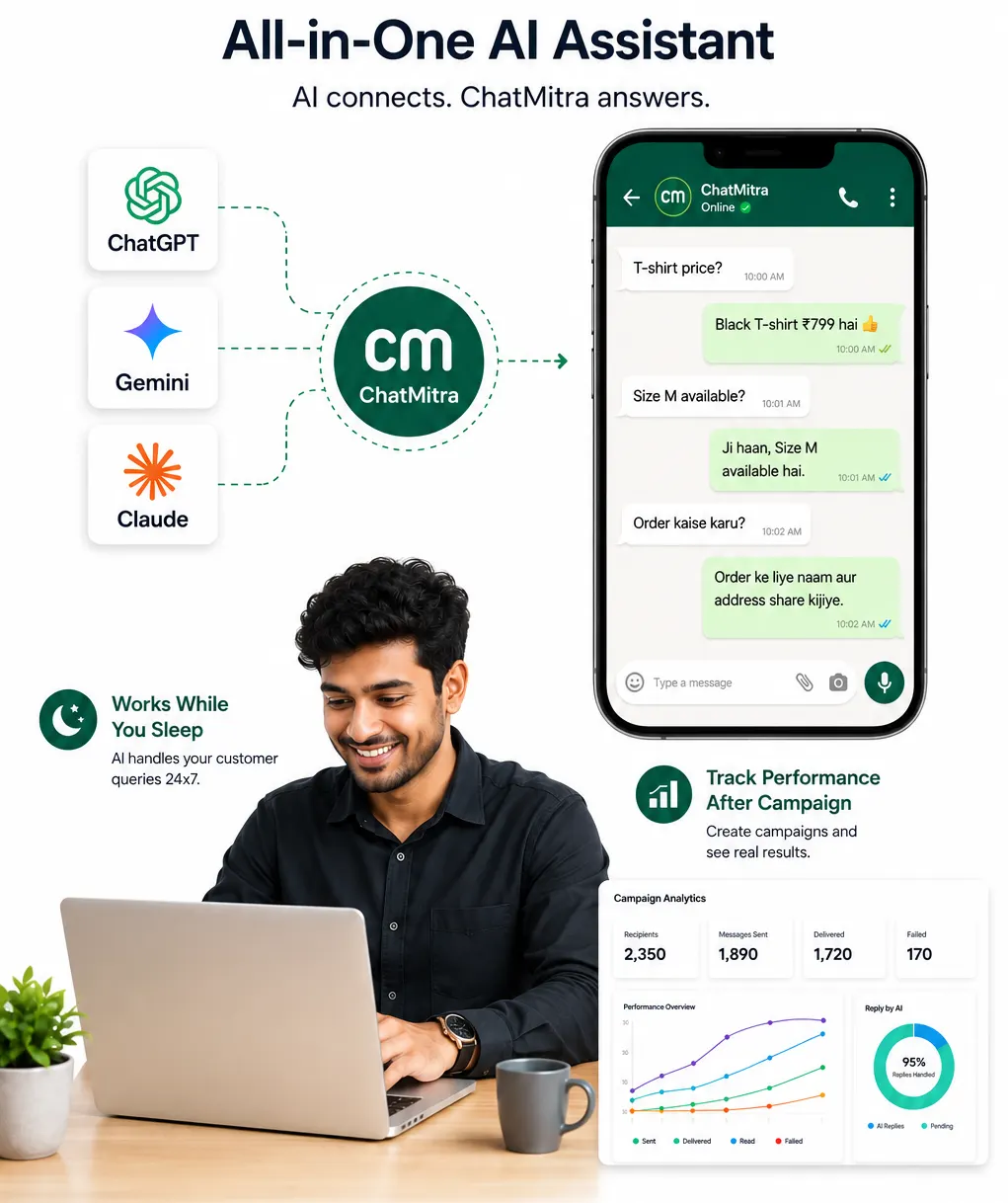
WhatsApp AI Chatbot for Business Automation
Set it up once. It keeps replying to your customers in Hindi, English, whatever they speak. No new hires. No app for them to download.
- No code
- Use your own OpenAI / Gemini key
- Live in under 5 minutes
If you're on WhatsApp all day, you already know the problem.
Most customers end up buying from whoever replies first. The reality is, by the time you get to your phone after dinner, half of them have already moved on.
The first reply wins.
A customer who waits 4 hours for a price quote usually doesn't wait — they message your competitor next.
Hiring more agents isn't a real fix.
One support person in a Tier-1 city is roughly ₹25–30k/month, plus laptop, plus training. Festival sale spikes? You can't hire 5 people overnight.
More chats ≠ more revenue.
The team gets buried in repetitive queries — pricing, availability, delivery — and the actual buying conversations slip through.
Set it up once. It keeps replying 24×7.
Honestly, most customer questions are repetitive. Pricing, stock, delivery time, return policy. That's exactly what the bot is for.
You tell it about your business — name, industry, a short description — and write a personality prompt (or hit Generate with AI and tweak the draft). Pick an AI provider you already trust. Set a backup in case it rate-limits. That's the whole setup.
The bot replies in whatever language the customer types in — Hindi, Hinglish, Gujarati, Tamil — because that's the underlying AI doing the work, not a translation layer.
Already running broadcasts or auto-reply rules on ChatMitra? The AI chatbot plugs into the same inbox.
Use the AI you already trust.
If you have an OpenAI or Gemini key sitting in your dashboard, plug it in. If you don't, we'll help you set up a free one in 2 minutes.
Click any provider for a setup guide and 2026 pricing →

OpenAI
GPT-5, GPT-4.1, o3
View setup →

Anthropic
Claude Haiku, Sonnet, Opus
View setup →

Google Gemini
Gemini 2.5 Pro & Flash
View setup →

xAI
Grok 4 — 2M context
View setup →

Perplexity
Web-grounded Sonar
View setup →

Ollama
Local or fixed-price cloud
View setup →

DeepSeek
V3 + R1 — cheap reasoning
View setup →

Hugging Face
Open-weights model hub
View setup →

NVIDIA NIM
Enterprise hosted models
View setup →

GitHub Models
GPT, Claude via Copilot
View setup →

OpenRouter
300+ models, one key
View setup →

Groq
Llama 3.3 — sub-sec speed
View setup →

Mistral
Open-weights from EU
View setup →

Cohere
Command R+ for RAG
View setup →

Together AI
200+ open models
View setup →

Fireworks AI
Fast open-model hosting
View setup →

Cerebras
World-record speed
View setup →

Clarifai
Cheap reasoning + vision
View setup →
Switch providers anytime. No migration headache. Run on OpenAI this month, switch to Gemini next month if it's cheaper. Your chatbot, conversations, and customer data stay where they are.
There's also a fallback chain — if your main AI hits a rate limit, the bot quietly switches to your backup. Customers don't see anything break.
What's actually inside.
Not a feature dump — these are the bits people actually use.
Personality you actually control.
Tell the bot who your business is and how it should sound. Write the prompt yourself, or click Generate with AI and tweak the draft. That's what the bot uses on every reply.
Access top AI providers with your key.
OpenAI, Anthropic, Gemini, Groq and 14 more. Bring whichever key you already have — or set up a free one. Switch to a different provider any time.
Fallback chain (up to 3 backups).
If your primary AI rate-limits or goes down, the bot auto-switches to your next configured provider. If everything fails, the customer sees a fallback message you wrote.
Tunable conversation memory.
Pick how long the bot remembers a chat — 30 minutes, 1 hour, 6 hours, or 24 hours. Pick how many recent messages it reads before each reply (1 to 100).
Built-in spam protection.
Set a max messages-per-customer-per-minute limit. Catches bot-like behaviour before it eats your AI credits. Defaults to 10 / minute.
Test before going live.
A built-in chat simulator runs your bot against real test messages — no WhatsApp sandbox needed. Try tricky questions, see how the AI handles them, and only flip Activate when you're happy.
How you actually set it up.
Five screens inside ChatMitra. This is the real wizard — no fake features, no screenshots-from-another-product.
Bot basics
Tell ChatMitra what kind of bot you're making and roughly who it's for. Takes about 30 seconds.
- Bot name — anything you like ("Diwali Sale Bot", "Care Team"). It's just for your records — customers don't see it.
- What will your chatbot do? — pick one of 6 use cases: Sales Assistant, Customer Support, FAQ Bot, General Assistant, Marketing, or Lead Qualifier. This pre-fills a starter personality in Step 3, so don't overthink it.
- Gender (optional) — Male, Female, Children, or All Genders. Helps the bot match its tone to your typical customer.
- Age group (optional) — 5 buckets from Teens (13-17) to Senior (50+). A youth-focused brand and a senior-focused clinic don't need the same tone.
Pick your AI
Pick the brain that powers your bot. The "AI provider" is the company that runs the actual artificial intelligence — like OpenAI, Google, or Groq.
- Filter chips — Free, Fast, Open Source, Paid. Start with Free if you've never used AI before — Groq and Gemini both have free tiers that are plenty for most businesses.
- API key — a long password-like string you copy from the AI provider's dashboard. Paste it here. ChatMitra checks it on the spot — green tick = ready, red = something's off.
- Model — same provider often offers several. Bigger model = smarter but slower and pricier. We auto-pick a sensible default.
- Creativity slider — 0 = robotic and exact (good for FAQs), 2 = chatty and improvises (good for sales). Most pick 0.7.
Pick your AI
Pick the brain that powers your bot. The "AI provider" is the company that runs the actual artificial intelligence — like OpenAI, Google, or Groq.
- Filter chips — Free, Fast, Open Source, Paid. Start with Free if you've never used AI before — Groq and Gemini both have free tiers that are plenty for most businesses.
- API key — a long password-like string you copy from the AI provider's dashboard. Paste it here. ChatMitra checks it on the spot — green tick = ready, red = something's off.
- Model — same provider often offers several. Bigger model = smarter but slower and pricier. We auto-pick a sensible default.
- Creativity slider — 0 = robotic and exact (good for FAQs), 2 = chatty and improvises (good for sales). Most pick 0.7.
Personality
The most important step. The "personality prompt" is the instruction sheet your AI reads before every single reply. Get this right and the rest takes care of itself.
- Business basics — name, industry (35+ to pick from), a one-line description, your phone number. The bot uses these directly in replies (e.g. "Big Earphone Store has 2-day delivery in Mumbai").
- Human tone — a single toggle. On = sounds warm and conversational, Off = sounds formal and corporate. Most stores leave it On.
- Pull context from your website (one click). Paste your website URL —
bigearphone.in, say — and click Fetch. ChatMitra opens the page on its servers, extracts the readable text (product names, prices, return policy, FAQs, anything public), strips out HTML and scripts, and stores it as context for the personality generator. - Or pull from a social profile. Paste an Instagram, Facebook, or LinkedIn page URL. Same flow — ChatMitra grabs the public bio + recent post text. Useful when your brand voice lives more on social than on a website.
- You don't have to write the personality prompt yourself. Click Generate with AI — pick four dropdowns (Role, Tone, Language, Industry), and ChatMitra writes the full prompt for you, weaving in the fetched website / social context.
- Tone choices — Friendly, Professional, Casual, Formal, Playful. Language — English, Hindi, Hinglish, Tamil, Marathi, Gujarati, Bengali, and more.
- Edit if you want. The generated prompt is editable text — adjust anything that doesn't sound right, then save.
ChatMitra fetches the public text from these pages, cleans it up, and feeds it into the personality generator below — so the bot already knows your products, prices, and tone of voice.
Memory & fallback
Set the bot's memory and put a safety net under it. This is what makes it feel reliable instead of robotic.
- Memory duration — how long the bot remembers a chat. If a customer messages today and again tomorrow, should the bot still know they asked about the red dress? Pick 30 min / 1 hr / 6 hrs / 24 hrs. Most stores pick 1 or 6 hours.
- Message history — how many recent messages the bot reads before each reply. 20 is the sweet spot — enough context, not too expensive on AI costs.
- Spam protection — caps how many messages one customer can send per minute. If someone fires off 50 messages in 30 seconds (often a bug or a bot), ChatMitra slows them down. Default 10/min.
- Fallback chain — your safety net. AI providers occasionally hit usage limits or have outages. Add up to 3 backup providers. Main one fails? ChatMitra tries the next one automatically. Customer never sees an error.
- Fallback message — if everything fails (rare), this is what the customer sees instead of silence. Something like "Our system is busy — please call us at 98XXX XXX12 and we'll respond shortly."
OpenAI · gpt-4o-mini valid
Gemini · 2.0-flash valid
Memory & fallback
Set the bot's memory and put a safety net under it. This is what makes it feel reliable instead of robotic.
- Memory duration — how long the bot remembers a chat. If a customer messages today and again tomorrow, should the bot still know they asked about the red dress? Pick 30 min / 1 hr / 6 hrs / 24 hrs. Most stores pick 1 or 6 hours.
- Message history — how many recent messages the bot reads before each reply. 20 is the sweet spot — enough context, not too expensive on AI costs.
- Spam protection — caps how many messages one customer can send per minute. Default 10/min.
- Fallback chain — your safety net. Add up to 3 backup providers. Main one rate-limits? ChatMitra tries the next one automatically. Customer never sees an error.
- Fallback message — if everything fails (rare), this is what the customer sees instead of silence. Something like "Our system is busy — please call us at 98XXX XXX12 and we'll respond shortly."
Review & activate
A clean summary of every choice you made in the previous four steps. From here, you have three options:
- Save Draft — keeps everything saved but doesn't go live. Come back any time to keep working on it. ChatMitra also auto-saves while you're editing, so you won't lose anything.
- Test — opens a fake WhatsApp chat window inside the dashboard. Type any message and see exactly how the bot would reply. Try tricky questions. Most issues show up here, before any real customer sees them.
- Activate — flips the switch. The next message your business gets on WhatsApp is answered by this bot, automatically. If another bot was already live, ChatMitra warns you ("Bot X is currently live — activating this one will pause it") so nothing collides.
- Pause anytime — if something looks off after going live, click pause. Your bot config stays saved; it just stops replying until you turn it back on.
WhatsApp connection is project-wide and set up once during onboarding — you don't redo it for every bot.
Need provider-specific instructions? See setup guides for OpenAI · Gemini · Groq · Anthropic · all leading providers.
What actually changes once it's running.
Before
- Phone buzzes at 11pm. You'll reply tomorrow morning. They've already messaged someone else.
- Diwali week — your team is buried in "is this in stock?" messages.
- Every 100 new chats a day = another agent, another desk, another headache.
- The genuine buying conversations get lost in the repetitive ones.
After
- The customer gets a real answer in seconds. At 11pm. On a Sunday. In Hinglish.
- Whether you get 10 messages a day or 1,000 during a sale, it doesn't slow down.
- Your team only steps in for the 10% that genuinely needs a human.
- You start seeing patterns — top questions, drop-offs — and fix them once.
Let's be honest about the money.
Most businesses we talk to spend ₹20–30k per month just keeping up with WhatsApp queries — agent salary, overheads, the WhatsApp Business app open all day. The chatbot replaces a big chunk of that work, not all of it.
Roughly what a support role costs
₹20–28k/month salary + setup + overheads. In a metro, easily ₹3–4 lakh a year.
Roughly what ChatMitra costs
From ₹999/month, plus whatever your AI provider charges (most start free).
What the bot actually handles
Usually 60–75% of routine questions. The rest still goes to your team — that's a feature, not a bug.
We don't promise miracles. There's a real calculator inside the dashboard once you sign up — plug in your numbers and see what makes sense for you.
Who actually uses this.
If you spend any meaningful part of your day on WhatsApp Business, you're probably in here.
E-commerce stores
Pricing, shipping, return policy questions, product information — the bot answers from your catalog details, then hands order requests to your team.
Service businesses
Salons, clinics, consultants. Pricing, services offered, hours — the bot answers; for actual bookings it collects details and forwards to your team.
Local shops & D2C brands
The "out of office" auto-reply on WhatsApp Business doesn't really cut it. This does.
Coaching & EdTech
Course queries, batch timings, fee structure — in the language students actually message in.
Real estate & finance
Pre-qualify enquiries before your sales team picks up the phone.
Not on this list? It learns from whatever content you give it — works for almost any business on WhatsApp. Just ask us .
Why people end up switching to ChatMitra.
| ChatMitra | Other tools | |
|---|---|---|
| Setup time | Under 5 minutes | Days, sometimes weeks |
| AI providers supported | 18 (OpenAI, Gemini, Groq, …) | 1 or 2, locked in |
| Pricing | From ₹999/month flat | ₹5,000+/mo per agent seat |
| Hindi & regional language quality | Native, not translated | Often English-only or auto-translated |
| Switch the underlying AI later? | Yes, anytime | Almost never |
See full pricing breakdown on the pricing page →
Trusted by Founders and Agencies Worldwide
Loved by 10,000+ big and small brands. World-famous and local across 21+ Countries





















Book a One-to-One Meeting With Our Product Expert
Have questions? We've got answers. Connect with our product expert for a personalized demo and discover the best WhatsApp Business setup for your business.
Book a Free Demo
Try it. If it doesn't save you time, just turn it off.
15 days free. No card. No long forms.
Frequently Asked Questions
What is a WhatsApp AI chatbot, exactly?
It's a chatbot that sits on your WhatsApp Business number and replies to customers using a large language model (OpenAI, Gemini, Groq, etc.) instead of pre-written button flows. You write a personality prompt that describes your business and how the bot should sound. The bot uses that prompt plus the recent conversation to reply on its own.
How is this different from the auto-reply already inside WhatsApp Business?
The native WhatsApp auto-reply is one fixed message — "we'll get back to you soon". An AI chatbot actually understands what the customer asked and responds with a real answer. If you want the simpler, rule-based version, check our auto-reply rules feature — it's free and good for basic cases.
Do I need my own OpenAI or Gemini key?
Yes — you bring your own AI key. We support enterprise-grade provider support (OpenAI, Anthropic, Google Gemini, Groq, and more). Most of them have generous free tiers, so you can start without paying anything for AI itself. If you don't have a key, we'll walk you through setting up a free one in 2 minutes.
Will the bot speak Hindi properly? My customers don't type in English.
Yes. Honestly, this is the bit we obsess over most. Customers in India type in Hindi, Hinglish, Gujarati, Marathi, Tamil — often switching mid-sentence. The bot handles that naturally because the underlying AI models (especially Gemini and the latest GPT/Claude versions) understand all of it without translation.
What happens when the bot doesn't know something?
Honestly, it's only as good as the personality prompt you write (or generate). It works off that prompt plus the recent conversation context — it doesn't have a separate knowledge base. If your primary AI rate-limits or fails, ChatMitra automatically tries your backup providers (you can add up to 3). And if everything fails, the customer sees the fallback message you wrote during setup. We'd rather be honest about this than oversell it.
Honestly, will this actually save me money compared to an agent?
It depends on volume. Most businesses we work with are spending ₹20–30k/month on someone (or part of someone's time) handling WhatsApp queries. The chatbot handles the repetitive 60–75% — pricing, delivery, business hours, return policy — so that role either gets freed up for higher-value work, or you delay the next hire. See the pricing page for the actual numbers.
How long does setup really take?
If you already have your WhatsApp Business API set up — under 5 minutes. If you're starting from scratch, the WhatsApp/Meta verification can take a day or two (that part isn't us, it's Meta). After that, the bot itself is quick.
Where does my customer data live?
On our servers in India, encrypted at rest. We don't share it with the AI providers beyond the message text needed to generate a reply. We're a Meta Business Partner, so we follow their data handling rules too.
What is a 'token' in AI pricing?
A token is roughly 4 characters of English text — about three-quarters of a word. So 'How are you?' is about 4 tokens. AI providers like OpenAI and Gemini bill you per million tokens you send in (input) and receive back (output). For a typical WhatsApp conversation of ~17 messages, you use about 2,500 tokens total. That's why a 1,000-conversation month often costs only a few hundred rupees on cheaper models.
What is a 'context window' and does it matter for my chatbot?
Context window is how much text the AI can read at once — the system prompt, your business info, and the recent conversation, all combined. It's measured in tokens. GPT-5 family has 400K tokens (about 300,000 words), Claude Sonnet 4.6 has 1M, Llama 3.3 has 128K. For WhatsApp chat, even 128K is plenty — most conversations are well under 5,000 tokens. The bigger windows matter for long B2B negotiations or businesses that want the bot to remember weeks of customer history.
What's the difference between 'input' and 'output' tokens?
Input tokens are everything you send TO the AI — your business personality prompt, the customer's message, recent conversation history. Output tokens are what the AI sends BACK — the bot's reply. Output is almost always more expensive per token than input. Example: GPT-5 Mini costs $0.125 per 1M input tokens and $1.00 per 1M output. That's why long bot replies cost more than long customer questions.
What's a 'system prompt' or 'personality prompt'?
It's the instruction the AI reads BEFORE every customer message. The system prompt tells the bot who your business is, how to talk, what it can say (your prices, hours, return policy), and what NOT to say. ChatMitra writes this for you when you click 'Generate with AI' in Step 3 of the chatbot setup — you pick a tone and language, the system prompt is generated automatically. You can edit it later.
What is a 'thinking' or 'reasoning' AI model?
A reasoning model (also called a 'thinking' model) pauses to work through a problem step-by-step before replying — like OpenAI's o3, DeepSeek-R1, or Claude with extended thinking. They're better at multi-step problems (loan eligibility math, comparison logic, complex troubleshooting) but slower and 3-10× more expensive than regular chat models. For everyday WhatsApp chat, a regular model like GPT-5 Mini or Llama 3.3 is faster and cheaper.
What does the 'temperature' or 'creativity' slider do?
Temperature controls how predictable vs creative the bot's replies are. Range is usually 0.0 to 2.0. At 0.0, the bot always picks the most likely next word — same answer every time, very robotic. At 2.0, it improvises a lot — friendlier but occasionally goes off-script. Most ChatMitra businesses set it to 0.7 (the default) — friendly but reliable. Crank it down to 0.3 for FAQ-style replies, leave at 0.7 for sales conversations.
What is a 'multimodal' AI model?
A multimodal model can understand more than just text — usually images and sometimes audio. Gemini 2.5 Flash, GPT-5, and Claude Sonnet 4.6 are all multimodal. For WhatsApp chat, this means a customer can send a product photo, a damage picture, or a screenshot — and the bot can describe what it sees and reply about it. Useful for returns ('did this arrive damaged?'), retail ('do you have this style?'), and clinics ('is this rash serious?').
What's a 'fallback chain' in ChatMitra?
If your primary AI provider rate-limits you or has an outage, ChatMitra automatically tries the next provider in your fallback chain — and so on, up to 3 backups. Customers don't see an error. A typical setup: Groq as primary (fast and cheap), Gemini as backup #1, OpenAI as backup #2. If none of them work, the customer sees a fallback message you wrote (something like 'Our system is busy, please call us at...').
What does 'rate limit' mean and how does it affect my bot?
Rate limit is a cap on how many requests per minute (RPM) or tokens per minute (TPM) you can send to an AI provider. Free tiers have tight limits — Groq's free tier is 30 RPM and 6,000 TPM, which is fine for testing but breaks during a Diwali sale spike. When you hit a rate limit, requests fail until the next minute. ChatMitra's fallback chain catches these failures and routes to a backup provider so customers never see a broken reply.
What is RAG (retrieval-augmented generation)?
RAG is when an AI looks up information from a document store before replying — instead of relying only on its training data. Useful for businesses with deep FAQ documentation (insurance policies, product manuals, course curricula). Cohere's Command R+ is built specifically for RAG. ChatMitra's AI Chatbot doesn't use a separate document store — it relies on the personality prompt and conversation context. For document-heavy use cases, you'd typically pair ChatMitra with a separate knowledge base.
What does 'free tier' actually mean across AI providers?
It varies. Some providers (Gemini, Groq, Cerebras) have permanent free tiers with rate limits — useful for production at small scale. Others (OpenAI, Anthropic) give a one-time signup credit (~$5) and then charge per token. Some (Cohere) offer free Trial keys that are explicitly NON-COMMERCIAL — fine for testing only. ChatMitra shows the exact free-tier details on each provider's setup page so you don't get surprised when you go live.